
A Reading of What Is a Dispositif? and The Arcades Project
Context
This document presents a combined reading of two texts: Gilles Deleuze’s What Is a Dispositif? (1992) and Walter Benjamin’s The Arcades Project — specifically the Exposé of 1935, Paris, the Capital of the Nineteenth Century. These texts were not written in conversation with each other. Deleuze was extracting the conceptual skeleton of Foucault’s life work. Benjamin was documenting the physical and cultural remains of 19th century Paris. This presentation brings them together — using Deleuze’s framework as the analytical lens through which Benjamin’s historical analysis becomes legible as a theory of power.
The central argument is simple: Benjamin was doing historically what Deleuze later theorised abstractly. The arcade, the panorama, the World Exhibition, the bourgeois interior, the Parisian street, and Haussmann’s boulevard are not just historical phenomena — they are apparatuses. Each one shapes what can be seen, what can be said, how power flows, and ultimately who people become. Neither author uses the other’s vocabulary. We are the analysts who bring the two together.
The Three Authors
Michel Foucault (1926–1984) spent his career excavating how power operates through institutions — the asylum, the clinic, the prison, human sexuality. Each book mapped how knowledge and power co-produce each other historically. Foucault’s insight was that modern power is not concentrated in a sovereign you can point to — it is dispersed, productive, and invisible, working through the design of spaces, the rules of institutions, and the habits of everyday life.
Gilles Deleuze (1925–1995) wrote What Is a Dispositif? in 1988, four years after Foucault’s death. His question: what is the abstract skeleton behind all of Foucault’s historical analyses? His answer is the dispositif — the apparatus. Deleuze names the fourth line, subjectivation, which Foucault had not fully theorised: the moment when force folds back on itself and produces a self.
Walter Benjamin (1892–1940) never finished The Arcades Project. He worked on it for thirteen years and died fleeing the Nazis in 1940. What survives is an enormous archive of quotations, observations, and fragments organised into thematic sections — an archaeology of 19th century Paris done through its material remains: the shopping galleries, the panoramas, the world exhibitions, the furnished interiors, the streets, and the demolished neighbourhoods. Benjamin’s method was montage — placing fragments next to each other without explanation and letting the collision produce meaning. He once wrote: “I needn’t say anything. Only show.”
Part One: The Apparatus and Its Lines
What Is an Apparatus?
Before Foucault, most political theory located power in a sovereign — a king, a government, a ruling class you could point to. Foucault’s insight is that the most effective power is invisible. It works through the design of spaces, the rules of institutions, and the habits of everyday life, shaping what people want and who they think they are.
The apparatus — dispositif — is any configuration of a space, institution, or platform that operates in this way. Deleuze describes it as a skein: a loosely coiled bundle of thread, multiple lines running in different directions, never a fixed structure. The apparatus has no existence independent of its lines. Change the lines, change the apparatus.
A useful test: any space is an apparatus if you can answer four questions about it.
- What does it make visible — and what does it keep hidden?
- What does it make sayable — and what does it silence?
- What power relations does it encode between the people inside it?
- What kind of person does it produce?
By this definition, the prison, the hospital, the school, and Instagram are all apparatuses. So are the Paris arcades.
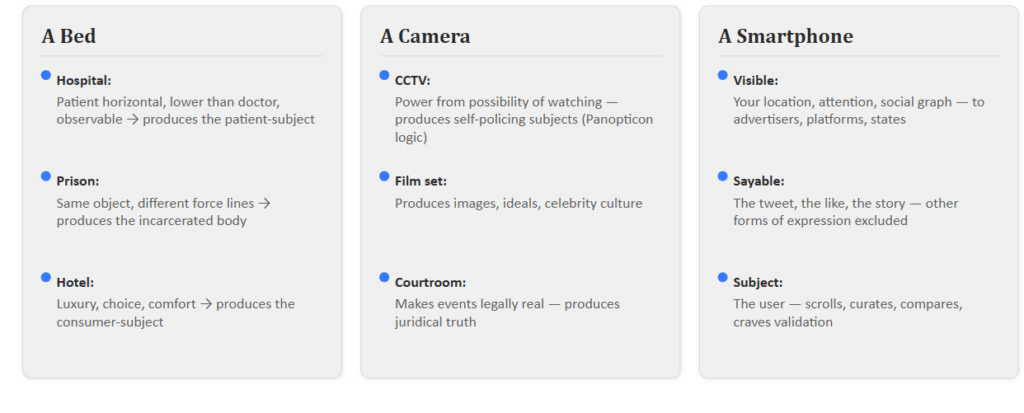
The same object can belong to completely different apparatuses. A bed in a hospital makes you a patient. In a prison it makes you an incarcerated body. In a hotel it makes you a paying guest. It is never the object that matters — it is the relationships, rules, and expectations wrapped around it.
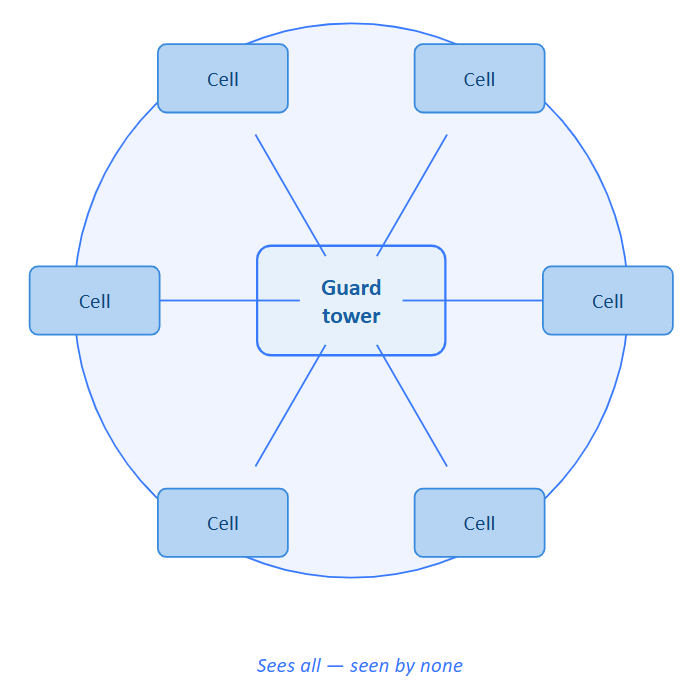
Line 1: Visibility
Every system controls what gets seen and what stays hidden. The arcade puts the commodity under brilliant artificial light and makes the factory that produced it completely invisible. The social media feed shows you the highlight reel and hides the algorithm selecting it. Foucault’s prison example makes the mechanism concrete: the Panopticon creates a situation where prisoners don’t know if they are being watched, so they police themselves. The possibility of being seen is sufficient. Power flows from the asymmetry of visibility, not from direct force.
Visibility is not light falling on pre-existing objects. It is a regime that determines what can be seen at all — and the regime is always constructed in someone’s interest.
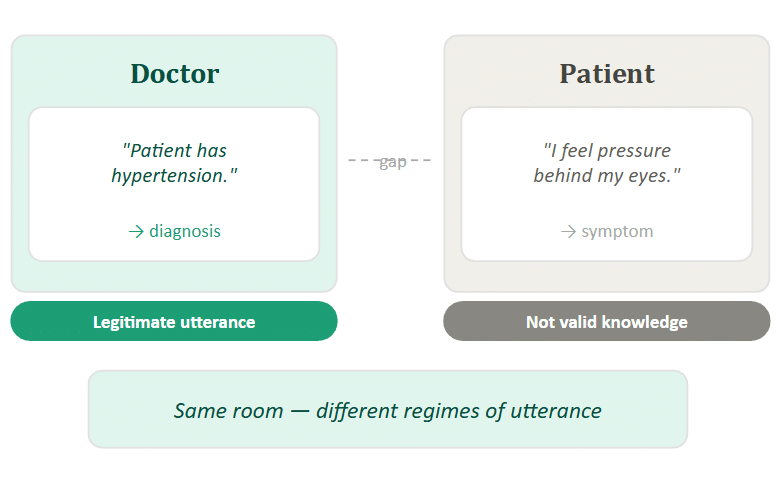
Line 2: Utterance
Every apparatus also controls whose voice counts as knowledge and whose does not. In a hospital, the doctor’s words are a diagnosis. The patient’s words are symptoms to be decoded — not knowledge to be heard. This is not about censorship. It is about which statements are treated as legitimate truth before anyone has even evaluated their content.
The gap between what can be seen and what can be said is where power operates most silently. You can observe something clearly and have no legitimate utterance for it within the apparatus you are inside.
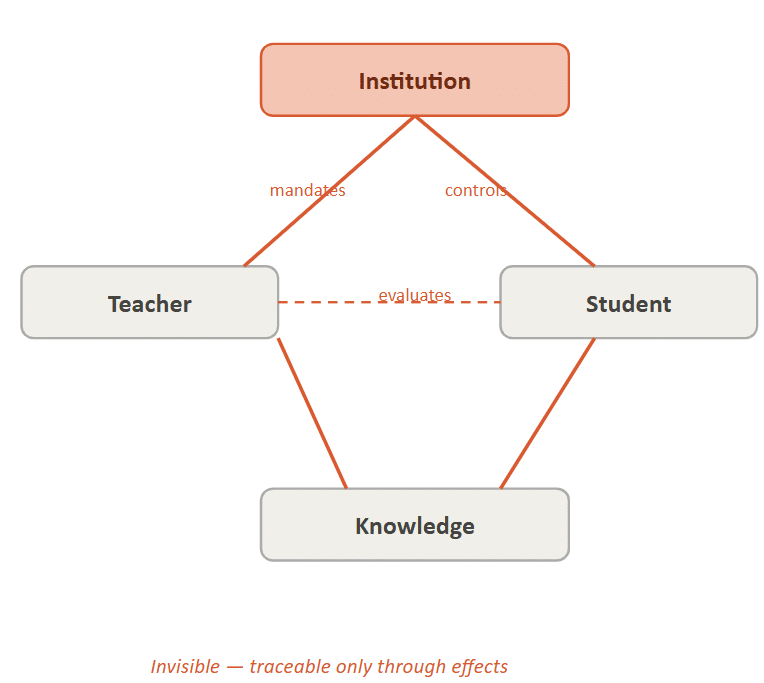
Line 3: Force
Power does not sit in any one person. It runs through every relationship in the system — between student and institution, between teacher and knowledge, between manufacturer and consumer — shaping what everyone does without anyone necessarily intending it. The grade is the clearest example: no one forces you to write in a particular way, but the knowledge that you will be evaluated shapes every sentence you produce. Force is invisible and unspeakable. You can only trace it through its effects.
Line 4: Subjectivation
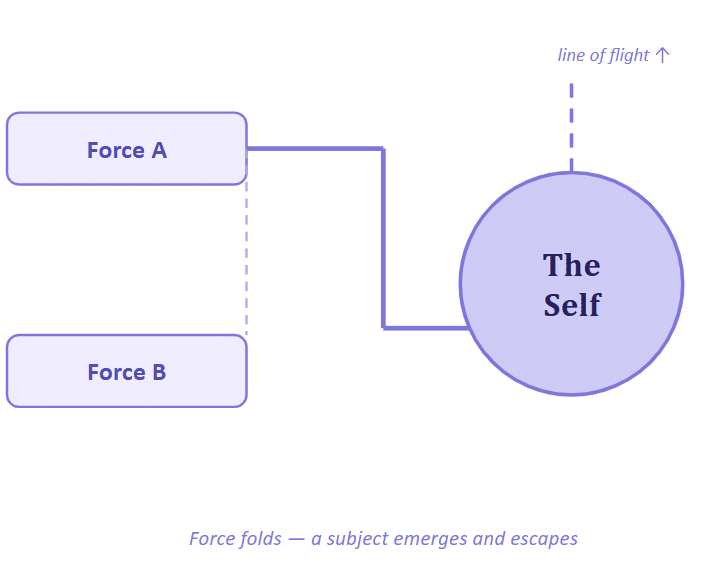
This is Deleuze’s most original addition to Foucault. The apparatus does not only constrain a pre-existing subject — it actually produces the subject. It gives you the tools, the language, and the identity to operate within it. And those same tools can be turned back on the apparatus. The student who uses academic writing to question the institution of academic writing itself is the example: produced by the apparatus, partially escaping it. This is the line of flight — real, but never complete.
Line 5: Fracture
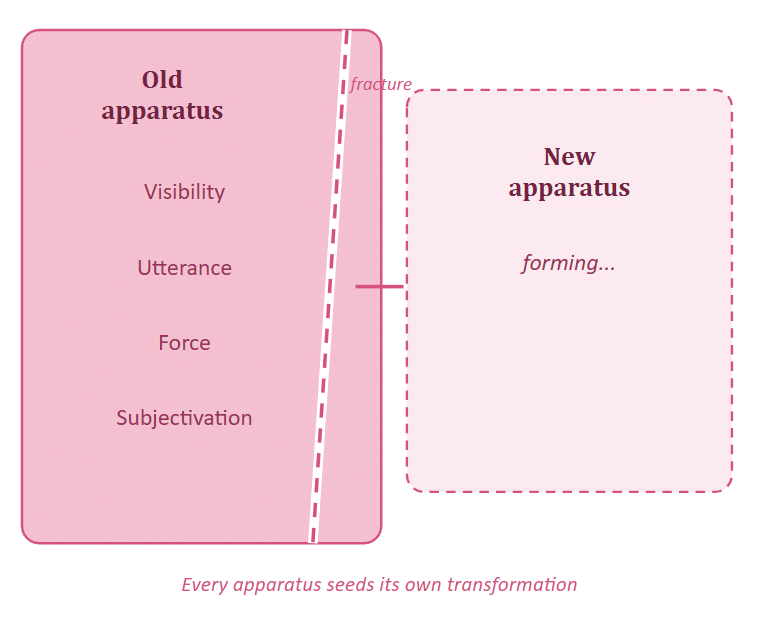
Every system contains the seeds of its own breakdown. Fracture is not a separate line — it is what happens to any of the other four lines under sufficient pressure. The French Revolution is Deleuze’s example: what changed was not that one person said something new. It was that an entirely new regime of what could publicly be said emerged all at once. The crack in the apparatus is not a failure — it is where a new apparatus begins to form.
Part Two: Benjamin’s Six Sections
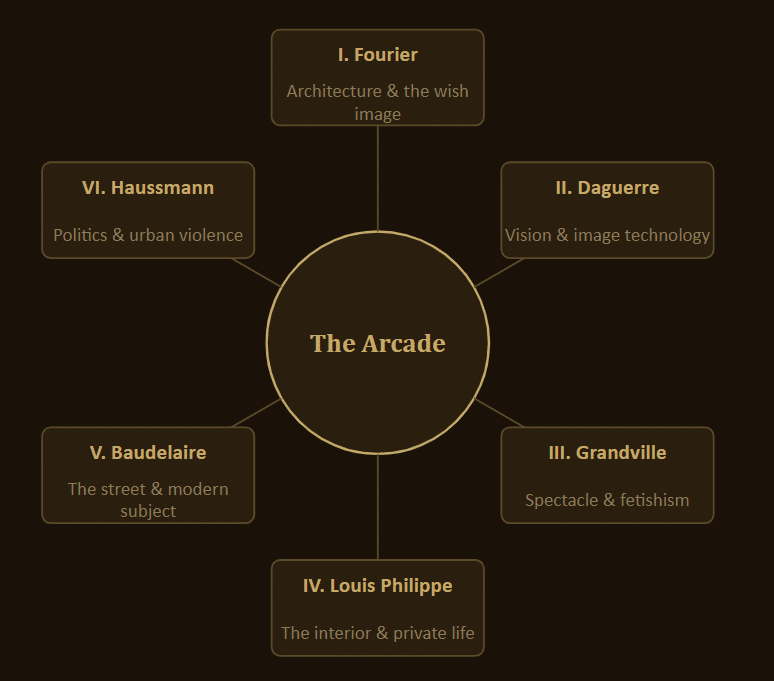
Benjamin’s Arcades Project has six sections. Each pairs a historical person with a space or phenomenon they embody. The person is the entry point — the lens. The space is what Benjamin is analysing. The six sections are not sequential chapters. They are six simultaneous angles on the same object: the apparatus of 19th century consumer capitalism, with the Paris arcade at its centre.
Benjamin never explains why he chose these six persons. The argument is made through accumulation — placing historical fragments next to each other and letting the collision produce meaning. He was an archaeologist, not a philosopher. He analyses without theorising. Which is why the apparatus framework can be applied to his work from outside — it fits his material like a key fits a lock.
Section I — Fourier, or the Arcades
The Paris arcades emerged after 1822 — glass-roofed, marble-panelled corridors running through entire city blocks. Benjamin calls them “a city, a world in miniature.” They were the first spaces built specifically to make shopping feel like an experience: gas lighting, permanent display, everything brilliant and desirable, with no trace of where any of it came from or who made it.
Iron was the first truly new building material of modernity — but architects clothed iron columns as Pompeian pillars and wrapped factories as Greek temples. Benjamin writes: “Construction plays the role of the subconscious.” The 19th century dreams in iron but thinks in stone.
Benjamin’s key concept here is the Wunschbild — the wish image. Inside every commodity on display there is a hidden wish, a dream of something better, a suppressed utopian impulse. The socialist Charles Fourier looked at the arcade and saw a prototype for his phalanstery — his vision of an ideal communal society. Benjamin takes this seriously. Every commodity space contains a wish for its own overcoming.
As apparatus: The glass roof and gas lighting produce a regime of visibility where the commodity glitters and labour disappears. Price tags, advertising, and fashion encode what can be said about objects. The commodity fetish directs every encounter between seller and customer. And the apparatus produces its characteristic subject — the flaneur, the wandering consumer-observer who is not at home in the arcade but cannot leave it.
Section II — Daguerre, or the Panoramas
The panorama was a 360-degree painted canvas mounted inside a cylindrical building, designed to simulate total environments — changing daylight, moonrise, waterfalls — before photography existed. You paid to stand inside a manufactured simulation of a place you had never been. This is the logic — packaging an experience, selling immersion — that runs in a direct line from the panorama through cinema, advertising, and the endless scroll of a social media feed.
Louis Daguerre ran the most famous panorama theatre in Paris — the Diorama — before inventing the daguerreotype in 1839. He is the connecting figure between two image technologies: the artisanal illusion machine and its mechanical successor. Photography kills the panorama industry by making it redundant, then floods the market with images of faces, landscapes, and events that circulate as commodities independent of their subjects.
Benjamin makes a precise structural claim: “Just as architecture, with the first appearance of iron construction, begins to outgrow art, so does painting, in its turn, with the first appearance of the panoramas.” Painting has gone industrial. It has outgrown the category of art.
As apparatus: The panorama creates a regime of total visual immersion — nature reproduced as spectacle, reality packaged as product. The spectator pays to surrender their gaze to a manufactured world. The apparatus produces the passive viewer — the forerunner of the cinema audience, the television watcher, the social media scroller.
Section III — Grandville, or the World Exhibitions
The World Exhibition turned shopping into a spectacle and spectacle into a religion. Benjamin quotes Hippolyte Taine writing in 1855: “Europe is off to view the merchandise.” The exhibition transforms viewing goods into a religious act — the commodity becomes sacred, pilgrimage to the exhibition is structurally identical to pilgrimage to a shrine.
J.J. Grandville was a French caricaturist whose drawings were wildly surreal — planets wearing hats, flowers with human faces, commodities taking on cosmic significance. His Un Autre Monde (1844) imagines a universe where objects have come alive and taken over. Benjamin chose him because Grandville’s art does visually exactly what the World Exhibition does commercially: it elevates the commodity to metaphysical status. He is the unconscious artist of commodity fetishism — not intending critique, illustrating capitalism perfectly from inside.
Fashion is the liturgy of this religion. It prescribes the ritual according to which the commodity fetish demands to be worshipped — and it changes the ritual constantly to keep worshippers returning.
As apparatus: Everything is made maximally displayable — the Exhibition is a visibility machine for commodities, use value hidden, exchange value radiant. Advertising (réclame) is born here as the language of the commodity. Fashion binds subjects to the commodity cycle. The apparatus produces the consumer-pilgrim: a subject who constitutes identity through acts of consumption and spectatorship.
Section IV — Louis Philippe, or the Interior
Louis Philippe was the “bourgeois king” — the first ruler to explicitly identify the state with the interests of the property-owning middle class. He dressed like a businessman, carried an umbrella, presented himself as an ordinary citizen. His reign (1830–1848) is the historical moment when the private individual steps onto the stage of history for the first time.
As the city became a space of commerce, the home became its complement — the place where the middle-class subject retreated to be a person rather than a customer. Benjamin writes: “The interior is not just the universe but also the étui of the private individual. To dwell means to leave traces.” The home is a case for the self. Every object in it displays the personality of its inhabitant.
The central figure of the interior is the collector — “the true resident” — who strips objects of their commodity character through possession, transforming exchange value into connoisseur value. But Benjamin’s point is that this is not an escape from commodity culture. The collector who lovingly acquires objects is doing exactly the same thing as the shopper — just with a story about taste instead of a price tag.
The detective story emerges from this space. Poe reads the traces inhabitants imprint on their homes. The criminal is always middle class.
As apparatus: The interior makes the private self visible to itself — every object is a self-portrait. The discourse of taste and connoisseurship determines whose utterance counts as legitimate aesthetic knowledge. The bourgeois manages alienation through aesthetic possession. The apparatus produces the collector — a self constituted entirely through objects, the first consumer subject.
Section V — Baudelaire, or the Streets of Paris
Baudelaire is the poet of Les Fleurs du Mal (1857) — the first major poet to take the modern city as his subject. He invented the concept of the flaneur and theorised la modernité — newness as a quality independent of use value, the engine of fashion’s false consciousness.
The flaneur is the person who wanders the city as an observer — not quite part of the crowd, using it as cover. Benjamin reads this figure as the perfect product of the Parisian street apparatus: someone who thinks they are watching the system from outside but is already inside it. The crowd is the veil through which the familiar city becomes phantasmagoria — now a landscape, now a room.
The street is a force field. Every encounter between classes, genders, buyers and sellers is a power relation. Even the artists and writers who wandered the boulevards for inspiration — the bohème — were in the marketplace looking for a buyer. Benjamin is clear: the flaneur’s apparent freedom is cover for the fact that he is, like everyone else on that street, potentially for sale.
Benjamin’s sharpest image is the body as commodity — the most complete expression of exchange value, a person who is simultaneously the seller and the thing being sold, the figure who most completely lives the logic of the market.
As apparatus: The city as phantasmagoria — the commodity glitters everywhere, hiding its origins. Baudelaire invents a new utterance adequate to the alienated city gaze — the prose poem. The crowd is a force field navigating class, gender, and economic position. The apparatus produces the flaneur: at the intersection of marketplace and crowd, observing, alienated, always potentially for sale.
Section VI — Haussmann, or the Barricades
Baron Georges-Eugène Haussmann (1809–1891) was Napoleon III’s Prefect of the Seine from 1853 to 1870. He demolished approximately 60% of medieval Paris, displaced 350,000 working-class residents, and built the wide boulevards that define Paris today. His official justifications were sanitation, circulation, and aesthetics.
Benjamin reads the real purpose: the boulevards connect the barracks to the workers’ districts by the shortest possible route, and are wide enough to make barricades impossible. The boulevard is a weapon of class war disguised as urban improvement. Haussmann himself noted in his memoirs that widening streets served to prevent barricade construction.
This is Benjamin’s closing argument: the entire apparatus of 19th century Paris — the arcade, the panorama, the world exhibition, the bourgeois interior — is revealed as ruins even before it crumbles. By the time you can see a system for what it is, the conditions for its transformation are already forming. The Paris Commune of 1871 is the moment of dialectical awakening: the barricade goes up across the Haussmann boulevard, the dream of the 19th century shatters. The Commune was crushed in a week. But the crack had appeared.
As apparatus: The boulevard is a visibility machine — surveillance, military parade, no shadows or corners where barricades can hide. Urban planning is the utterance of class power, calling demolition beautification and dispossession modernisation. The barricade versus the boulevard is the force line made physical. The apparatus produces the revolutionary subject — displaced, stripped of urban physiognomy, radicalised in the suburbs to which they were pushed.
Synthesis: Benjamin’s Sections and Deleuze’s Lines
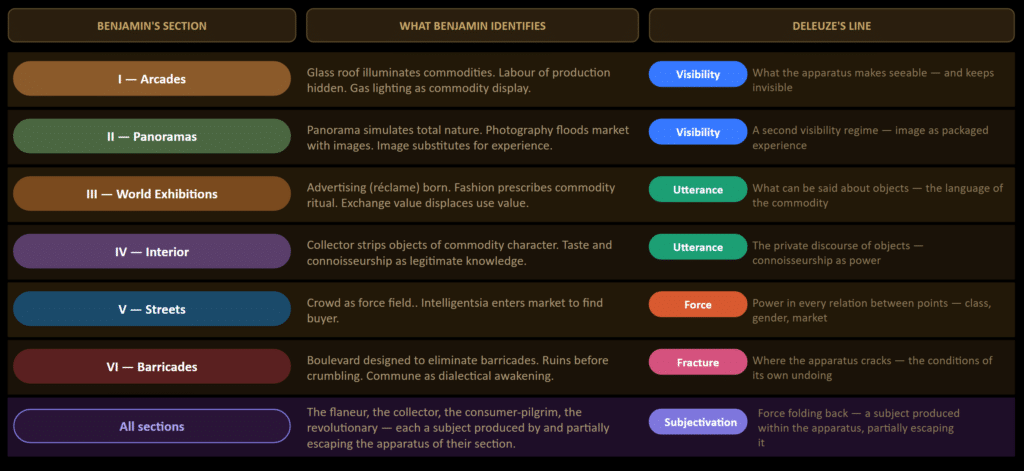
The grid below shows the connection between Benjamin’s six sections and Deleuze’s five lines. Benjamin was doing historically what Deleuze later theorised abstractly. Each section maps onto a specific line of the apparatus — not as a forced reading, but as a natural fit between a historical analysis and a conceptual framework produced fifty years later.
Conclusion
Benjamin was writing about shopping galleries and city streets. Deleuze was writing about philosophy. But the question both are answering is the same: how does a system — a space, an institution, a culture — shape what people can see, say, do, and ultimately become, without anyone at the top issuing orders?
The apparatus is the answer. Not a theory imposed on the material from outside, but a name for something the material was always already doing. The arcade was always a visibility machine. The World Exhibition was always prescribing a language for objects. The boulevard was always encoding force relations between the army and the working class. And every one of these spaces was always producing subjects — the flaneur, the consumer-pilgrim, the collector, the revolutionary — who thought they were free and were instead, precisely and thoroughly, the product of the world they moved through.
The crack, Benjamin says, is already there. In the arcade’s glass roof, in the barricade across the Haussmann boulevard, in the collector who cannot stop buying, in the flaneur who cannot go home. Every apparatus seeds its own transformation. Reading Benjamin through Deleuze does not explain this away. It makes it visible.
