
// Introduction
Let’s be honest: when we talk about reviving historic sites, the conversation usually goes one of two ways. Either we treat the building like a museum piece that can never be touched, or we drop a cold, glass-and-steel box in the middle of it and call it “modern.”
For the Bab al-Luq market in Cairo, I wanted to do neither. I didn’t want to destroy the past, but I didn’t want to just stare at it either. I wanted to hug it.
Literally.
My project, A Ballooning Market, is a proposal for what I call “pneumatic parasitism.” It sounds like a disease, I know, but stick with me. It’s actually a love story between a rigid, historic steel skeleton and a soft, inflatable landscape that grows inside it.
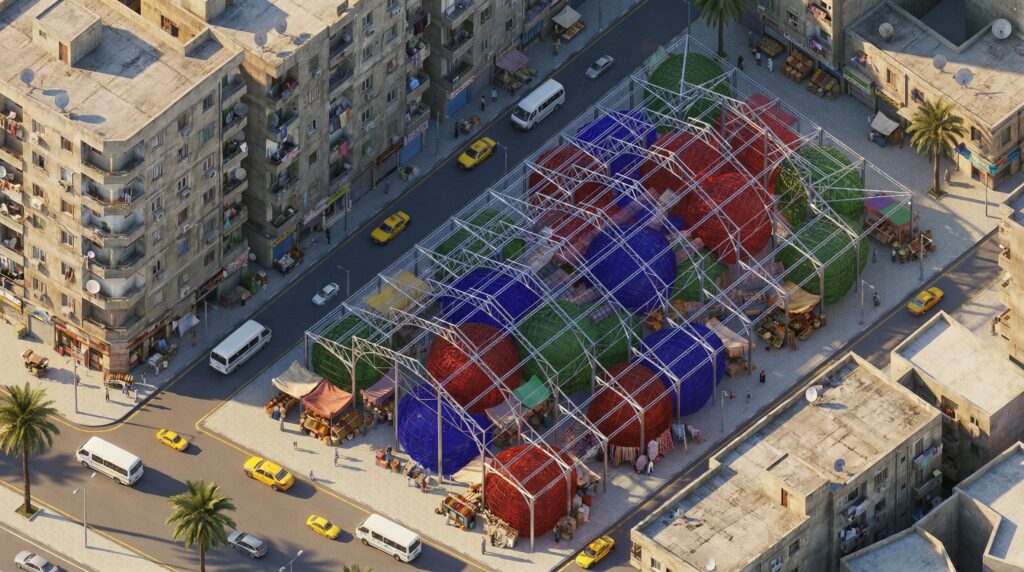
Context View Rendering (D5 Render and AI Enhanced)// The Big Idea: Respect the Void by Filling It
The concept is simple: take the hollow shell of this beautiful historic structure and fill the void with a network of massive, inflatable balloons. It’s architectural symbiosis. The steel frame provides the constraints, and the balloons provide the life. The idea is to transform the spatial perception from a hollow shell into a dense, navigable pneumatic landscape.
But getting there? That was… messy.
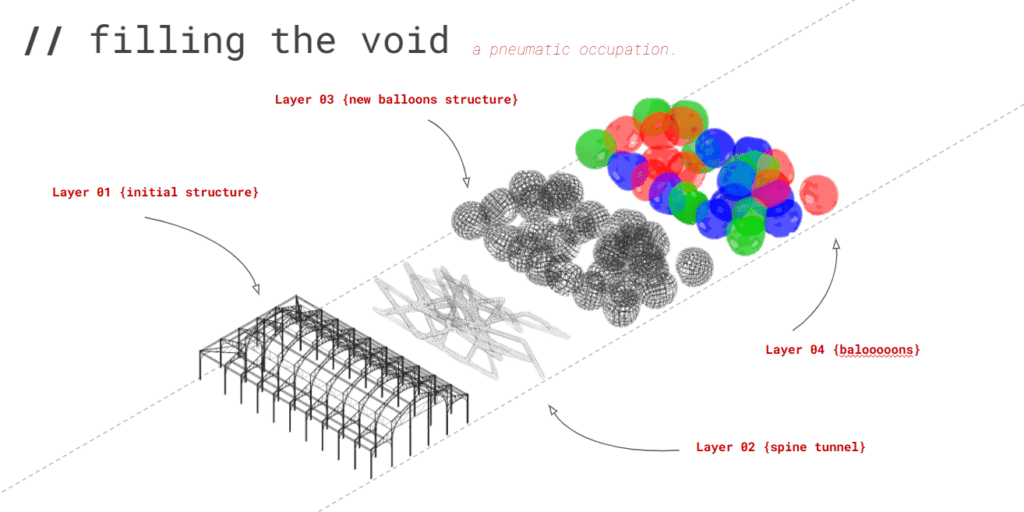
Exploded Axonometric (Rhino and Grasshopper)// The “Epic Fails” (Or: Why My Balloons Were Ghosts)
In the spirit of total transparency—because we all know Instagram architecture isn’t real life—I have to show you, well what we don’t really like to show.
When I first started running simulations in the Kangaroo physics engine, it was a disaster. Basically, my balloons had no physical awareness of each other. They were just ghosting through one another in a chaotic, colorful mess.
Then, once I gave them bodies, they decided to ignore the building entirely. That was the “I don’t care about history” era, where my nice soft balloons were aggressively eating the historic steel columns they were supposed to be “hugging.”
It took a four-phase algorithmic process (Generation, Simulation, Circulation, Rationalization) to teach these digital balloons manners. But eventually, we got them to inflate, collide, and pack themselves perfectly against the heritage frame without eating it.
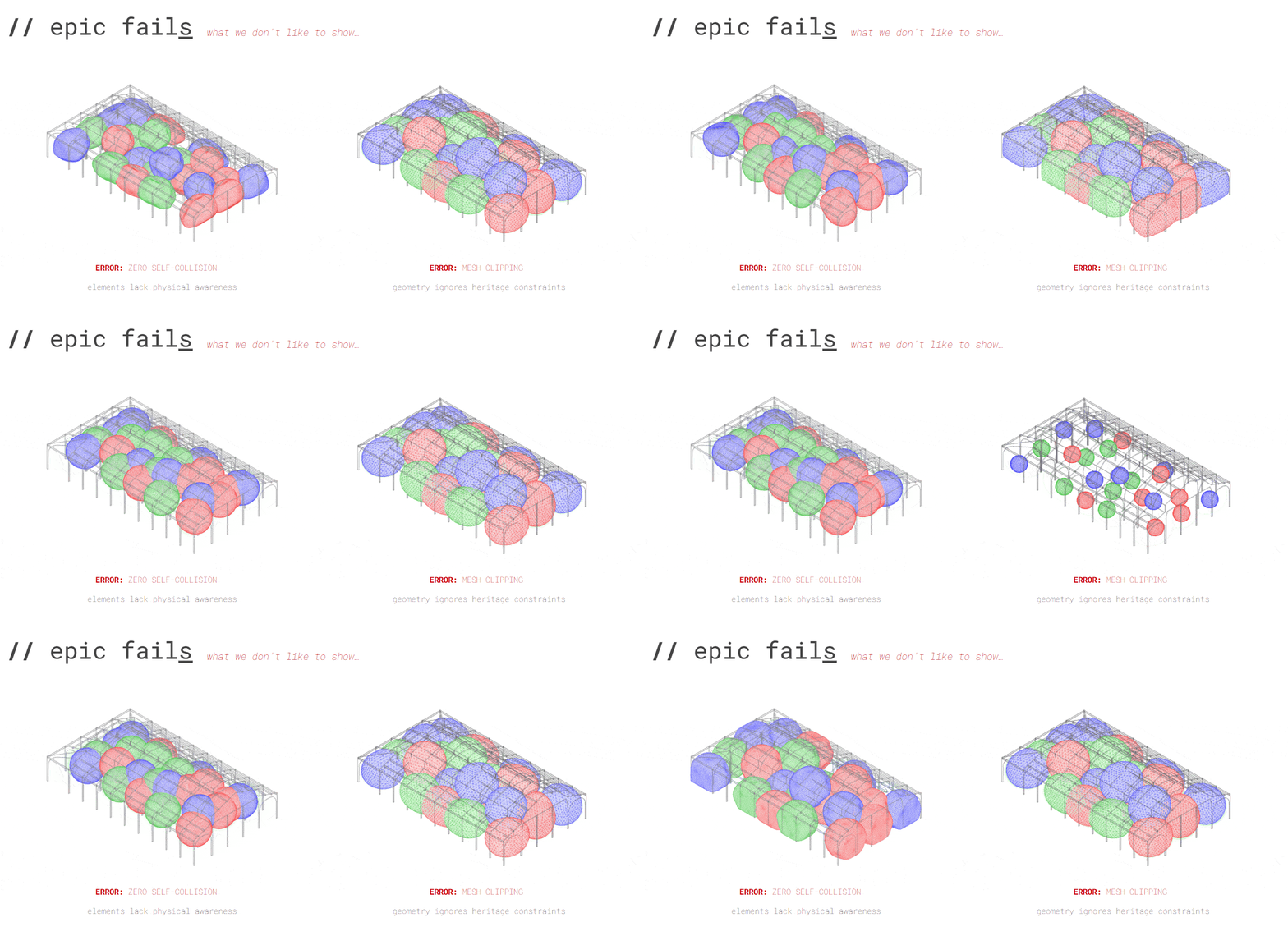
Axonometric View (Rhino and Grasshopper)// Taming the Spaghetti Code: The 4-Step Algorithm
Here is a look under the hood at the “spaghetti code” that makes it all work:
Phase 1: Generation (The Constraints) First, we had to get the computer to actually see the historic building. We used Dendro voxelization to turn the complex heritage geometry into a simplified mesh that our collision detection could understand. Then, we used “stochastic seeding” to randomly populate the void with points—these served as the seeds where our balloons would eventually grow.
Phase 2: Simulation (The Physics Engine) This is where Kangaroo took the wheel. Instead of just blowing them up with pressure (which causes explosions), we used “volume goals.” We applied multiple collision goals to force the balloons to pack together organically. Crucially, we programmed them to “hog the steel columns.” We wanted them to push against the original structure, finding their own shape based on the constraints of the past.
Phase 3: Circulation (The Surgery) Once the balloons were packed, we needed to carve out space for the humans. We sorted the centroids of the balloons along the Z-axis (vertically) to find a logical path for the “spine.” Then, using a Boolean difference operation, we subtracted mass to carve out the continuous tunnel—creating the playscape wormhole.
Phase 4: Rationalization (The Build) Finally, we had to turn this digital blob into something buildable. We cleaned up the mesh with a quad remesh, inflated the individual panels, and used Weaverbird to extract a clean frame. This turned a complex form into buildable ETFE components.
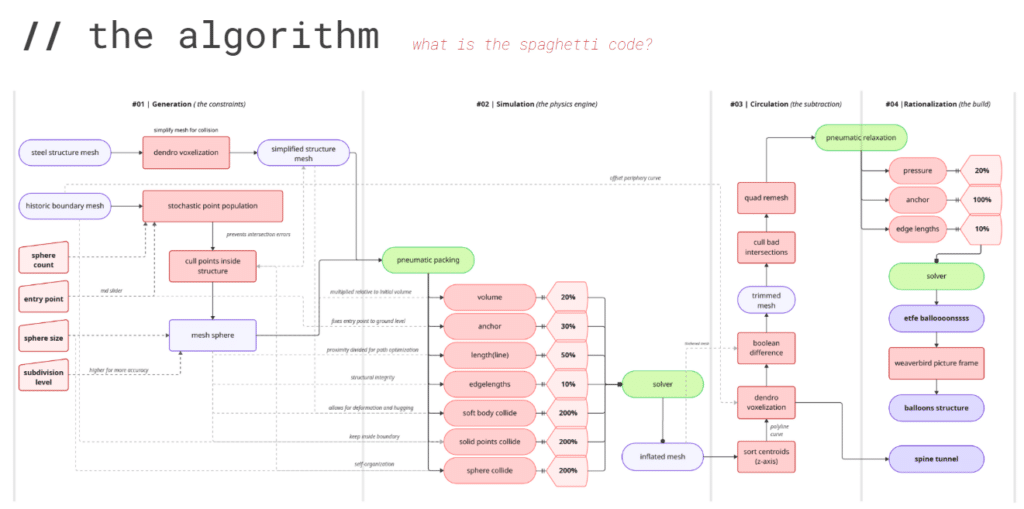
diagrammatic pseudo-code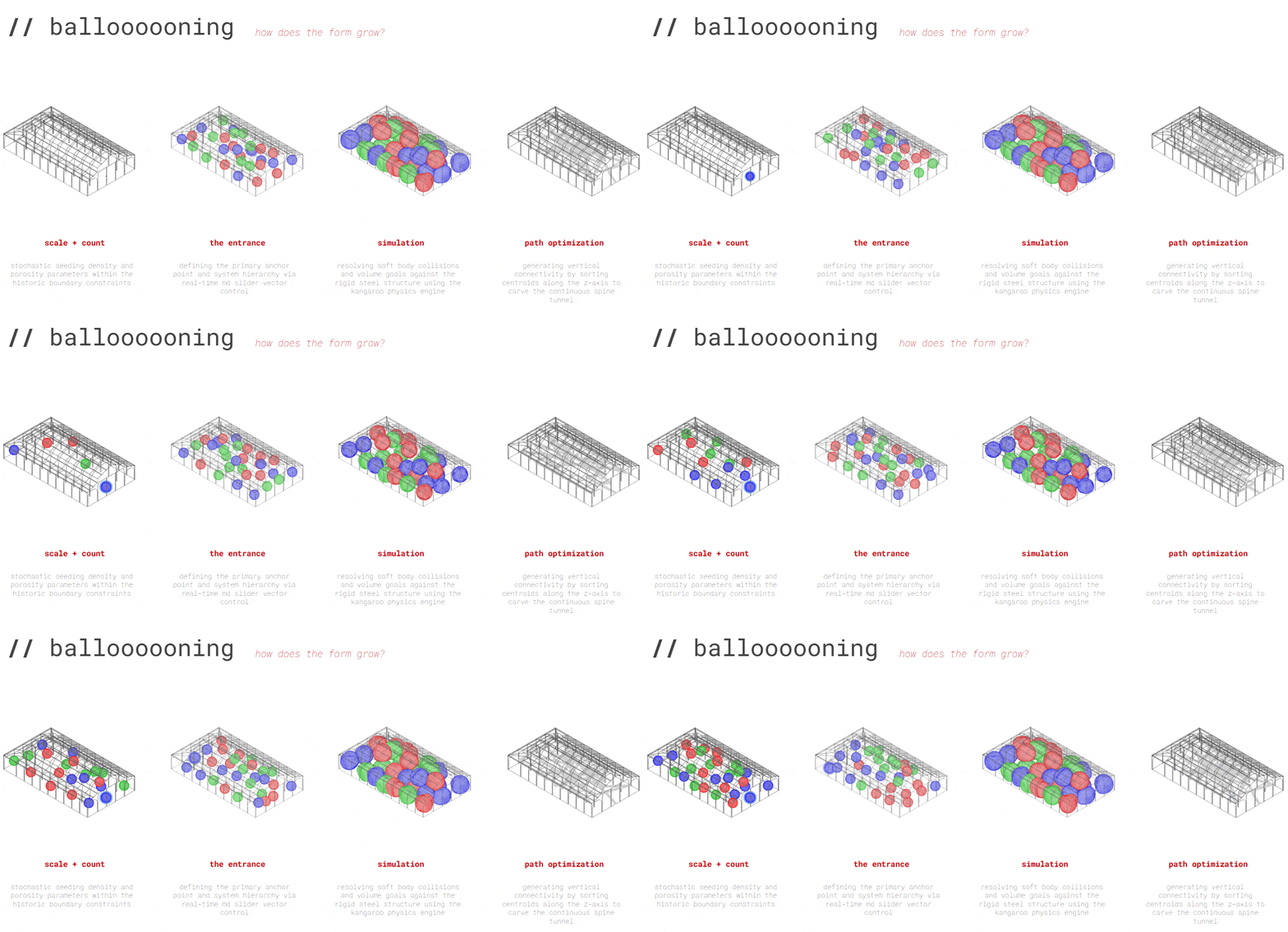
Axonometric Process View (Rhino and Grasshopper)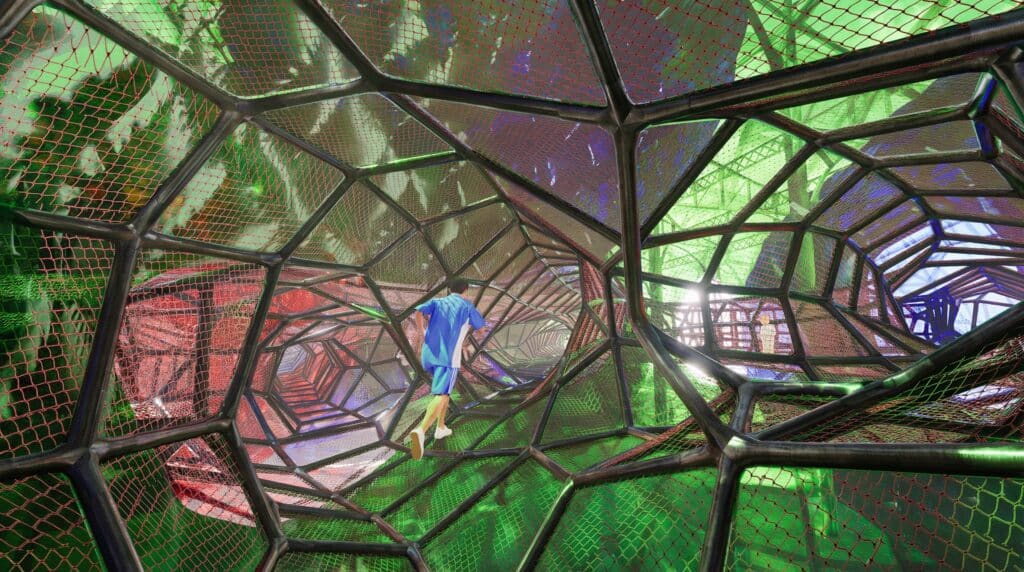
Perspective View Rendering (D5 Render and AI Enhanced)// Pick Your Balloons
Finally, I didn’t want this to be a static monument. The design is a parametric system. We created a matrix where users can control variables like Density, Scale, and Volume.
Want a shady, intimate souk for quiet conversations? Dial up the density. Want a big, airy plaza for a festival? Dial it down. The public isn’t just occupying the space; they’re curating it.
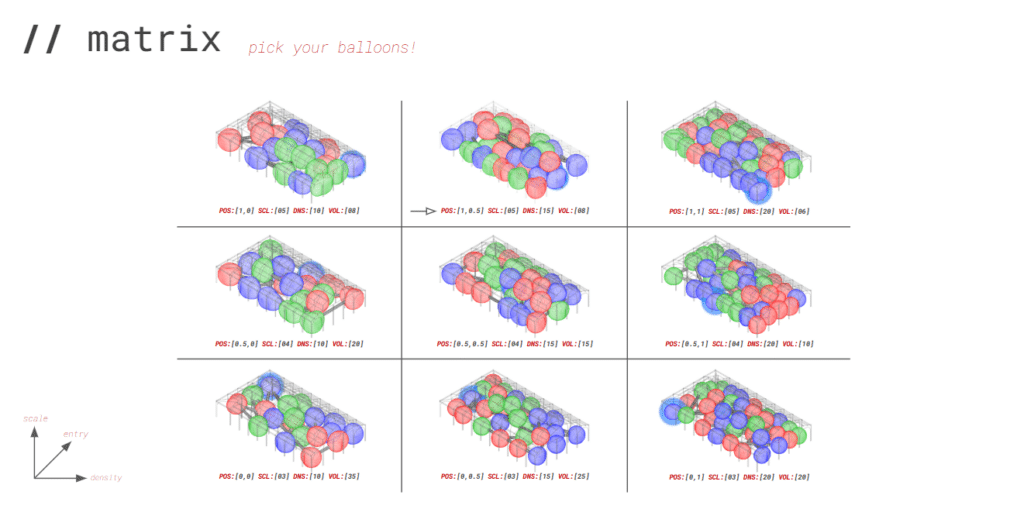
Matrix Of Iterations (Rhino and Grasshopper)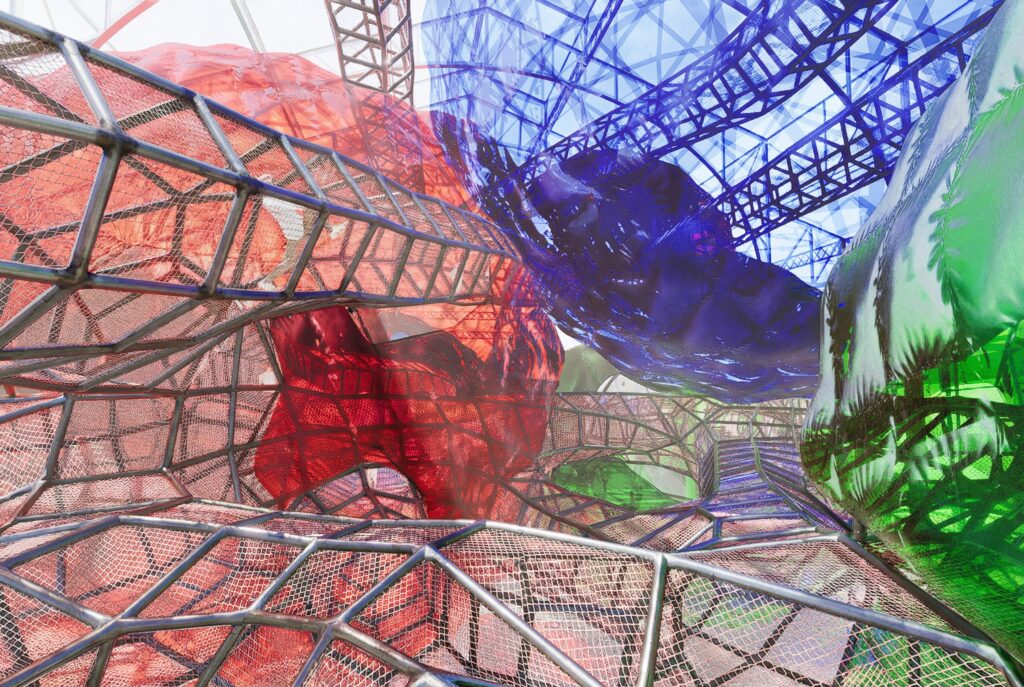
Perspective View Rendering (D5 Render and AI Enhanced)// The RGB Glitch: It’s Not Just Pretty Colors
You might be looking at the renders and thinking, “Okay, Emilie, but why the aggressive Red, Green, and Blue? Did your screen break?”
The RGB color scheme is intentional. It’s a functional glitch.
Historic Cairo is often defined by “beige analog dust.” By introducing a pure digital spectrum (RGB), we signal that something new is happening here. But it’s not just for vibes; it’s for wayfinding. The balloons are made of ETFE cushions with 40% translucency. And here is where the color logic gets cool: it’s not just about the shadows on the floor. Where the balloons themselves physically overlap, their colors mix to create secondary CMY hues—Cyan, Magenta, and Yellow.
It’s a spectroscopic effect happening right in the canopy. If you look up and see a flash of Cyan in the balloon network, you know exactly where you are in the system. The aesthetic is the function.
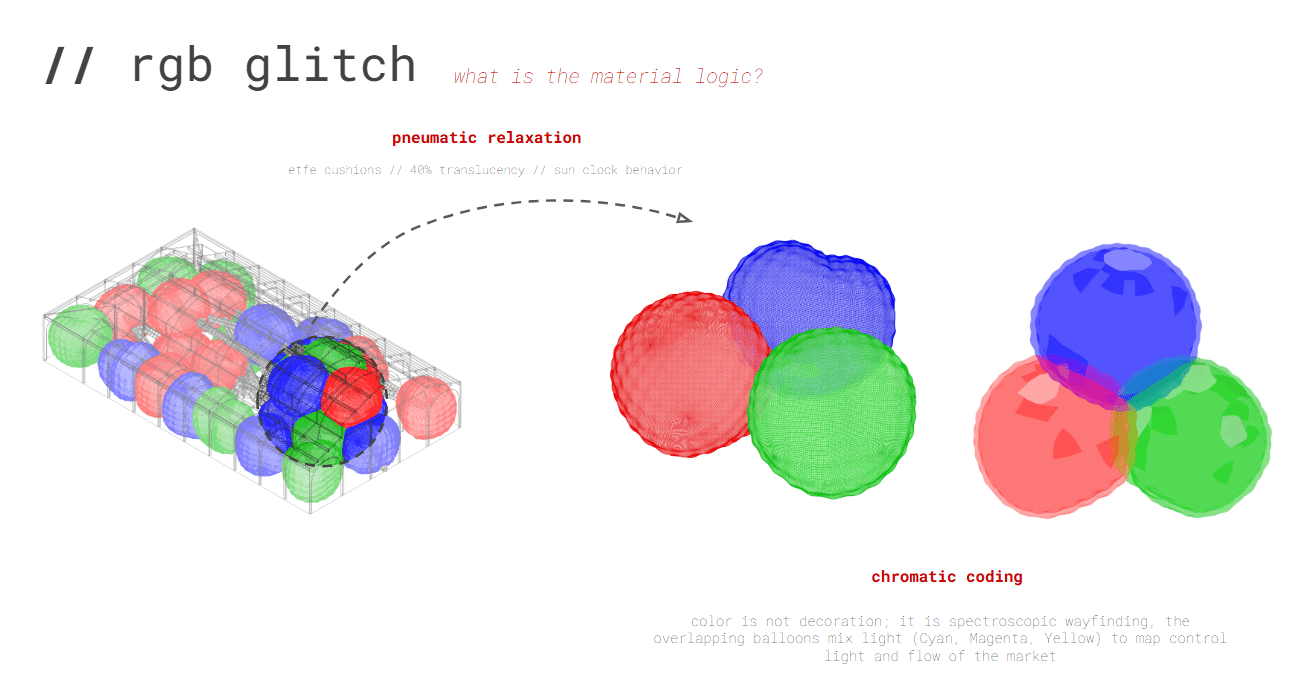
Axonometric View (Rhino and Grasshopper)// Two Worlds in One: The Secret Wormhole
The best part of this project is that it’s actually two buildings in one.
- The Ground Floor (The Souk): For the adults, it’s a bustling commercial market. You weave between the bottoms of the balloons, shopping in stalls lit by that shifting colored light.
- The Spine (The Playscape): Above the market, carved through the mass of balloons, is a structural net tunnel.
This is the “wormhole.” While the adults are down below buying spices and textiles, the kids are navigating a completely different world suspended in the air. It’s a hidden layer of the city just for them.
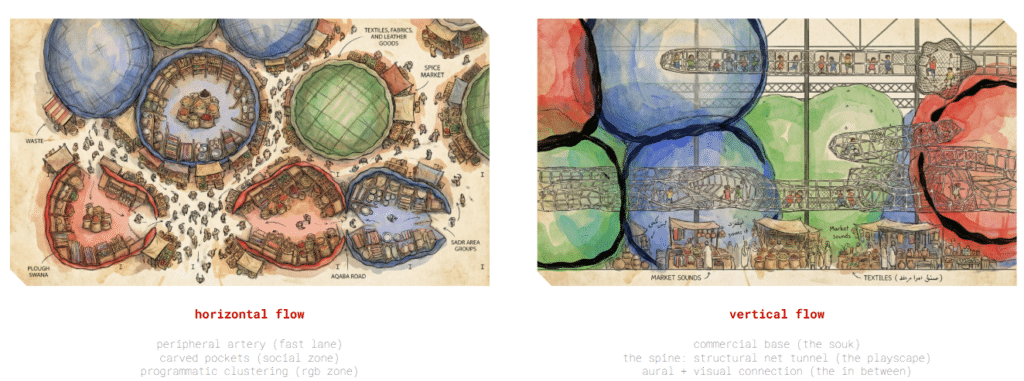
Plan And Section (Rhino and AI enhanced)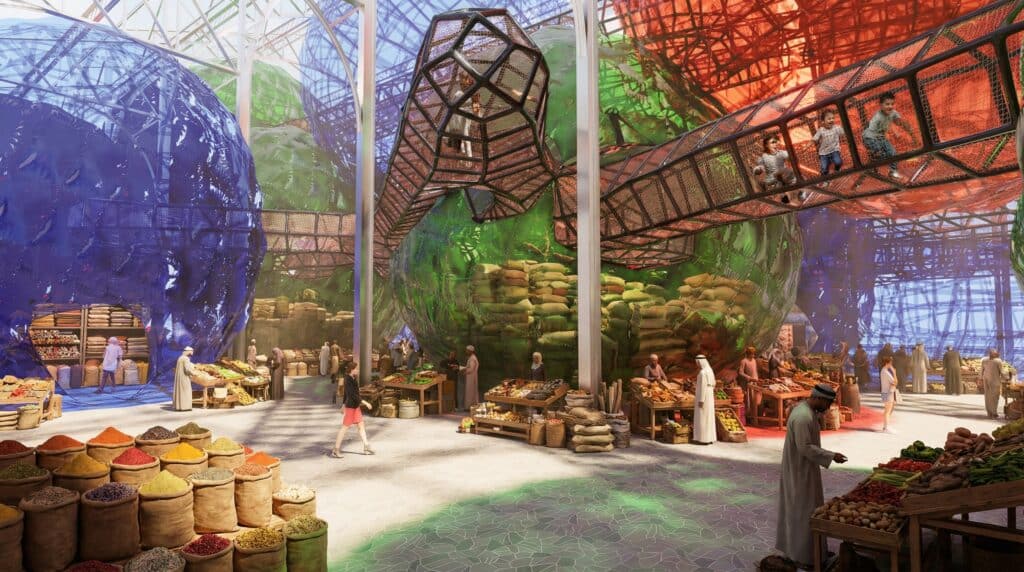
Perspective View Rendering (D5 Render and AI Enhanced)
Perspective View Rendering (D5 Render and AI Enhanced)The Future is Lighter
This project is, for now, a digital proposal. But it proved a critical point: we don’t need heavy concrete to make a heavy impact. By leveraging air and algorithms, we can breathe new life into our cities—hugging the past without being suffocated by it.
For now, the balloons are safely stored in my script (where they can’t pop). But the logic holds: if we can activate a historic void with something as simple as code and air, imagine what else is possible?
So, while you can’t physically meet me in the wormhole just yet, the blueprint is ready. I’m just waiting for someone to hand me the air pump.
