
Artificial Intelligence is often discussed in the AEC industry through extreme narratives, either as fully automated architecture or algorithms replacing designers altogether. But in reality, AI’s impact is much quieter and much more practical.
Today, AI is not designing buildings for us. Instead, it is supporting the many process-heavy tasks that surround design.
AEC workflows involve significant computational and repetitive work: rendering, structural checks, wind simulations, environmental analysis, documentation, and coordination. These steps are necessary but time-consuming, and they often happen late in the process only to validate decisions that were already made.
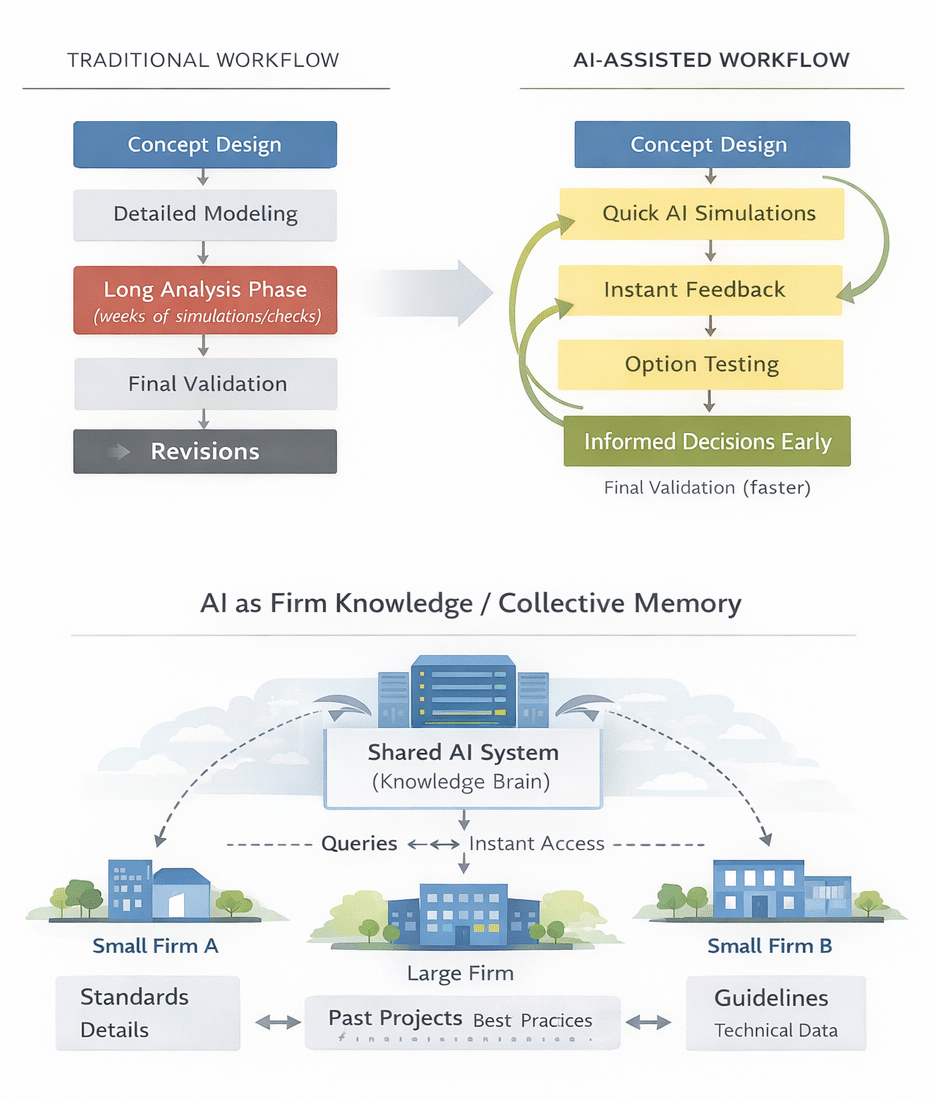
AI shifts this dynamic. By accelerating simulations and analysis, it allows feedback during the design phase itself rather than only at the final stage. Instead of checking performance after everything is fixed, designers can test multiple options quickly and develop intuition while designing. In this sense, AI becomes a decision-support tool rather than a design generator.
AI is also useful beyond design production. At an organizational level, large firms are beginning to use internal AI chatbots that allow employees to instantly query company standards, past projects, or technical knowledge. This functions almost like a shared institutional memory. It reduces onboarding time, improves consistency, and makes knowledge less dependent on hierarchy. If such systems become open or accessible to smaller firms, expertise could become more democratized across the industry.
At the same time, there are limitations. Unlike tech or finance sectors, AEC data is rarely clean or structured. Projects are often undocumented, lessons are not stored, and practices vary by region. Without reliable data, fully automated AI systems remain unrealistic. Building shared repositories, standards, and AI-specific policies will be necessary before deeper integration becomes possible.
Most importantly, architecture and construction directly affect human lives. Ethical decisions, cultural understanding, client relationships, and safety responsibilities cannot be automated. AI can process numbers and speed up workflows, but humans must remain in the loop to interpret results and take accountability.
While AI doesn’t replace designers, it enhances decision-making and allows us to develop practical design intuition more quickly in a field where mastery usually takes years.
