

Designing a staircase is one of the most complex spatial and structural challenges in residential architecture. It requires a delicate balance between ergonomic constraints, safety regulations, and aesthetic fluidity. Traditionally, this process is confined to complex CAD software, demanding continuous intervention from the architect even for basic modifications. With Ascend, I set out to challenge this paradigm, bringing the power of computational design directly into the web browser.
The Concept: Interactive Parametrics
Ascend is an interactive 3D web application that transforms the conception of staircases into an exploratory, intuitive, and highly accessible process. Developed by integrating advanced parametric logic with modern frontend frameworks, the app allows clients, interior designers, and architects to collaborate in real-time on an accurate 3D model.
The goal was to bridge the gap between complex algorithmic modeling and user-friendly interfaces, making mass customization available to non-experts without sacrificing architectural precision.
Workflow and Spatial Context
The user journey is designed to be both seamless and profound:
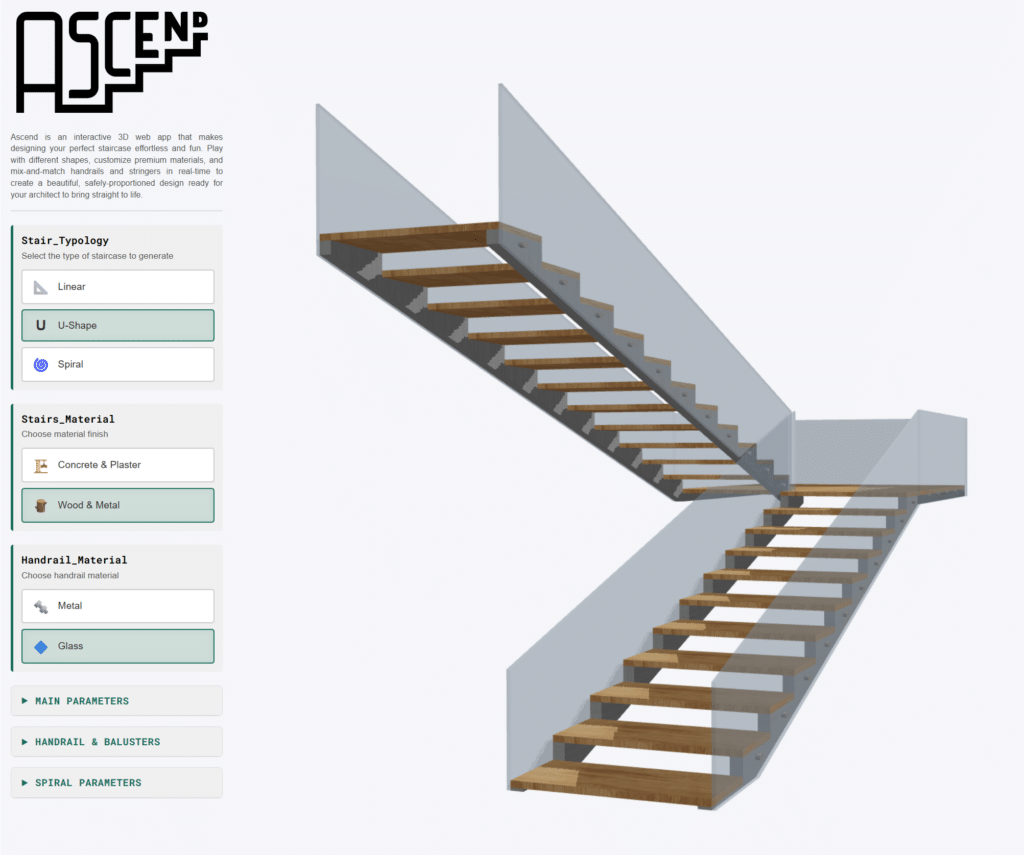
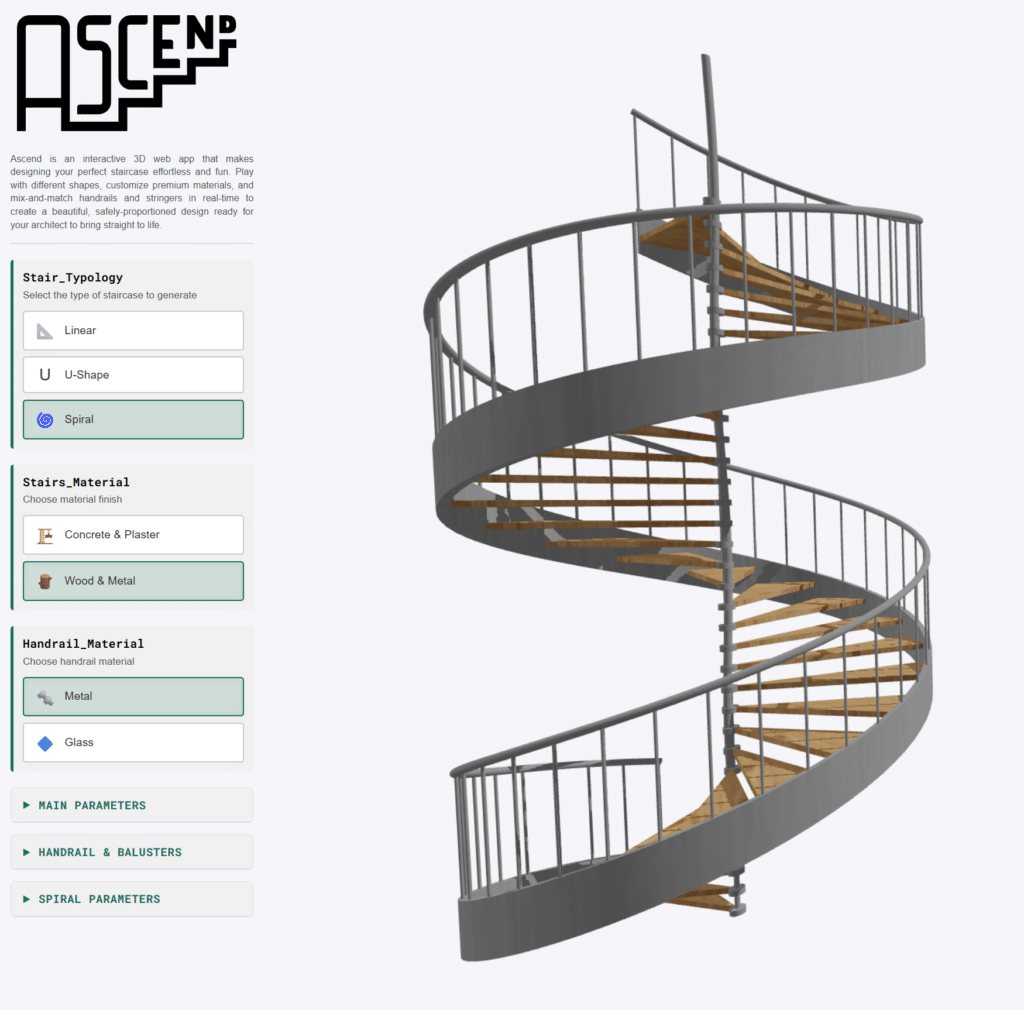
- Typology & Orientation: Users start by selecting the core geometry—Linear, U-Shape, or Spiral. The architecture can be instantly adapted to the host environment using the Flip tool, which mirrors the entire structure along the XZ or YZ planes.
- Spatial Awareness: A staircase never exists in a void. We introduced a contextual wall feature that simulates the physical boundaries of the room, helping users visualize real-world proportions and spatial impact.
Real-Time Computational Control
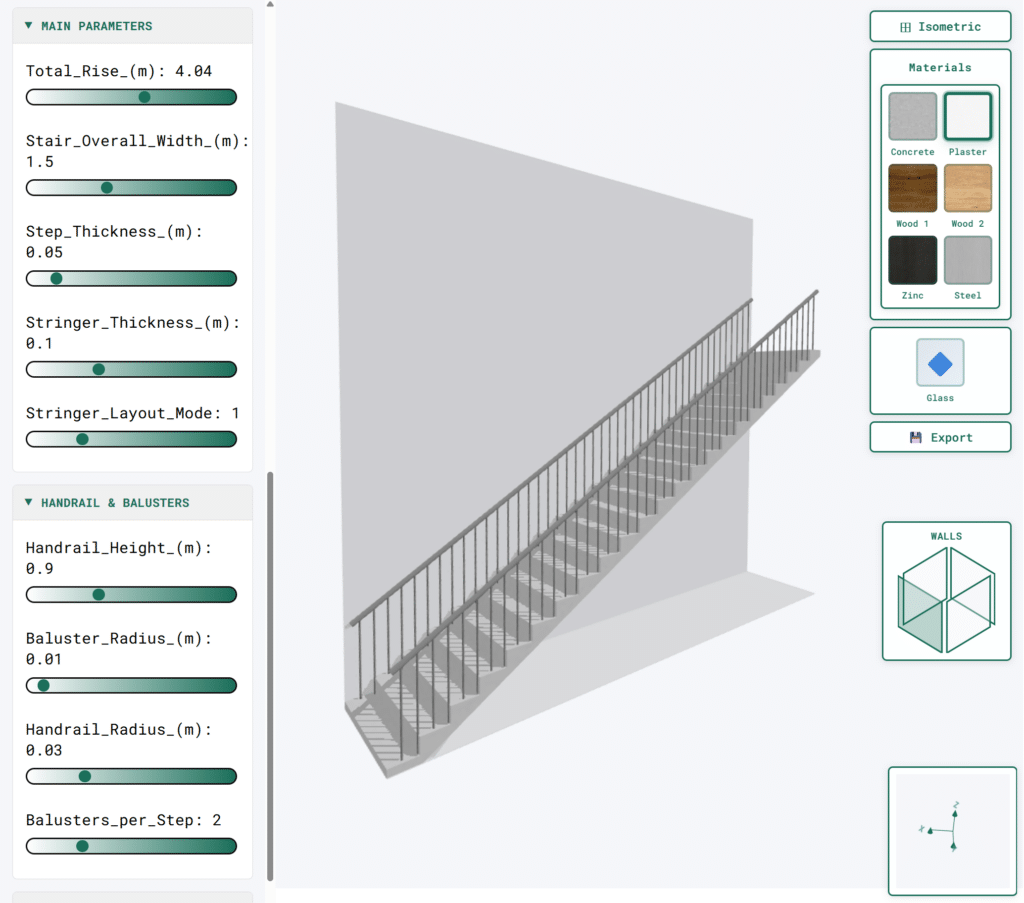
The true computational engine of Ascend lies in its parametric controls. Through a clean interface of sliders and drop-down menus, the underlying mathematics of staircase design are simplified into immediate visual commands.
Users can effortlessly manipulate:
- Total rise and overall width
- Step and stringer thickness
- Baluster density, radius, and handrail heights
- Spiral-specific parameters like the central column radius
Every interaction queries a backend powered by Rhino Compute, instantly recalculating the grasshopper definition and pushing the updated 3D mesh back to the browser. This ensures that every generated configuration is not just a visual approximation, but a physically plausible and safely proportioned structure.
Materiality and Detailing
Aesthetic definition is crucial for interior design communication. Ascend offers a robust material library allowing for sophisticated combinations. Users can define the core structure (e.g., Concrete & Plaster vs. Wood & Metal) and apply specific high-quality textures such as Classic Wood, Polished Concrete, Zinc, or Glass handrails. This real-time rendering gives clients immediate feedback on how light and materials will interact in their space.
From Web directly to CAD
The major limitation of most web configurators is that their outputs remain trapped on the screen. Ascend breaks this barrier by functioning as a true architectural data generator.
When the conceptual design is finalized, users can hit Export and download a pristine, layered .3dm file. This means the client isn’t just sending a picture to their architect; they are providing an exact, dimensionally accurate 3D model ready to be integrated into the final BIM or CAD workflow.
Ascend optimizes the briefing phase, eliminates spatial misunderstandings, and delivers a workable geometric foundation for fabrication. It is computational design made truly democratic.
