Introduction
When we imagine a corridor in a typical apartment building, we picture a purely functional passageway — a space designed for movement, not for meeting. These circulation zones are often long, narrow, and socially inert. Yet they structure much of our daily experience of housing, shaping how residents encounter one another.
Cohousing projects show that it doesn’t have to be this way. With simple design moves — widening a corridor, opening a view, adding a pause point — circulation can become a social catalyst. But these decisions are usually intuitive rather than analytical. This raises a key question for architectural research.
Can spatial analysis systematically identify opportunities for social encounter and inform targeted design interventions?
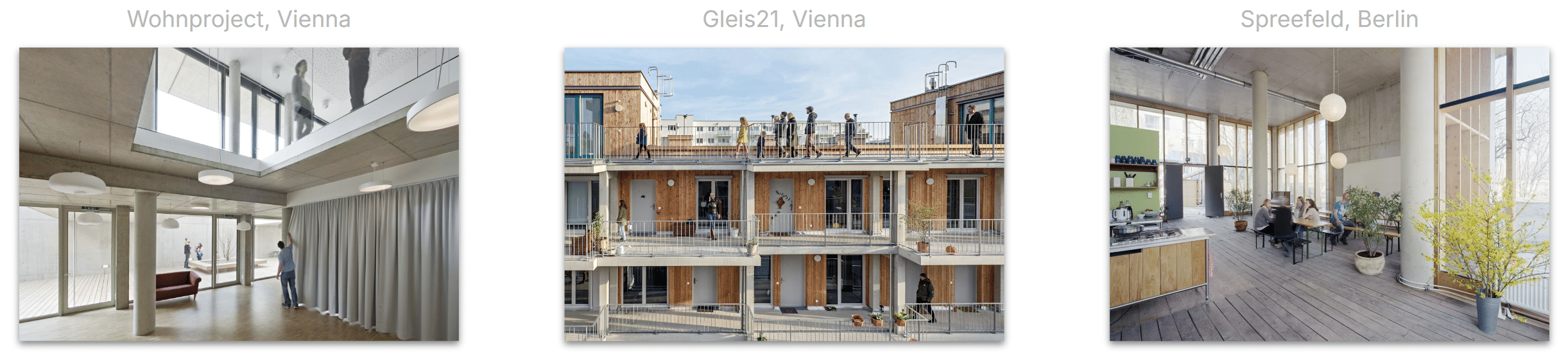
To explore this, we studied three cohousing buildings through spatial‑network analysis, visibility analysis, and circulation topology:
- Wohnprojekt Wien (Vienna, Austria) — A multi‑generational cohousing development organized around a central double‑loaded corridor with shared ground‑floor amenities.
- Gleis21 (Vienna, Austria) — A cooperative housing project featuring exterior perimeter walkways and an active community‑oriented ground floor.
- Spreefeld (Berlin, Germany) — A hybrid living‑working cohousing complex combining public ground‑floor programs with point‑access residential clusters above.
Case Study 01 – Wohnproject, Vienna
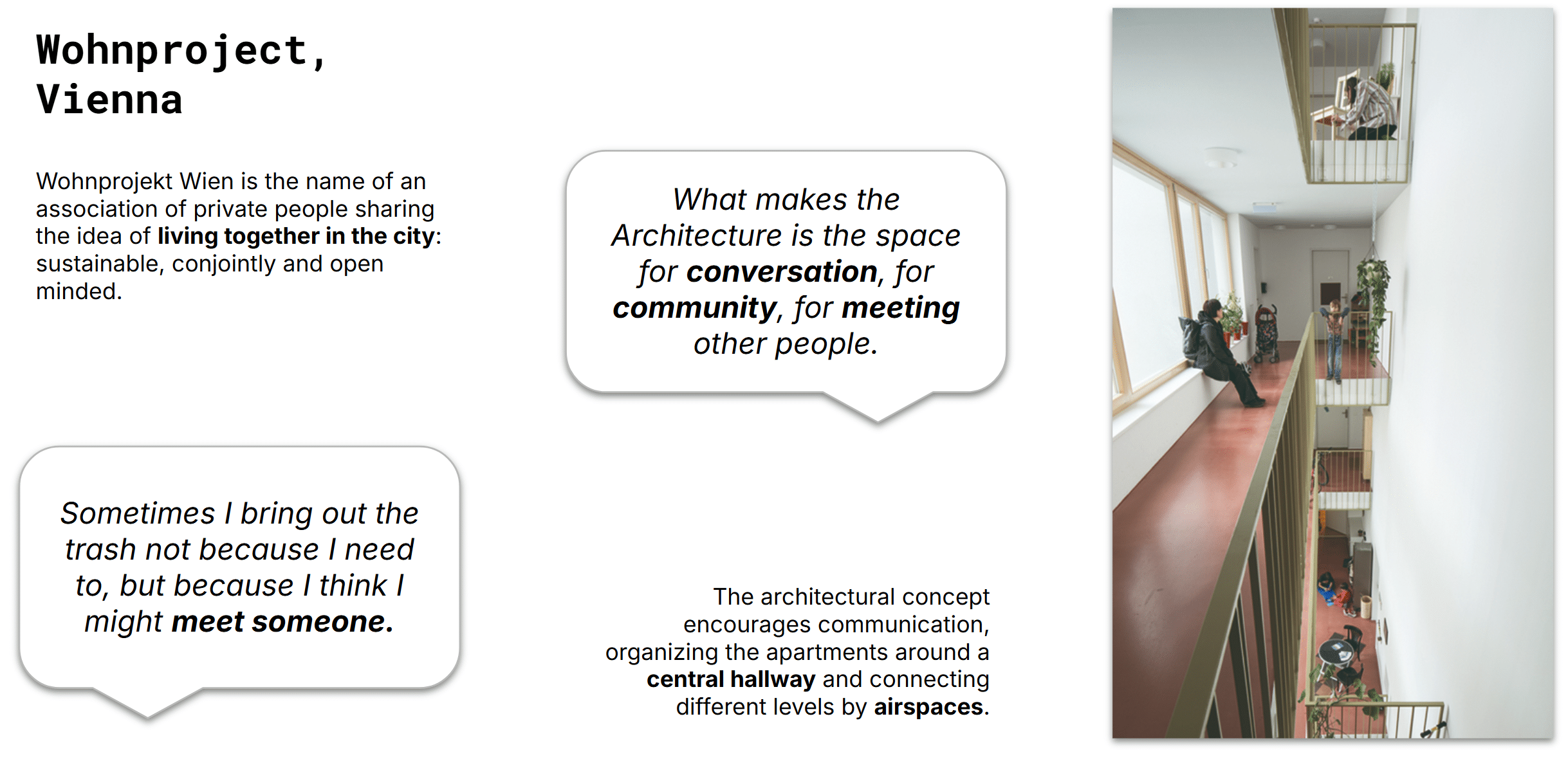
Wohnprojekt Wien organizes its residential units around a central internal hallway, using a series of airspaces to visually and spatially connect different levels. These voids soften the separation between floors, allowing sound, light, and sightlines to travel through the building and subtly encouraging communication across the community.
Floorplan
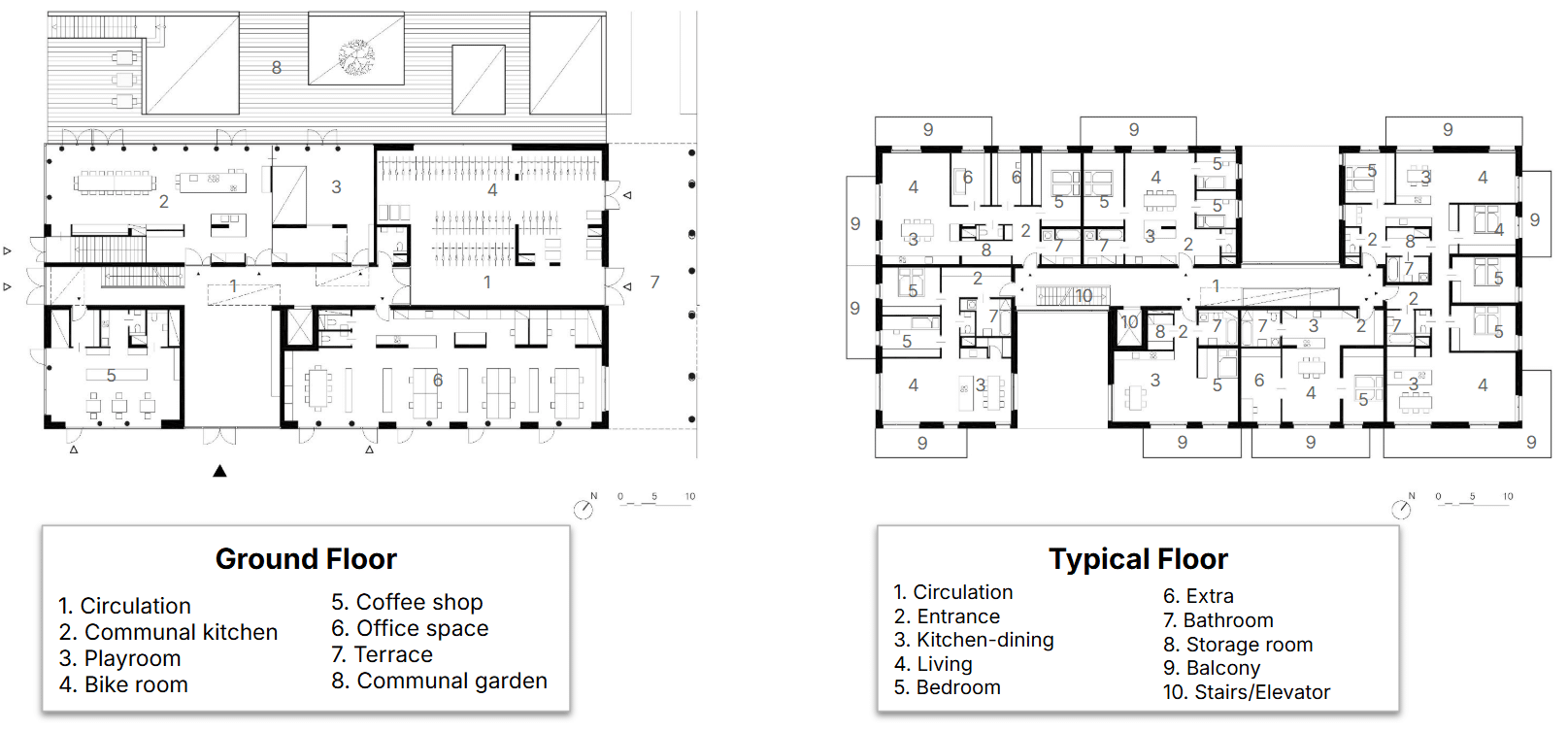
The building is organized around a double‑loaded corridor, which serves as the main internal spine and anchors a highly active ground floor. Here, a cluster of shared programs — including a communal kitchen, bike room, coffee shop, and office space — creates a lively social base for the community. Above, the residential units range from compact studios to generous three‑bedroom apartments, offering a diverse mix of living arrangements while maintaining a coherent relationship to the central circulation space.
Topology
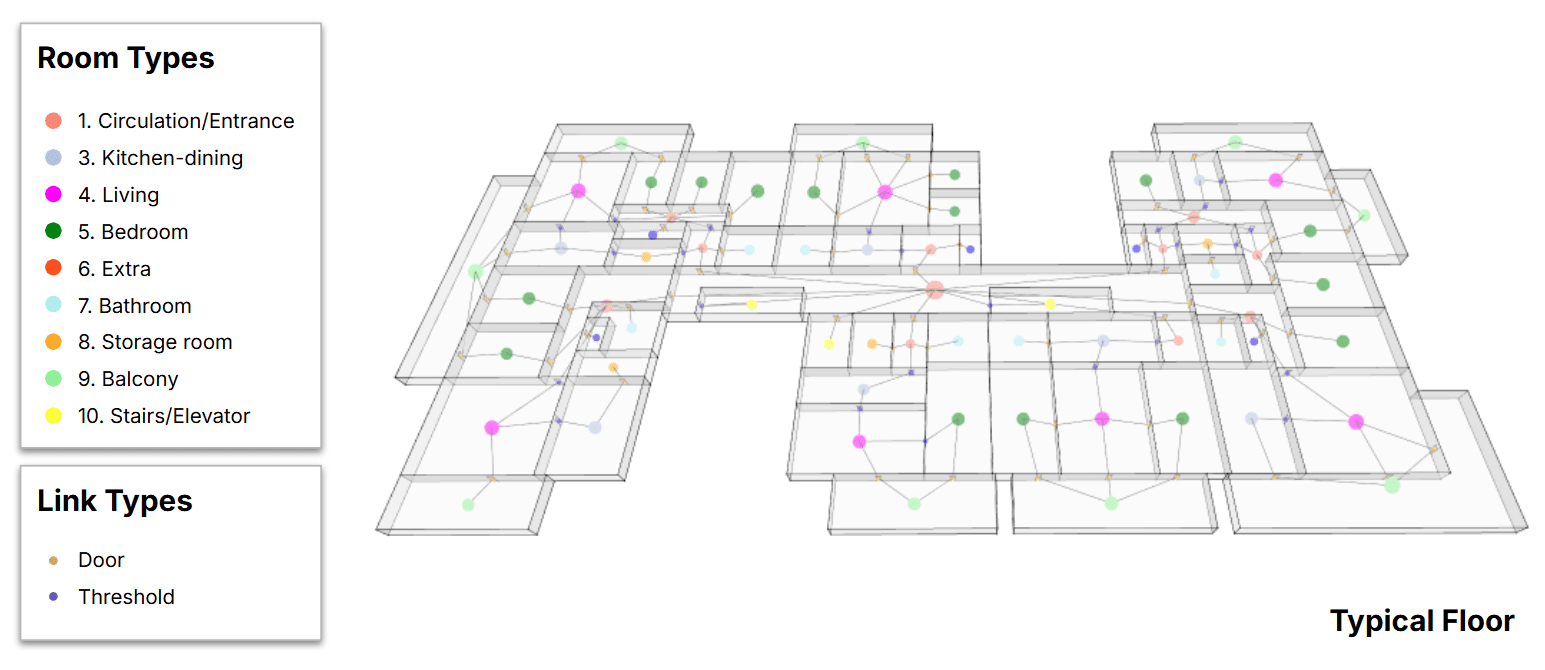
The topological graph clearly positions the corridor as the building’s primary connective element, the space through which all circulation is ultimately routed. In contrast, the living rooms occupy more peripheral positions, extending toward the balconies and forming quieter, outward‑oriented zones. Access to each apartment is mediated by small foyers, which introduce a subtle threshold between the shared circulation spine and the private domestic interior, creating a semi‑buffered transition that supports both privacy and social permeability.
Space Syntax Analysis
The corridor operates as the radial heart of the building, the element from which all other spaces draw their spatial logic. Its consistently high centrality values reveal more than just efficient circulation: they point to a structural role in shaping social life within the project. Because every major communal function branches from this spine, residents are naturally funneled through a shared zone where paths overlap, glances meet, and informal encounters become part of daily routine. Rather than acting as a neutral passage, the corridor becomes a social condenser — a space that not only organizes movement but actively supports the building’s collective identity by keeping all communal areas closely and intuitively connected.
Visibility & Movement
Shortest‑path analysis reinforces the role of the corridor as the building’s primary movement channel, showing how everyday circulation naturally concentrates along this central spine. While the horizontal apertures along the corridor restrict in‑plane visibility, they simultaneously open up vertical sightlines between levels, allowing residents to perceive activity across floors. This layered visibility strengthens the sense of shared space and subtly supports social awareness within the building.
Case Study 02 – Gleis21, Vienna
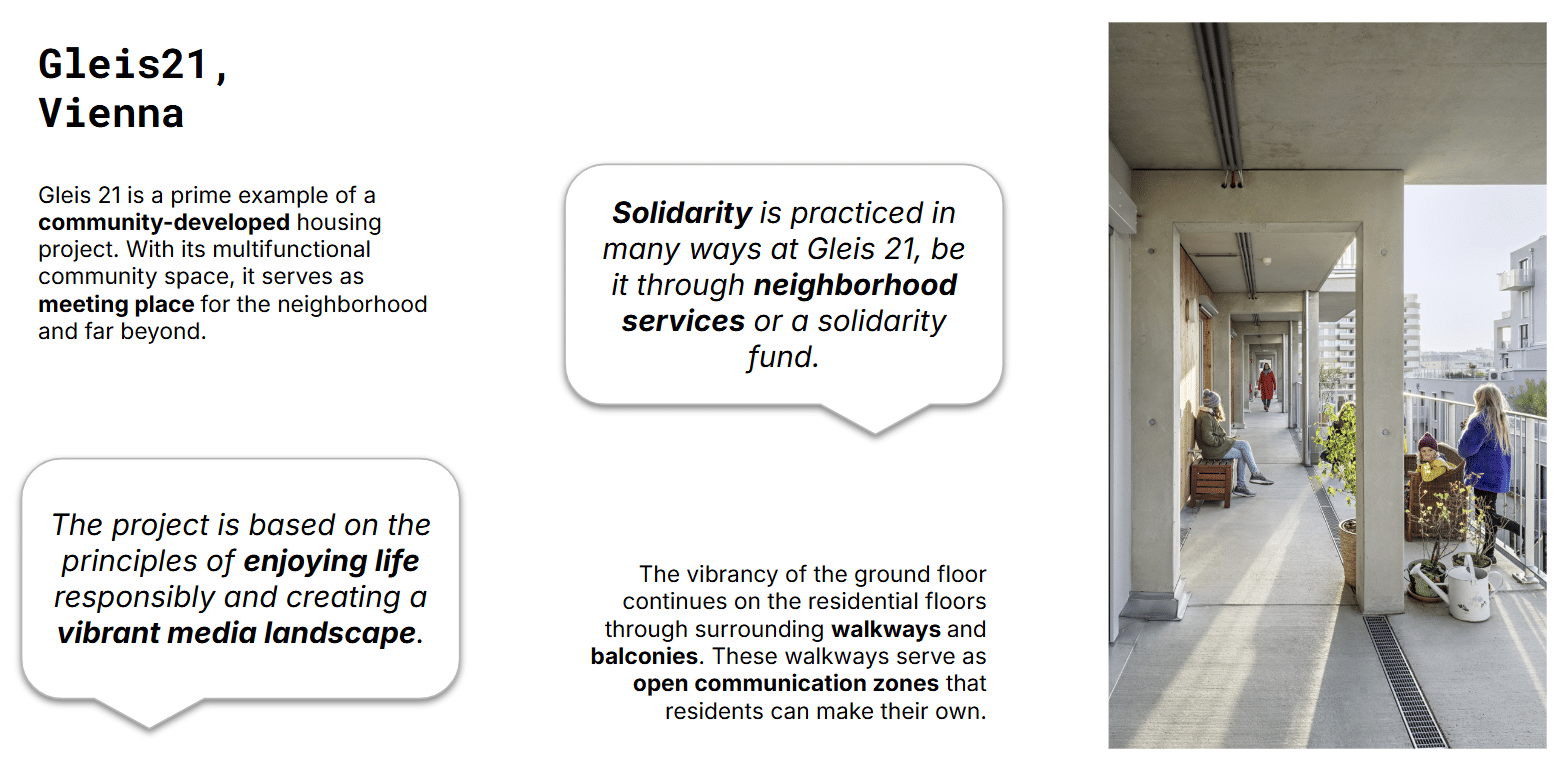
Gleis21 shifts the social interface outward by placing circulation along exterior perimeter walkways, transforming them into open communication zones rather than mere access routes. These elevated paths act as semi‑public streets in the sky, blurring the boundary between private units and shared community life, and creating a continuous social edge around the building.
Floorplan
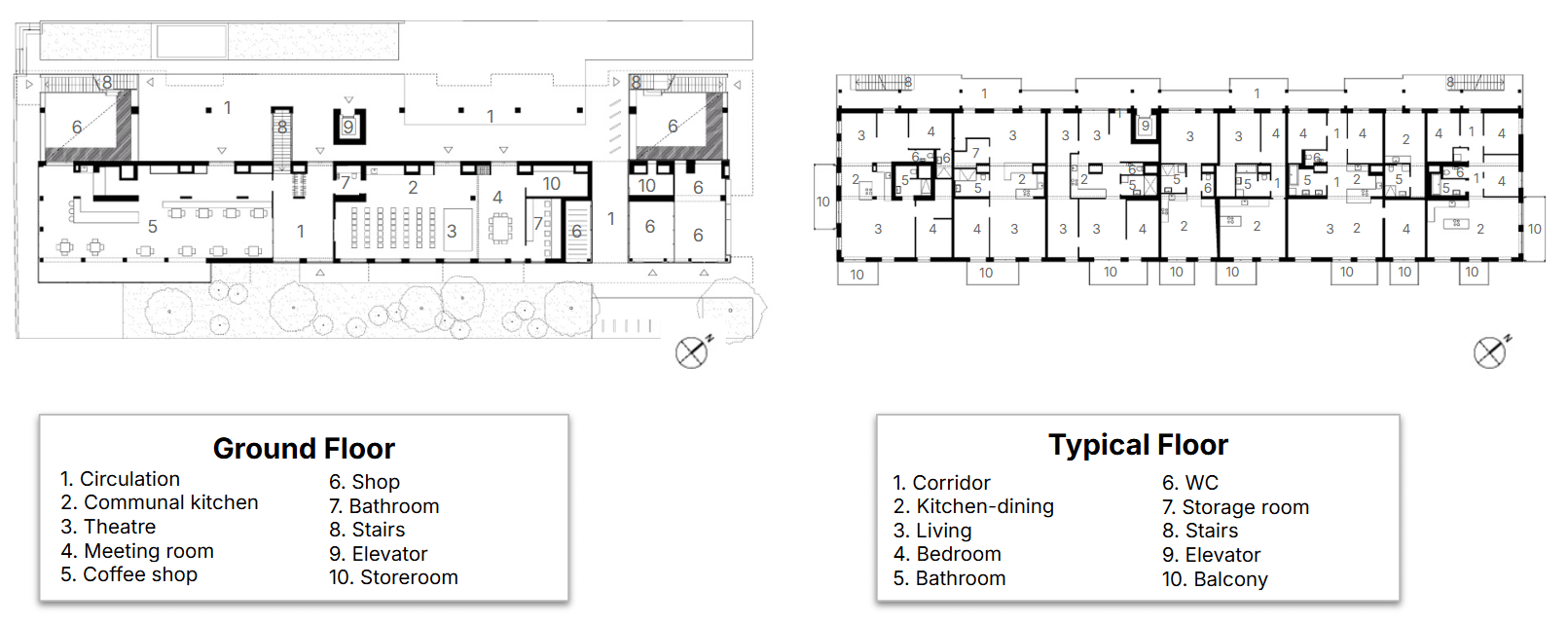
The ground floor brings together a series of multifunctional community spaces, forming an active social base for the building. Above this level, the upper floors strike a careful balance between private residential units and the shared circulation that links them. This layering of program creates a gradient of public to private, where everyday movement through the building naturally weaves residents into a shared spatial rhythm.
Topology
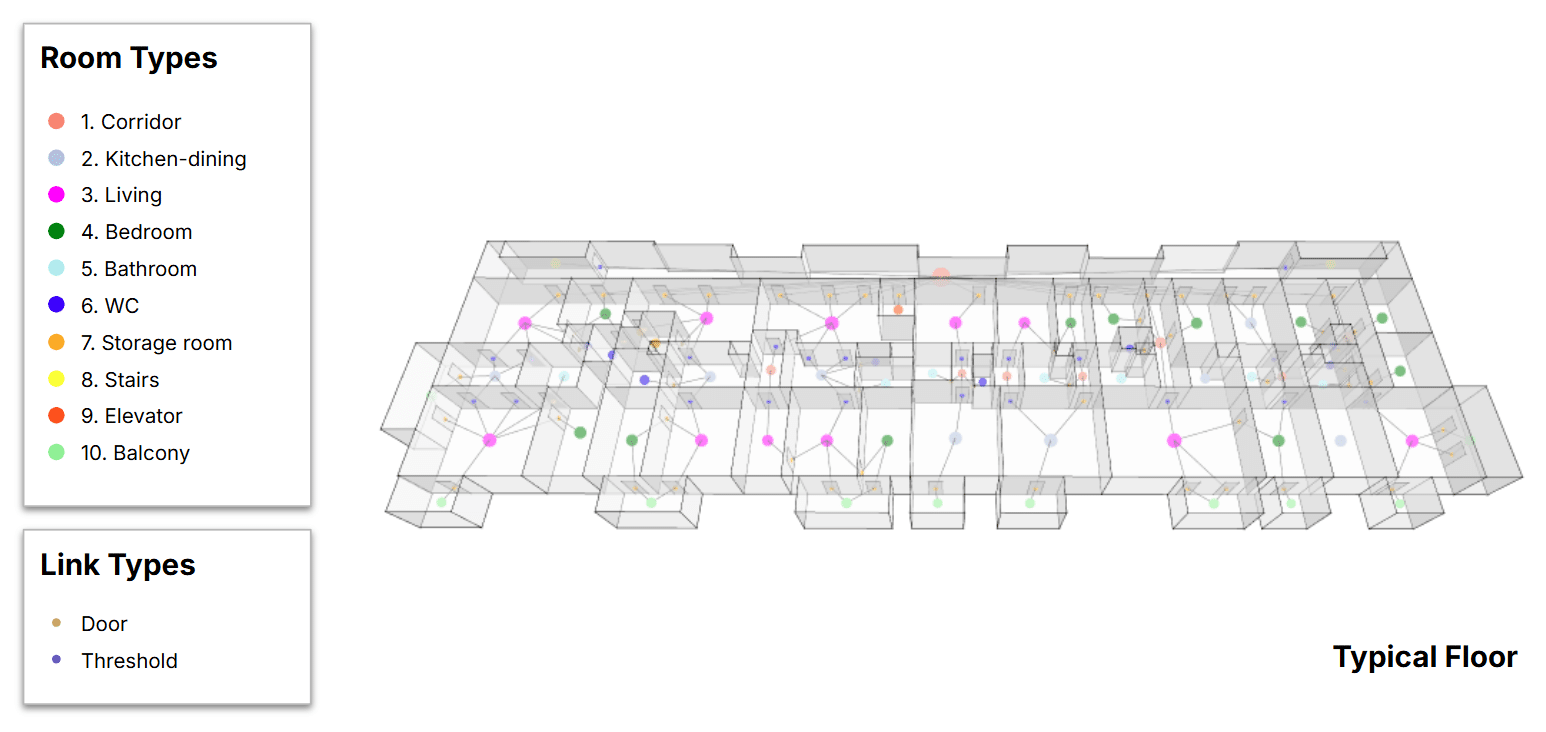
Communal rooms and bedrooms are positioned along the building’s perimeter, where they benefit from generous daylight and a stronger relationship to the exterior. In contrast, the smaller service spaces are gathered toward the central zone, creating a compact and efficient core. This arrangement not only enhances the environmental quality of the primary living spaces but also reinforces a clear spatial hierarchy between active, light‑filled rooms and the more utilitarian functions tucked deeper within the plan.
Space Syntax Analysis
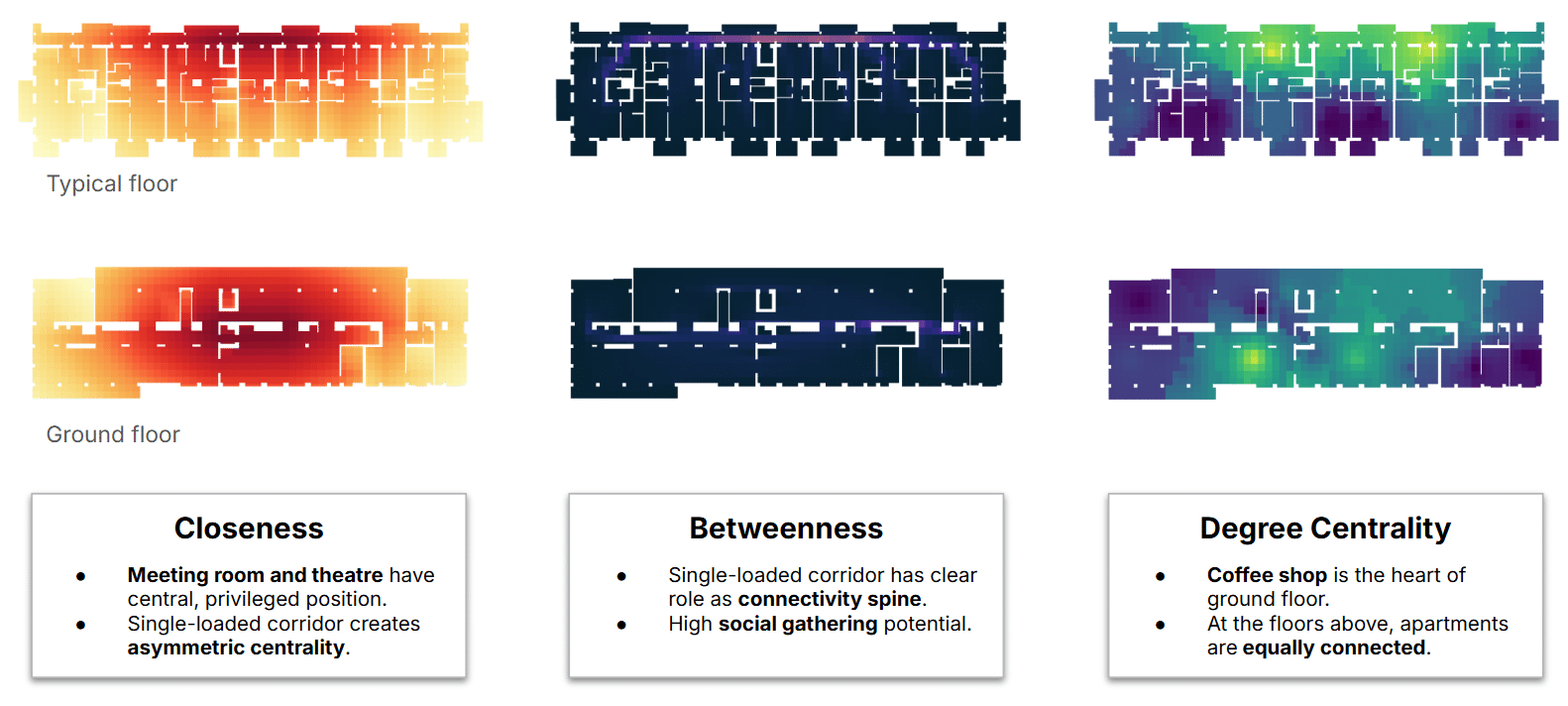
Across the building, the ground floor emerges as the most globally accessible zone, with public programs positioned at the heart of the spatial network. As we move upward, the pattern shifts: the upper‑floor corridor generates a distinctly asymmetric centrality, acting as the main connective spine that organizes movement and links the residential units. At a more local scale, degree centrality peaks around the coffee shop, which becomes a natural micro‑hub of interaction, while the residential units maintain a balanced level of connectivity, ensuring spatial equity across the floors.
Visibility & Movement
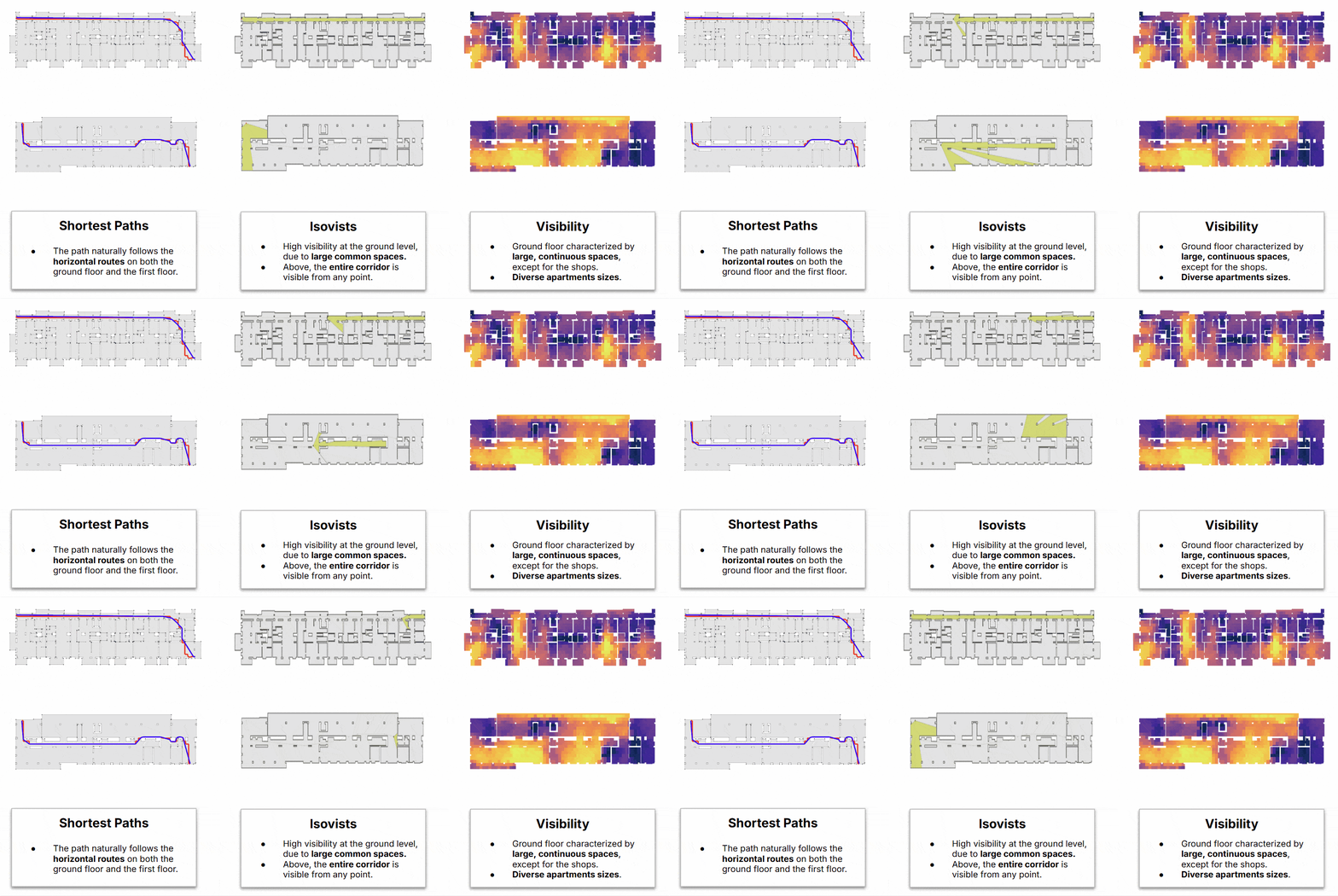
Movement naturally aligns with the main horizontal routes that structure the first two floors, reinforcing the building’s clear circulation logic. On the ground floor, large and highly visible zones dominate the spatial experience, creating an open and legible environment where activity is easy to perceive. The only exceptions are the enclosed shop spaces, which remain visually contained and operate as more inward‑focused pockets within an otherwise transparent and interconnected layout.
Case Study 03 – Spreefeld, Berlin
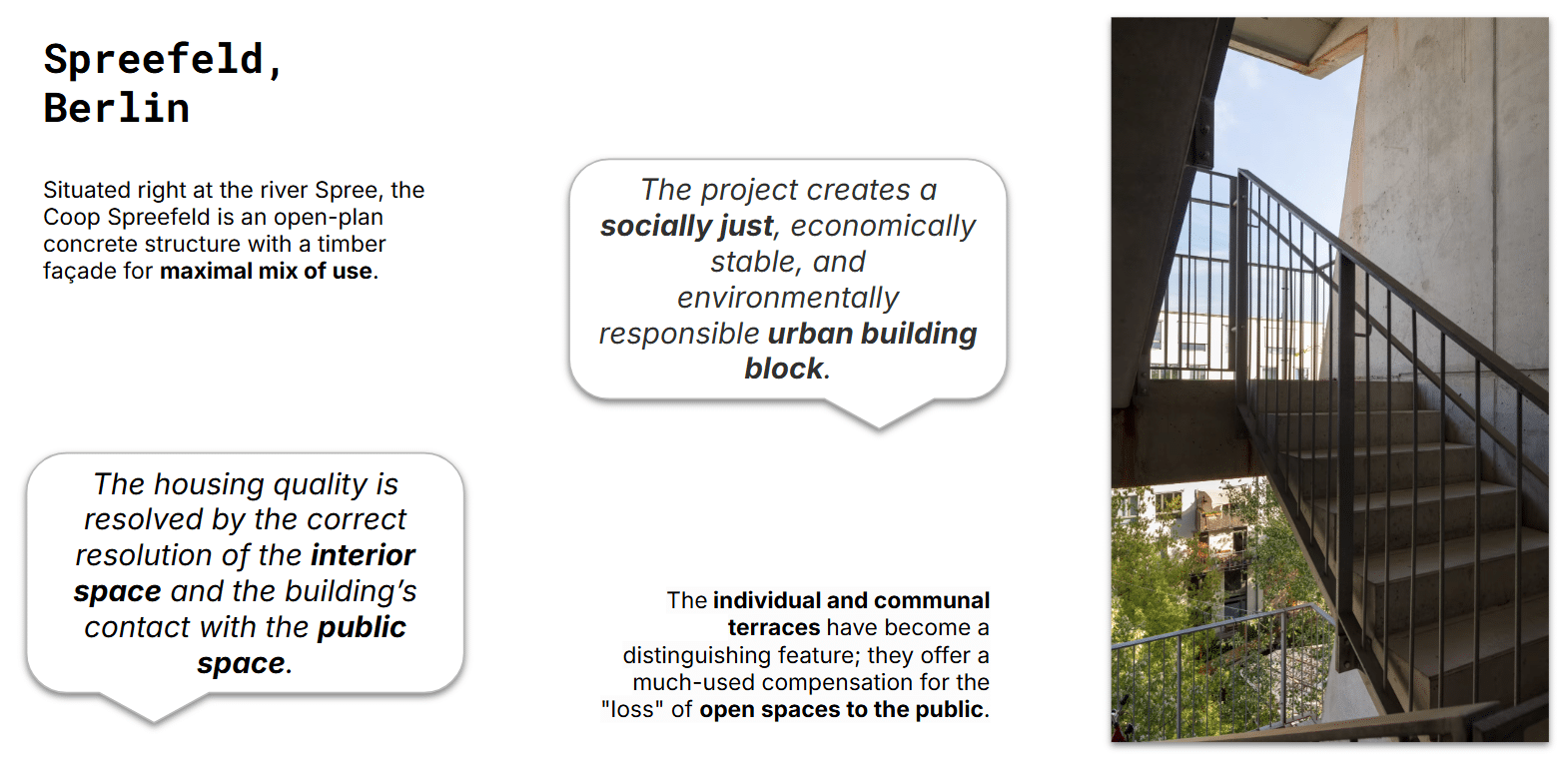
Spreefeld blurs the boundary between interior life and the surrounding public realm, structuring the project around a point‑block access layout that anchors circulation at the core while allowing communal and semi‑public programs to spill outward. This configuration creates a porous interface where living, working, and shared activities overlap, reinforcing the project’s ambition to function not just as housing, but as an active social ecosystem embedded within the neighborhood.
Floorplan
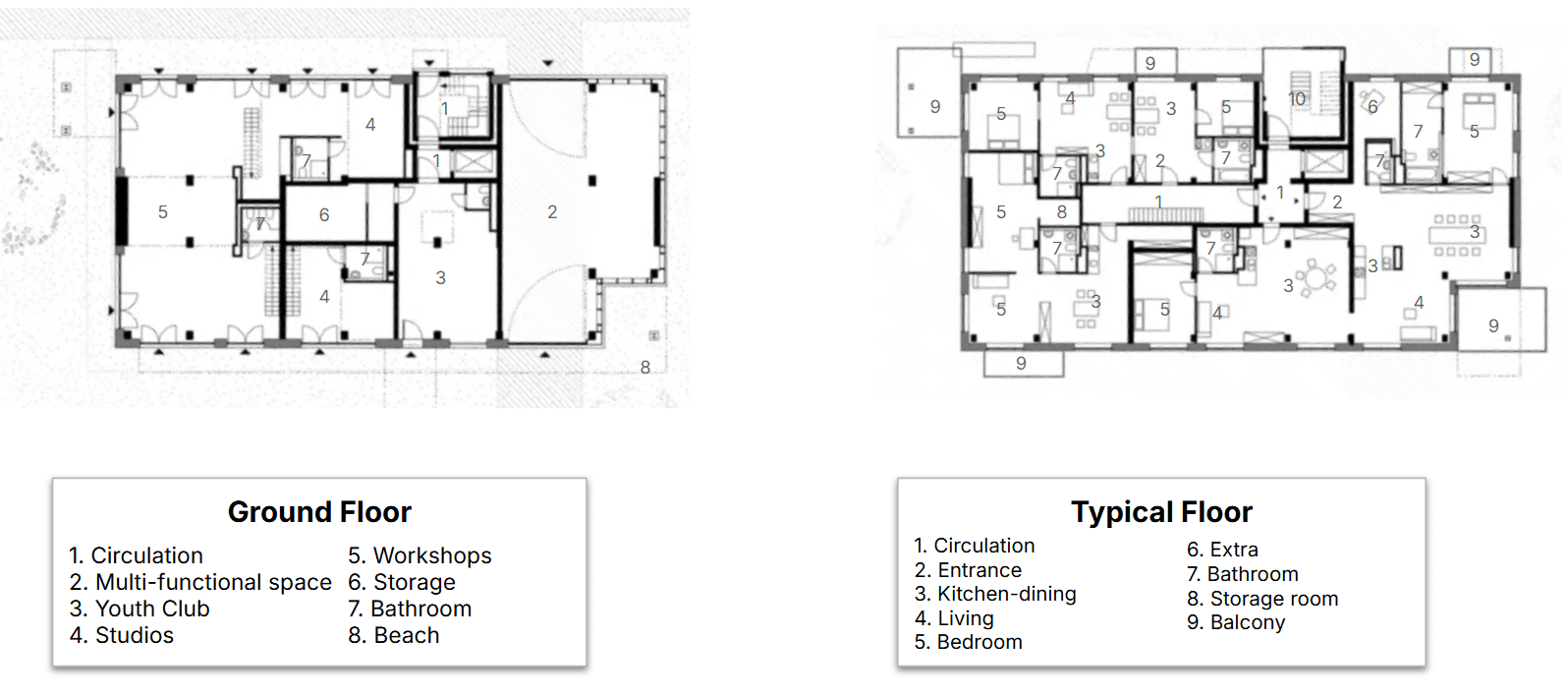
Workshops, studios, and a youth club animate the ground floor, creating an active public interface that anchors the project within its neighborhood. Above this lively base, the residential units cluster around a central corridor, forming a compact vertical community. This stacked arrangement establishes a clear gradient between the open, multifunctional programs at street level and the more intimate domestic spaces above, while keeping circulation at the core of the building’s social and spatial logic.
Topology
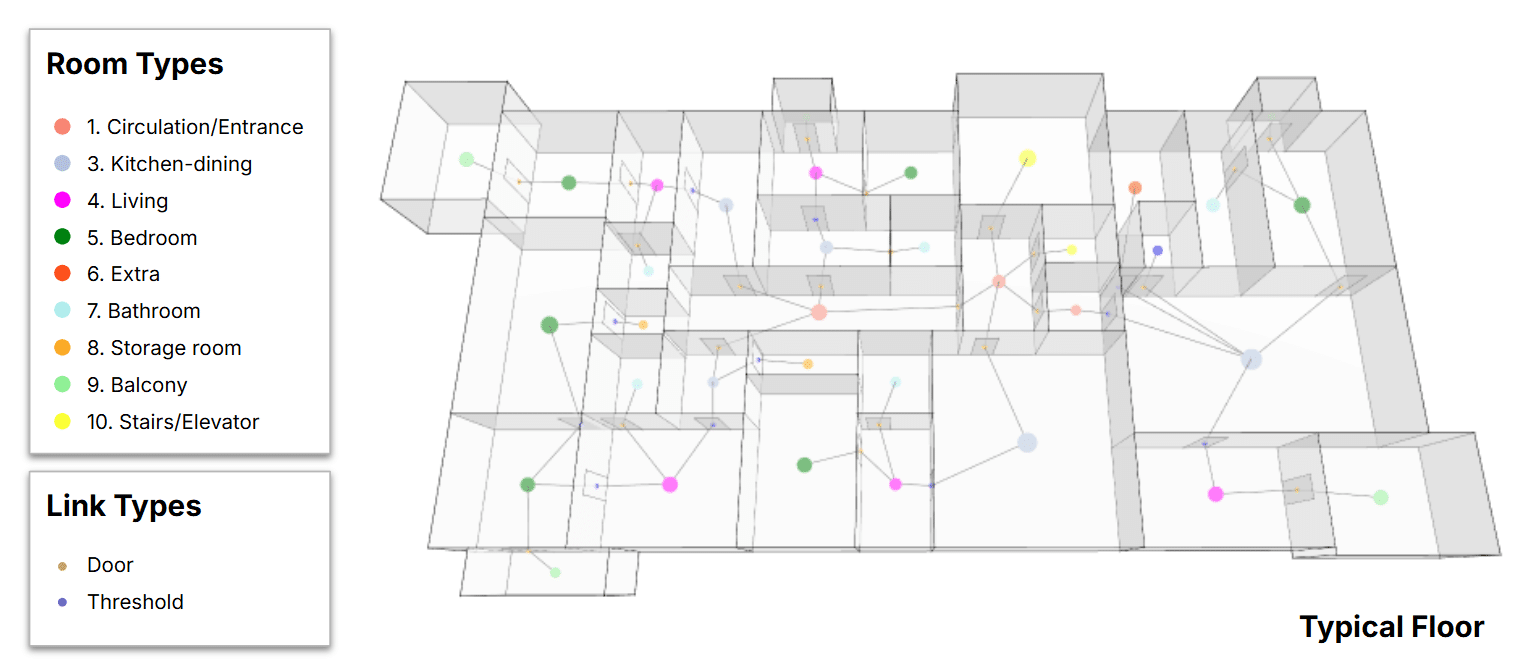
Five apartments branch off the central corridor, each one accessed through a short transitional zone that softens the shift from shared circulation to private life. Within the units, the living and kitchen‑dining rooms function as internal hubs — the social cores around which daily routines unfold — giving each apartment its own micro‑center of activity while still remaining connected to the larger communal spine of the building.
Space Syntax Analysis
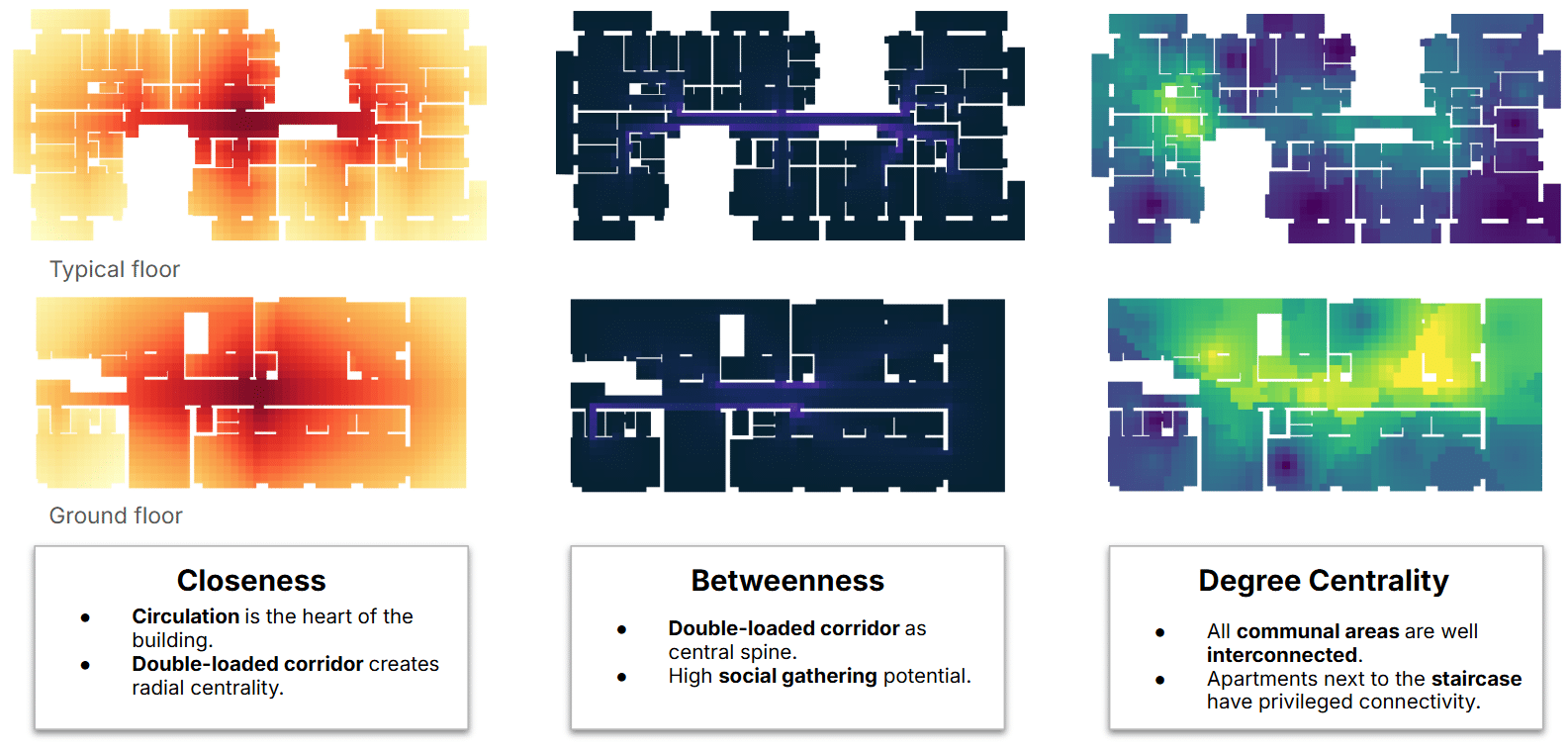
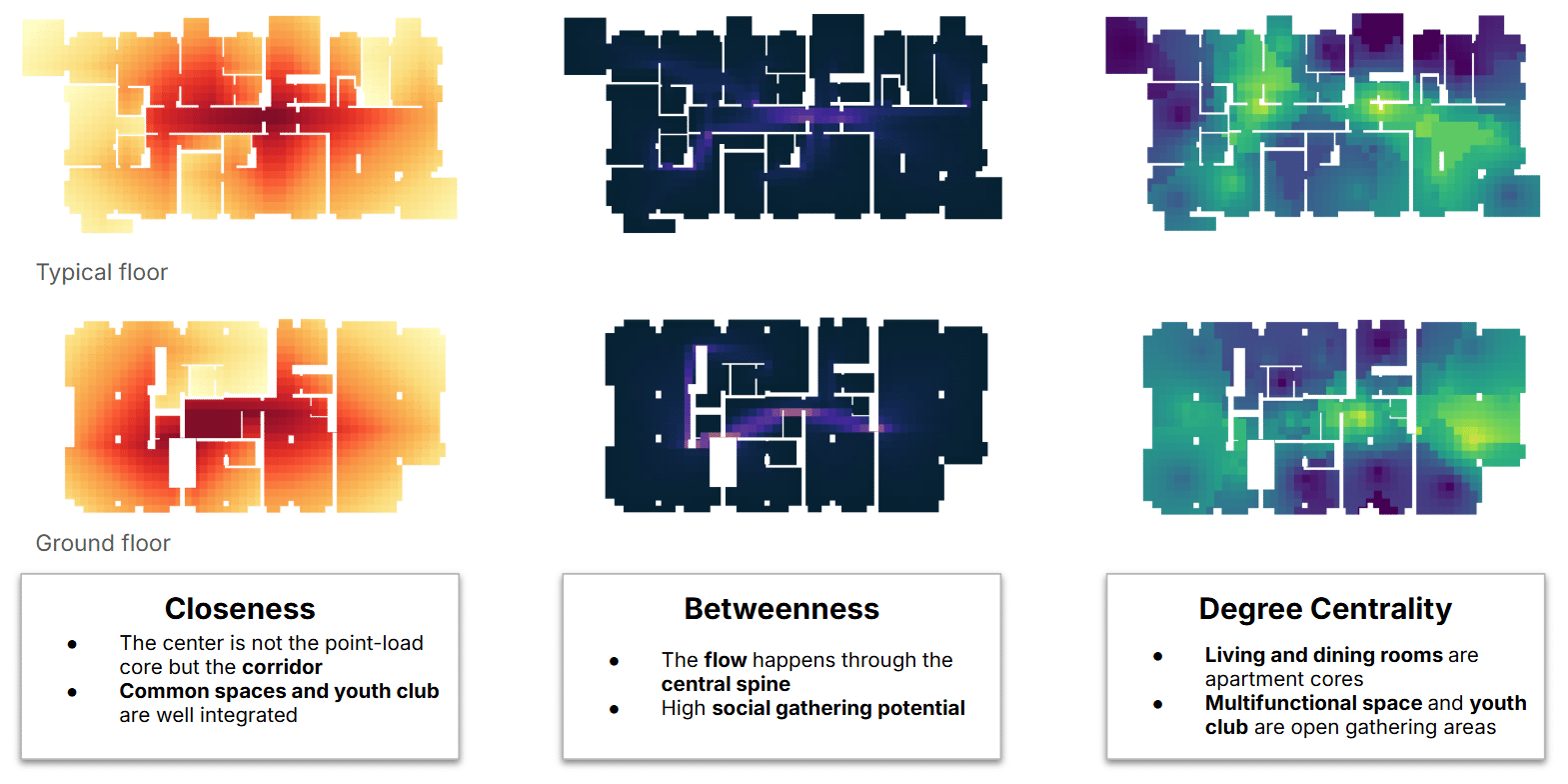
Closeness centrality shows that integration is shaped primarily by the corridor, which operates as the project’s main connective armature rather than relying on a single dominant core. This distributed structure keeps movement legible and evenly accessible across the plan.
Betweenness centrality further reinforces the corridor’s importance, revealing it as the critical flow path where routes converge and where the potential for informal social gathering is naturally highest. It becomes the spatial hinge through which most interactions are mediated.
At a more local scale, degree centrality highlights the living rooms and the multifunctional spaces on the ground floor as the strongest nodes of connectivity. These areas act as micro‑hubs within the broader network, supporting both everyday routines and spontaneous encounters.
Visibility & Movement
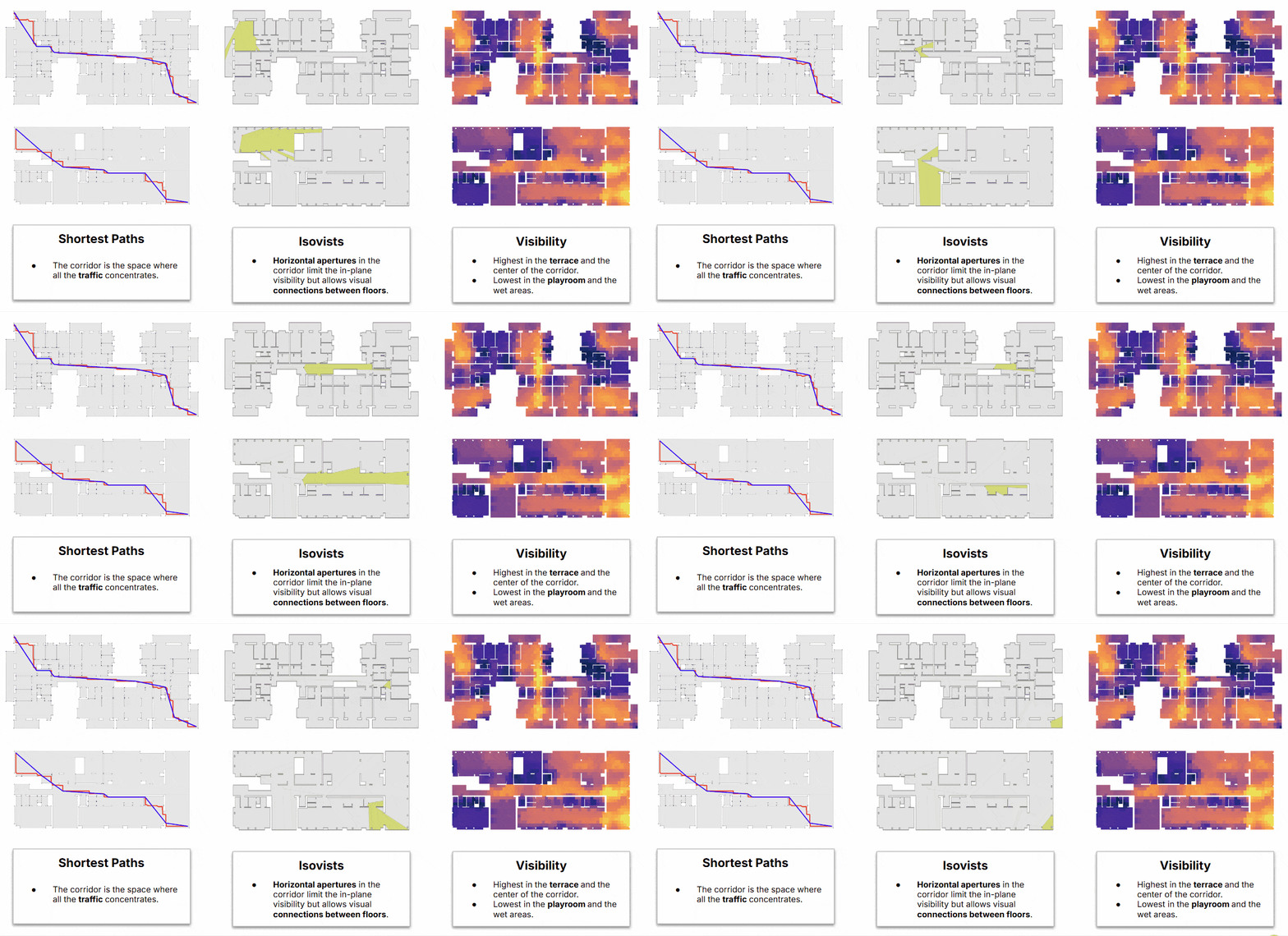
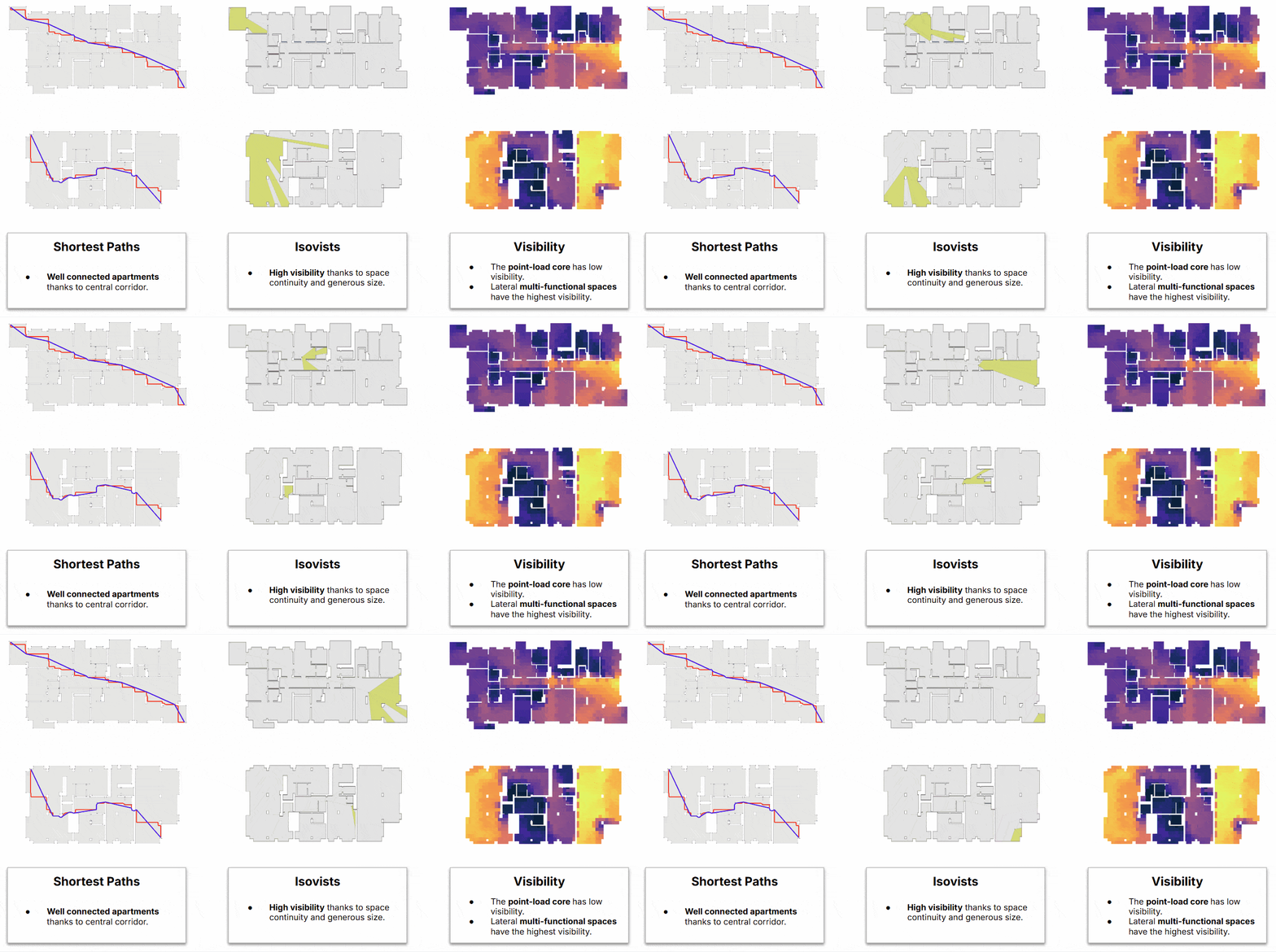
The shortest‑path analysis confirms that the apartments are well connected, with circulation efficiently routed through the central corridor. Isovist analysis adds another layer to this reading, revealing strong spatial continuity across the communal areas, where sightlines remain open and overlapping. Within this network, the lateral multifunctional spaces emerge as the most visible nodes, acting as visual anchors in the shared environment. By contrast, the point‑load core remains a visual blind spot, reinforcing its role as a purely functional element rather than a social or perceptual connector.
Conclusions
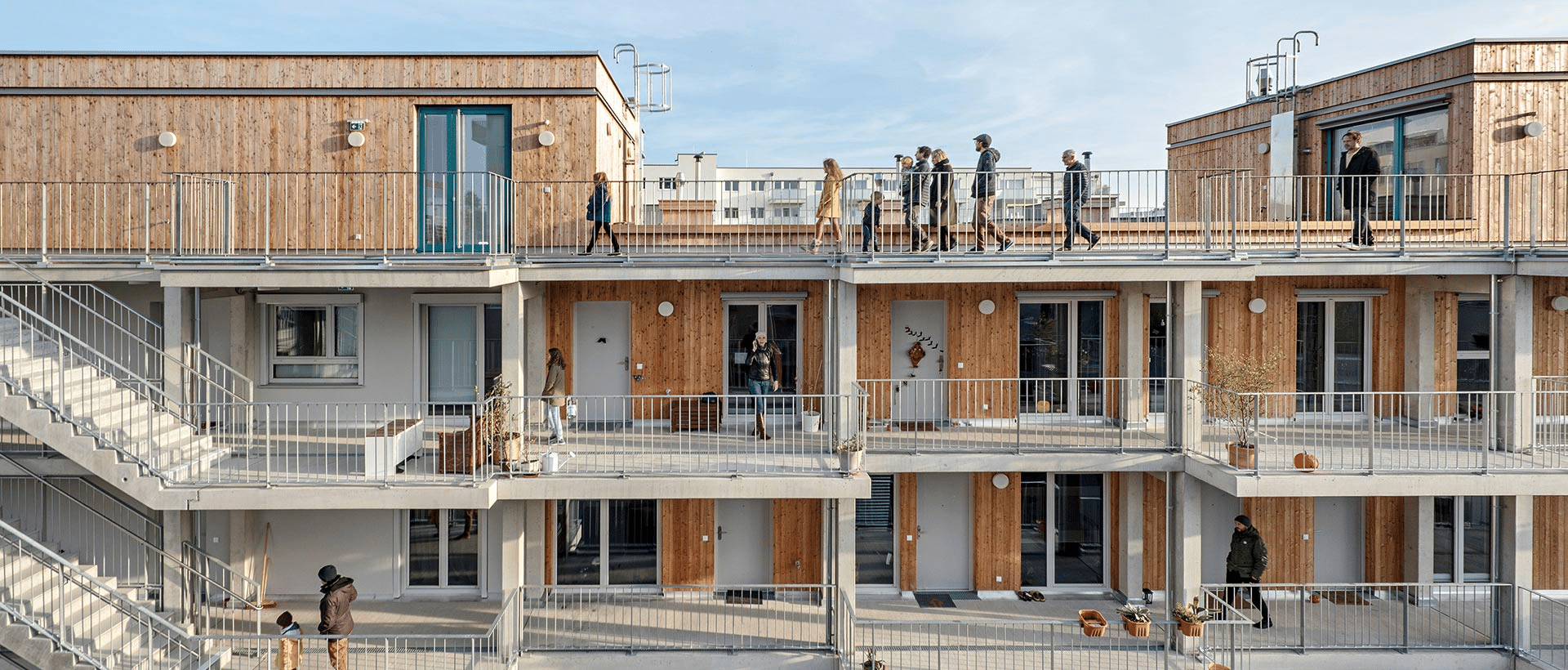
Across all three buildings, one pattern is consistent: high visibility and strong spatial connectivity are the conditions that enable social encounter. What differs is how each project achieves this through its circulation type. Among them, the single‑loaded corridor stands out for its social potential — channeling movement, maximizing chance encounters, and supporting visual openness.
The broader takeaway is clear: housing quality is shaped not only by the private unit, but by how circulation spaces connect residents to the shared life of the building. Spatial analysis gives us a systematic way to identify these opportunities and design for community, not just compliance.
Next steps
Looking ahead, the next step is to combine the analytical layers — centrality, visibility, and shortest paths — into a composite reading of the building. Identifying spaces that are both highly visible and highly central would highlight the most strategic points for design interventions such as seating, daylight openings, planting, or other micro‑amenities that encourage people to pause and interact. Correlating the metrics could further clarify which spatial conditions most strongly support social activity.
Extending the analysis into three dimensions would deepen this understanding, capturing how visibility and movement operate not only across floors but between them, especially in buildings with vertical apertures or multi‑storey communal spaces.
Finally, the analysis largely confirms what intuition already suggests, but with clarity and evidence. This reliability hints at broader applications: lightweight tools, interfaces, or apps that help non‑expert designers — or even residents — understand the social potential of circulation spaces and make more informed spatial decisions.
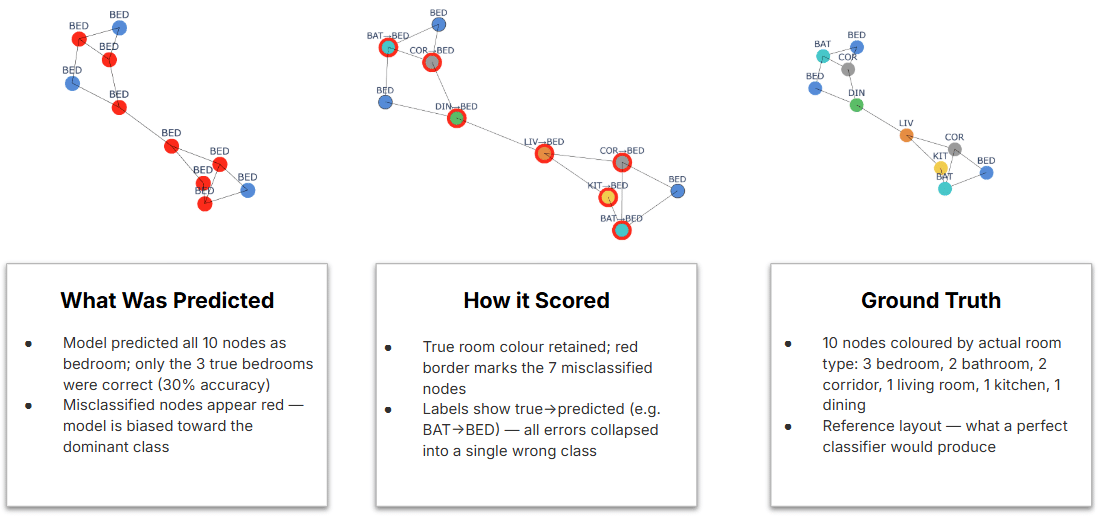
Appendix – Node Label Prediction Test
As an additional experiment, we tested node‑label prediction using the pretrained model from the modified Swiss Dwellings dataset. The model consistently misclassified all rooms as bedrooms. Part of this may be due to the fact that we modeled only a single apartment graph rather than the full floor‑level graph used in training. Another limitation is that all nodes in our test graph had very similar connectivity levels (nearly identical degree centrality), giving the model little structural variation to distinguish between room types. Since bedroom was the predominant class in the training dataset, the model defaulted to it when uncertain.
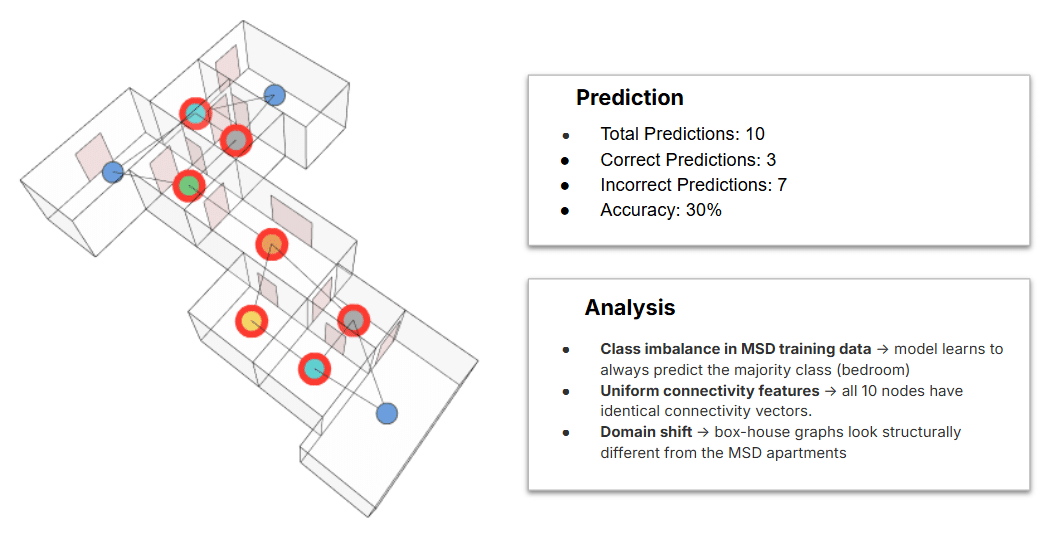
More fundamentally, the mismatch also reflects the different spatial logic of cohousing projects. Compared to the standardized Swiss layouts, these buildings feature larger apartments, weaker room hierarchies, and more open, fluid spatial configurations. The failure is therefore informative: it shows how pretrained models struggle when confronted with non‑typical, socially oriented housing typologies, and suggests that future work would require fine‑tuning or a dataset that better represents the diversity of contemporary collective living.