How intentional pauses in digital workflows improve accountability, decision-making, and collaboration in BIM practice.
There’s a particular kind of confidence that comes with a smooth workflow. Files transfer without errors, models update on schedule, clash reports run automatically, information moves. That feeling is satisfying. It can also be exactly what should make you pause
This project, developed for the BIM & Smart Construction Theory seminar, examines that tension through the concept of productive friction — intentional moments of pause within a collaborative BIM workflow that help teams make better decisions, maintain responsibility, and keep human judgment in the room. The argument isn’t that we should slow everything down. It’s that we should be deliberate about what we let run fast.
Friction, in this sense, is not inefficiency. It is a checkpoint.
Decisions Hide Inside Workflows
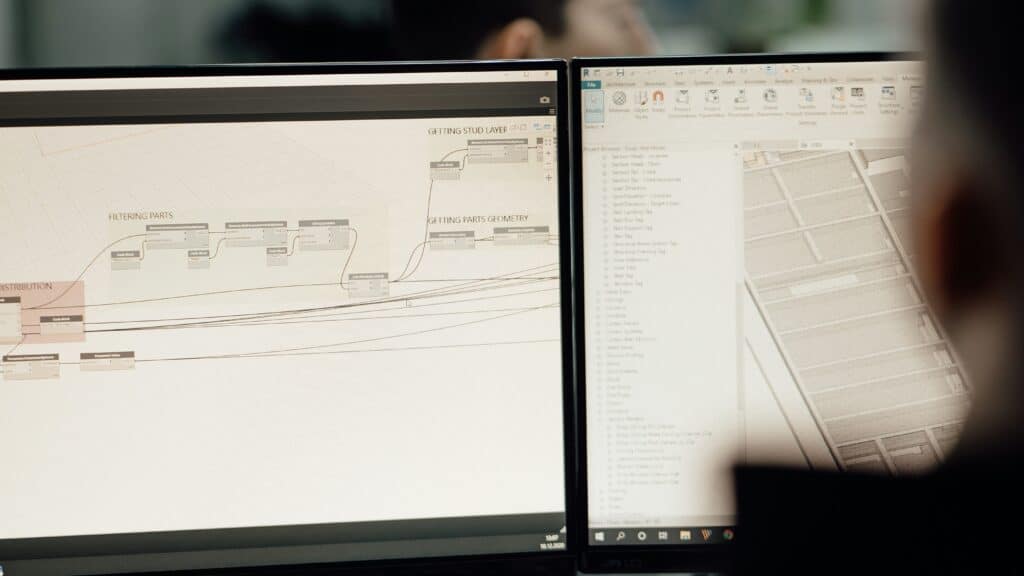
Important project decisions don’t happen only in meetings or formal sign-offs. In live BIM environments, many happen quietly inside the workflow itself.
They live in naming conventions, clash resolution sequences, update protocols, automation scripts, data filtering logic. In the moment, these feel like settings rather than decisions. But settings are decisions — and once a workflow becomes normalized, they become harder to see, harder to question, and harder to trace when something goes wrong.
The core question isn’t whether BIM tools work efficiently. It’s whether the people using them can still see where the judgment is happening.
What Productive Friction Actually Looks Like
The word friction usually implies drag — unnecessary steps, slow approvals, things that should be fixed. That kind of friction should be reduced. But there’s another kind.
Productive friction is a checkpoint placed at exactly the moment where a decision is consequential, difficult to reverse, or likely to compound if left unexamined. In practice:
- a confirmation before publishing changes to a federated model
- a named handoff between disciplines instead of a silent update
- a visual warning when geometry is built on incomplete assumptions
- a review gate before batch-approving clash resolutions
These are small interventions. Their purpose isn’t to slow the whole process — only the right moment.
Take clash detection. When an automated script proposes fixes and a coordinator approves them in bulk, the team has handed a coordination decision to an algorithm without reading it. If that decision is wrong, the problem surfaces later — and costs far more to fix.
Research Method: Conversations as Theory
This project used podcast interviews to test ideas against professional experience — not as documentation, but as a way to develop a grounded position from real practice.
One distinction kept emerging: some friction obstructs, but some friction clarifies. The most useful checkpoints aren’t bureaucratic obstacles. They’re moments that make authorship, responsibility, and judgment visible at exactly the point where automation might otherwise conceal them.
Why This Matters Now
Automation is essential. Repetitive tasks should be automated. Coordination checks should run continuously. Data should move efficiently. None of that is in question.
The issue is what gets automated alongside repetition. As AI tools generate options, classify issues, and propose solutions, workflows begin to automate not just checking — but deciding. The risk isn’t only that a tool might be wrong. It’s that teams no longer know where a decision was made, by whom, or on what basis.
Productive friction protects three things:
Accountability — making responsibility visible Traceability — making decisions understandable after the fact Agency — keeping human judgment genuinely present, not just formally possible.
Conclusion
BIM workflows shouldn’t aim for maximum smoothness at all times. They should be designed with intentional friction at the moments where unchecked automation could quietly undermine clarity, responsibility, or quality.
Smoothness can feel like progress. Often it is. But it can also become a kind of blindness — carrying teams too quickly through decisions that should have stayed visible, discussable, owned.
Not every pause is a problem. Some pauses are what make the work trustworthy. Friction isn’t the opposite of performance. At the right moment, it’s what makes performance reliable.