
Our project is Flux Façade, a collaborative workflow for data-driven parametric façade design.
The project was developed by Team 3.2 as part of the Collaborative Workflow Seminar in the Master in Advanced Computation for Architecture.
Flux Façade focuses on improving how environmental analysis and façade geometry interact within the design workflow.
Problem Statement
In large architectural projects, façade geometry is often driven by environmental data such as solar exposure.
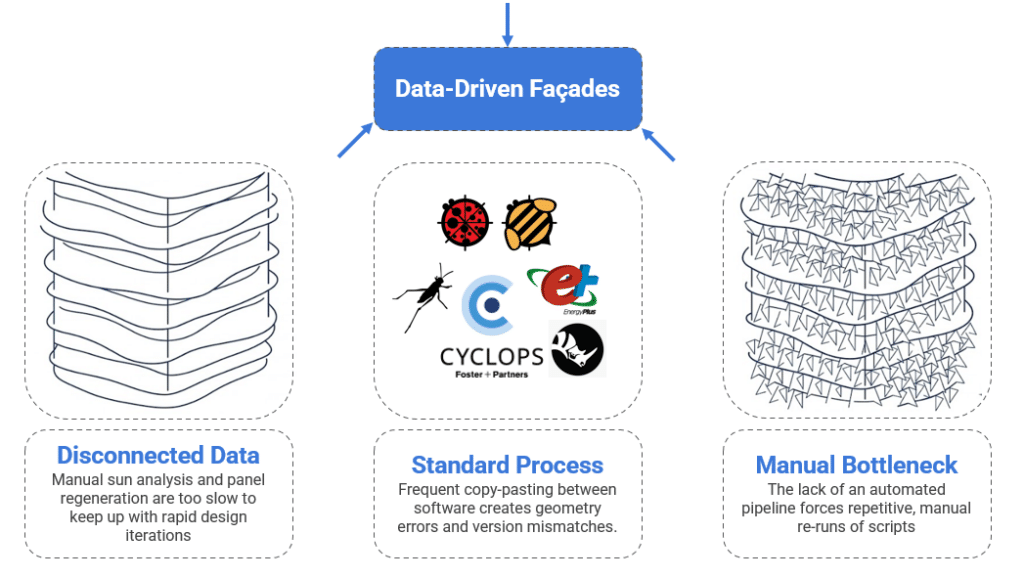
However, the current workflow is fragmented.
Designers frequently need to manually export geometry, run solar analysis scripts, regenerate panels, and then re-publish the results across different software platforms.
This process creates several issues:
- Disconnected data workflows
- Frequent manual repetition
- Geometry inconsistencies between versions
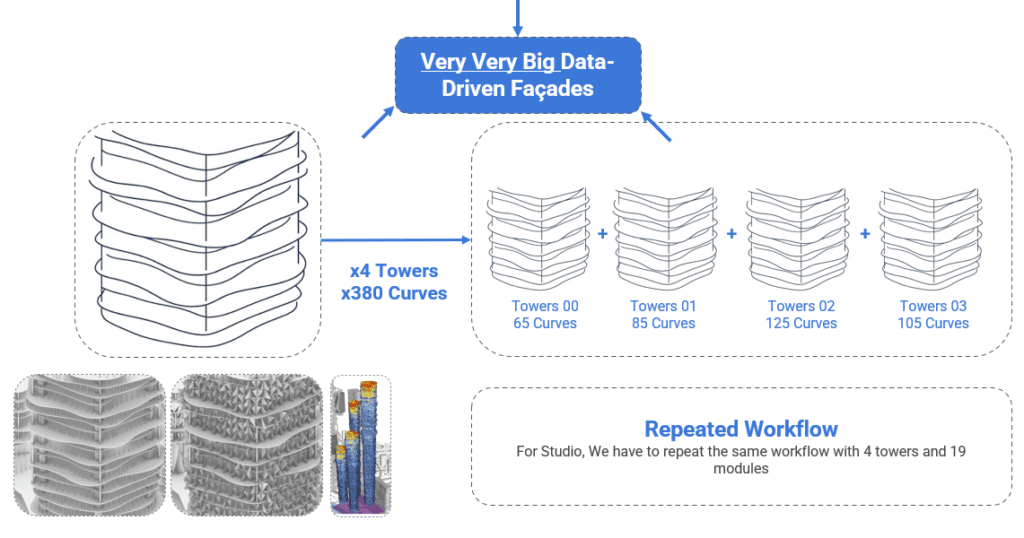
In our studio case, the façade design involves four towers and hundreds of curves, which must be repeatedly processed during design iterations.
This makes manual workflows inefficient and error-prone.
Target User
Our target user is the computational designer managing complex façade geometry.
In this context, the façade system is curve-dependent, meaning that even small geometric changes require recalculating panel geometry and solar exposure.
The designer must continuously coordinate between modeling tools like Rhino and Grasshopper, while also sharing data with environmental or analysis pipelines.
Flux Façade aims to automate this process so that designers can focus on design rather than data management.
Proposed Solution
Our solution is an automated pipeline that connects modelling, environmental analysis, and façade generation.
The system works with:
- Speckle input curves
- Speckle Automations for triggering processes
- Rhino Compute on a remote server
- Grasshopper scripts for solar analysis and panel generation
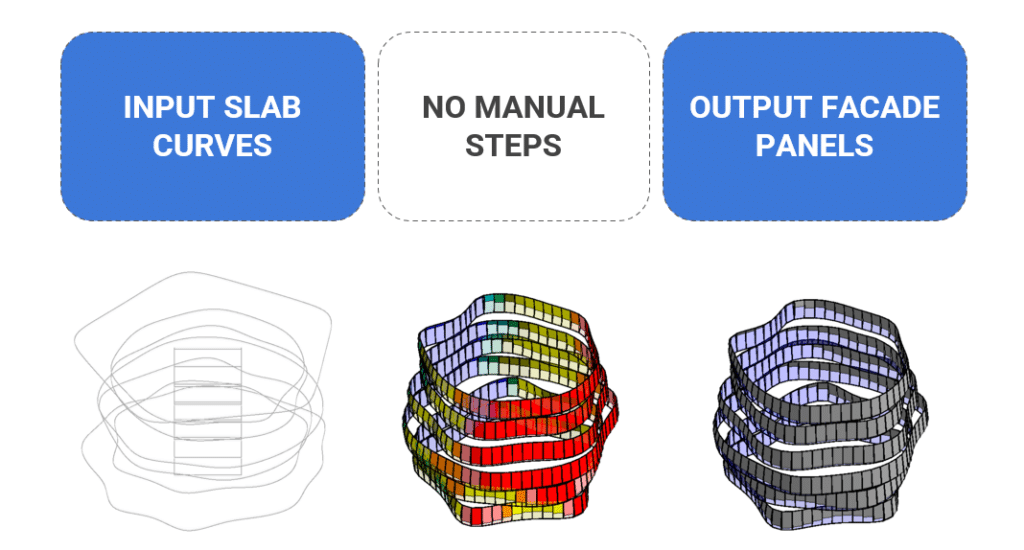
The goal is to create a system where curves can automatically generate façade panels without manual steps.
User Workflow
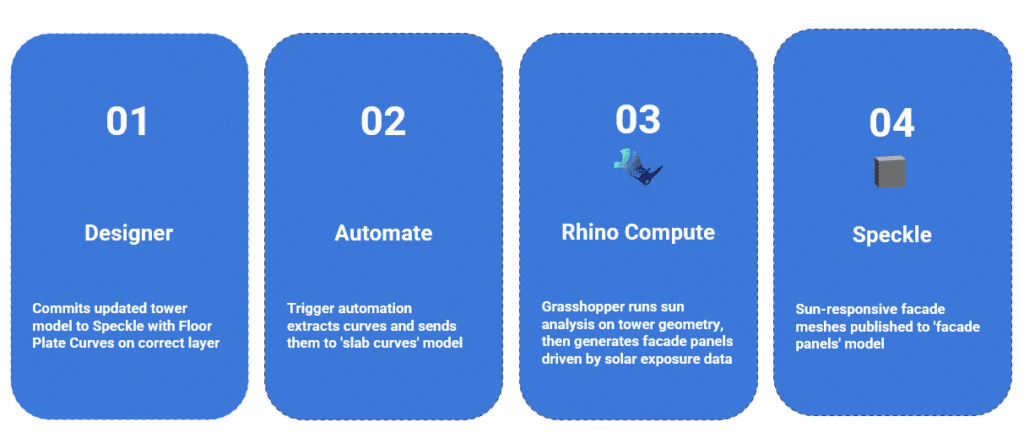
The workflow is divided into four steps.
First, the designer commits the tower model to Speckle, including the floor plate curves that define the façade geometry.
Second, a Speckle automation is triggered, which extracts these curves and sends them to a dedicated model for processing.
Third, the automation connects to the IAAC remote Rhino Compute server, where a Grasshopper script runs solar analysis on the tower geometry.
Finally, the generated sun-responsive façade panels are published back to Speckle in a new model.
How it works
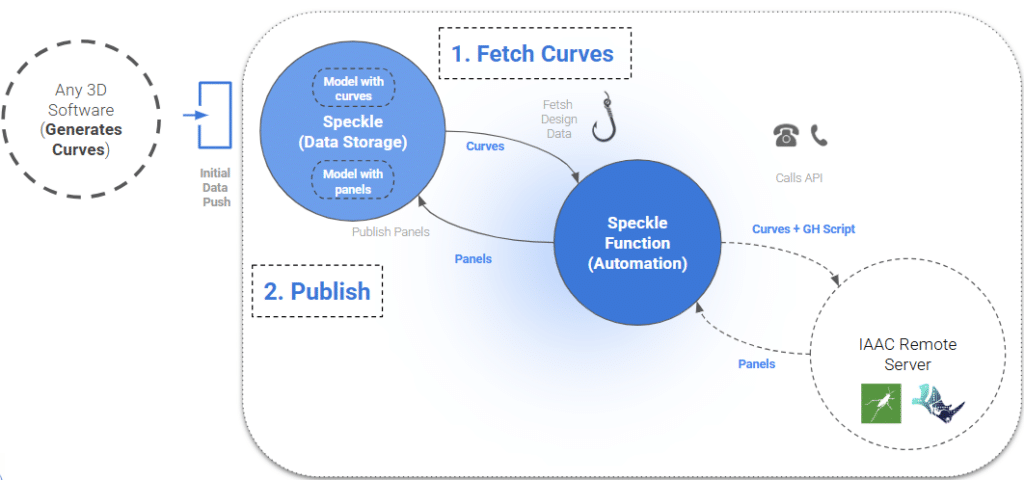
This diagram illustrates the system.
Any 3D software can generate façade curves and push them to Speckle, which acts as the central data storage platform.
Once the curves are committed, a Speckle function triggers the automated workflow.
The function calls the IAAC remote Rhino Compute server, which runs a Grasshopper script that processes the curves and performs solar analysis.
Based on this analysis, the script generates adaptive façade panels.
These panels are then published back to Speckle, creating a new model that contains the processed façade geometry.
This architecture allows the system to automate what would normally require multiple manual steps.
Evaluation
To evaluate the workflow, we considered both quantitative and qualitative metrics.
These include:
- Success rate of automated commits
- Processing time from model commit to façade output
- Scalability of the system
- Reduction of manual operations
- Accuracy of the generated façade panels
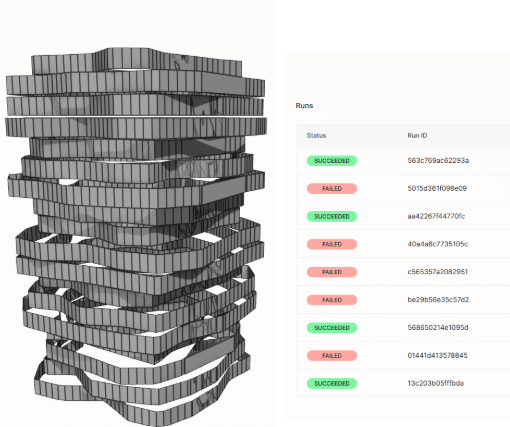
In our initial tests, we processed 15 curves successfully, while the full system target is over 300 curves across four towers.
Limitations and Future Work
The current version of the system has several limitations.
For example, large datasets can cause timeouts in Rhino Compute, and some geometry processing required workarounds due to data structure constraints.
In future versions, we aim to:
- Integrate full solar analysis pipelines
- Enable batch processing for large datasets
- Add parametric solar input controls
- Expand the system to process additional structural elements
These improvements would allow Flux Façade to scale to real architectural projects. And this workflow could be used with any Grasshopper output, making it a flexible approach.
