
MACAD 25-26 Theory Seminar Reflection
This essay reflects on my evolving understanding of the purpose of Artificial Intelligence in architecture, engineering, and construction following the Theory seminar at MACAD. Rather than attempting a comprehensive overview, it centres on a specific experience that crystallised broader implications about how these tools are restructuring design practice.
My initial assumption was that of AI making processes faster, treating it as an enhancement to existing methods rather than something that might fundamentally alter when and how design decisions happen.
The Shift
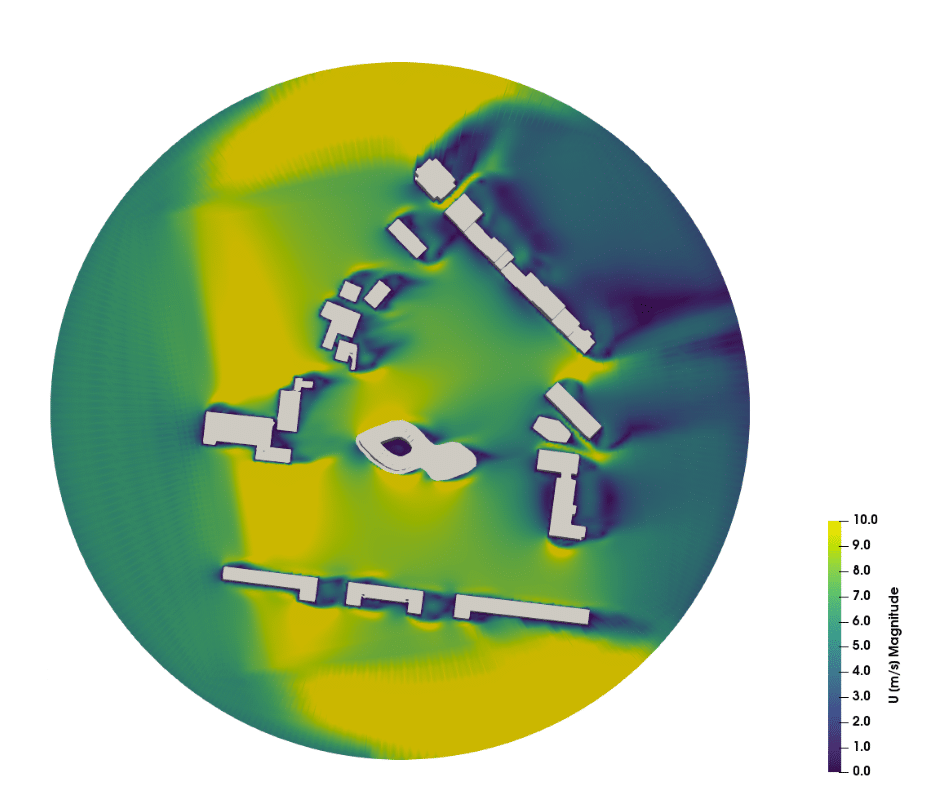
A project from Digital Tools for Environmental Analysis required testing wind comfort around a proposed urban development. Using the Eddy 3D plugin within Grasshopper, a standard CFD simulation required approximately eight hours for a single iteration. The output provided complete three dimensional vector fields showing airflow around every surface – detail necessary when pedestrian safety or structural loading informs design. Zhang et al. (2024) note that whilst such physics based simulations remain essential for validation, their computational cost pushes analysis into later design phases when geometric changes become expensive.
This eight hour wait seemed unavoidable until Infrared City was introduced. The tool employs machine learning models trained on existing CFD datasets to predict wind patterns in seconds. Research demonstrates how neural networks encode patterns from thousands of simulations, producing predictions almost instantaneously whilst maintaining 90 to 99% accuracy for comparative analysis.
Testing both methods on identical geometry revealed qualitative agreement – wind acceleration at corners, sheltered zones, flow through passages, but also limitations. Infrared City’s top down interpretation misses wind behaviour beneath overhangs, and it does not provide an option of analysing vertical surfaces as of now. However, for early stage comparative analysis, the 240 fold speed increase transforms what becomes testable. Rather than evaluating two or three options, I could test dozens in minutes, not days.

Pattern Recognition and Data Scale
The seminar revealed this pattern repeating across domains. Sergey Pigach from Thornton Tomasetti’s CORE studio demonstrated structural tools providing real time feedback on member sizing, tonnages, and embodied carbon. Their research indicates these accelerate early phases by 20 to 30% whilst enabling previously impractical coordination.
Beyond speed, these tools address data scale. Modern construction projects generate vast information quantities that exceed human cognitive capacity to process manually. This is where AI becomes crucial – it can analyse historical project data to identify patterns in delays and resource inefficiencies, enabling predictive decisions impossible through manual analysis. In design, AI evaluates thousands of variants against multiple performance criteria simultaneously, identifying optimal trade offs no human team could manually coordinate.
Before the seminar, I saw AI as an assistant speeding up processes. After engaging with these tools and hearing from practitioners, the reality became clearer – AI enables vastly more informed decisions at every stage, particularly at initial stages when flexibility is maximal and changes cost least.
Accountability and Professional Responsibility
Luca Belli, a guest lecturer from Twitter’s Machine Learning Ethics, Transparency, and Accountability team, emphasised that neural networks inherit whatever biases their training datasets contain. If structural tools train predominantly on North American or European projects, recommendations for different contexts may fail catastrophically. Practitioners remain legally accountable regardless of algorithmic involvement.
Deep neural networks function as black boxes – when AI recommends a particular system, the rationale may not be accessible for audit. In my view, informed by the seminar discussions, until we achieve Artificial General Intelligence (if we ever do), AI remains fundamentally a tool. It transforms professional roles from producing all work manually to managing, interpreting, and validating AI outputs, but responsibility stays with the licensed professional.
This demands heightened expertise. Professionals must understand data provenance and limitations, recognise when outputs reflect training bias, maintain competency to independently verify results, and defend every recommendation beyond “the algorithm suggested this.” We need to come as close as possible to understanding the processes behind AI tools because we remain accountable for outcomes.
Conclusion
The purpose of AI in AEC is to enable vastly more informed decisions at every stage by compressing analysis time and processing data at scales beyond human capacity. My experience comparing eight hour CFD simulations with seconds-long AI predictions illustrates how critical decisions can migrate from late stage validation to early exploration when changes remain inexpensive.
I envision a future of hybrid practice where professionals define constraints, interpret results, and make decisions amongst AI generated options. Understanding which data to trust, when recommendations generalise appropriately, where bias may distort outputs, and when human judgement must override computation becomes central to competent practice. AI changes which questions become practically askable, but responsibility for the answers remains fundamentally human.
References
- Zhang, H., et al. (2024). Generative artificial intelligence in built environment design: A review. ScienceDirect.
- Otani, R. (2024). The AI Revolution in AEC. Design Intelligence Quarterly.
- ESANN. (2025). Artificial Surrogate Model for Computational Fluid Dynamics.
- Infrared.city. (2024). SvN Architects: Optimising Urban Wind Comfort.
- ShapeDiver. (2025). CORE studio: Scaling Computational Design at Thornton Tomasetti.
