
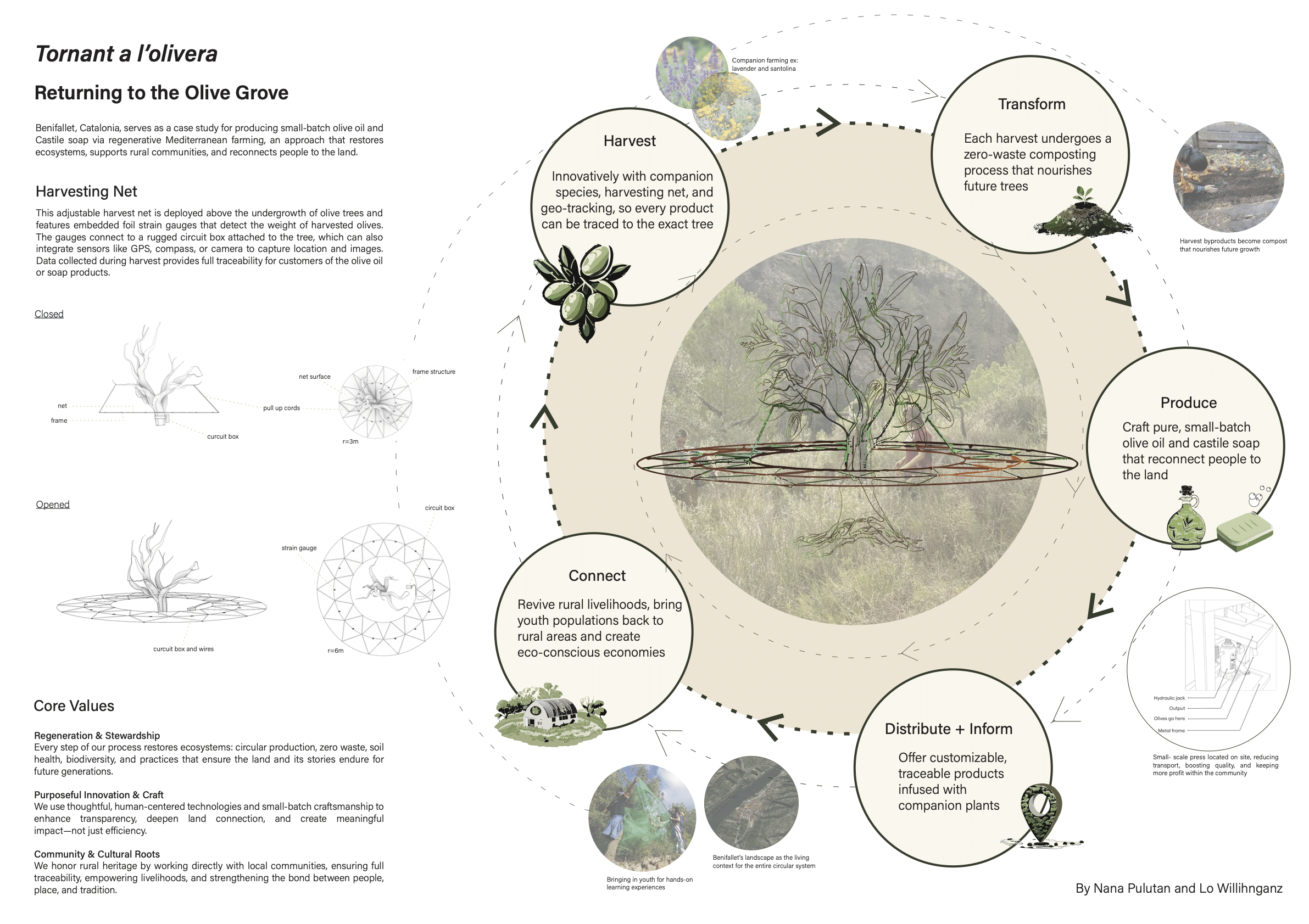
Tornant a l’olivera was born from a simple belief: that the most nourishing products come from landscapes that are alive, respected, and cared for.
Based in Catalunya, we work with regenerative olive groves where resilient olive trees coexist with aromatic undergrowth—lavender, rosemary, and native plants that strengthen ecosystems and shape the character of each harvest. From these living landscapes, we craft small-batch extra virgin olive oil and handmade Castile soap—pure, customizable, and fully traceable.
Our work sits at the intersection of tradition and innovation. We honor Mediterranean olive culture while using carefully designed technologies that help us harvest gently, process fresh, and share every product’s story with honesty.
Tornant a l’olivera exists to reconnect people to the land—and to help rural communities thrive again.
Mission
We harvest sustainably and innovatively so that every customer can trace their product to the exact tree where it began. Through our circular bioeconomy practices, and zero-waste approach, we transform every harvest into nourishment: from premium oils and soaps to compost that feeds future trees.
We honor nature by offering customizable, traceable products—strengthening ecosystems and deepening the story behind each bottle and bar. We champion regeneration, innovation, and a return to our roots, creating meaningful livelihoods that draw young people back to rural farmlands and co-create vibrant, regenerative and eco-conscious local economies.
Vision
Our vision is a world where nothing is wasted, every action restores life, and every connection—between consumer and land, innovation and heritage, past and future—helps build resilient, flourishing ecosystems for generations to come.
Core Values
Regeneration & Stewardship
Every step of our process restores ecosystems: circular production, zero waste, soil health and biodiversity practices that ensure the land and its stories endure for future generations.
Purposeful Innovation & Craft
We design thoughtful, human-centered technologies and small-batch craftsmanship to enhance transparency, deepen land connection and create meaningful impact, not just efficiency.
Community and Cultural Roots
We honor rural heritage by working directly with local communities, ensuring full traceability, empowering livelihoods, and strengthening the bond between people, place and tradition.
Product Innovation
Smart Harvesting Systems for Regenerative Olive Groves
We pioneer the use of intelligent harvesting nets designed specifically for multilayered, regenerative olive groves. Our groves integrate olive trees with companion plants such as lavender and rosemary, which serve as: (1) natural pest deterrents, (2) soil and biodiversity enhancers, and (3) aromatic inputs for downstream soap formulations. Our harvesting net has an adjustable diameter to fit the diameter of the olive tree and can be deployed without damaging the companion plants growing under the tree.
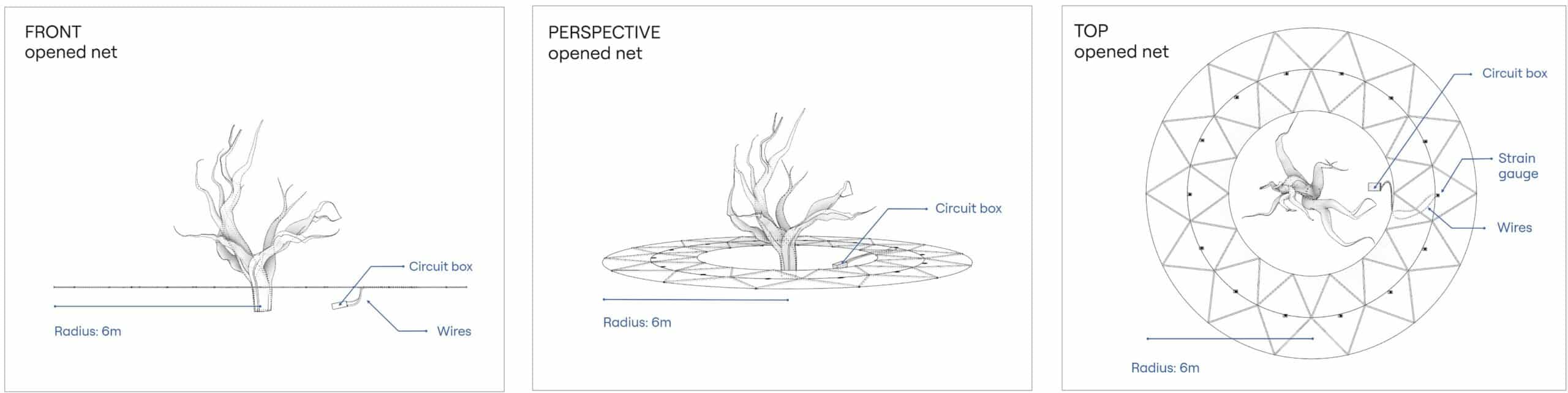
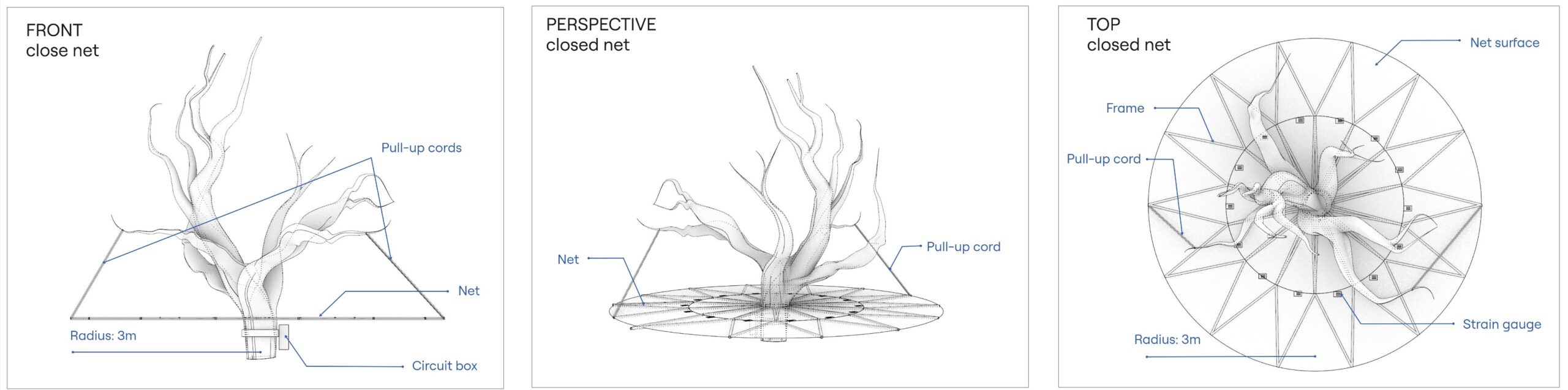
Embedded on the net’s surface are foil strain gauges that change resistance in response to mechanical stress—such as the weight of the harvested olives. The strain gauge and other sensors connect to a rugged circuit box that can be secured to the tree trunk during harvesting. Overall, our deployable harvesting net features:
- Integrated weighing system to measure yield per tree;
- Geotagging to precisely locate harvest origin; and
- Imaging and environmental sensors to assess fruit quality, grove conditions and possibly document other wildlife.
Our system enables data‑driven transparency, allowing us to optimize harvest timing for quality, not volume. It also allows us to maintain small, fresh batches and provide customers with verifiable provenance data, offering full traceability throughout the harvesting process.
Portable Olive Pressing for Fresh, Small Batches
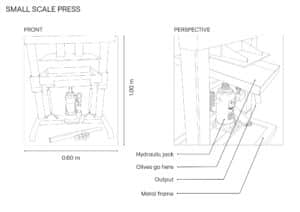
Unlike conventional olive oil production that relies on centralized, large‑scale mills, Tornant a l’olivera uses portable olive presses deployed directly at or near the grove. This approach minimizes time between harvest and pressing, and preserves polyphenols, flavor, and nutritional integrity. It also reduces transport emissions and oxidation risk. The result is exceptionally fresh extra virgin olive oil, processed at human scale, aligned with both quality and ecological responsibility. Figure 3 shows a design for a low-cost small-scale olive press based on the commonly-used coconut press in Southeast Asia.
Customizable Castile Soap
Tornant a l’olivera Castile soaps are produced using fresh, traceable olive oil from our partner groves. Our soaps are:
- Fragrance‑free by default, as most fragrant oils used (even naturally extracted options) can be too strong for people with sensitivities;
- Customizable for sensitive skin and specific needs; because each customer is considered unique; and
- Free from synthetic additives, preservatives, and colorants that harm our body and our planet.
Customer Experience & Education
Farm Visits & Workshops
Tornant a l’olivera headquarters and partner farms are open for scheduled visits, allowing customers to witness harvesting and pressing, participate in soap‑making workshops, and learn about regenerative agriculture and skin health.
Zero‑Waste Refill & Reuse
Our products are available through refill systems. We sell by mass or volume with minimal to no packaging—advocating the culture of “bring your own reusable container” so that single-use packaging will one day become obsolete.
Target Market
Our target market are well‑educated, health‑ and eco‑conscious women aged 25–45 who read ingredient labels and value transparency, simplicity and authenticity. They are often affected by allergies, sensitivities, auto-immune diseases, or other lifestyle‑related illnesses.
Psychographic Profile
Our target avatar buys organic and whole foods, investing in quality over quality. She supports local producers and artisans. She values self-care, and despite her demanding career, she understands that rest and relaxation is a part of productivity. She attends retreats and nature‑based experiences. And she is fed up with greenwashing in the food, health and self-care industry.
Competitors
Carapelli Italian Extra Virgin Olive Oil
- Uses blockchain technology for traceability with QR codes
- Sustainably produced, supports local farmers
Consortium for the protection of Toscano PGI extra virgin olive oil
- A consortium of about 9,000 olive oil producers that use a seal with QR codes that serve as a digital passport with information from the plant to the bottle, for a true product identity.
LUSH: Fresh Handmade Cosmetics | Vegetarian & Cruelty-Free
- Available worldwide, offers a wider range of skin care products
- Does not offer extra virgin oils
- Committed to traceability but not down to the tree-level as ours
- No customization
- Uses a lot of fragrances
Ku.tis Skincare by Cero Residuo: Zero Waste Online Store
- Offers all kinds of zero waste products, not just soap
- No traceability
- No customization
Jabon de Mallorca – artisanal soap; no traceability; no customization
Value Proposition
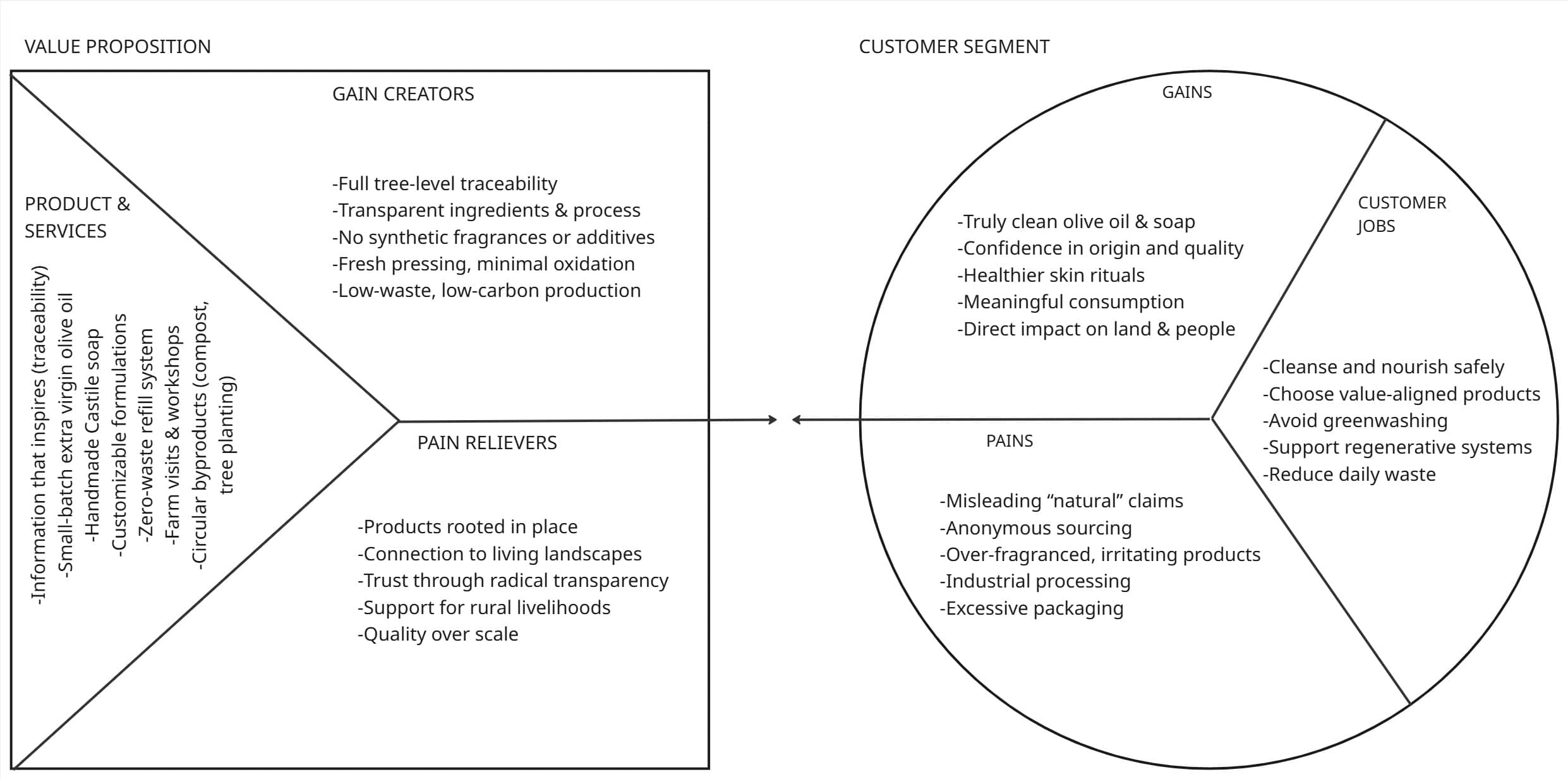
Full Traceability
Every bottle and bar carries a story: where it was grown, when it was harvested, how it was processed, and who made it. This is transparency—not as a claim, but as a practice.
Tornant a l’olivera is an invitation—to return to our roots, to care for the land, and to choose products that give back more than they take.
Why Traceability Matters
In a world where most products are anonymous, traceability restores trust.
At Tornant a l’olivera, every bottle of olive oil and every bar of Castile soap can be traced back to the exact tree, grove, and harvest that created it. This means you know not only what you are using, but where it came from, how it was grown, and who cared for it.
Traceability protects quality—ensuring our oils are freshly pressed and our soaps are crafted in small, transparent batches. It protects health—by eliminating hidden ingredients and unclear processing. And it protects the land—by making regenerative practices visible, accountable, and worth sustaining.
When you choose a traceable product, you are not just buying something pure. You are supporting living landscapes, fair livelihoods, and a system where nothing is hidden and everything is valued—from soil to skin.
Traceability is how we reconnect consumption with care; and products and people with place.
Business Model
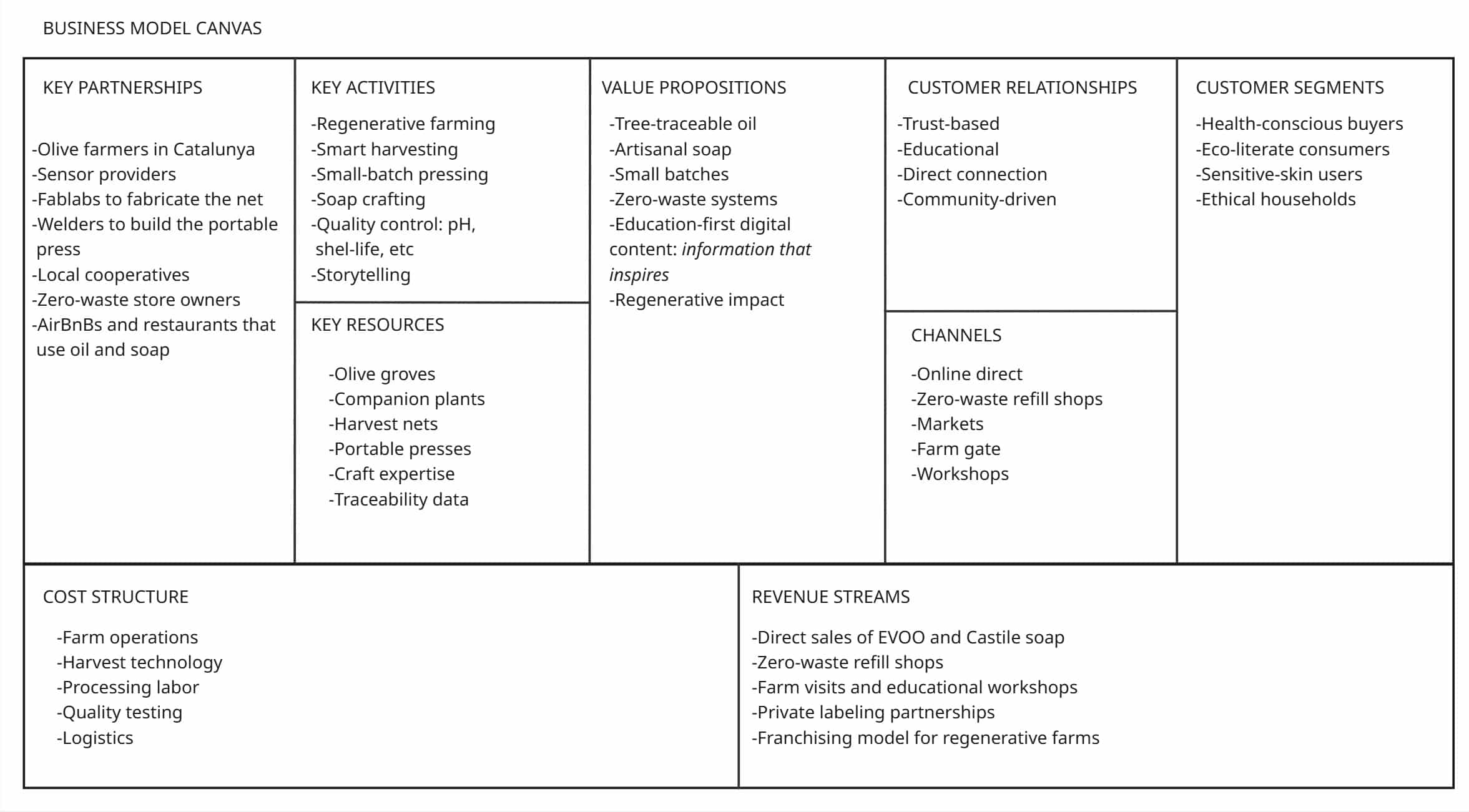
Franchising & Decentralization
Instead of expanding on our own, we choose to partner with other regenerative farms to maintain proximity to raw materials and reduce transport emissions while strengthening rural economies. We maintain quality and company culture by licensing our production systems and standards.
Revenue Attraction Plan
We dial down our target avatar and focus on education‑first digital content. We partner with aligned retailers and practitioners and build community trust through word-of-mouth. To get evidence-based data on what works on which target market, we design tests that allow us to quickly and least costly iterate through the Build → Measure → Learn feedback loop.
Operations & Quality Control
We operate on a human‑scale system design. We partner with laboratories to monitor pH, shelf‑life, and oxidation levels of our products. We document procedural manuals and quality standards and strive for continuous improvement through data and feedback.
Scaling & Exit Strategy
We streamline our systems at source farms. We scale our impact through franchising, not mass industrialization. Tornant a l’olivera is not designed to industrialize—it is designed to become replicable, resilient, and rooted.
Our goal is to transition leadership out of daily operations within 18 months (*fire ourselves*).
Who We Are
Co-founder and Interim Chief Troublemaking Officer (iCTO)
Nana Pulutan
Nana is an RF engineer with an unconventional résumé that somehow includes instrumentation, machine learning, permaculture, and zero-waste practice. Among her questionable life choices is pivoting from designing satellite and radar systems for disaster and extreme weather mitigation to designing built environments that work with nature to weather those same disasters. As her relationship with food and life became more intentional, her idea of “efficiency” shifted from industrial scale and speed to regenerative efficiency and seasonal rhythms. She likes spending time either in deep forests or deep waters, presumably because both tolerate entropy better than deep learning algorithms do. She is clumsy, disorganized, and impressively bad at exercising common sense. Never let her run a company.
Co-founder and Chief Olive Oil Officer (COO)
Lo Willihnganz
Lo is responsible for making sure things exist at all, and preferably in the right order. They have a long-standing suspicion of titles, but tolerate this one because it involves olives. Their background is an accumulation of practical skills, half-finished theories, and an unreasonable commitment to doing things carefully. Lo tends to focus on the unglamorous parts of work: noticing what’s missing, asking inconvenient questions, and keeping projects tethered to reality. They believe good work should feel steady, honest, and slightly boring in the best way. When not attempting to keep Tornant a l’olivera from drifting into pure abstraction, Lo can usually be found somewhere between a notebook, a kitchen, and a grove, quietly making sure nothing important is being ignored.
Faculty
Jon Minchin
Oliver Needham
