
Cities are often described in terms of movement. We often tend to move through them in familiar loops – leaving home to catch the metro, commuting to work, coming back in the evening, running errands, going to appointments. Over time, these repeated paths shape how we think about urban space and can seem to define our entire relationship with the city.
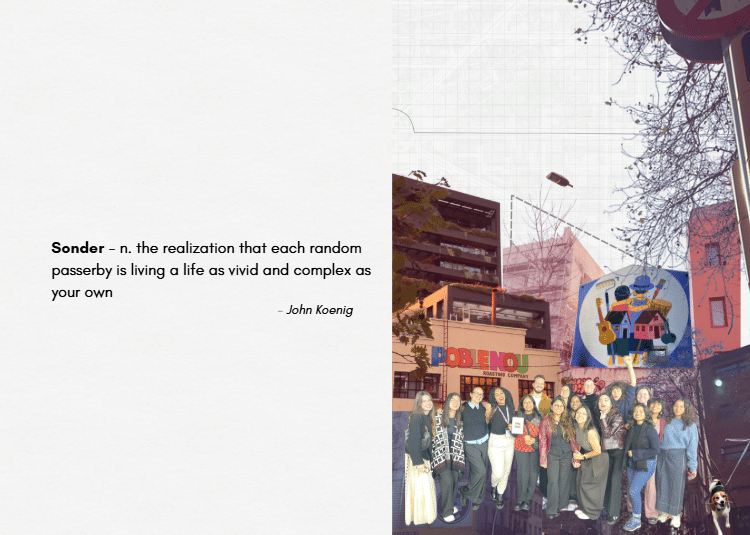
But, as we observed everyday life unfolding on the streets, we started to question this simplicity. And we were hit by “Sonder”, this realization that every passerby is living a life as vivid and complex as our own. This idea led us to explore just how many different experiences can be created within the same physical space.
And this shifted our attention from movement alone to the emotions, memories, and sensory impressions that shape how places are felt, remembered, and imagined
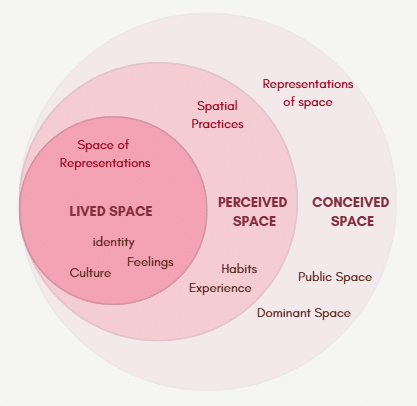
These reflections connect closely to the ideas of Henri Lefebvre, who believed that space is something we shape through our everyday lives. He explained this through three connected ways of understanding space.
Conceived space (how places are planned and designed by architects, planners, and institutions), Perceived space ( how we use the city in our daily routines) and Lived space (how places make us feel, what they remind us of, and the meanings we attach to them) .Even though our work focuses on lived space, these three ways of experiencing space are always connected.
Our initial idea was to conduct semi- formal interview with locals to understand their deep, personal connections to Poblenou over time. However, with limited time and resources, reaching a wide variety of people proved challenging, which might have compromised the depth of our insights.
Rather than viewing this as a limitation, we pivoted to what was feasible. We realized our own group—young women new to the neighborhood, students sharing the same timeline—served as an ideal focus. We developed our relationship with Poblenou collectively through shared routines and emotions. This method also brought key advantages: easy access, established trust, and candid sharing of experiences.
That brought us to our research question: How does a group of young, international female students construct Poblenou as a lived space which emphasizes the construction of meaning.
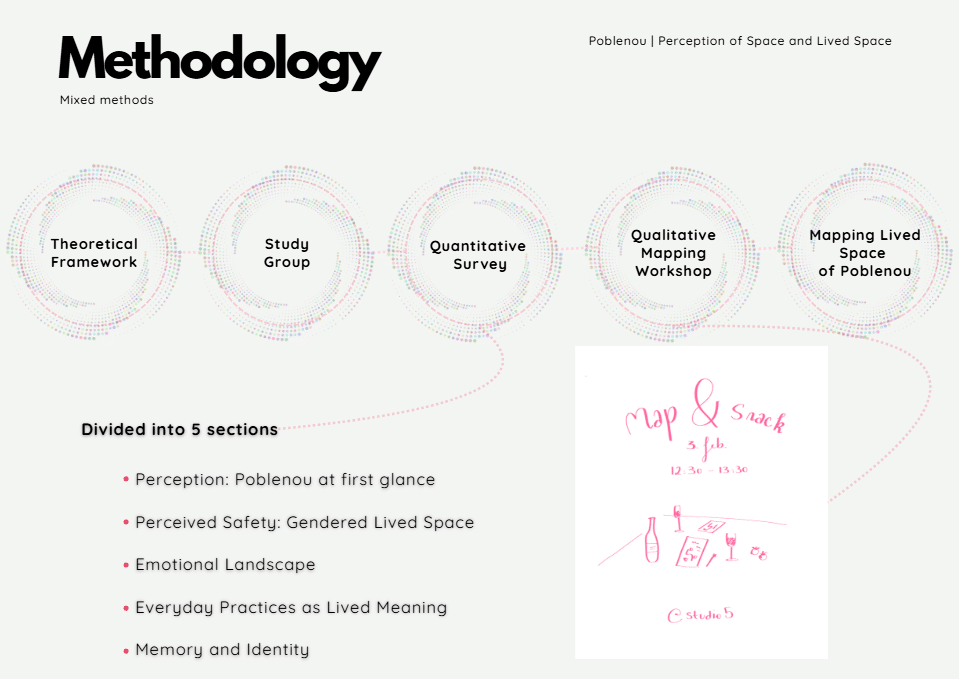
To address our research question, we put together a mixed-methods setup blending numbers and stories. We started off with a structured survey to spot common threads in how we saw things, felt, and sensed the place. The survey was organized into five interconnected sections reflecting dimensions of lived space:
- Perception: Poblenou at first sight
- Perceived Safety: Gendered experiences
- Emotional Landscape
- Everyday Practices as Lived Meaning
- Memory and Identity
Next came a group mapping workshop to sketch out our symbolic and imaginative takes on the space. Together, these let us dig into how everyday habits, feelings, and chats with each other create lived space. In the end, we turned our experiences of Poblenou into a collective map with geospatial flair.
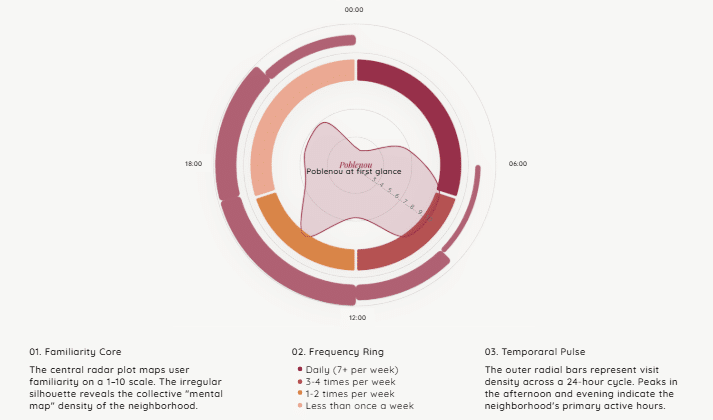
Our survey shows most of us are in Poblenou every day, especially afternoons. The “familiarity core” spreads out to the edges, where we all feel pretty connected . Visits pick up after midday and keep going into evenings. Overall, it shows Poblenou isn’t just a pass-through spot; it’s where we actually spend time and feel at home.
Perception
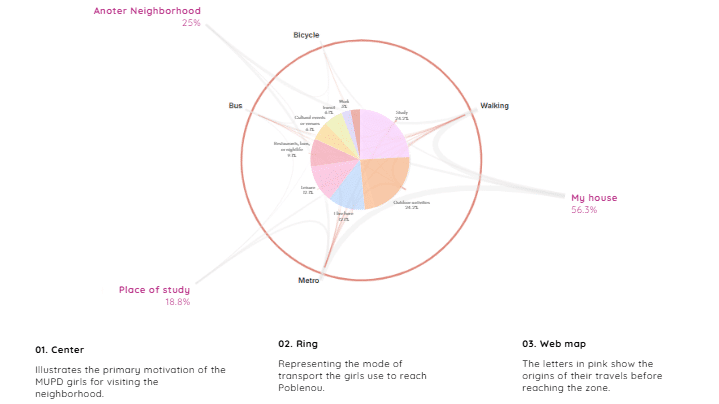
The diagram layers three things: why we come to Poblenou (studying and outdoor stuff at the center), how we get in (walking for full immersion, metro for key spots, biking in between), and where we start from (not everyone lives close). Even with those differences, our repeat trips build familiarity and attachment. Routes turn into meaningful paths, spots into personal landmarks. That’s how familiarity shapes lived space—shared city bits become our neighborhood, then part of collective memory.
Perceived Safety
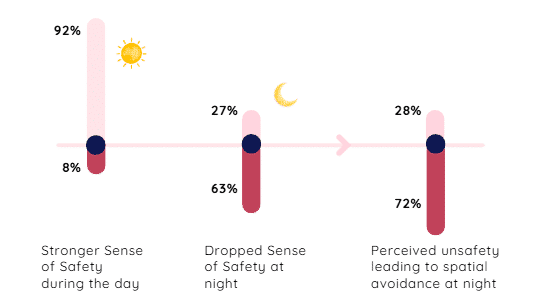
This diagram shows how perceptions of safety change over time. During the day, 92% of participants reported feeling safe, while at night this drops to just 27%, with 63% feeling less secure. Although the physical space remains the same, its meaning shifts with lighting, activity, and social presence. Notably, 72% said that feeling unsafe at night leads them to avoid certain streets and routes. These places remain accessible, but become emotionally restricted. In the terms of Henri Lefebvre, this reflects how lived space is shaped by experience and context. For our group, Poblenou is not one fixed place, but a set of changing emotional landscapes between confidence and caution.
Emotional Landscape
When we asked about emotional connections, Poblenou suddenly became full of color. Participants associated it with everyday sensations—the smell of coffee and sea air, the sounds of construction and parrots, graffiti, cafés, chimneys, and the symbols emerging from creative spaces. These small, ordinary experiences form a shared symbolic language of the neighborhood. Space is not only seen, but also smelled, heard, and emotionally interpreted. Through these sensory and symbolic associations, Poblenou becomes more than a location—it becomes a place shaped by memory, imagination, and collective feeling.
Habits
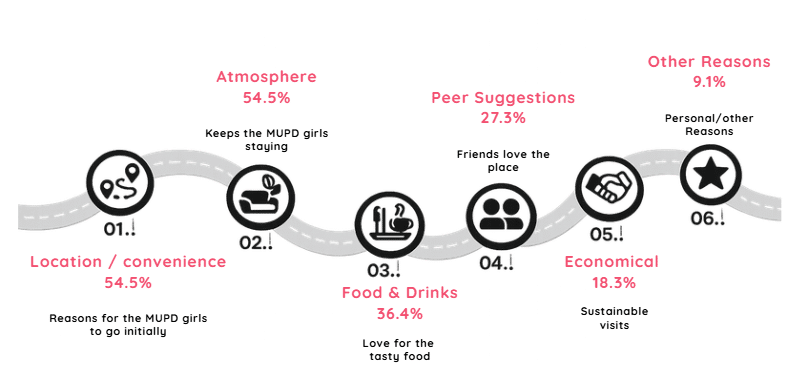
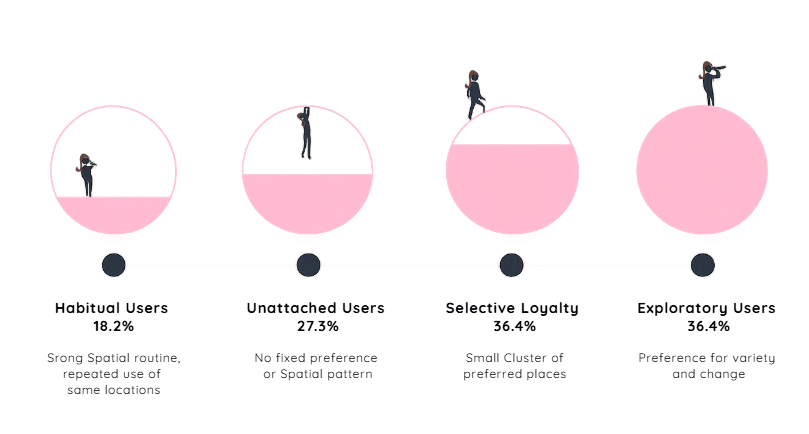
We found that participants connect to Poblenou through “their” favorite spots—places they return to because of comfort, atmosphere, recommendations, or convenience and through repeated visits and flexible routines, these spaces gradually become personal, meaningful parts of their everyday lives. These habits show how belonging is built slowly through everyday use rather than fixed schedules. Over time, familiar routes and favorite places shape a personal map of the neighborhood, turning shared public spaces into lived, emotional territories.
Memory and Identity
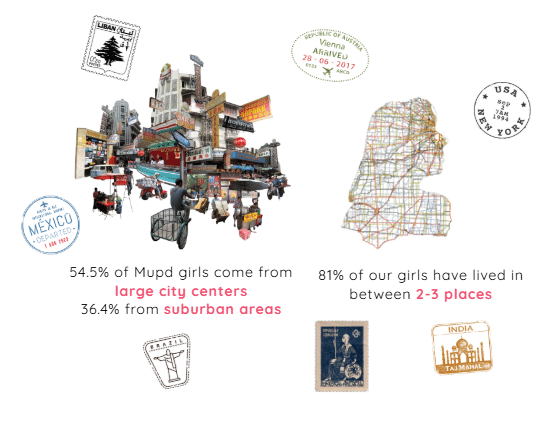
Next, we looked at who our participants are and where they come from. Their previous living environments—whether dense cities, small towns, or rural areas—shape how they experience and claim space in Poblenou. Similarly, living in different cities or countries influences their adaptability and openness. Those who have moved frequently often relate to places differently from those who are more locally rooted.
In short, the places people visit, the habits they form, and the routines they follow are deeply connected to their personal histories. Space is not just physical; it is relational, shaped by movement, memory, and meaning. It is no surprise, then, that Poblenou feels so familiar to us—constantly changing, fresh, and full of multicultural energy,
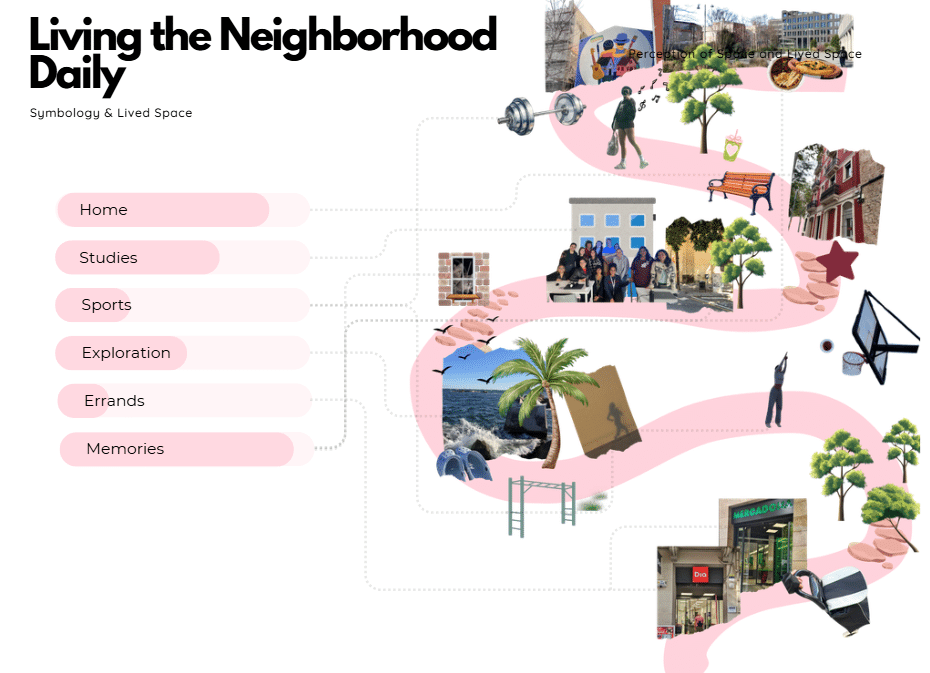
Now to view Poblenou from the eyes of the resident, we asked one of the participants who lives in the area to share her experiences. For her, living in Poblenou, the neighborhood is more than just streets and buildings—it is part of her everyday life. Her home gives a sense of stability, while studies, sports, and errands shape familiar routes and routines. At the same time, moments of exploration and small discoveries keep the place alive and evolving. Over time, memories turned what was once unfamiliar into something deeply personal. She longer just moves through this space—but feels connected to it and responsible for it. Through these daily, emotional, and creative layers, Poblenou has truly become her home.
Conclusion
Overall, we deeply valued this research process, as it helped us better understand what lived space truly means. Our question at the beginning was – How does a group of young, international female students construct Poblenou as a lived space? And although there is no one way to answer this question, we feel like we have moved closer to identifying the things that make this place, and specifically this street our common experience of Poblenou. Through symbols, emotions, memories, routines, and laughter, we have collectively created meaning in this place. Poblenou, for us, is not just a location, but a lived and evolving environment shaped by everyday life.
