PROBLEM: Current urban investment decisions, particularly in social housing, are largely based on financial feasibility studies, static socio-economic indicators, and ESG-style metrics that fail to capture how people actually experience and use space and often overlook real-time behavioral dynamics: how people move, engage with space, perceive safety, or interact socially.
In dense metropolitan environments like London, spatial conditions evolve rapidly. Static datasets and spreadsheet-based decision models fail to capture this fluid urban reality.
SOLUTION: To address this, the project proposes a multi-layered AI framework that combines predictive modeling, behavioral data analysis, and multi-criteria optimization that spatializes investment scenarios. So the tool is working as a consultant in the pre-construction phase of social housing by embedding behavioral intelligence directly into the decision pipeline. The system aims to support investors and planners in making more adaptive, transparent, and socially aligned urban investment decisions.
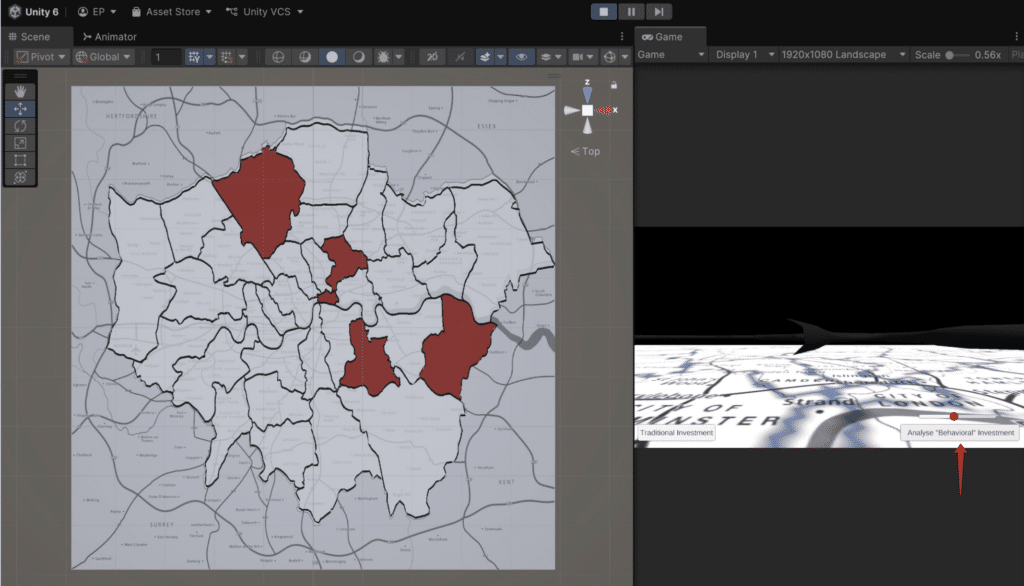
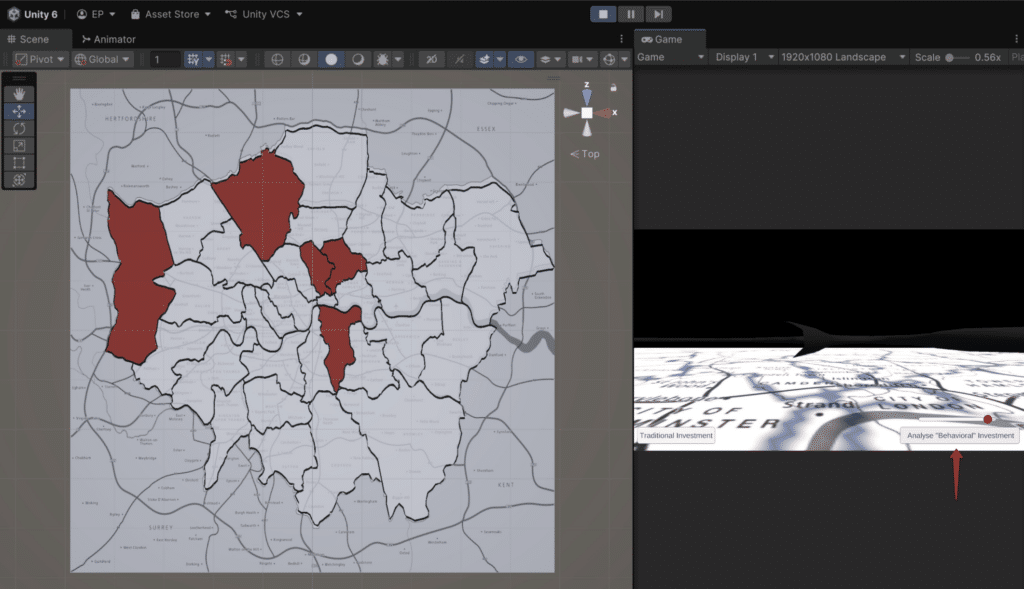
The AR interface was developed to provide an intuitive and spatially grounded method for visualizing borough selection based on behavioral criteria. This allows investors, urban planners, and other stakeholders to rapidly assess and compare areas through a clear spatial representation of their performance. By enabling real-time exploration of behavioral scenarios, the interface supports more informed and context-aware decision making in the selection of appropriate boroughs.
The process that the user can follow is:
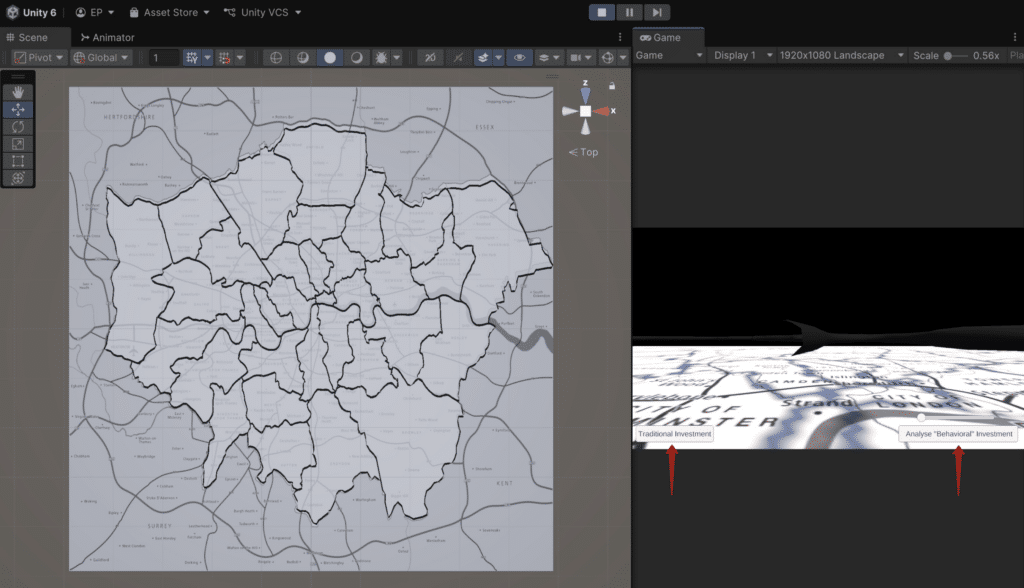
Initially, the user witnesses the map of London, and can find two buttons called “Traditional Investment” and “Analyze ‘Behavioral’ Investment”
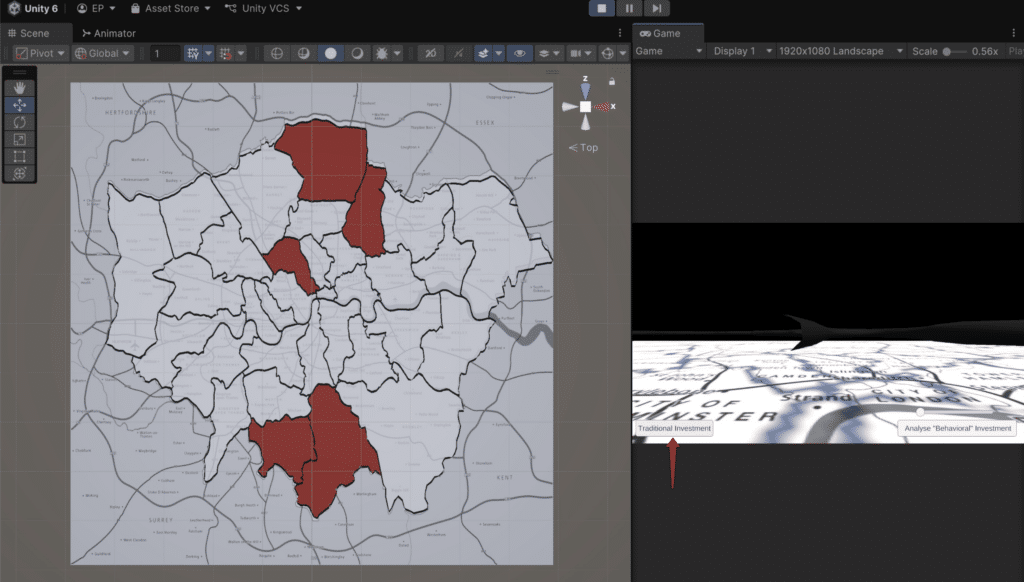
Then, when the user clicks the button of “Traditional Investment,” can see which areas are suggested.
Later, by adjusting the slider of behavioral implication, the selected boroughs are also changing providing the optimal suggestion.