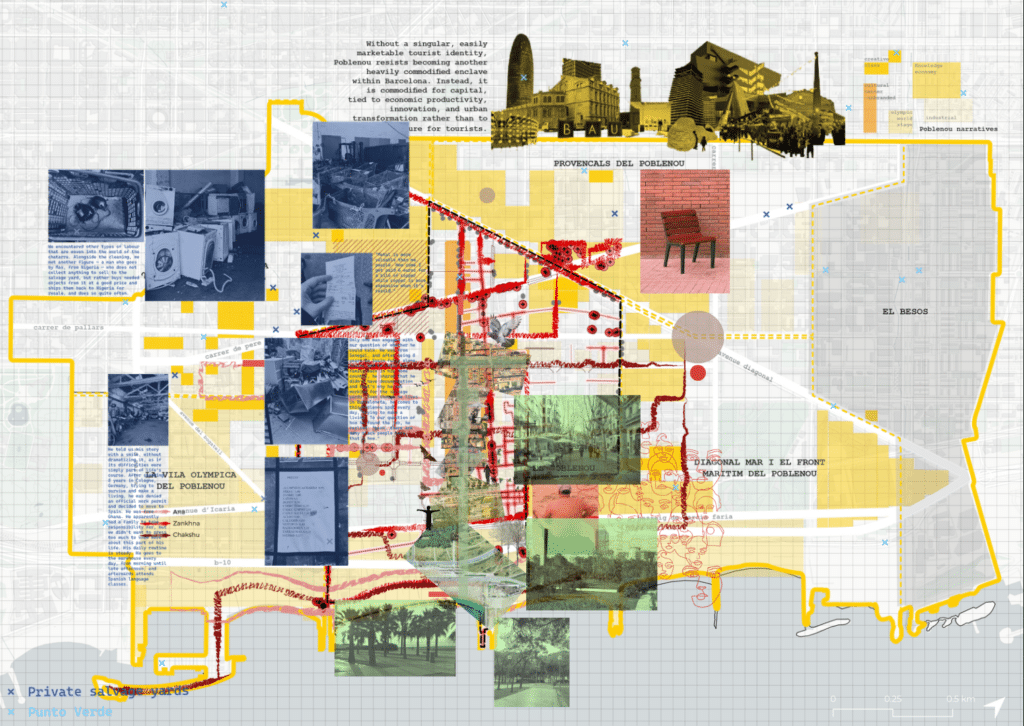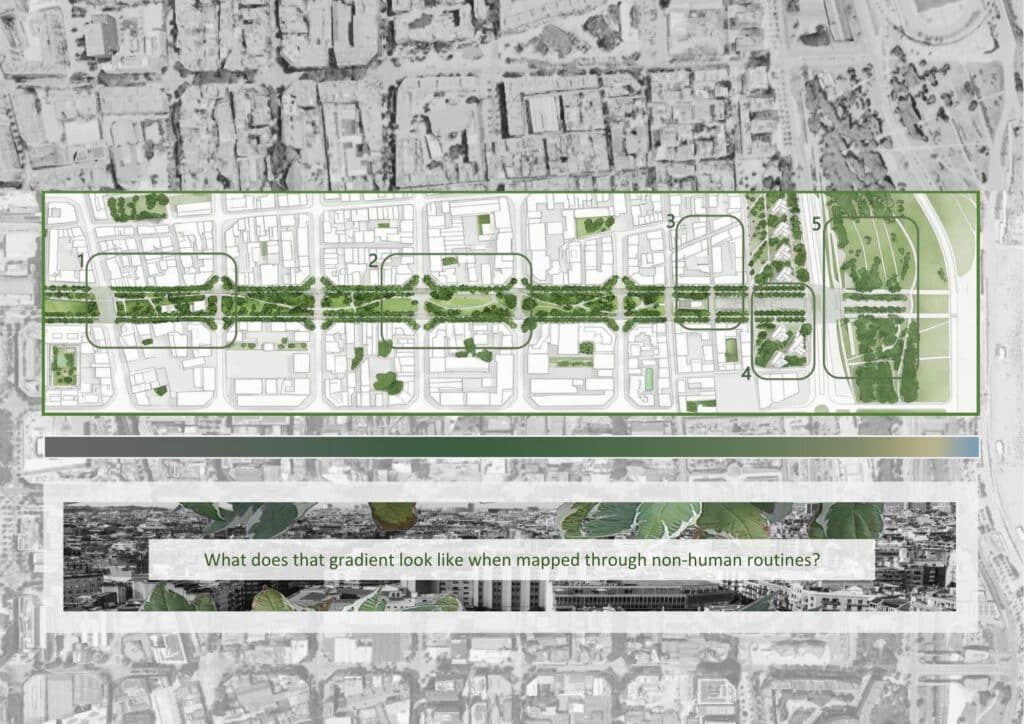
- Introduction
Urban space is conventionally conceptualized as an anthropocentric construct. However, non-human species continuously appropriate architectural surfaces, infrastructural voids, and vegetated fragments. Birds occupy ledges and canopy layers, insects colonize engineered soils, bats navigate nocturnal corridors along tree lines, and plants root within pavement fissures. These presences are not incidental; they reflect how spatial design either accommodates or restricts ecological processes.
This investigation asks:Does the existing urban structure invite biodiversity or reinforce ecological exclusion?
Where do non-human species reside within Poblenou’s built fabric?
How do their daily and seasonal routines interact with urban morphology?
2. Methodological Framework
A multi-scalar ecological mapping approach was employed across three sites: Rambla del Poblenou, Parc del Poblenou, and Poblenou Beach. Methods included:
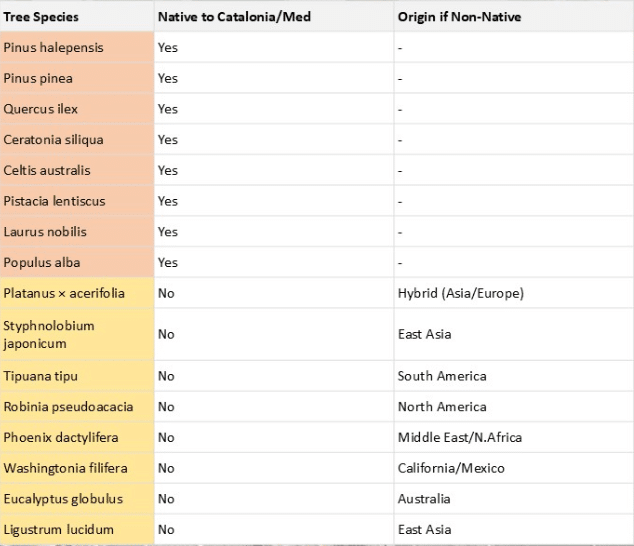
- Tree and shrub inventories (native versus non-native origin; canopy–understory stratification)
- Bird sound recordings and acoustic mapping to identify biodiversity hotspots
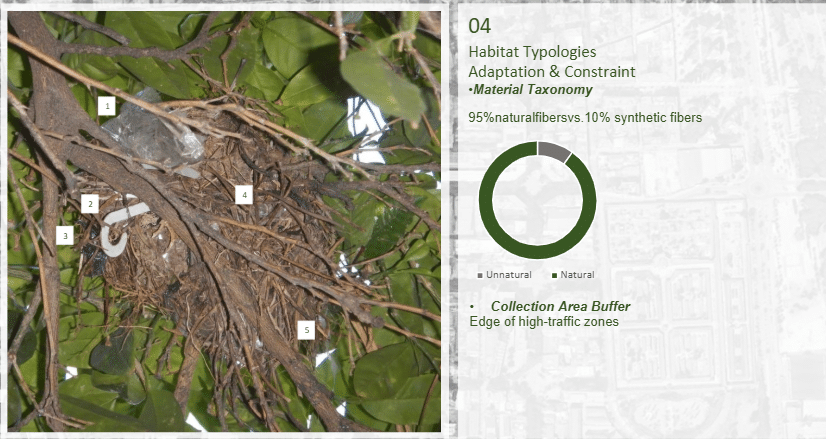
- Nest and roost documentation in façades, palms, and infrastructural cavities
- Pollution and disturbance gradient assessment
Acoustic mapping functioned as a diagnostic layer, correlating species richness with vegetation structure and human disturbance intensity.
ZONE 1: Carrer de Pujades
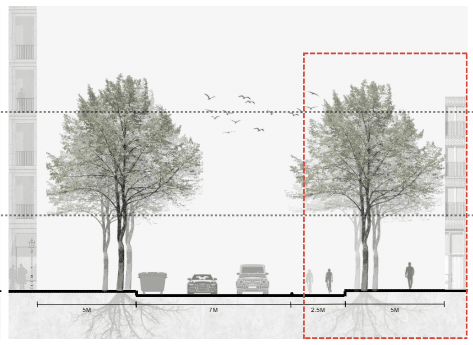
Most of the trees found here are Plane Trees (Platanus × hispanica), a species widely planted across Barcelona. Although they are not originally native to the region, they were selected for their fast growth, broad canopy, and strong resistance to pollution and compacted urban soil.
In the context of a wide, noisy street, these trees play an important environmental role. They act as natural buffers—helping to filter air pollution, reduce urban heat, and create nesting and resting spaces for birds above the constant flow of traffic.
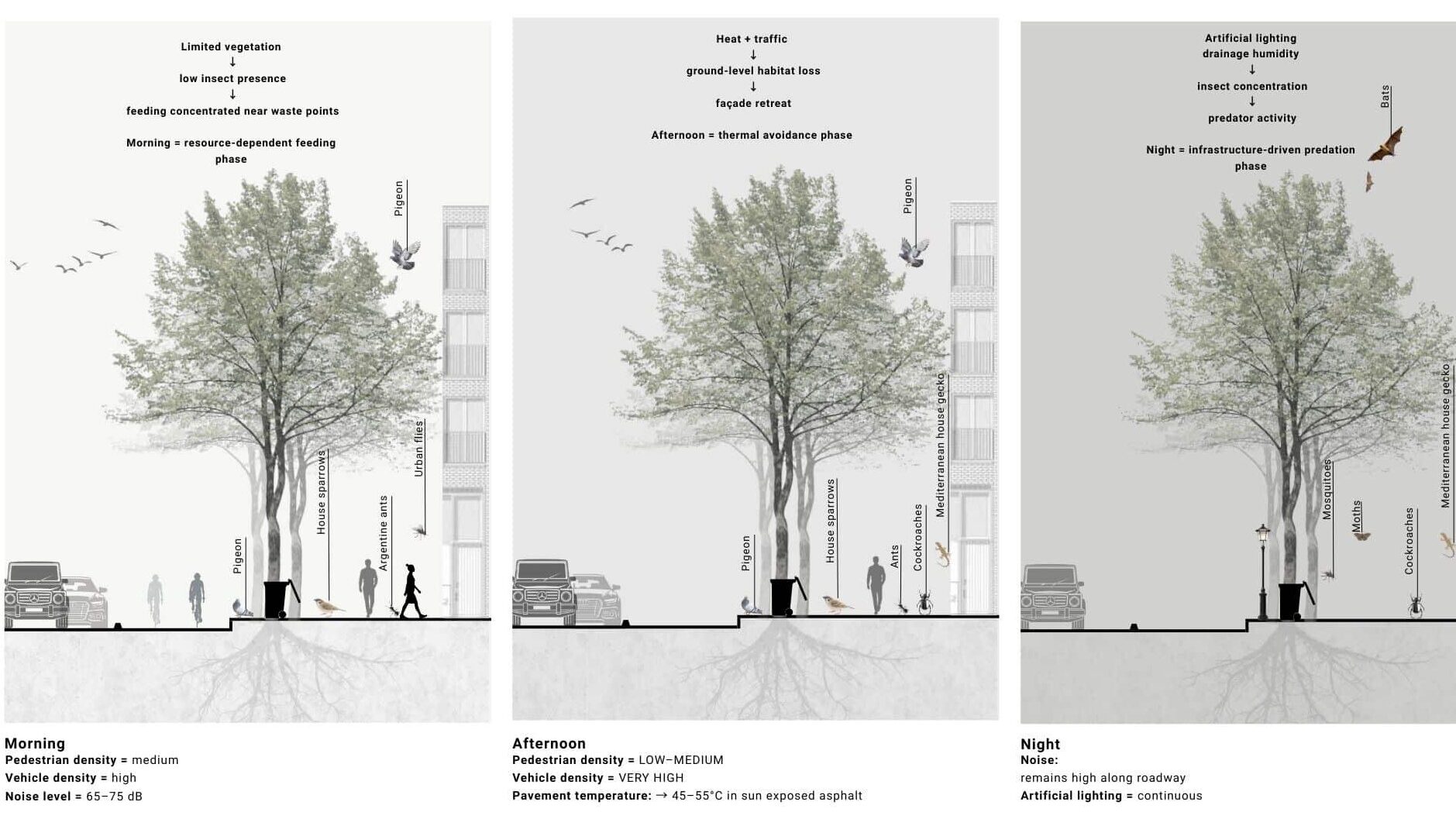
Non-human life on Carrer de Pujades changes throughout the day in response to traffic, heat, and limited tree cover.
In the morning, heavy car traffic and pedestrian activity create noise and disturbance, reducing the presence of insects on the ground. Pigeons and sparrows feed mainly near trash areas and remain in the shade close to building edges.
By the afternoon, sunlight heats the asphalt, making open areas too warm for many species. Birds and insects move toward shaded spots along buildings or near drains, where temperatures are cooler.
At night, streetlights attract insects, which in turn draw animals such as bats and geckos that feed under the artificial lighting. The street effectively becomes a nighttime hunting space shaped by both lighting and underground systems.
Zone 2: Rambla del Poblenou
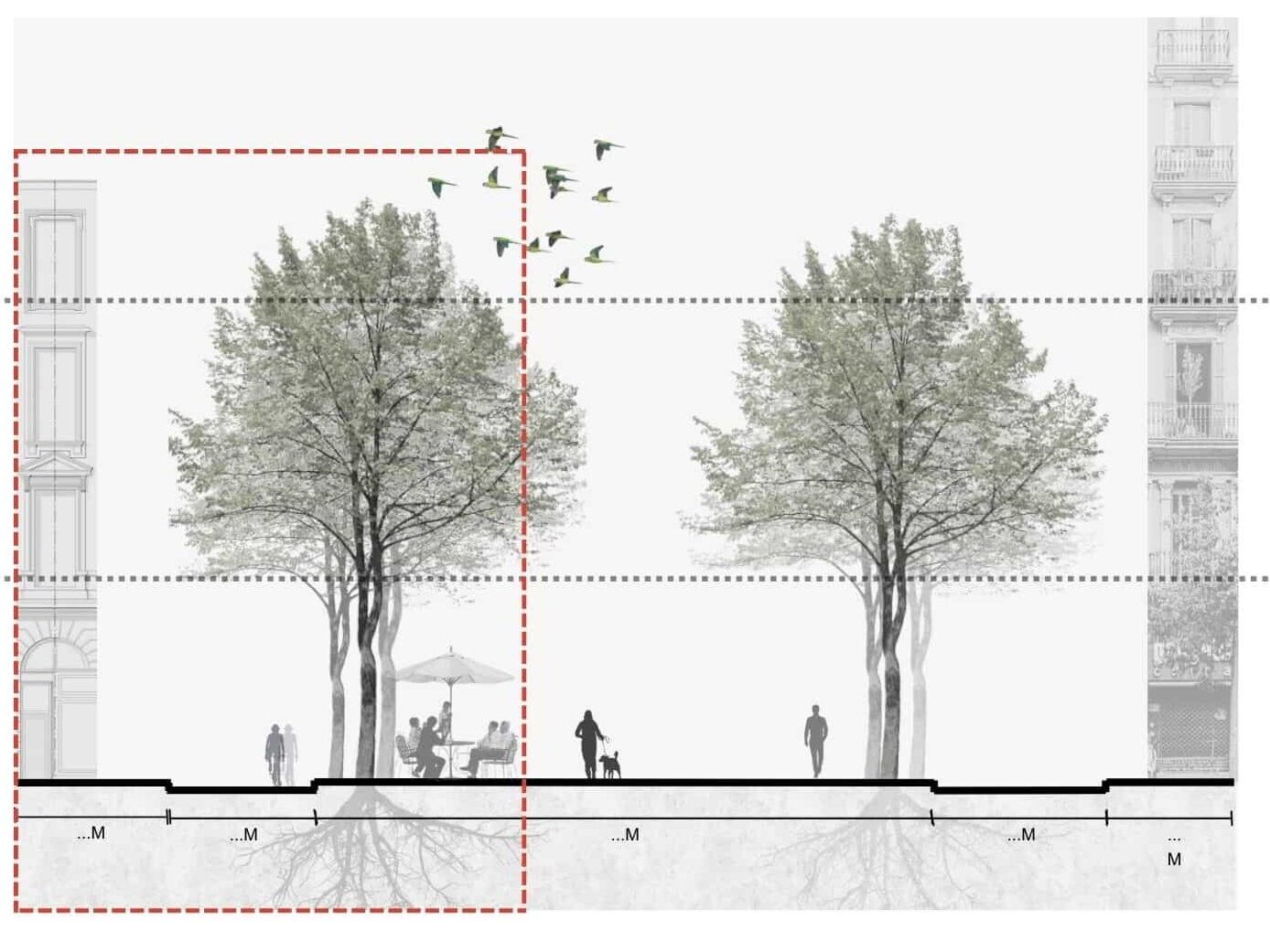
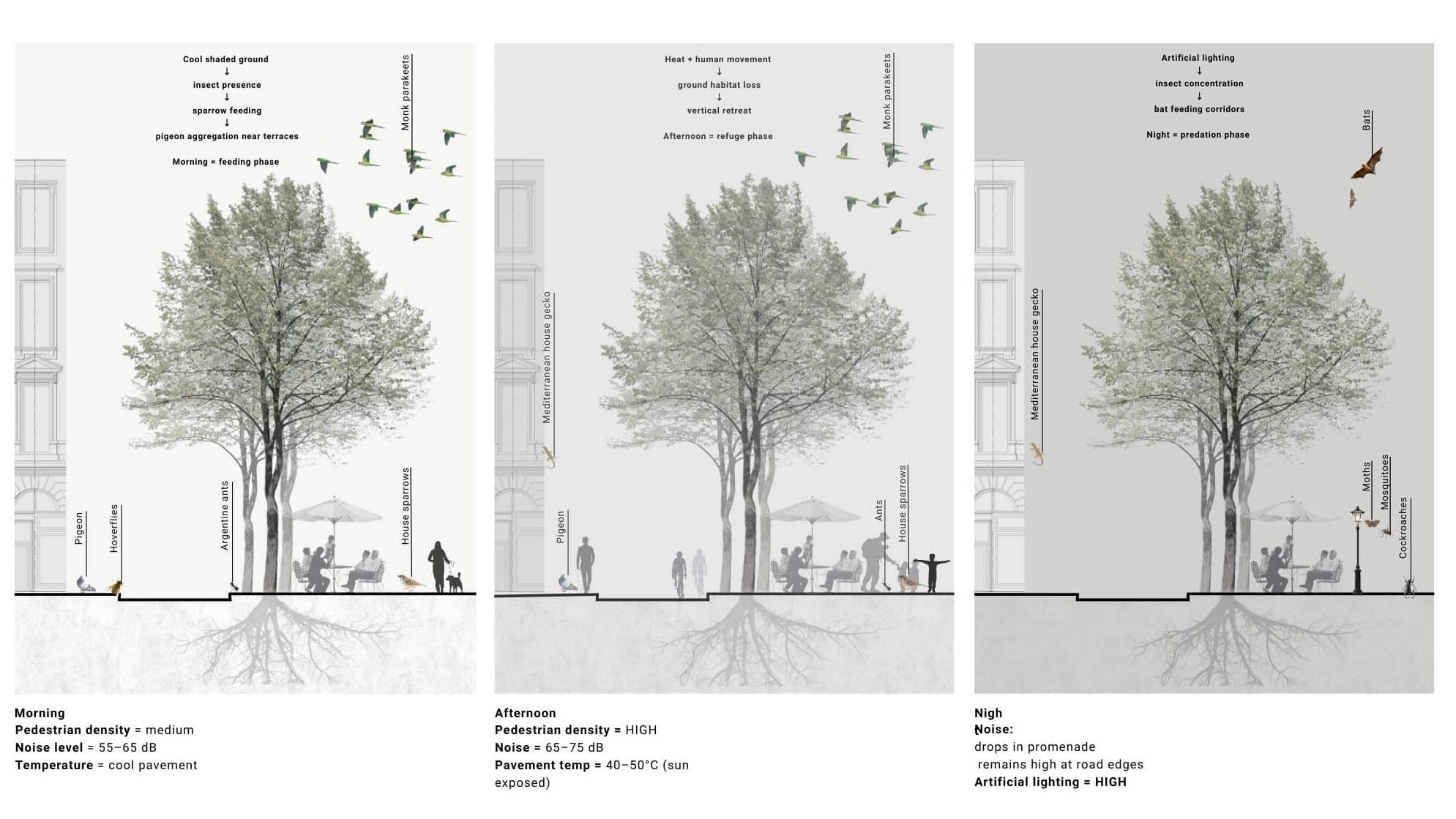
Non-human life along Rambla del Poblenou varies throughout the day according to temperature, noise, pedestrian activity, and street lighting.
In the morning, cooler ground temperatures and low human presence allow insects to occupy tree pits and areas near terraces. These insects provide feeding opportunities for birds such as sparrows and pigeons.
By the afternoon, sunlight heats the pavement and the street becomes busier, prompting birds and insects to move to shaded areas under trees or along building edges.
At night, streetlights attract insects, which in turn draw animals like bats and geckos that come to feed. The street transforms into a nighttime hunting space influenced by artificial lighting.
The patterns of non-human life along the Rambla are shaped by these daily environmental changes.
ZONE 3:
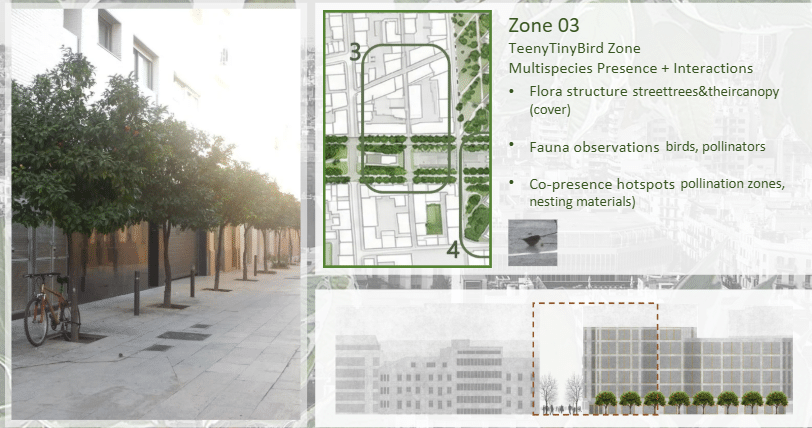
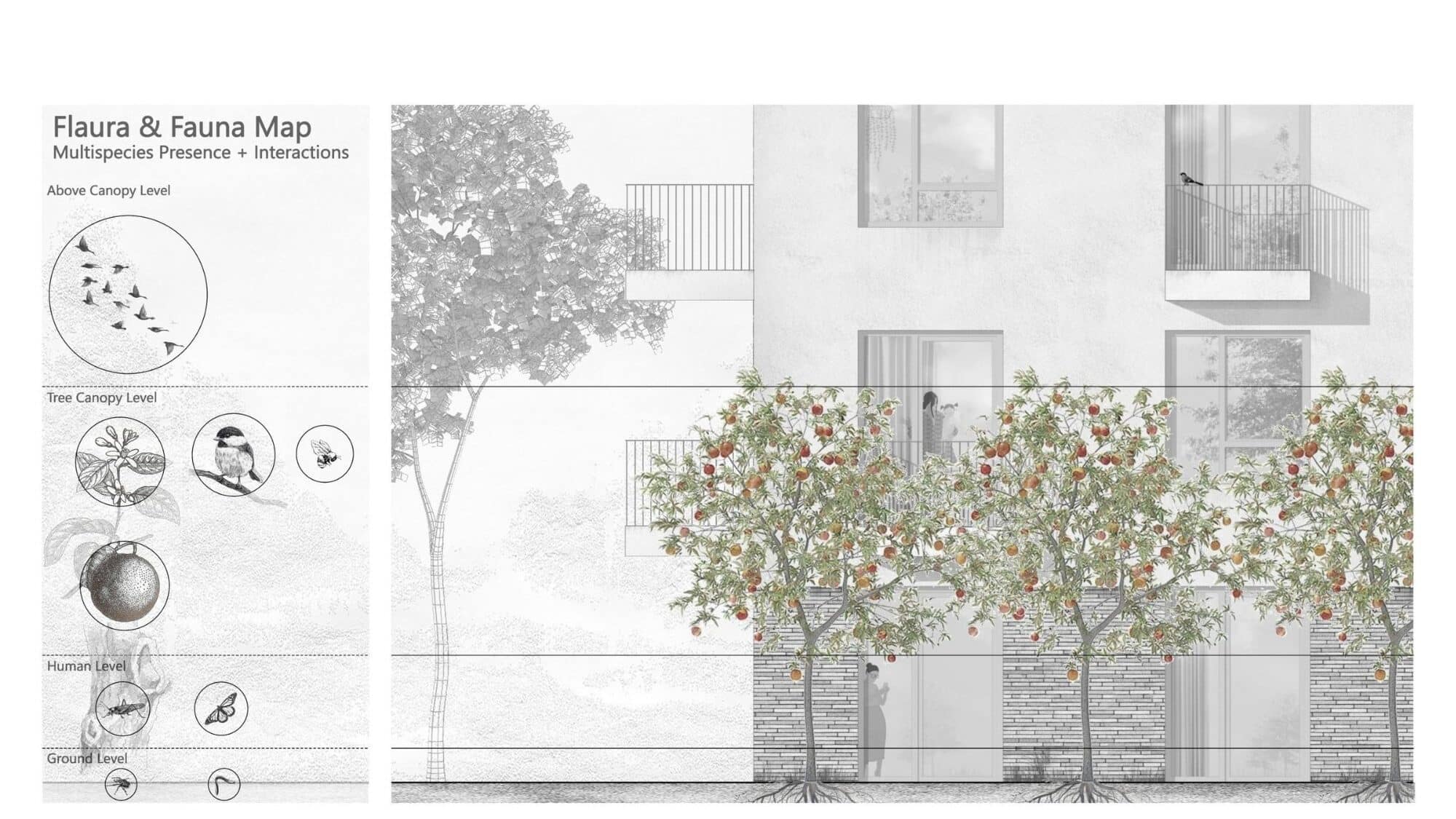
3. Façades and Vertical Surfaces as Ecological Infrastructure
Urban buildings operate as surrogate geological formations. Ledges, crevices, balconies, and bridges provide nesting and roosting niches.
- Pigeons (Columba livia) demonstrate high human dependency and pollution tolerance, indicating waste-driven anthropocentric systems.
- House sparrows (Passer domesticus) occupy fine-grain crevices and low vegetation; their decline signals over-sealed urban fabric.
- Magpies (Pica pica) utilize street trees and edge conditions, reflecting fragmented but functional habitat networks.
- Monk and ring-necked parakeets (Myiopsitta monachus / Psittacula krameri) establish communal nests in palms and façades, suggesting climatic permissiveness and ecological imbalance favoring invasive generalists.
- Bats inhabit cavities and navigate tree corridors during nocturnal hours.
Green façades (medianeras verdes) extend vertical habitat potential; however, ecological performance depends on plant selection, structural complexity, and maintenance regimes.
4. Vegetation Structure and Habitat Support
4.1 Native Mediterranean Assemblages
Species such as Pinus halepensis, Pinus pinea, Quercus ilex, Ceratonia siliqua, Pistacia lentiscus, and Celtis australis reflect Mediterranean ecological memory. These assemblages provide:
- Canopy shelter and nesting opportunities
- Understory microhabitats
- Seasonal food resources
- Diverse insect guild support
For example, Quercus ilex sustains numerous insect species and cavity-nesting birds, while Ceratonia siliqua supports pollinators and small mammals through nectar and fruit production.
4.2 Ornamental and Exotic Monocultures
Species including Platanus × acerifolia, Phoenix dactylifera, Washingtonia filifera, and Eucalyptus globulus offer limited understory development and reduced trophic complexity. Along the beachfront, palms provide structural perches but minimal ecological layering. Boulevard monocultures constrain biodiversity to urban-tolerant generalists and reduce resilience to disturbance.
5. Comparative Spatial Analysis
Parc del Poblenou
The park aligns partially with Mediterranean ecological logic. Pines combined with shrub layers create vertical stratification supporting birds, pollinators, hedgehogs, lizards, and bats. Acoustic density is higher in zones with understory complexity, indicating moderate ecological resilience.
Rambla del Poblenou
The Rambla functions as a linear canopy corridor dominated by plane trees and shallow engineered planter strips. Understory depth and soil volume are constrained. Ecological layering is reduced, and species present are largely urban-adapted birds. The spatial logic reflects industrial-boulevard typologies emphasizing order over ecological assemblage.
Poblenou Beach
The beachfront prioritizes ornamental palms adapted to saline winds and sandy soils. While climatically resilient, habitat diversity is minimal. Connectivity to broader ecosystems is weak, and biodiversity is limited to disturbance-tolerant species.
6. Non-Human Routines as Spatial Indicators
Temporal observation reveals structured ecological rhythms:
- Morning pollinator circuits follow flowering shrubs.
- Midday bird activity concentrates in shaded canopy cores.
- Evening bat movement traces linear tree corridors.
- Seasonal nesting clusters around areas of canopy continuity and reduced disturbance.
These routines expose how soil permeability, vegetation stratification, façade porosity, and maintenance practices directly shape ecological occupation.
7. Discussion
Poblenou presents a mosaic condition. Parc del Poblenou retains fragments of Mediterranean ecological continuity. Rambla del Poblenou reflects engineered monoculture logic with limited layering. The beachfront emphasizes ornamental resilience over biodiversity complexity.
Non-human presence functions as a spatial diagnostic: where native assemblages and vertical stratification exist, ecological networks persist. Where surfaces are sealed and planting homogenized, biodiversity narrows to invasive or pollution-tolerant species.
8. Conclusion
Mapping Poblenou through non-human routines reframes the district as a multispecies territory shaped by both design intention and adaptive occupation. Urban morphology—tree selection, understory integration, façade permeability, and disturbance management—determines whether space operates as habitat infrastructure or ecological barrier.
Recognizing biodiversity as a structuring principle rather than ornamental supplement is essential for advancing more-than-human urbanism. Non-human lives do not merely inhabit Poblenou; they reveal the ecological logic embedded within its streets, parks, and waterfront landscapes.