
Scrap Metal, Migration and Urban Recycling
To better understand people, we must understand the spaces they occupy – the city they navigate, the neighborhood they experience. Robert Park notes that the city is a man’s most consistent and on the whole, his most successful attempt to remake the world he lives in more after his heart’s desire. (…) indirectly, and without any clear sense of the nature of his task, in making the city man has remade himself (Park, 1967).
Therefore, the relations, processes, and networks we see in a city are human-made, and in turn, they make the man as well: these systems shape individual and collective experiences, their rights and behaviours in the city. But behind the official systems that define urban epistemology, like datasets, municipal maps, and policy frameworks – where labour is regulated and value circulates through recognized channels, there exist other representations of the city, other processes, both formal and informal. Ones that do not appear on any map. Present, but not recorded. Noticed, but never truly seen.
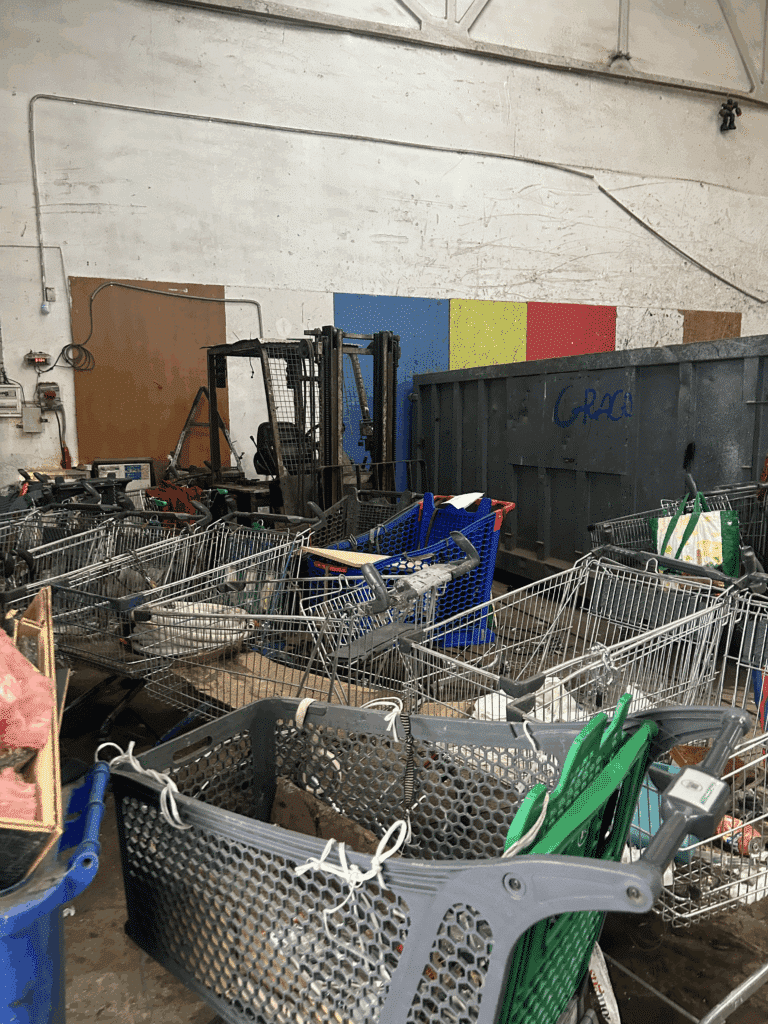
Our focus is on scrap metal collectors in Poblenou – commonly referred to as “chatarreros” – which is translated as “scrap” or “junk” workers – people who are materially integrated into the city’s recycling economy yet largely absent from its formal forms.
Their labor sustains urban sustainability narratives by recovering and recirculating metal waste, but they remain precarious, and structurally marginalized. By collecting what the rest of the people already consumed, and finding a new value in the pile of junk, bringing it to the salvage yards and then getting paid based on the material they collected, they occupy a paradoxical position: essential to the city’s economy while invisible within its official knowledge systems. (“Their labour exists outside of formal economic boundaries. Equipped with grocery carts that introduce a noisy disruption in an otherwise refined and modern tech-hub that Poblenou has become, they navigate sidewalks, industrial leftovers, and residential streets in search of discarded metal. Sometimes solo, sometimes in groups, these people salvage valuable or invaluable items. The value, though, is precarious. It is determined, but not guaranteed, at the recycling centres.”)
study question:
How do data regimes, migration law, and urban property structures produce and sustain informal scrap economies?
In the geopolitical context of metal’s growing value – driven by shifts toward sustainable energy, digital technologies, and AI – the informal labour we see in the streets of Poblenou and beyond feeds directly into the global supply chain for critical materials. What gets collected in the back streets of Barcelona is entangled, however invisibly, with some of the most contested resources in the world today. Therefore, recycling has become a strategy not only for healthier urban living and more sustainable cities, but also a way of recovering the same value that can have different layers in the local and geopolitical sense. Today, Barcelona has a five-category recycling system – paper and cardboard, plastic and metal containers, glass, organic waste, and general waste. It is designed to standardize and automate the process, focusing on packaging and household products.
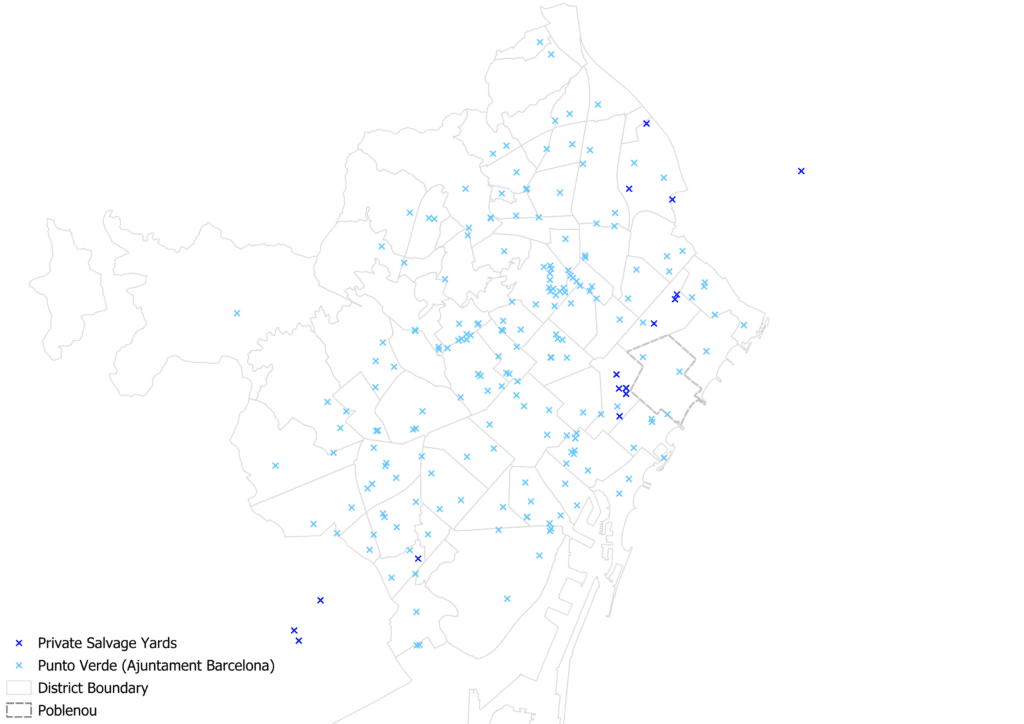
There is significant infrastructure around recycling and waste in the city, though metal is not part of the official system, unlike glass, plastic, or cardboard. For larger items there are the Puntos Verdes – household drop-off recycling centres – as well as private services for construction waste disposal. Since Puntos Verdes are drop-off points, you bring the waste there yourself, without any payment in return. This institutional arrangement produces a gap, which gets then utilized by scrap workers.
APPROACH
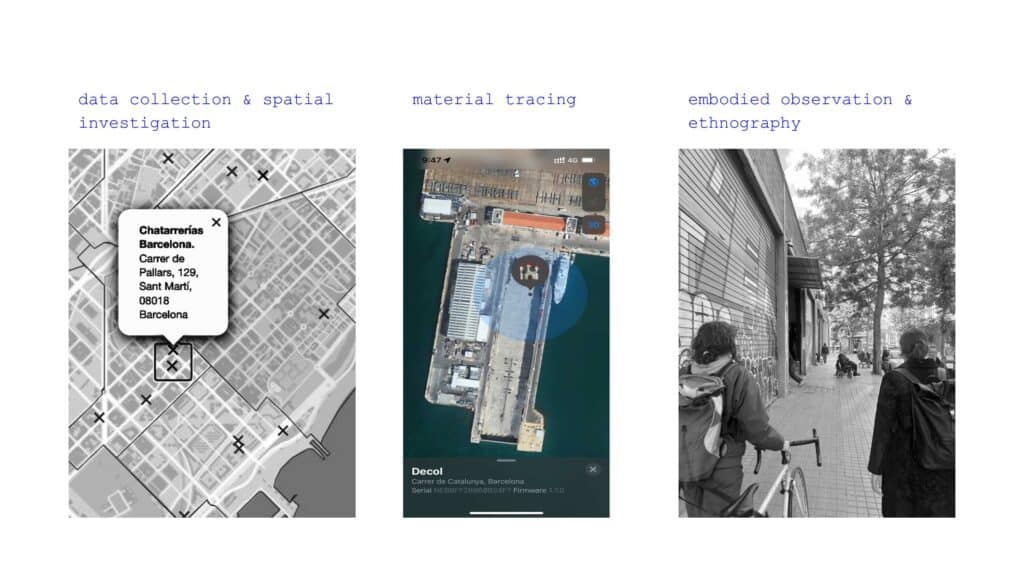
Our approach to the study consisted of different steps: First, locating scrap yards proved to be a complex process. As private entities, they do not appear in official municipal datasets. The dataset therefore had to be assembled through alternative means, including platform-based searches. Even within digital platforms such as Google Maps, visibility was inconsistent: some sites were listed, others were partially documented, and several were not registered at all. The process of constructing this dataset thus became an exercise itself, revealing how spatial visibility is unevenly produced depending on the formality.
The next step was to conduct a tracing experiment. We acquired geotags and attached them to discarded objects that could potentially be picked up and transported across the city. The uncertainty regarding who might pick them up, how they would travel, and where they would ultimately end up was an intentional part of the process. We first geotagged a metal cup, left it near IAAC in Poblenou, and monitored its movement. Within a few hours, it had travelled across the city, and by the following day it had reached the Port of Barcelona. The next object we selected was a broken hairdryer, which ultimately became a faulty test but also a meaningful part of the process, revealing the unpredictability of material circulation.
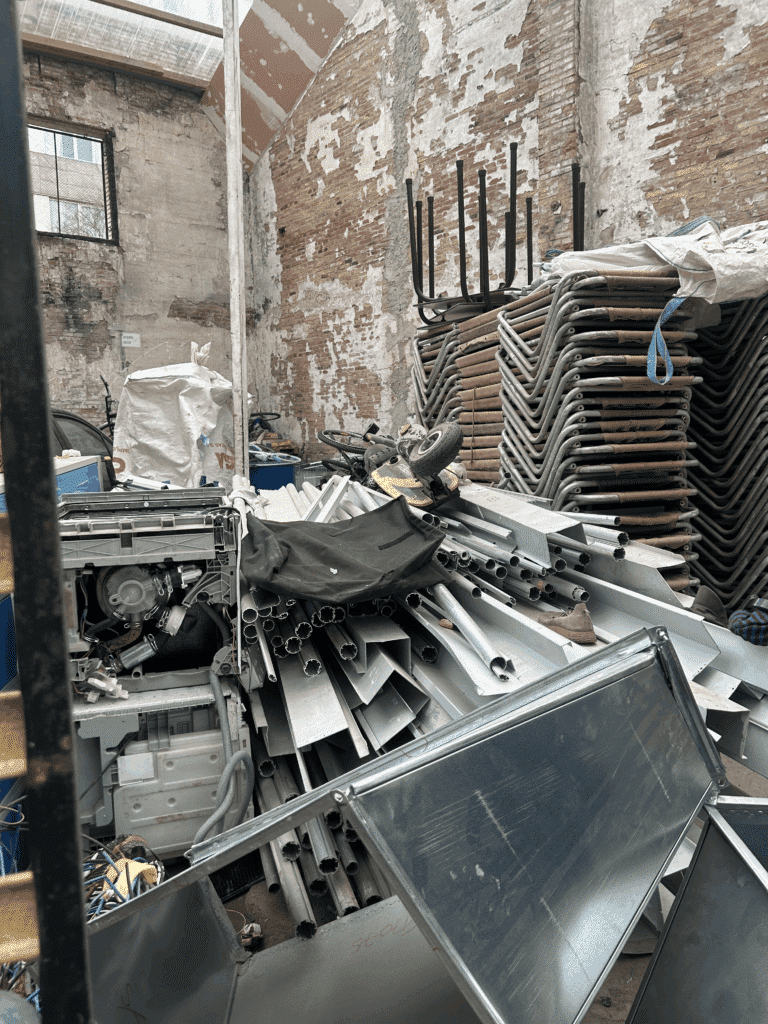
The final and most important step was to go into the city and speak directly with people involved in scrap collection, to listen to their experiences and understand where they come from. This ethnographic approach is presented in the form of a diary (See the attachment 1) that we consistently maintained throughout the research period. It included informal conversations, sensory observations, and interviews conducted in multiple languages or through translation tools when necessary. During this process, we found that it was necessary to move beyond the formal boundaries of Poblenou and into adjacent areas, particularly the district of Sant Martí. Many of the people we encountered operated across neighborhood borders, reflecting the fluid geography of informal labor networks that do not align with administrative divisions. Salvage yards, storage spaces, and gathering points were often located in zones, where a visible shift from former industrial facilities to rapidly gentrifying residential and technological developments could be observed. These areas revealed how informal economies persist within spaces undergoing urban transformation, occupying the gaps between industrial decline and new forms of redevelopment.
Together, these approaches combine spatial investigation, material tracing, and embodied observation to reveal how metal circulates through both visible infrastructures and hidden human networks across the city.
THEORY + ANALYSIS
Through multiple conversations, we learned that most of the people engaged in this process are undocumented migrants. The racial dimension is visible — most of them are from African countries or from what is referred to in contemporary political discourse as the ‘global south.’ Most of them are in pursuit of a better life, migrating from their home countries to European ones, where they are willing to put themselves under legal risk (“After spending 8 years in Cologne, Germany, trying to survive and make a living, he was denied an official work permit and decided to move to Spain. He was from Ghana”).
Here we draw on Michel Foucault, who argues that urban governance operates through the management of populations, circulation, and risk, rather than solely through prohibition(Faucault, 1975-76). What is interesting is that informal scrap collectors are not simply excluded from the city – they are governed through a regime that tolerates their presence while denying them formal recognition and protection.
Their undocumented status positions them as both economically useful and legally precarious. Biopower is evident in the dual exposure these workers face: to environmental hazards such as toxins and physical strain, and to legal vulnerability through immigration enforcement and labour exclusion. Their bodies become sites where migration policy, urban waste regimes, and global commodity markets intersect.
In this sense, scrap collectors function as an informal infrastructure of urban metabolism — sustaining material circulation while absorbing the social and environmental costs of that circulation and rarely get awarded, or benefit themselves.( “Metal is more valuable than me, people. How come I get paid 6 euros for a kilo of copper while copper is more expensive when it’s resold.”).
This is backed by the theory of racial capitalism, by Cedric Robinson, who argues that capitalist accumulation is a system that has always depended on racial differentiation, characterized by structural racism. Within this framework, racialized migrant labor is not accidental but structurally positioned as flexible, precarious, and extractable. Informal scrap economies in Poblenou are shaped by migration regimes that produce undocumented status and by social networks organized along racial and national lines. Based on our interviews, we came to realize that most people previously knew each other, or they got easily connected because of what country, what part of the world they came from (“Look, there are many black people here, that’s how”). Access to work sites, information, and protection often circulates through these networks, forming alternative infrastructures of survival. Value extraction occurs not only through the resale of metal but through the legal and social conditions that keep certain workers more vulnerable to exploitation. The price of scrap therefore reflects not only commodity markets and global flows, but hierarchies of race, citizenship, and belonging.
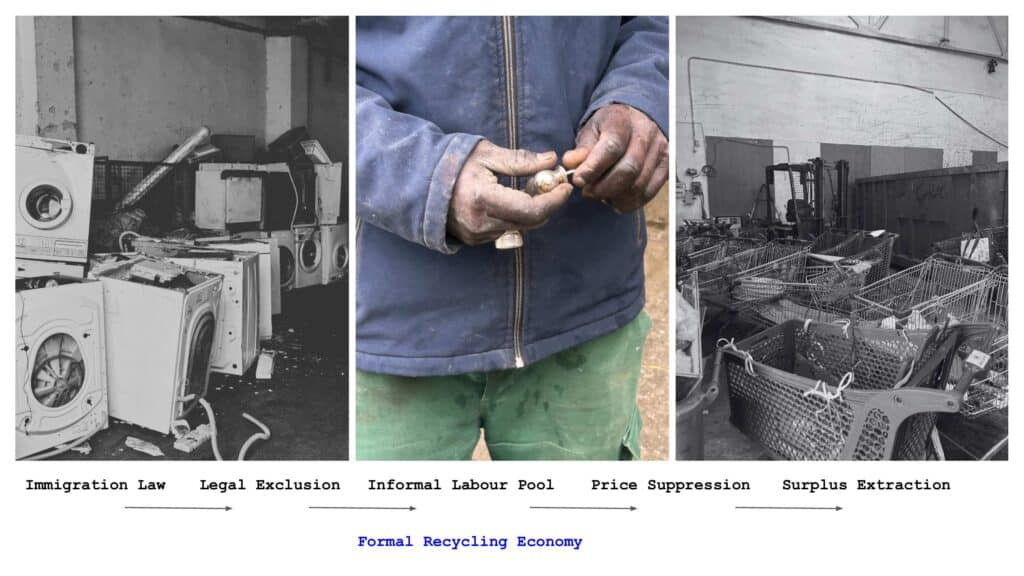
This scheme illustrates our final conclusion: how restrictive immigration laws create a structural chain that ultimately sustains the formal recycling economy through informal labor. The legal “Catch-22” prevents undocumented migrants from obtaining work permits while simultaneously requiring employment to regularize their status, producing legal exclusion from formal jobs. As a result, many are pushed into an informal labor pool where activities such as scrap metal collection become one of the few available means of survival(“It’s tiring, but what can you do? You have to endure, and people are nice”). Their precarious position suppresses the prices they receive for collected materials, since buyers can exploit their lack of alternatives and protections. This enables surplus extraction, where intermediaries and recycling businesses capture the higher market value of metals while paying collectors minimal amounts. As David Harvey argues, surplus is an absolute necessity for the development of the cities, implying that surpluses have been extracted from somewhere and from somebody (Harvey,2008). In this way, the formal recycling economy — often framed as sustainable and regulated — is materially supported by an invisible foundation of marginalized workers whose labor remains outside official recognition and creates a parallel urban economy, characterized by survival and migration
(“We continued to talk to people. This time, the conversation was not individual but dynamic, flowy, fun – we would speak to one person, another would arrive, and suddenly we were all talking together, laughing, sharing jokes and fragments of personal stories. And then we left, as observers always do — having been let in and allowed to listen”).
