
From Point Clouds to Digital Twins: Inside the Cloud2BIM Workflow
The Architecture, Engineering, and Construction (AEC) industry is currently undergoing a major technological shift. We are witnessing a definitive transition from manual, labor-intensive site measurements to AI-driven scan-to-BIM workflows. The goal is clear: to unlock the digital potential of existing buildings by creating high-fidelity records that support more efficient design, engineering, and facility management.
As students in the Master in Advanced Computation for Architecture and Design (MaCAD) at IAAC in Barcelona, we recently explored this frontier for our Architectural Theory for BIM Tools seminar. To truly understand how artificial intelligence is reshaping these workflows, we sat down with Václav Nežerka, a researcher at the Faculty of Civil Engineering at the Czech Technical University in Prague. Specializing in structural engineering and computational automation, his mission is centered on democratizing as-built modeling for the construction industry.
Here is a deep dive into our conversation, exploring the gap between raw point clouds and usable BIM models, the logic of automated IFC generation, and the emerging link between as-built models and dynamic digital twins.
The Origins of Automated As-Built Modeling
The push toward automating the scan-to-BIM process was born out of direct industry necessity. As Václav explained, the initial impulse for his research came from a student working part-time in the field, who expressed just how difficult and tedious it was to manually rebuild architectural geometry from point cloud data.
This necessity became even more urgent during a European research project focused on pre-demolition audits. Existing buildings had to be thoroughly documented, their individual elements classified, and their materials identified. However, in most cases, no BIM models existed for these older structures. Instead of dedicating countless hours to modeling everything by hand, Václav and his team shifted their focus entirely toward automation.
Early progress in their research came from developing algorithms capable of segmenting structural slabs and dividing large buildings into individual floors. This approach proved to be highly effective, especially when tested on a massive 22-storey building. From that initial success, the automated workflow expanded to recognize walls, openings, and other key structural elements. Throughout this development, continuous collaboration with practicing professionals remained a key factor; it clarified exactly what file formats the industry actually needs and ensured that the academic research could be practically applied beyond the university setting.
Bridging the Gap Between Point Clouds and BIM Models
For those outside of daily BIM practice, the distinction between a point cloud and a BIM model, and why the conversion between the two is so critical, might seem abstract.
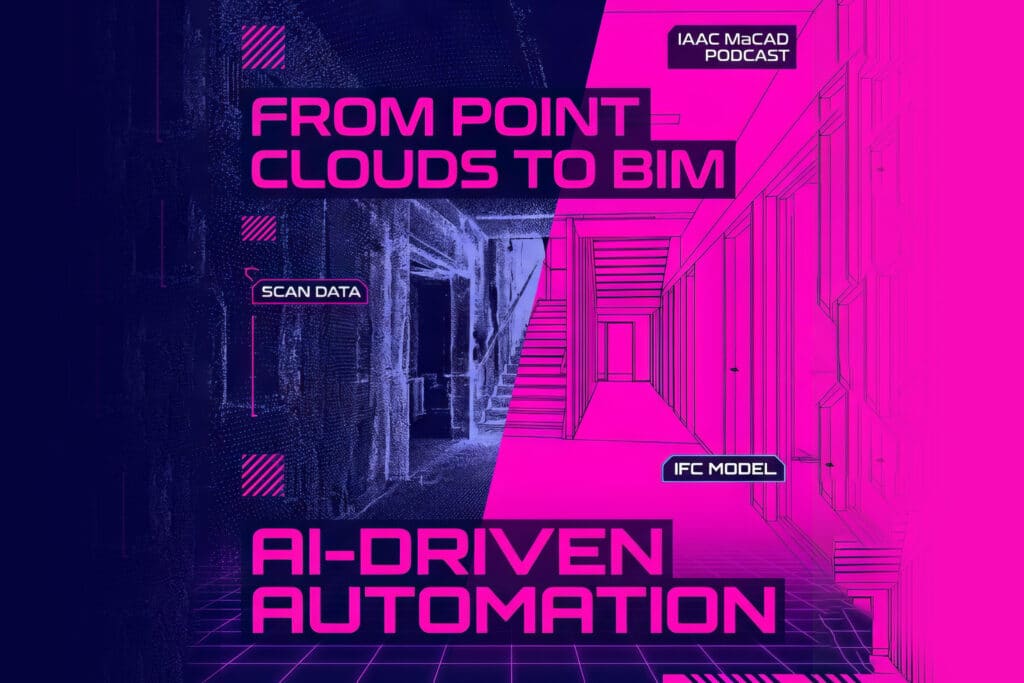
Point clouds are incredibly useful for visual reference. A human can look at a dense sea of points and immediately understand the spatial layout of a building. However, by themselves, point clouds are not practical for most architecture and engineering tasks. You cannot easily perform structural calculations, spatial planning, or structured downstream processing with raw geometric points.
A BIM model, by contrast, is highly structured. It can be stored much more efficiently, manipulated easily, and utilized for complex analysis. The scan-to-BIM process is the critical conversion step that bridges this gap. It turns raw geometric capture into a highly structured, intelligent model that can actually support and streamline design, engineering, and lifecycle management processes.
Cloud2BIM Workflow: From Point Cloud Regularization to IFC Output
So, how does an automated scan-to-BIM pipeline actually work? According to Václav, the ultimate goal was to make the pipeline as simple and complete as possible from the user’s perspective: a user simply uploads a point cloud and receives a standardized IFC model, or increasingly, a native Revit output in return.
Internally, however, the process relies on a highly sophisticated sequence of steps:
- Regularization: The raw point cloud must first be regularized because laser scans inherently have uneven point densities depending on where the scanner was positioned in the room.
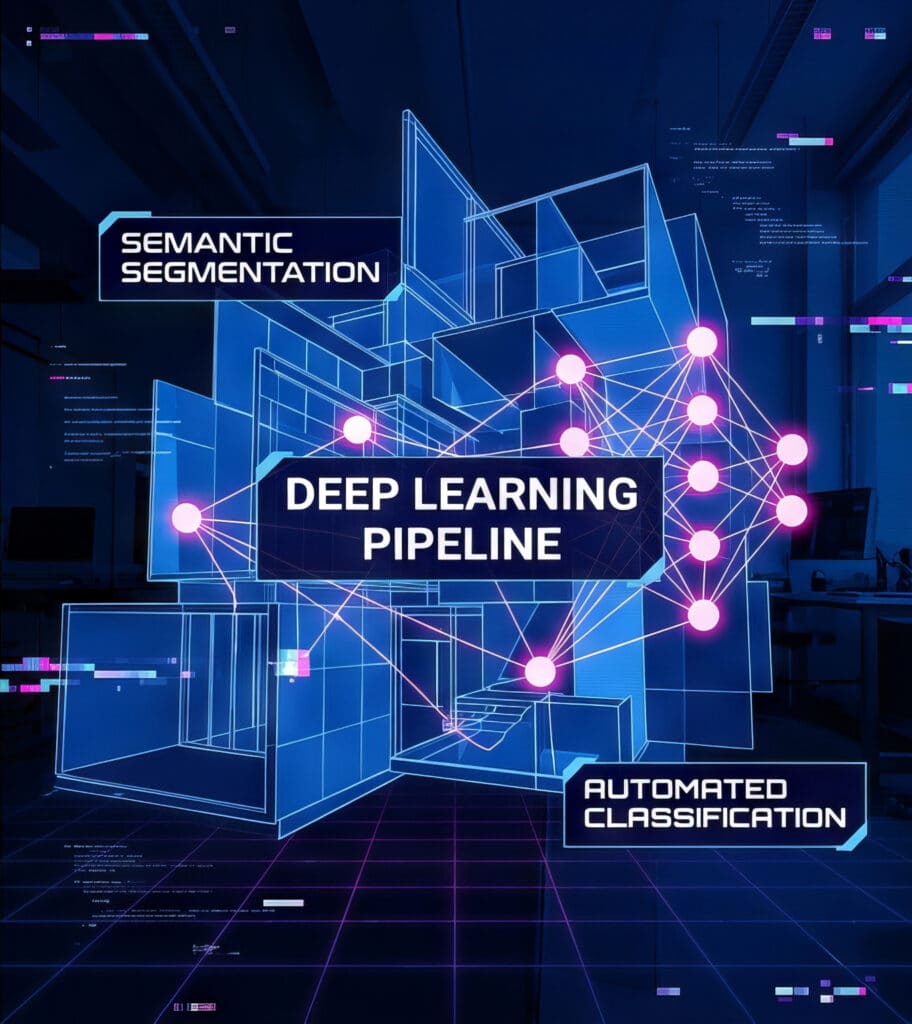
- Virtual Slicing and Machine Learning: The building is virtually cut to detect its principal direction and identify the floor slabs. Because earlier heuristic methods struggled to accurately identify slabs, especially in buildings with varying ceiling heights, the workflow shifted toward machine learning. The team actually generated synthetic houses and synthetic point clouds to train an AI model capable of placing slabs with much higher reliability.
- Floor-by-Floor Processing: Once the slabs are identified, the building is processed floor by floor. Horizontal cuts are used to trace the walls, while advanced segmentation models classify groups of points into distinct building elements.
- Opening Detection and IFC Translation: Finally, doors, windows, and other openings are detected, and the resulting structured data is seamlessly translated into an IFC format.
Interestingly, the workflow intentionally avoids attempting full 3D machine-learning reconstruction all at once. Processing a whole building in 3D through neural networks is far too computationally heavy. Instead, the pipeline strategically decomposes the building into simpler, manageable stages.
The Shift to AI-Supported Segmentation and the Limits of Automation
A major turning point in this research was the decision to abandon classical geometric fitting methods, such as the widely used RANSAC algorithm, in favor of AI-supported segmentation.
While traditional fitting algorithms are mathematically robust, they are poorly suited to the reality of indoor environments. RANSAC requires strong mathematical assumptions, such as knowing the expected number of planes, their approximate sizes, or other rigid boundary conditions. Real buildings are rarely that clean. Existing structures are filled with furniture, architectural irregularities, missing scan data, and general visual noise. Because exact geometric fitting becomes too fragile when faced with these variables, AI-based approaches are vastly superior. Artificial intelligence is much more tolerant of clutter, noise, and uncertainty, making it perfectly aligned with the “messy” conditions of real-world scan-to-BIM projects.
However, full automation still has strict limitations. Currently, achieving very high Levels of Development or Detail (LOD) through automation alone is impossible. Automation relies on scanning, and higher LODs require information that simply cannot be seen by a laser scanner. Foundations are buried underground, and MEP systems hidden inside walls remain invisible.
Because of this, Václav notes that the current goal of automated pipelines is not fabrication-level completeness. Instead, the focus is on the reliable reconstruction of the major structural and spatial elements, landing roughly in the LOD 200 to 300 range. Because the Cloud2BIM workflow is modular, new recognition models can be added in the future to detect more details. Yet, invisible components will always require manual modeling or complementary sources of building data.
Automated As-Built Models as a Foundation for Digital Twins
Looking toward the future, these automated as-built models are the foundational stepping stones for facility management, predictive maintenance, and the creation of Digital Twins.
As Václav pointed out, digital twins are often misunderstood as merely being 3D models. A true digital twin is dynamic and predictive; it allows for complex simulations and the visualization of ongoing operational changes through live data feeds. For existing buildings, scan-to-BIM is absolutely essential. Without an accurate as-built model, there is simply no geometric or spatial basis upon which to build a digital twin.
While Václav remains highly pragmatic, noting that the AEC industry moves slowly and widespread transformation in facility management will not happen overnight, the technology is undeniably here. The rapid creation of automated as-built models opens the door to vastly improved building operation workflows, especially when live sensor data and simulation models can finally be linked back to an intelligent, AI-generated BIM environment.
Show Notes & Resources
- Research Paper: Read the full Cloud2BIM paper on arXiv: https://arxiv.org/html/2503.11498v1
- Guest Information: Learn more about the Faculty of Civil Engineering at the Czech Technical University in Prague.
- Digital Twins in Action: Explore the digital twin demonstration platform mentioned during our discussion: https://iot-magic.com/demo-overview.html
