
Rethinking Robotics Through Experience
Reflections on a lecture by Madeline Gannon
Introduction
“Somehow, someway, I have built a career out of misusing technology.”
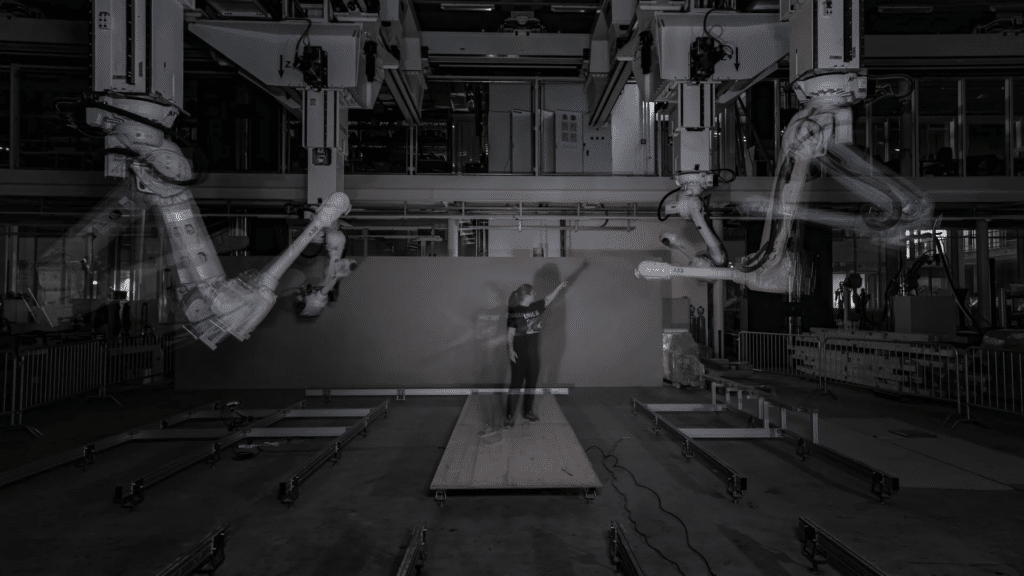
Madeline Gannon has spent over a decade working at the intersection of industrial robotics, art, and human interaction. This text presents a thematic synthesis of her lecture for the MRAC, followed by a curated Q&A session. Her professional trajectory reveals a gradual shift from the material to the immaterial: from architecture to installations, and from there to software and real-time interaction. Her approach is defined by the unconventional use of technology, highlighting the potential of “misuse” as a creative strategy. In this context, the figure of the amateur emerges as a key agent of innovation, unbounded by disciplinary conventions or implicit constraints.
The Contemporary Context: Toward Post-Intelligence Robotics
Gannon situates the present within a transitional moment in which robotics is moving beyond its academic confinement into market dynamics. She refers to this as a “post-intelligence” condition: the convergence of artificial intelligence and robotics (physical or embodied AI). This shift has been accelerated by the emergence of systems such as ChatGPT, which have contributed to the normalization of AI in everyday contexts. However, Gannon challenges the narrative of automation as inevitable, emphasizing instead its political and collective nature.
“Automation is not inevitable. It’s not a force of nature. It’s intentional, and it is our collective choices as a society for what we allow to happen.”
From Function to Feeling
“If robots are ever going to have mass adoption, how they make us feel is going to be way more important than what they do.”
The central argument of the lecture is that the success of robotics will not be determined by functional efficiency, but by its capacity to generate emotional connections. What is currently missing is a UX/UI layer for robotics: usability, interaction, and emotional experience. This gap represents a critical opportunity for artists, designers, and architects to contribute meaningful value—not as mere users of these tools, but as creators of the fundamental technologies that connect technical capabilities with society.
The Illusion of Life: Pareidolia as Design Material
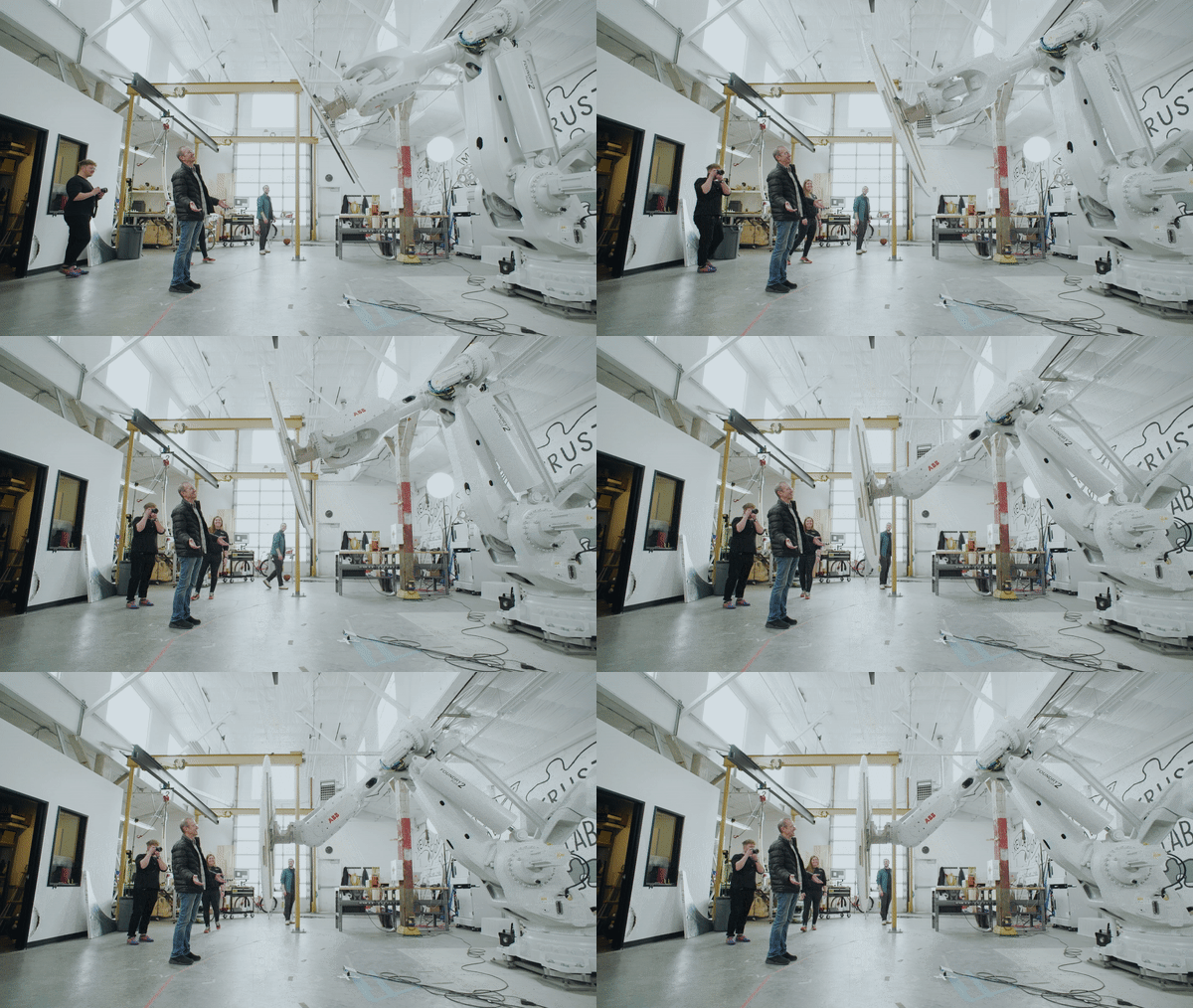
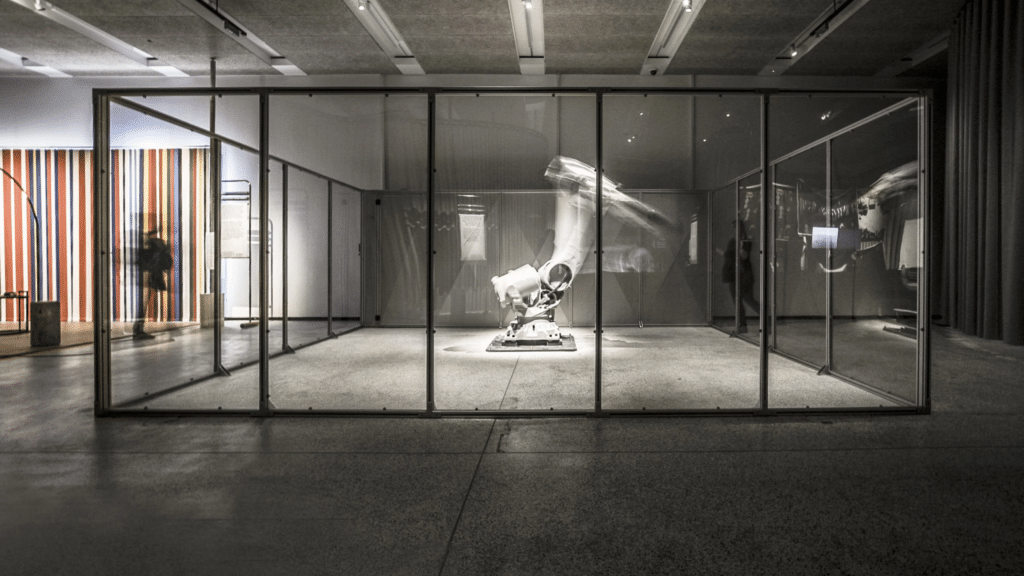
One of her most well-known projects, Mimus (2016, Design Museum London), involved giving an ABB industrial robot a “personality” through code adjustments that rendered its movements unpredictable, curious, and seemingly alive. Over 100,000 people visited the installation in six months—not to observe its task, but to connect with it. This work is grounded in the principle of pareidolia: the human tendency to attribute intention to inanimate objects. By applying this and other animation principles to robotic motion, Gannon creates deliberate gaps that the human brain fills automatically, transforming the viewer into a co-creator of the experience.
Amateurism, Play, and Skeptical Optimism
Gannon’s practice is structured around three key principles:
- Amateurism: Not knowing what cannot be done becomes an advantage. Ignorance of established limits enables the exploration of non-obvious connections.
- Intentional Play (Playfulism): The creative process is driven by directed experimentation through open-ended questions.
- Skeptical Optimism: A proactive stance that combines ambition with critical awareness.
Practical Advice for Students and Young Professionals
Gannon concludes with four concrete recommendations:
- Have your own website: maintain a personal archive independent of external platforms.
- Respond to emails: consistency and long-term accessibility are valuable professional assets.
- Be professional: meet budgets, invoices, and deadlines reliably.
- Be kind and generous: colleagues are collaborators, not competitors; sharing knowledge and opportunities creates more value than it diminishes.
Part II — Q&A
Q1. In the videos, the robot is working inside a box. I assume this is for safety, but how do you prevent failure scenarios—wrong signals or bugs?
I adopt a layered approach. I always assume three vectors of failure: bugs in the code, hardware failures, and human unpredictability. I design redundancy for all three. The level of acceptable risk depends on the context: in temporary events where my team is present, I can take more risks. In permanent installations, systems must be “baby-proof”—literally. At the Design Museum, ABB was a sponsor, which added an extra layer of accountability.
Q2. How can this approach to giving life to robots influence architectural practice? What is the relationship between art and architecture in this new wave of fabrication?
The most immediate applications lie in interface design: creating intuitive systems that unlock creativity, making tools accessible to non-technical users, and improving operational safety. Most industrial robot accidents occur because someone assumes the robot is off when it is actually on—a design problem that architects are well equipped to solve.
Q3. From a technical standpoint, how are feedback loops constructed to create continuous rather than step-based behavior?
My process has three layers: basic real-time control, behavioral systems (such as controllers or simulations), and modifiers (noise or oscillations). The combination of these layers produces fluid and expressive movement. Adjusting the filtering of sensor data directly affects perceived behavior, allowing the tuning of the system’s “personality.” It is essentially a form of handcrafted algorithmic sculpting
Q4. Are you considering extending this approach to everyday devices, such as household appliances or connected objects?
The current IoT landscape is quite uninteresting because it is driven by cost reduction: what is the cheapest device we can produce? A designer would instead ask: what experience will make someone fall in love with this machine? The Roomba points in the right direction—people name it, build houses for it, treat it like a pet. As soon as something moves in your home, it becomes part of your tribe. This is a gap in creativity, not technology. AI tools are leveling the field, enabling both technical and creative actors to compete.
Q5. Why focus on human or animal references? Why not develop forms of expression specific to robots?
I don’t aim to make robots human. I focus on the specific kinematics of each machine—what it can express within its constraints. I let industrial robots be what they are, and give them something they lack: a sense of physics. A robot can hold a position indefinitely, but that is not legible to us. If it “breathes,” if its gaze wanders, if it conveys weight or energy—these are artificial constructs that make it understandable, not human. These are animation principles applied to hardware with very different constraints than film.
