
Current construction projects lack a reliable early-warning system to predict building-code compliance issues, which leads to delays, rework, safety risks and higher project cost. Traditional inspections usually occur near the end of construction. This makes it difficult to correct issues efficiently and increases the risk of delays and safety concerns. Visual problems such as unsafe stairs, missing railings, or exposed wiring are often missed until final inspections.
| What Compl-AI is
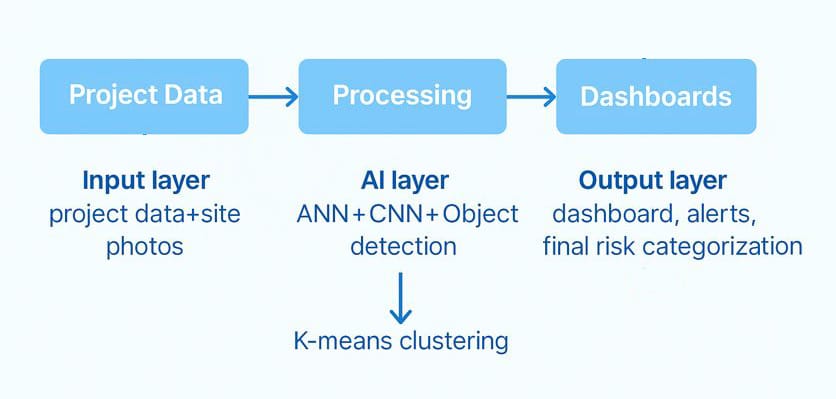
Compl-AI functions as an early-warning system for residential construction projects by addressing a key limitation of traditional compliance checks: risk cannot be reliably assessed from a single data source. Compliance issues arise from both project-level factors and on-site conditions. For this reason, Compl-AI analyzes structured project data, such as size, budget, delays, and contractor history, alongside site images. By integrating these inputs, the system produces a risk score, detects visual violations, and assigns a final risk level (Low, Medium, or High), enabling earlier and more informed intervention.
| How it works
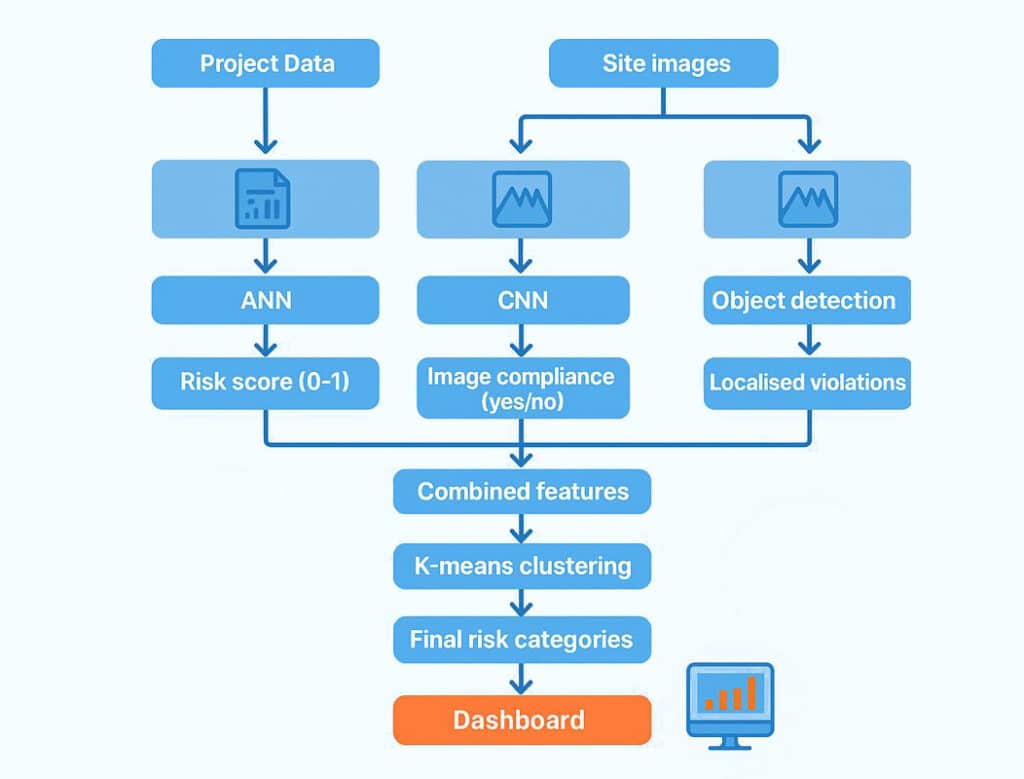
It integrates structured project data and unstructured site imagery into a multi-model AI pipeline for compliance risk assessment. Project-level features and image-based predictions are processed in parallel and then fused into a unified representation for risk analysis. The resulting outputs are delivered through dashboards and automated alerts, enabling project managers to prioritize inspections and initiate corrective actions at early stages of construction.
- Project Risk Prediction (ANN) : An Artificial Neural Network analyzes project data and produces a risk score between 0 and 1, indicating the likelihood of non-compliance.
- Visual Compliance Detection (CNN): A Convolutional Neural Network examines site photos and classifies them as compliant or non-compliant.
- Violation Localization (Object Detection): Object detection identifies what the violation is and where it appears in the image, providing clear visual evidence.
- Risk Categorization (K-Means): All results are combined and grouped into Low, Medium, or High risk categories using K-Means clustering.
| Benefits and Limitations
Compl-AI enables early identification of building-code compliance risks, helping reduce late-stage rework, project delays, and safety issues. By integrating project data with visual evidence from site images, the system supports more targeted inspections and objective, data-driven decision-making, while automated risk categorization improves resource allocation across multiple projects. However, its effectiveness depends on the availability and quality of historical project data and labeled images, and complex regulatory nuances may not always be fully captured through visual or statistical patterns alone. As building codes and construction practices evolve, the models also require regular updates to maintain accuracy and reliability.
| Further development
Future development of Compl-AI could focus on integrating IoT-enabled devices to strengthen real-time monitoring and risk prediction. Smart helmets, fixed site cameras, drones, and environmental sensors could continuously capture visual and contextual data, enabling dynamic risk updates throughout the construction lifecycle. Combining IoT streams with the existing AI pipeline would improve temporal awareness, reduce reliance on manual data collection, and support proactive, real-time compliance management.
| Reference
- Jane, K. (2024). Automated Code Compliance Checking: Tools that can automatically check building designs for compliance.
- AlterSquare. (2025). AI Safety Compliance: How Smart Cameras Prevent 80% of Construction Accidents. Medium.
- Nakhaee, A., Elshani, D., & Wortmann, T. (2025). A Vision for Automated Building Code Compliance Checking by Unifying Hybrid Knowledge Graphs and Large Language Models.
