
CONCEPT
Cymat-E explores the concept of an acoustic radar, a device that can detect and visualize the ideal audible range, or the distance where sound is heard most clearly and comfortably.
The idea takes inspiration from how radar systems map physical space, but instead, we are mapping sound space. Using microphones and sound analysis, the system measures how sound travels, reflects, and changes within different environments, helping us understand where the listening experience is best.
WORKING PRINCIPLE
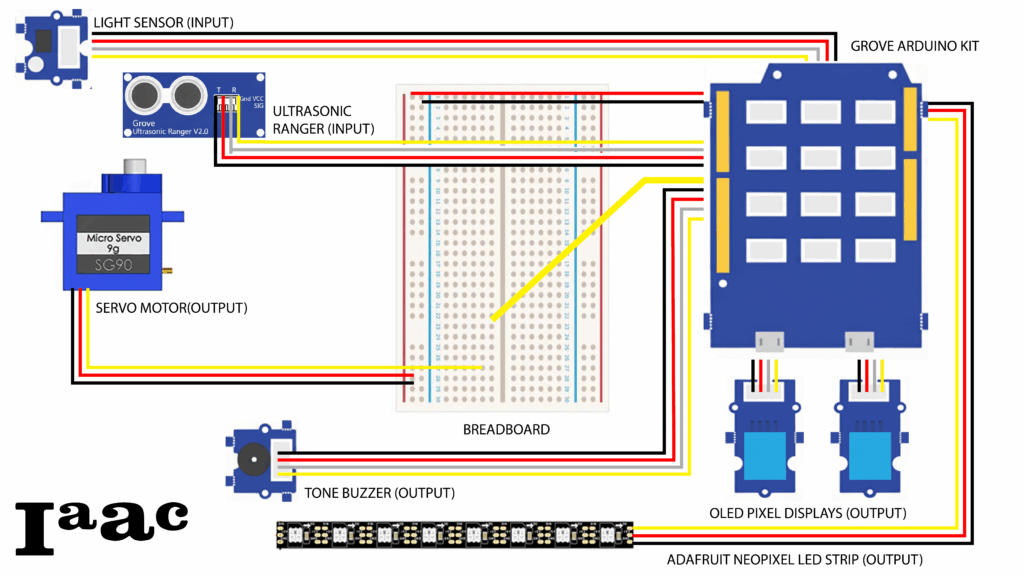
Connections to the Seeeduino (Grove Arduino Kit)
Input Connections
- Light Sensor (Input):
- Connects to a Yellow Grove Socket (Analog Input, likely A0 or similar).
- Ultrasonic Ranger (Input):
- Connects to the White Grove Socket (Digital Input, likely D4 or similar).
Output Connections
- Micro Servo 9g SG90 (Output):
- The signal wire (Yellow/White) connects to the Breadboard.
- A separate wire from the Breadboard connects to a Yellow Grove Socket (Digital Output, likely D5 or D6 as it’s PWM capable, or another digital pin).
- Tone Buzzer (Output):
- Connects to a White Grove Socket (Digital Output, likely D2 or D3).
- OLED Pixel Displays (Output) (x2):
- Both displays appear to be connected in parallel to the same Grove socket.
- Connect to a Blue Grove Socket (I2C/IIC connection, typically SDA/SCL pins).
- Adafruit NeoPixel LED Strip (Output):
- The signal wire connects to the Breadboard.
- A separate wire from the Breadboard connects to a Yellow Grove Socket (Digital Output, likely D7 or D8).
PROTOTYPE
REAL-WORLD APPLICATION
Cymat-E is an acoustic radar, capable of detecting the ideal audible range, the distance at which sound is experienced most clearly and naturally. While this technology has applications across multiple fields, its potential in spatial sound design is particularly compelling.
By mapping how sound propagates through a space, the device reveals how materials, geometry, and layout influence the acoustic experience. This opens new possibilities for architects and designers, enabling them to shape spaces not only through form and light but also through how sound is perceived and felt.
Looking ahead, the technology could transform design processes. Imagine museums that adjust ambient sound dynamically based on visitor movement, or public spaces where acoustics adapt for clarity and comfort. Ultimately, this approach envisions a future where architecture becomes truly immersive, using sound as a deliberate design element to enhance the sensory and emotional experience of space.
https://drive.google.com/file/d/10WXR3P0lk0ZcHmDFN9Z48eq5ViGTkYrm/view
