
Bab al-Luq Market – Cairo, Egypt

The ‘Diffused Skin Market’ project aims to cool down the market space without closing it off.
The goal was to create a ‘diffusion filter” skin, that drops the temperature but keeps that vibrant natural light that vendors need to sell their products.
The challenge when analyzing the place, wasn’t just ‘designing a roof. The main issue was the tempareture inside the market: It was incredibly hot, the sun hit hard and the noise was constant.
The proposed solution to all these issues was a parametric suspended skin, enhancing light, height and circulation inside the market. The skin acts as a “diffusion filter” that lowers the temperature at the same time that maintains the natural light needed to see the market products.
1. Early Explorations

First approach
Scale of ground / membrane intersections is sometimes too tight and restrictive for the circulation and doesn’t work functionally.

Second approach
Start adapting to an existing roof element – in section it seems you are introducing a completely different plane that does not interact with the roof geometry.

New Goal
Integrate paht circulation, avoid collisions with the building
2. Computational Methodology
The architecture skin does not obstruct the flow; it grows around it.
- Inputs: Existing roof geometry, circulation paths, light directions.
- Process: Grasshopper, Kagaroo, form-finding and panelization.
- Outputs: final canopy surface, oculus, tiling system.
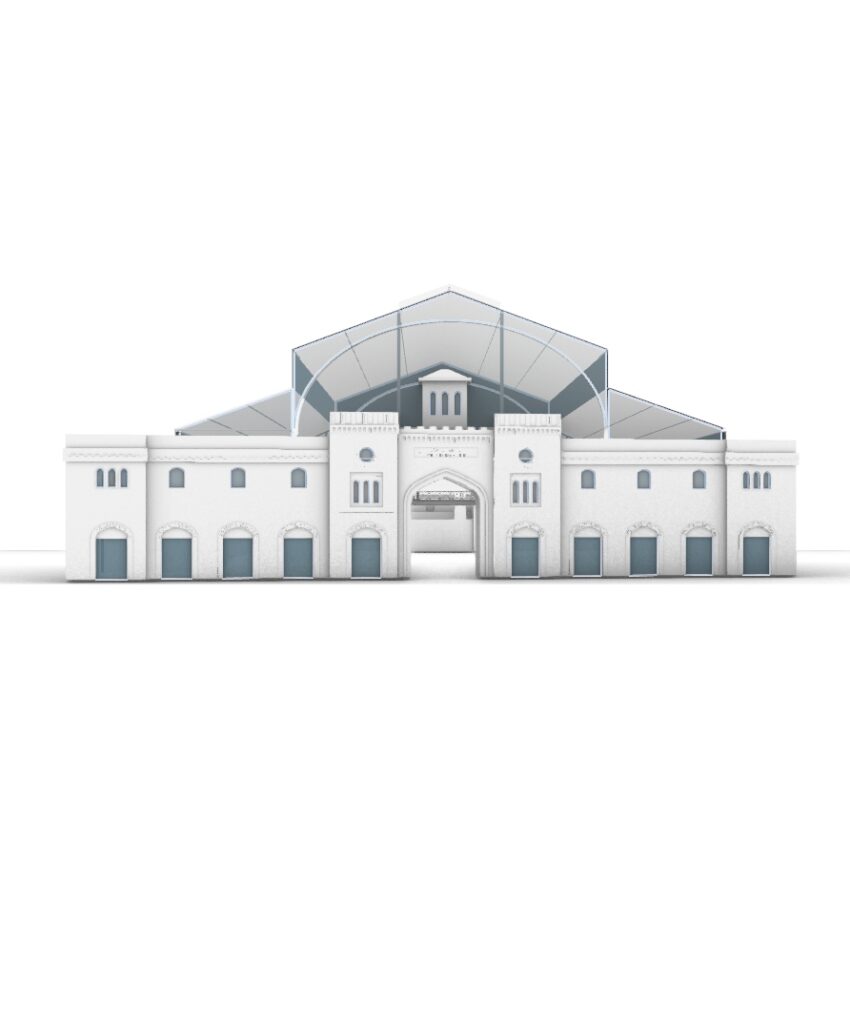
Market Structure

Full Market
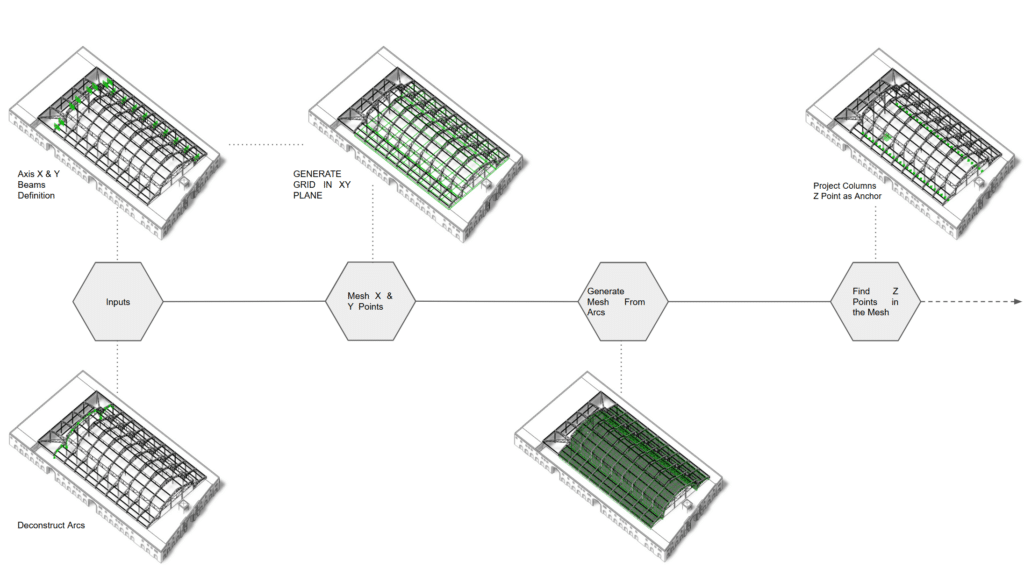
Computational Workflow Part 01
The smarter logic started with the basics: the ‘Inputs’.
A grid was generated on the XY plane and projected a specific anchor points. Based on the existing roof geometry and the paths where people actually walk, instead of forcing a shape,
The idea was to ensure that the designed sit perfectly on the old iron structure, respecting the heritage of the building rather than competing with it.
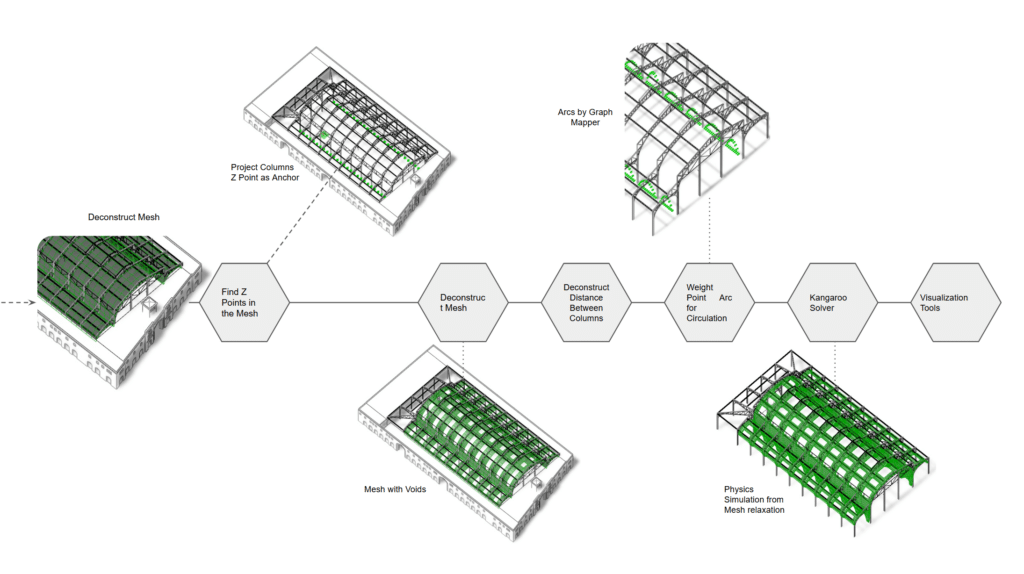
Computational Workflow Part 02
The proposal was design with the Kangaroo plug-in to simulate gravity.
The starting point was the existing market structure, where voids and arches were projected and meshed.
The mesh was conceived as a fabric, hanging from the iron structure, that naturally falls down to the floor. In order to pull the mesh down, the colums were used as a ‘Weight Point’ resulting in organic arches.
3. Form-finding process
Mesh relaxation
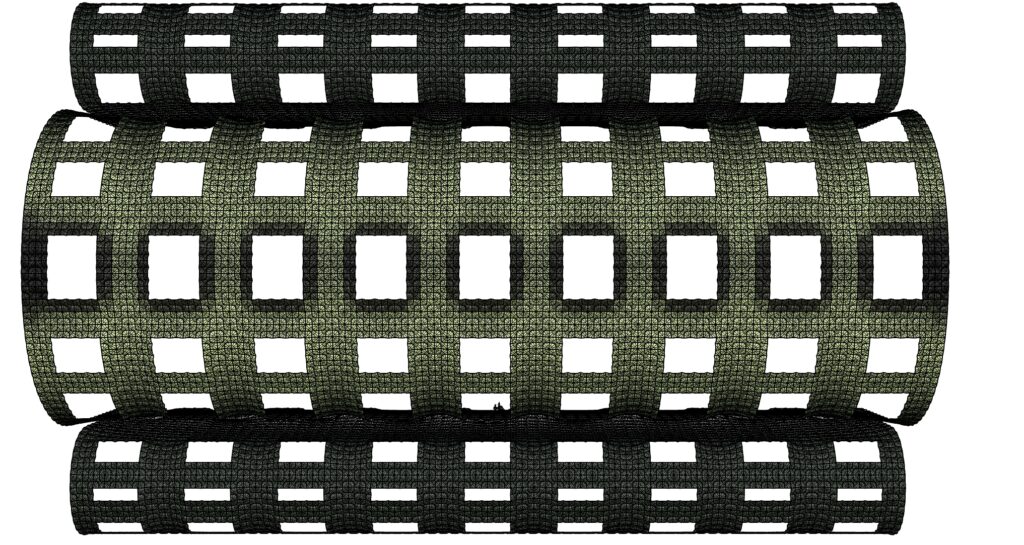
Starting from the existing market structure as input, voids and arches are projected and meshed, relaxed with Kangaroo and thickened into translucent tiles, while different opening ratios (10 to 80%) controlling the depth and porosity of the suspended skin.

Tile System
After the relaxed mesh is wrapped with thousands of square cells, each cell hosts an Escher interlocking tiling system, while a non-aesthetic colour gradient encodes a height-driven material logic in which higher zones of the canopy are assigned denser material and lower zones become more porous.


Void Iterations
The void opening iteration compares 10% and 50% opening of the projected roof voids,
Opening 10%
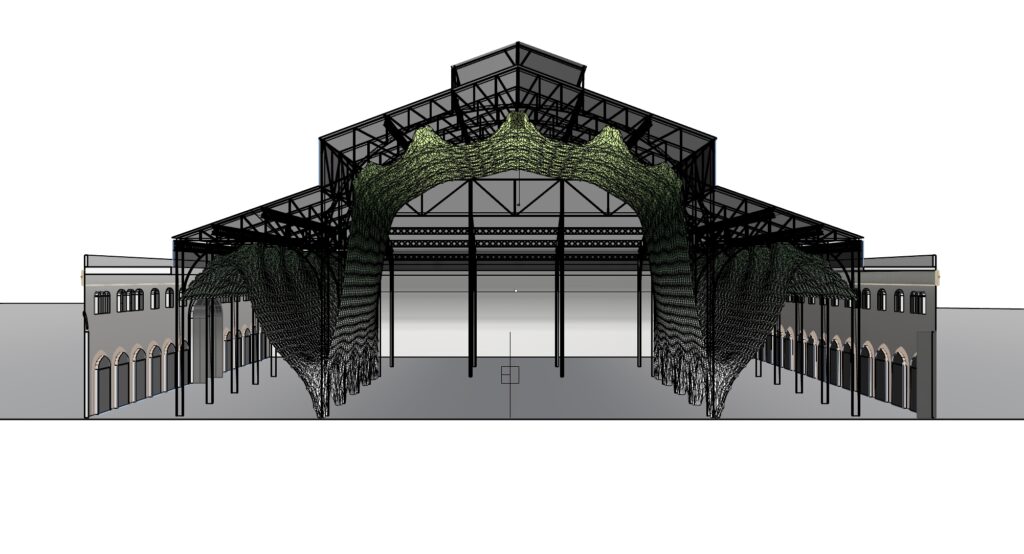
Opening 50%

Arches Iteration
The arches iterations were used to simulate three different scenarios of the parabolic arches modulation, adjusting the depth and porosity of the skin to choose the best option that maintained the space below the vault opened and confortable enought to move through.
Iteration 1

Iteration 2
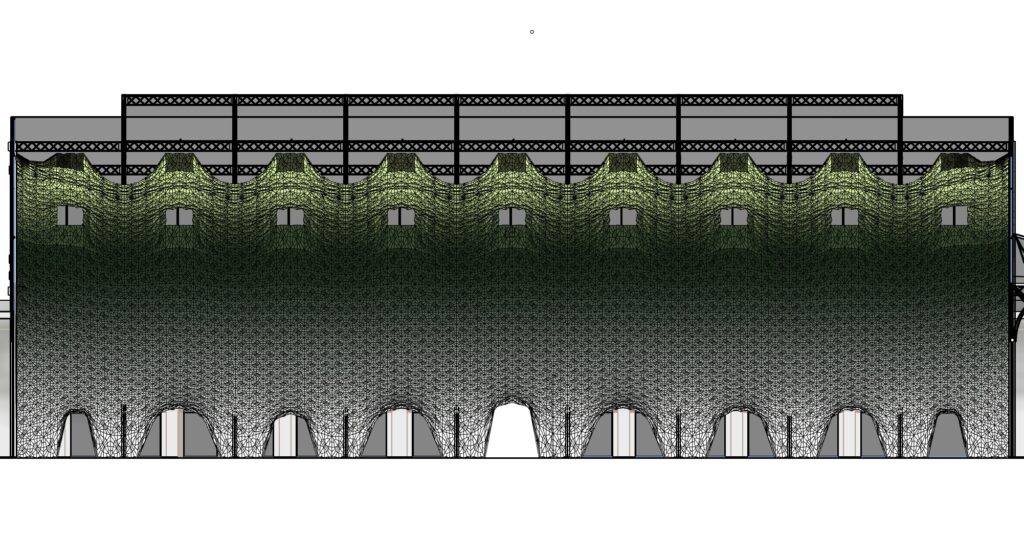
Iteration 3

4. The Result
A mesh rolled down from the existing iron structure, matching the current structure voids, to allow the smooth air flow and light difussion.

The skin rolled down below the iron structure.
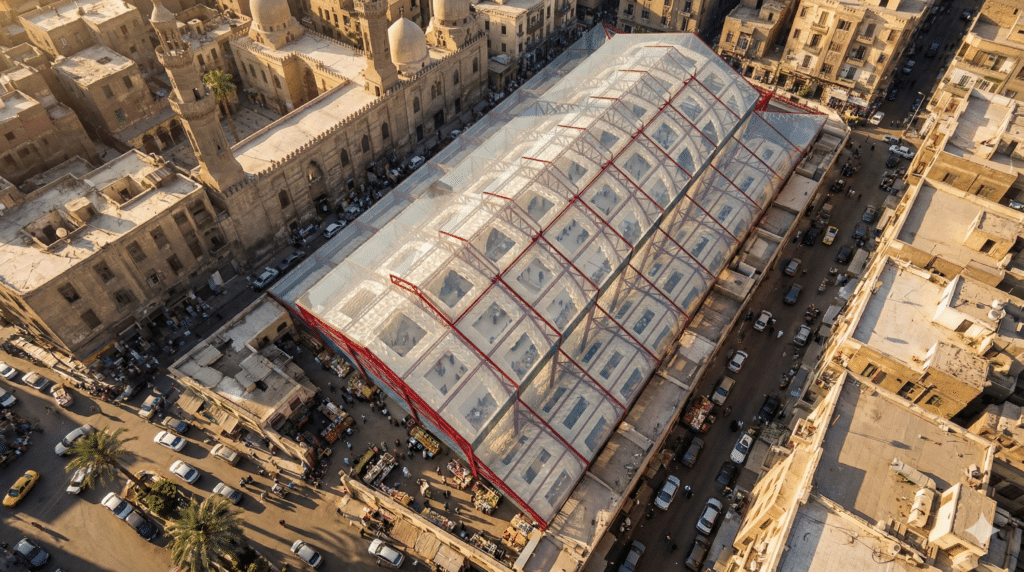
The mesh system matches the voids of the existing structure

The skin reduces the high temparture, while diffusing the light inside the market.
