
Introduction: More Than a Robot in a Hard Hat
The buzz around Artificial Intelligence in the Architecture, Engineering, and Construction (AEC) industry is impossible to ignore. Every conference seems to feature a new tool promising to revolutionize everything from design to demolition. You might be forgiven for picturing an AI as a robot in a hard hat, making jokes about needing a “bit” more training.
But beyond the hype, what is the true purpose of AI in our field? It’s rapidly evolving from a simple efficiency tool into a complex digital partner. Let’s explore that evolution—from supercharged assistant to predictive oracle—and the critical question: what does this actually mean for the engineer on the ground?
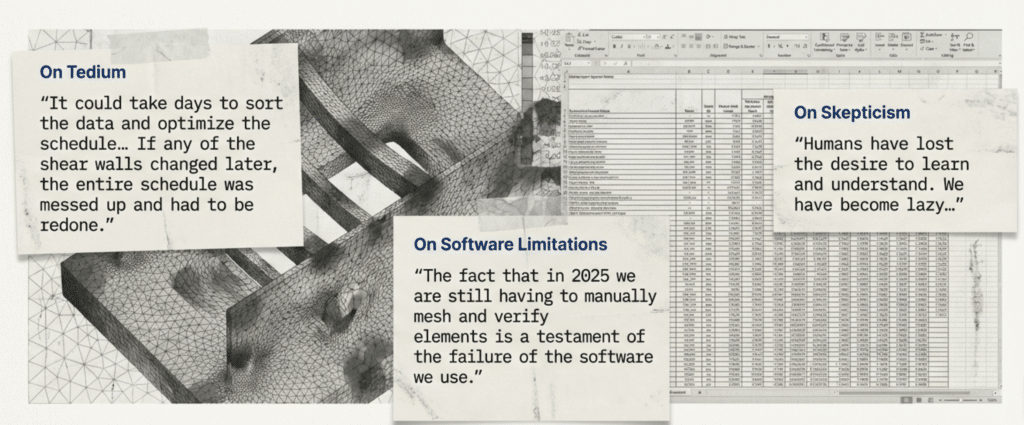
1. The Supercharged Assistant: Supercharging Our Abilities, Not Replacing Us
The most immediate purpose of AI is to act as a powerful digital assistant. It excels at automating the tedious stuff so humans can focus on the hard stuff. AI isn’t here to replace engineers; it’s here to give them superpowers.
We see this daily on forums like Reddit’s r/StructuralEngineering. Engineers report using AI to write VBA macros for complex spreadsheets or to polish technical reports that, as one user eloquently put it, “sound like shit.” This isn’t about offloading core engineering; it’s about streamlining the administrative headaches.
This assistant role also extends to data analysis that would drown a human. In water management, AI sifts through IoT sensor data to detect leaks. In urban maintenance, Convolutional Neural Networks (CNNs) automate the detection of sewer defects from CCTV footage—saving poor interns from hours of staring at sewer pipes. AI acts as the tireless analyst, flagging issues so you can make the decisions.
2. The Generative Partner: Designing a Smarter World
Beyond just assisting, AI is becoming a “generative partner,” creating novel design solutions a human might never conceive. This is a shift from checking designs to generating them.
Take structural topology optimization. Deep learning models can now generate a near-optimal structure for a set of conditions without endless iteration. This isn’t just cool tech; it’s a sustainability engine. Optimized forms mean less material and less waste.
We are even seeing AI enable sci-fi levels of green infrastructure. The Carbelim BioMimetic Facade, for example, uses algae-based photobioreactors to turn a building’s facade into a CO2 capture system. This isn’t just a better version of an old idea; it’s a new paradigm enabled by advanced tech.
3. The Digital Crystal Ball: Predicting the Future
Perhaps AI’s most profound purpose is serving as a digital crystal ball for infrastructure. By forecasting failures, AI enhances safety and protects the public.
Cutting-edge wireless Structural Health Monitoring (SHM) systems are now embedding sensors directly into materials. These sensors transmit data to deep neural networks that can predict mechanical properties and forecast structural failures before they happen.
This accuracy allows operators to shift from “fix it when it breaks” to proactive, predictive maintenance. Whether it’s using models for flood forecasting or monitoring bridge health in real-time, this capability transforms capital planning from a guessing game into a data-driven strategy.
4. The Sobering Paradox: Why Governance is Non-Negotiable
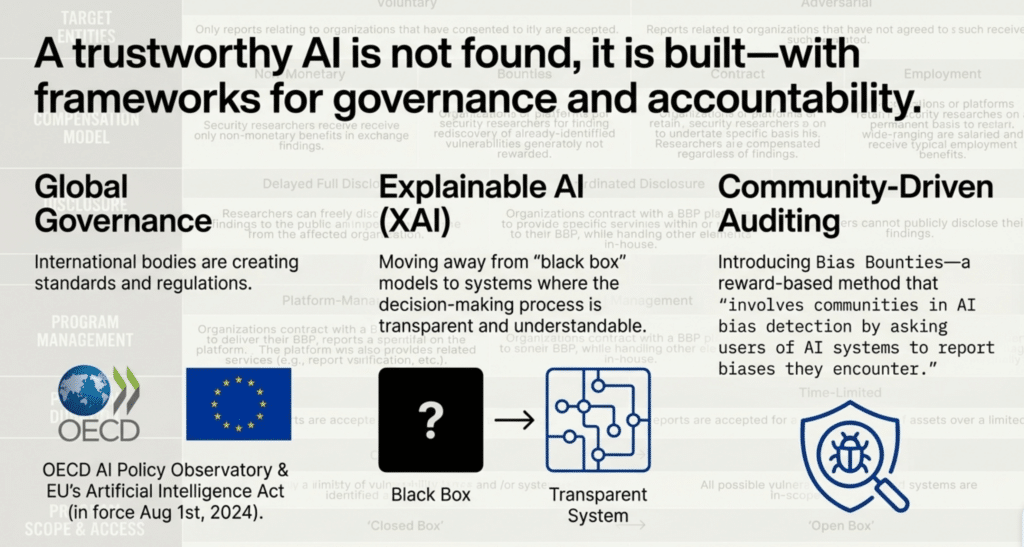
However, this power comes with a sobering paradox: AI has immense potential for good, but also for harm if left ungoverned.
Rumman Chowdhury, a leader in responsible AI, calls it “moral outsourcing”—the danger of blaming the algorithm for biased outputs. We cannot treat a biased algorithm as a technical glitch; we must hold its creators accountable.
Consider the risks: An AI trained on economic metrics might prioritize retrofitting luxury apartments over vulnerable, low-income housing. Or, a damage assessment model might underestimate risks for rural structures simply because they were underrepresented in the training data. Without intentional governance, AI could amplify historical inequities, mistaking economic value for societal importance.
5. The Ultimate Purpose: Upholding Professional Judgment
This brings us to the ultimate truth: AI is here to enhance human judgment, not replace it. The engineer’s hand must remain on the controls.
Consider “Alex,” a senior structural engineer. An advanced AI recommended reducing steel reinforcement in a high-rise core to cut costs, citing that it met safety margins. But Alex, using decades of experience, challenged the recommendation. He flagged long-term fatigue concerns the AI’s training data hadn’t fully captured.
Alex’s intervention was a crucial act of risk management. But for an engineer to make that call, the AI cannot be a “black box.” We need Explainable AI (XAI) tools that show us why a model made a decision. We need to be able to interrogate the logic, not just blindly trust the output.

Conclusion: Building the Future, Responsibly
The true purpose of AI in AEC is partnership. It handles scale, speed, and complexity; we provide judgment, ethics, and context.
From the assistant fixing your “sounds like shit” reports to the generative partner imagining algae facades, AI extends our capabilities. But this partnership demands responsibility. As we build the next generation of infrastructure, we must also build the next generation of engineers—equipped not just to use AI, but to guide it wisely.
Full disclosure: This article itself was heavily partnered with AI. With all these thoughts, concerns, and reference images to juggle, without my digital assistant, I definitely wouldn’t have made it to my holiday plans!
——————————————————————————————————————————————————————————————————————————-
References
- Aceves, Paula. “‘I do not think ethical surveillance can exist’: Rumman Chowdhury on accountability in AI.” The Guardian, May 29, 2023.
- Al-Habaibeh, Amin, et al. “Accelerating Whole Life Carbon Assessment in Construction with Artificial Intelligence.” Energy Catalyst, Vol. 01, 2025, pp. 54-67.
- Lee, Hyunho, and Wenwen Li. “Geospatial Artificial Intelligence for Satellite-Based Flood Extent Mapping: Concepts, Advances, and Future Perspectives.” arXiv preprint, 2024.
- Plevris, Vagelis, and Haidar Hosamo. “Responsible AI in structural engineering: a framework for ethical use.” Frontiers in Built Environment, Vol. 11, July 11, 2025.
- Pop, Marius, et al. “A Machine Learning-Driven Wireless System for Structural Health Monitoring.” INCAS BULLETIN, Vol. 16, Issue 3, 2024.
- Reddit. “Is there any actual use case for AI for structural engineers?” r/StructuralEngineering, 2025.
- Talatahari, S., and B. Nouhi. “Generative Artificial Intelligence in Structural Optimization: Opportunities, Challenges, and Future Directions.” International Journal of Optimization in Civil Engineering, 15(3):317-334, 2025.
- Tamanna, Yasmin. “10 Top Climate Adaptation Startups and Companies to Watch in 2025.” StartUs Insights, July 9, 2025.
- WI.Plat. “AI in Water Management: Smart Leak Detection Solutions.” January 3, 2025.
