

Oriol Carrasco – Anomaly.Build
Oriol Carrasco is a PhD architect from Barcelona. He is a senior fabrication expert at IAAC with extensive expertise in composite manufacturing. Oriol currently teaches in MAA and 3DpA programs. He has been co-leading the Design with Nature research line since 2013, teaching now in the metabolic introductory studio. He has been combining teaching and working in the engineering and architectural fields since 2005, collaborating with big firms for developing projects in Europe and South America. Considers himself passionate about computational design, prototyping of real-scale mock-ups and novel fabrication methods.
Transcript of the guest lecture at IAAC on 19 November 2025 by Jiani Zhang and Subha Tahsin Saba.
During the lecture, Oriol Carrasco presented the core philosophy and working methodology of Anomaly.Build, emphasizing the seamless integration between digital design and full-scale fabrication. He argued for a paradigm shift: architecture should no longer treat design and construction as separate phases, but rather as a continuous, tightly coupled pipeline from geometry generation to production execution. This integrated pipeline enables the realization of complex, free-form geometries that would be difficult, if not impossible, to build under conventional workflows.
Carrasco described the typical workflow at Anomaly.Build. Beginning with a parametric or computational geometry model, the pipeline proceeds through structural analysis, detailing of connection logic, tolerance management, and eventually to the generation of production-ready fabrication files (e.g., CNC cutting patterns, mould-making data, assembly instructions). At each stage, the team maintains control over constructability, manufacturability, and on-site assembly feasibility. He emphasized the importance of early thinking about fabrication when designing, because decisions taken in the modeling stage significantly influence downstream feasibility and cost.
He also highlighted the firm’s collaborative approach: Anomaly.Build works closely with architects, structural engineers, fabricators, and building contractors, effectively acting as a bridge between conceptual design and on-site construction. Through case studies, including large-scale projects such as the Sagrada Família, he illustrated how their methodology allows for the translation of highly complex digital geometries into buildable components with precise tolerances, efficient production, and rationalized assembly sequences.
Finally, Carrasco reflected on the educational significance: he argued that computational design education must not only teach generative modeling, but also incorporate fabrication logic, engineering considerations, and full-scale mock-ups, in order to prepare future architects to engage effectively in the full lifecycle of built projects, from conception to realization.
[Question 1] Which types of geometries or components tend to create the largest gap between digital models and actual constructability? How do you typically bridge that gap?
Carrasco explained that the largest gaps emerge in geometries characterized by high curvature, non-uniform thickness, or complex node and connection conditions, especially in free-form shells, double-curved surfaces, or components requiring bespoke joins. In these cases, purely digital models may neglect structural behavior, tolerances, assembly sequencing, or on-site constraints. To bridge this gap, Anomaly.Build performs early structural and fabrication feasibility studies. They incorporate engineering analysis (for example, finite-element checks), connection logic design, tolerance allocation, and construction sequencing during design development. This ensures that the digital model is not just visually “correct” but also constructable and manufacturable.
[Question 2] How much of the pipeline from geometry to production files (cutting paths, molds, connection details) can be automated? Which stages still require the most manual intervention?
Carrasco indicated that the initial stages, including geometry generation, parametric modeling, and even basic nesting or panelization, can be highly automated. Algorithmic scripts and computational design tools can generate cut-paths, subdivide surfaces, and produce CNC-ready patterns. However, stages requiring engineering judgment, such as connection detail design, tolerance allocation, quality control criteria, mould setup for non-standard components, and on-site assembly logistics, still depend heavily on manual intervention and experienced engineers. These are areas where automation remains limited.

[Question 3] In your experience, is it more effective to pre-encode tolerances in the design stage or rely on real-time fabrication feedback loops? What systems do you use to manage tolerances?
Carrasco argued that a hybrid approach is most effective. They pre-encode a baseline tolerance budget during design by defining acceptable variation ranges for thickness, connection gaps, and similar parameters, but they also integrate real-time fabrication feedback, especially during prototyping and full-scale mock-ups. By combining upfront tolerance definitions with iterative fabrication feedback loops, such as measuring produced components, comparing them against design tolerances, and adjusting parameters, they can gradually refine both the digital model and the production process. This two-step strategy helps control tolerance drift and ensures final assembly precision.
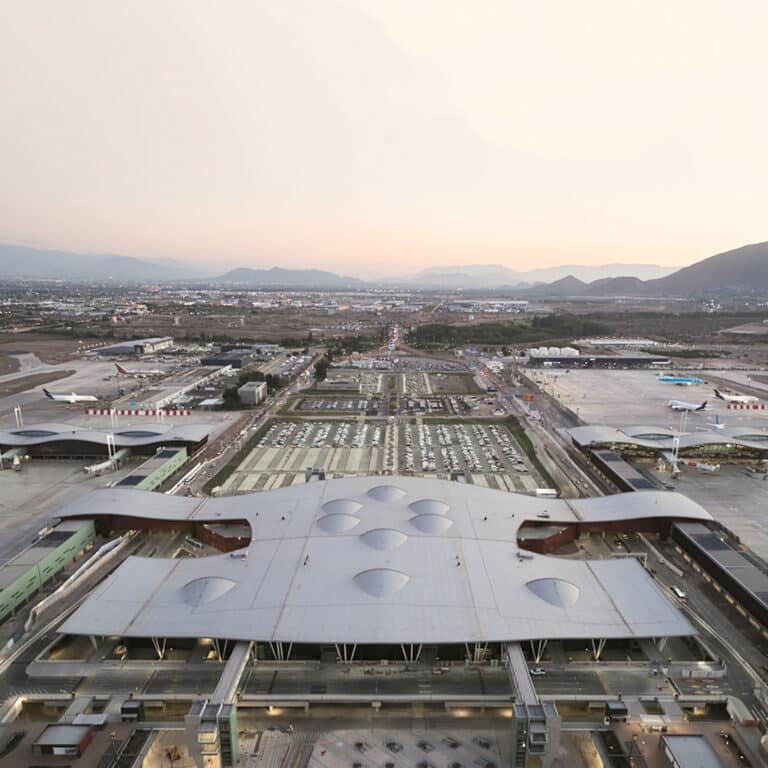
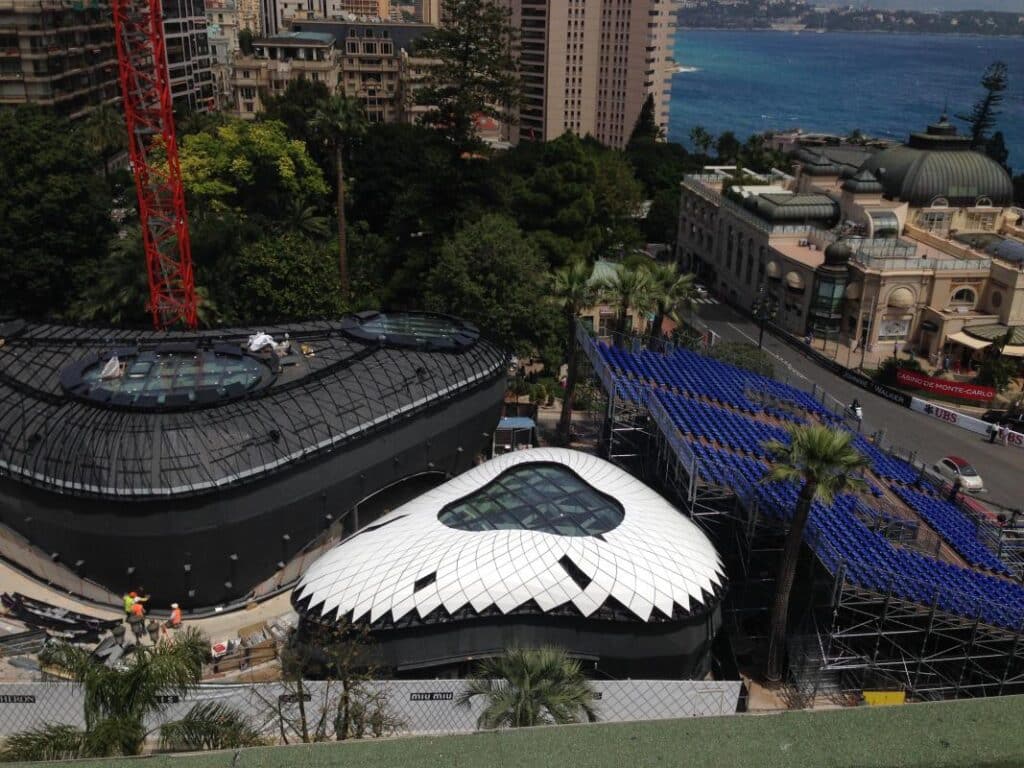
[Question 4] As you do very large scale projects, like the Chile airport, the Monaco pavillion, or the Sagrada Familia, where every piece and measurements are very delicate and precise, in case of any errors where do you start to fix the problem? In my understanding, all the fabrication pieces are very connected and any kind of error may or may not affect a lot of the surroundings too.
Carrasco emphasized that error management is highly contingent on the stage at which the discrepancy is detected. Fabrication issues are often subtle and are typically not revealed until on-site construction begins. The process usually starts with classifying the error type, determining whether a component has been incorrectly oriented, a measurement has deviated from the intended specification, or a part simply fails to fit within the assembled system. Once the nature of the problem has been identified, an appropriate remediation strategy can be formulated. Rather than a single universal procedure, resolution methods are developed on a case-by-case basis, since each error manifests at a different point in the workflow and must be addressed according to the circumstances in which it is encountered.
[Question 5] Is there any checklist or protocol that you follow to minimize the potential damage caused by fabrication or construction errors?
Costalo explained that a checklist does not really come in handy, since errors are not predictable, but a layered verification strategy tends to work best. He mentioned that a set of baseline checks is usually built into the digital design phase, including dimensional cross-referencing, tolerance allocation, and clash detection between components, and then real-time monitoring is added once fabrication and construction actually begin. By combining those upfront digital checks with ongoing on-site inspections, such as sampling CNC outputs, comparing as-built measurements against model specifications, and adjusting fabrication parameters on the fly, both the model and the production workflow can be gradually refined.
He emphasized that he makes every effort to minimize errors from the outset, yet acknowledges that issues can still emerge. When they do, he evaluates them case by case, taking steps as needed to keep the problem from escalating and to maintain precision through to final assembly.
