
Abstract
In Contemporary Architecture, we are witnessing a shift from standardized building systems towards highly differentiated, data driven and geometrically complex structures. These projects challenge conventional workflows, requiring new methods to manage variation, fabrication logic, and translation of digital models into physical assemblies. Our research investigates how computational design, parametric modelling, and digital fabrication workflows enable this transition, focusing especially on how design information is structured to move efficiently from concept to construction.
Guest: Marc Fornes TheVeryMany
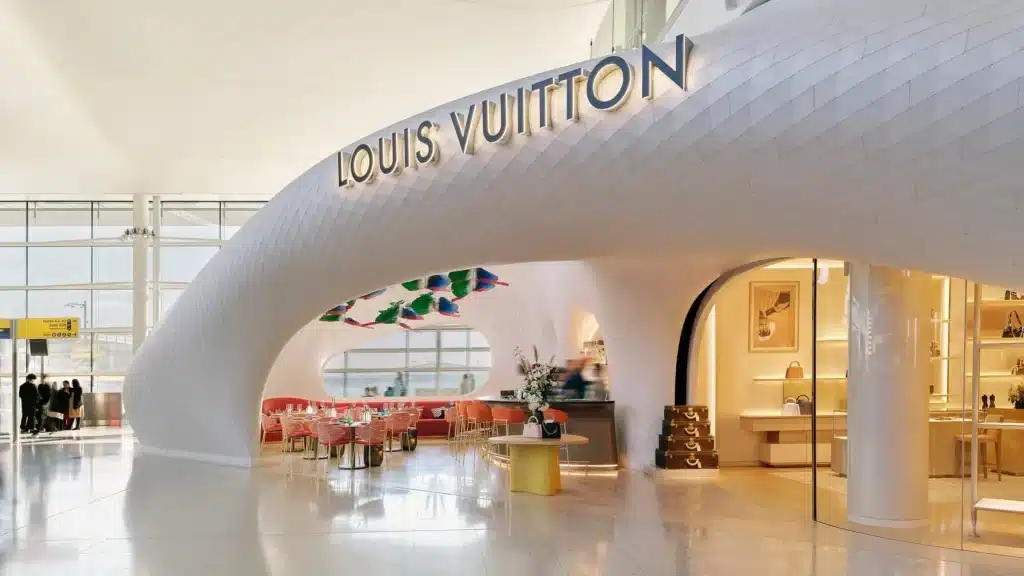
Marc Fornes is an Architect and the founder of The Very Many, a New York–based studio known for large-scale, site-specific structures that integrate form, structure, and surface into unified systems. His work focuses on computational design, parametric workflows, and digital fabrication, particularly in the development of thin-shell and non-standard architectural systems. Situated between architecture and public art, his projects translate complex curvilinear geometries into buildable assemblies and have been exhibited internationally, including at the Centre Pompidou and the FRAC Centre. Fornes has also shared his research through lectures, teaching, and professional practice at leading institutions and firms.
Prepared Questions:
1. General question “ice breaker”:
We understand you started as more traditional architect, how did you end up into computational design and digital fabrication?
2. Specific question “Identity”:
We have noticed that in many of your pavilions there’s almost no visible substructure. The enclosure itself seems to become the structure or geometry, skin, and performance all fused into one system. Is that an intentional design philosophy from the start, or something that emerges through the computational process?
3. Specific question “Reality”:
Since the structure is embedded in the skin itself, how does that change the way you prepare fabrication data? With geometry as complex as this, what methodologies do you use for fabrications? How are these processes automated?
4. Specific question “Challenges”:
What are the main challenges you encounter when fabricating complex architectural systems, and where do you see the greatest opportunities for improving digital design-to-fabrication workflows in the future?
5. Wrap up question “Future”:
Having followed and engaged with your work, how do you envision the types of structures you will explore in the future?
Actual Questions:
1. We want to start as an icebreaker, maybe to talk a little bit about the origins of your journey. Your work today is strongly associated with computational design and digital fabrication. But that trajectory doesn’t happen overnight. How did you end up into computational design and digital fabrication?
2. So, the next thing is more about like diving into your work, what we notice in after studying a lot of your projects and even small processes, like details, which we come across, one thing we see as your projects do not have a visible substructure as we traditionally perceive it, it’s more like a special enclosure and performance, fused into one kind of a system. Which brings us to something we’ve been very curious to know if this is intentional from the start, or does it emerge from some kind of a computational process?
3. So like moving on, as you mentioned, you try to learn from all the data sets you have previously worked on. And that’s how we see it as well, where your projects are seen as data rich geometries of sorts. How does that change the way you prepare, say, the fabrication data and what kind of methodologies you use and how are these kind of processes automated? Because I see there are like a lot of systems that get embedded into it and it’s not something which maybe like one or two people can repetitively do, so it has to have some layer of automation into it.
4. Probably like our next question was related to fabrication and what are the greatest opportunities which could improve like the digital design and two fabrication workflows in the future?
Bonus Question: I’m going to go a little bit off script because from the conversation, something came up. Would you recommend, because when I studied architecture and engineering, I did something completely different to what we’re doing now into these masters. Also in order to get into architecture school, I did freehand drawing. So would you recommend to newly architects to know how to code, to learn how to code during university years?
5. As we close, and we want to say that your work is already recognizable and influential in the field of computational architecture, as we already said. So, now that we have followed and we are able to identify your work, which is not something that we can say for many architects, in the future are you envisioning different types of structures?
Sound Post Processing:
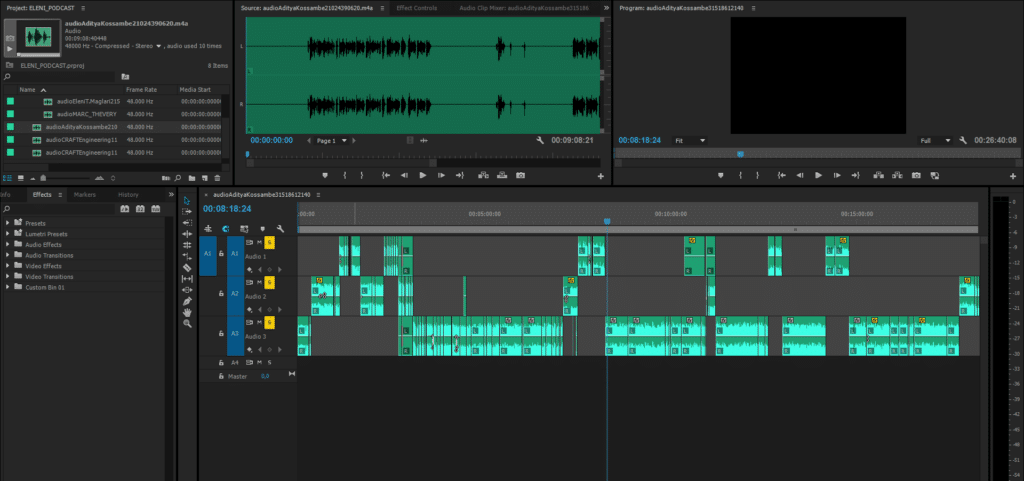
For audio post-processing, we used Adobe Premiere. By editing out pauses and speech errors, we reduced the recording by approximately four minutes. The final duration of the podcast is 26 minutes and 40 seconds. The audio was then further refined using Adobe Podcast to enhance clarity and overall sound quality.
To listen to the podcast, stay tuned!
Featured Image: Pillars of Dreams: https://theverymany.com/pillars-of-dreams
