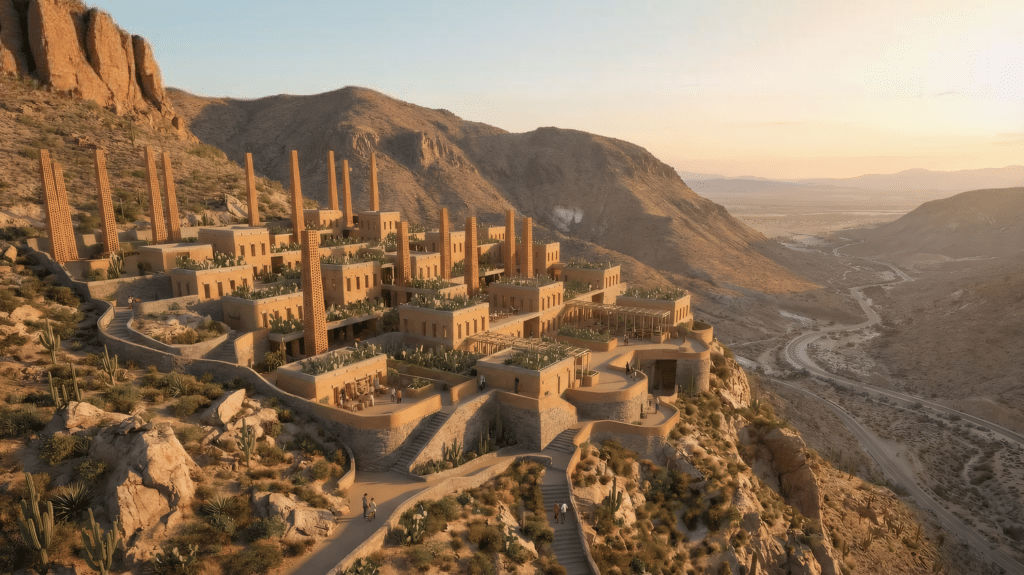
“Terrascape does not impose an external order; it encodes the survival logic of the Mexican informal ‘barrio’ to transform it into a dignified, resilient, and dynamic housing system.“
The Geometry of Necessity
In the rugged topography of Chihuahua, Mexico, the “Barrio” is not just a residential zone; it is a morphological catalyst. It embodies a vernacular intelligence of incremental growth and survival. GEOMORPHING TERRASCAPE stems from research on how to dignify this informal praxis by logically encoding the organic growth of Mexican neighborhoods.
To combat the extreme climate of Chihuahua, we designed a resilient architecture that integrates form and function using the Monoceros plugin. Through logical aggregation rules, we created a porous, mixed-use system that leverages thermal inertia and mutual shading, transforming the essence of the informal neighborhood into a technical, sustainable habitat perfectly adapted to the desert.
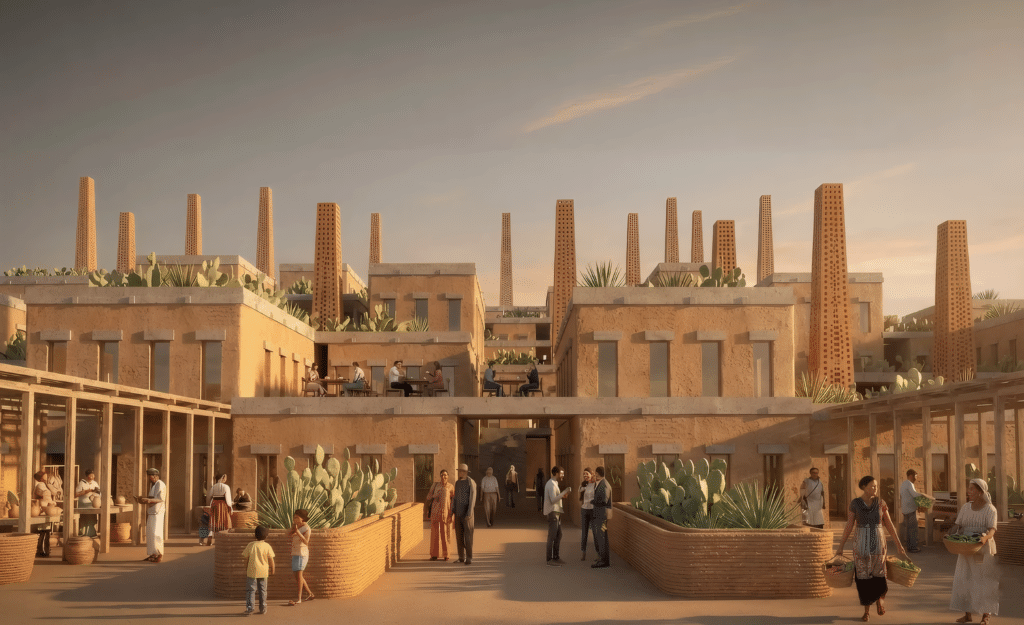
Design Strategy: Encoding the “Barrio”
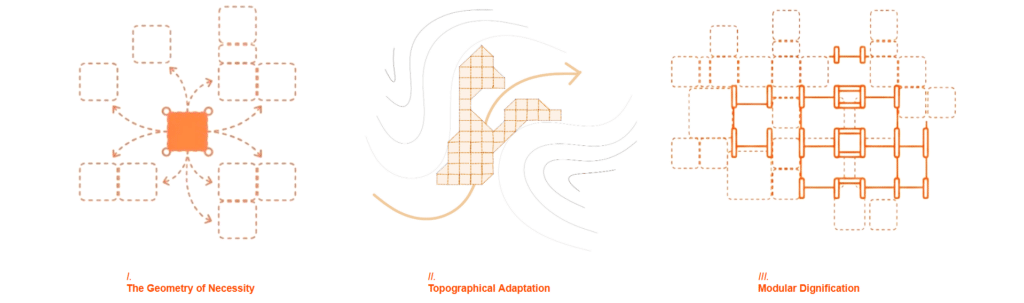
Our strategy translates the spontaneous survival logic of the barrio into three core computational concepts:
- The Geometry of Necessity: We utilize Wave Function Collapse (WFC) algorithms to mimic organic growth, ensuring the architecture expands by rule-based necessity rather than imposed grids.
- Topographical Adaptation: The system acts as a responsive agent that interweaves with the hills of Chihuahua, turning steep terrain challenges into spatial assets.
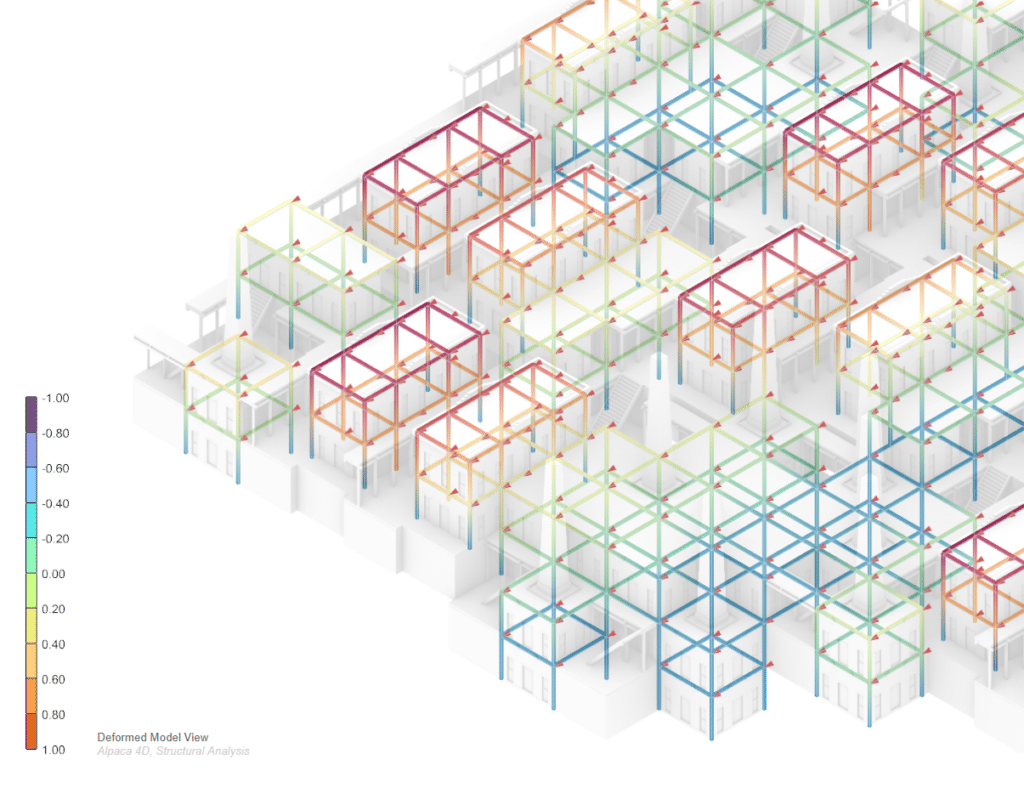
- Modular Dignification: We elevate the informal model through technical precision, ensuring structural safety and climate resilience without losing the essence of self-construction.
Topological Organization: The “Tianguis” Typology
The project’s organizational logic is inspired by the traditional Mexican Tianguis (open-air market); a typology defined by a “little bit of everything”. This fosters a mixed-use environment where residential clusters are limited to no more than six modules to maintain a human scale and promote social interaction.
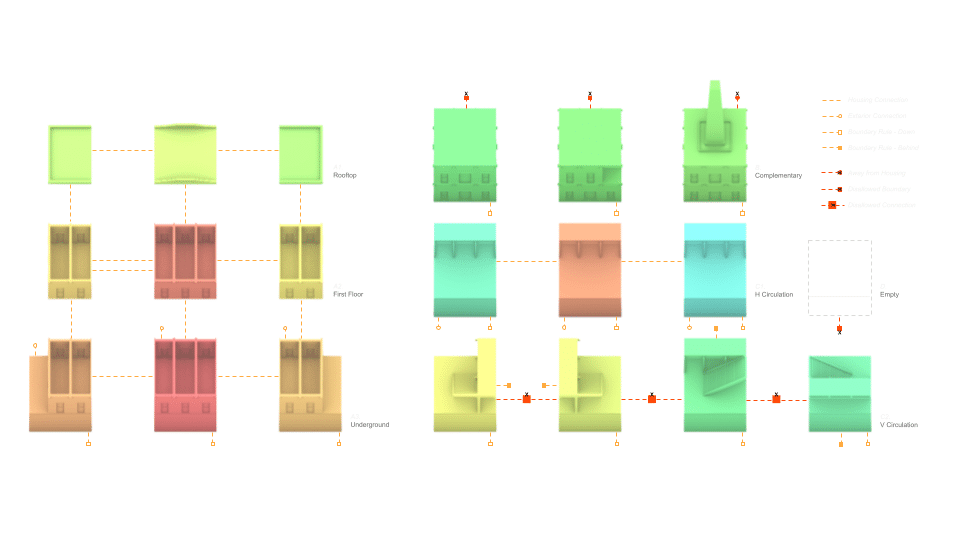
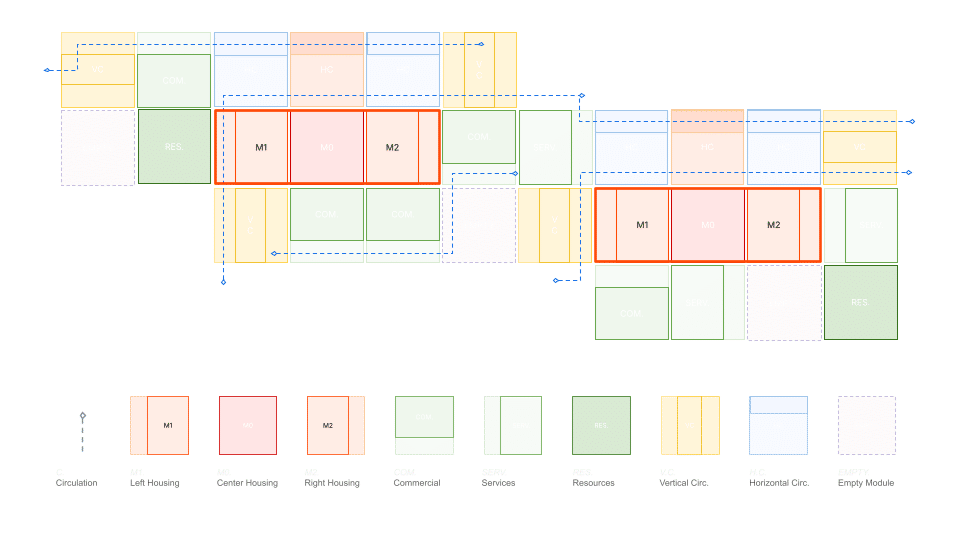
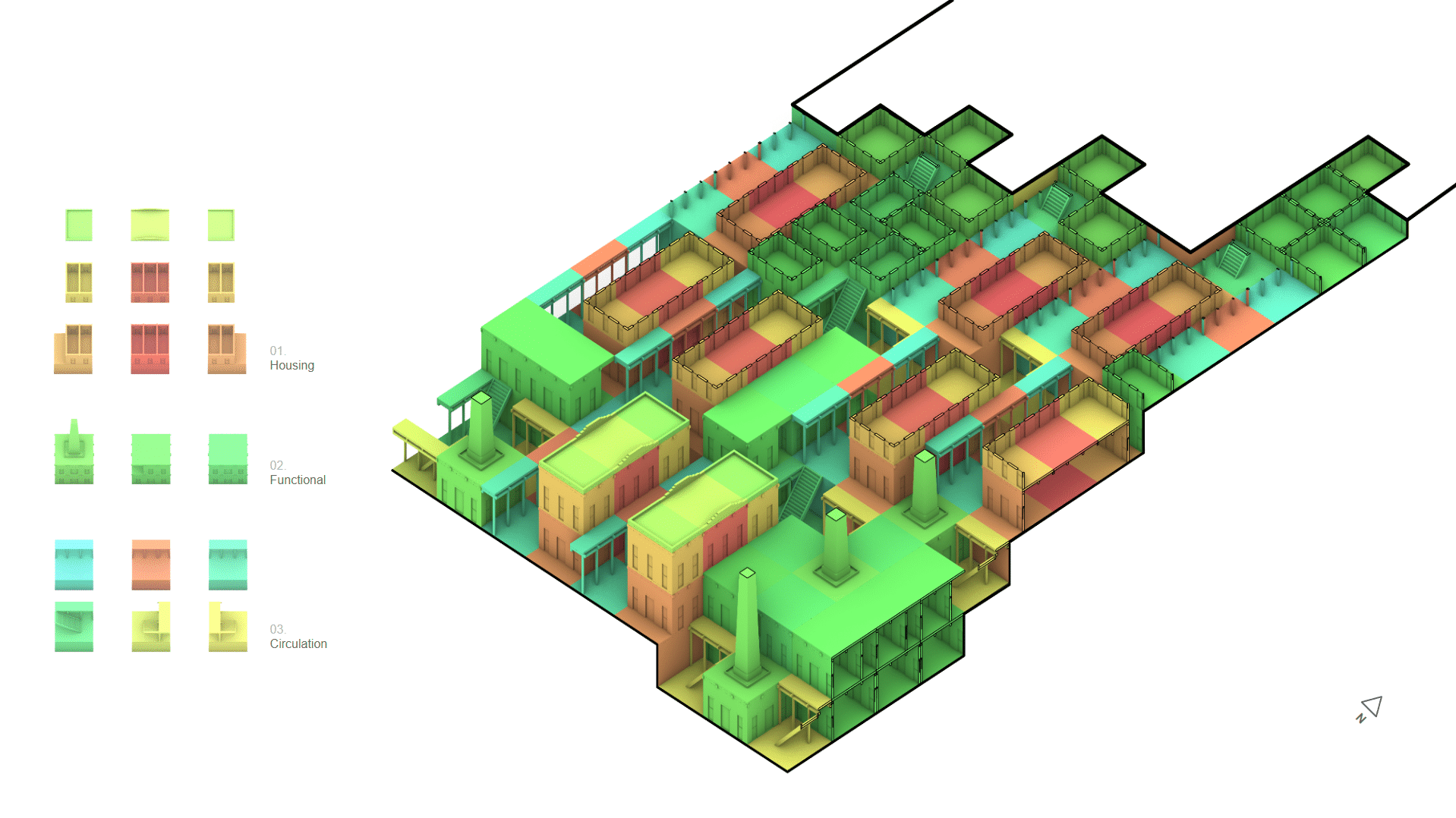
The system defines three specific module types to achieve this:
- Housing Modules: Units of up to three levels. Subterranean units leverage thermal inertia, while upper units open into voids for ventilation.
- Functional Modules: These address specific programmatic needs, including commercial spaces, essential services, and resource management (rainwater harvesting).
- Circulation Modules: Vertical cores and horizontal bridges that ensure connectivity while adapting to the rugged topography.
Algorithmic Workflow & Technical Logic
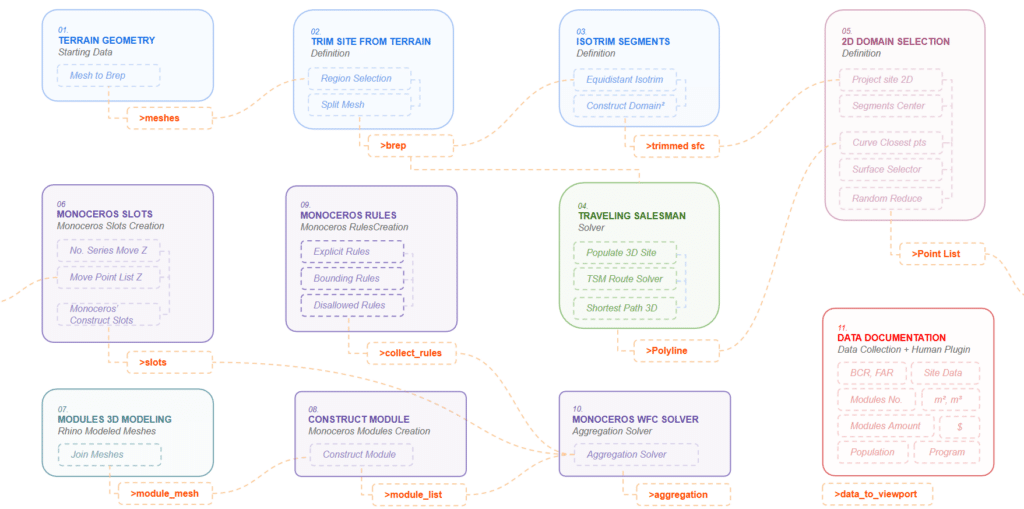
Our Grasshopper workflow is rigorous. We begin with the terrain geometry, select the site, and apply a Traveling Salesman Problem (TSP) algorithm to optimize the shortest path between points of interest. This route is projected onto a modular grid where we apply Monoceros rules. The result is an aggregation that not only defines the form but provides real-time data on area, BCR (Building Coverage Ratio), FAR (Floor Area Ratio), and population density, allowing for total development control.
Materiality & Structure: A Hybrid System
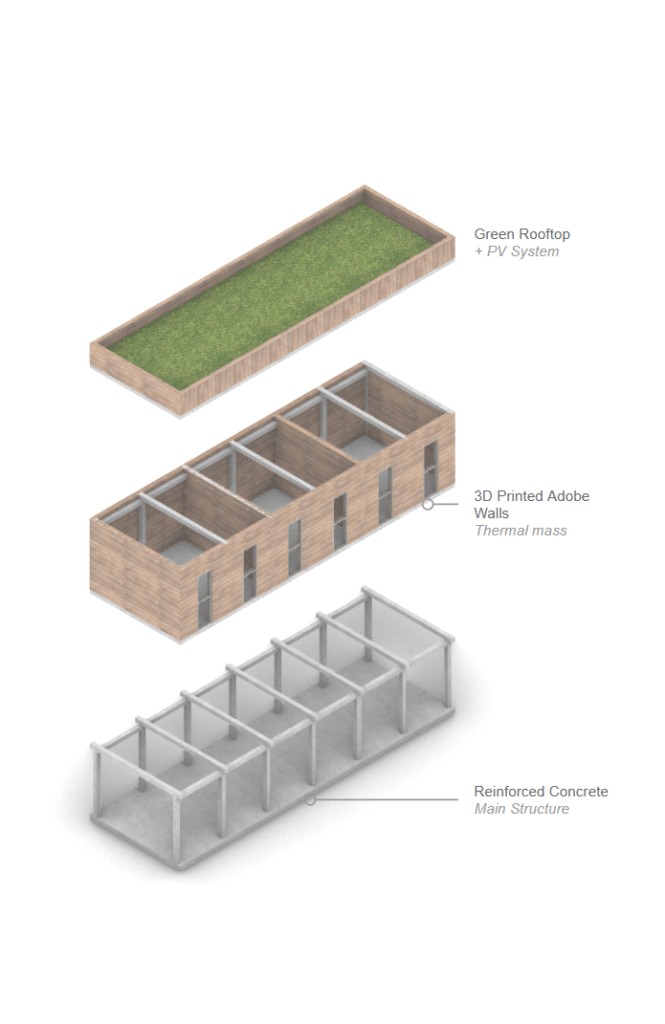
Terrascape utilizes a hybrid structural system that bridges traditional thermal mass with modern technology:
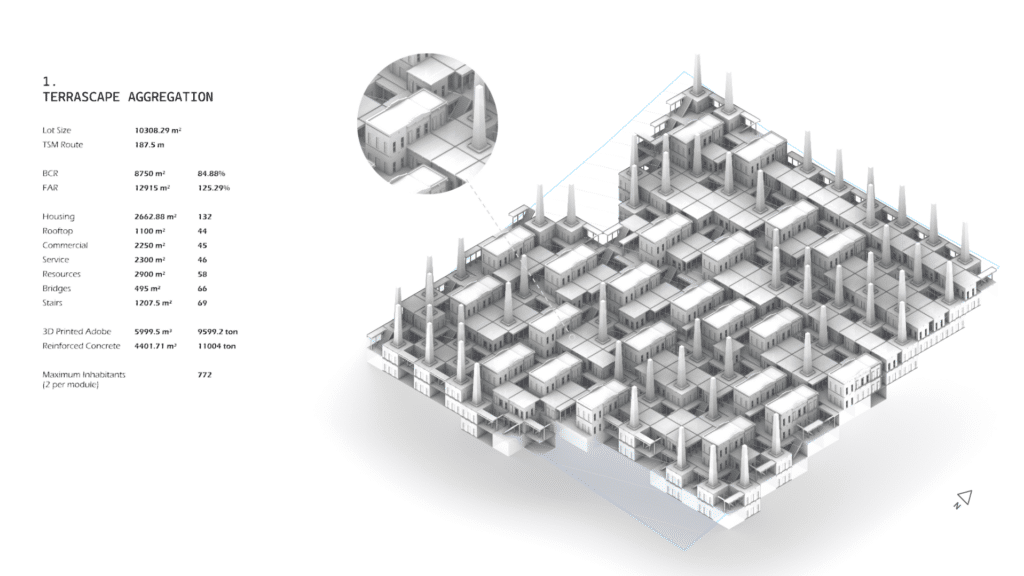
- 3D Printed Adobe: Used for its superior thermal capabilities and low embodied carbon. [cite_start]On our primary aggregation site, the design utilizes approximately 9,599 tons of adobe to create 5,999 m³ of volume.
- Reinforced Concrete: Complements the adobe with strategic reinforcements to enhance compressive strength and ensure long-term structural integrity.
Environmental Strategy: A Living Metabolism
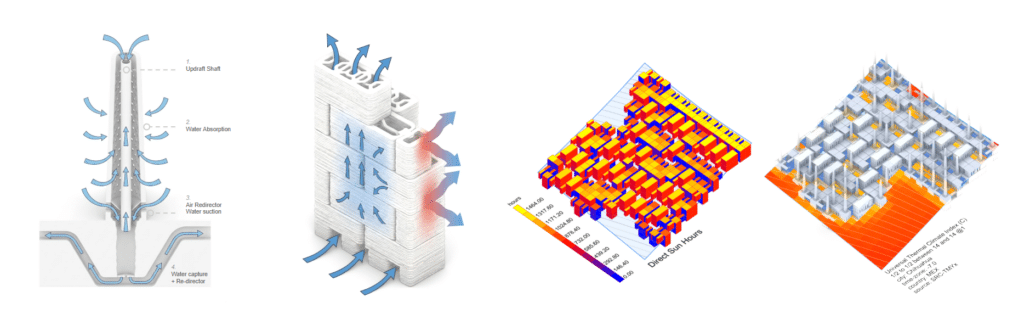
Geomorphing Terrascape employs high-performance environmental strategies centered on atmospheric moisture capture towers that generate 3 to 10 liters of water per square meter daily through biomimetic suction and pressure differentials. The system utilizes 3D-printed adobe with a thermal phase shift of 8 to 12 hours to mitigate Chihuahua’s extreme 20°C diurnal temperature range, effectively maintaining interior climates between 20°C and 25°C. Combined with optimized shading geometries that reduce surface temperatures by 15°C and regulate the Universal Thermal Climate Index, this modular fabric transforms desert thermal stress into a resilient, self-sustaining habitat.
The Architecture
The project is better understood tridimensionally than in 2D plans, so this isometric view is fundamental to explaining its logic. It is a horizontal development that organizes three main systems: housing, functional areas, and an intricate circulation network. By rejecting standardized floor plans, the design utilizes a diversity of formal elements that adapt to the natural topography, creating a dynamic, multi-level navigation experience.
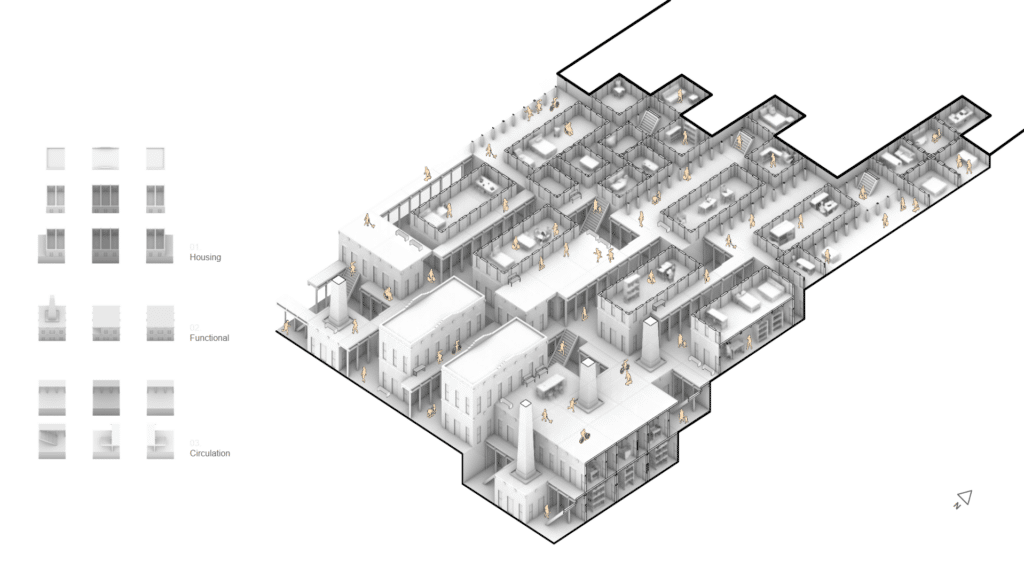
Here, the system is shown fully resolved, transforming abstract logic into a habitable experience. By increasing the level of detail, we observe how housing units, functional spaces, and complex circulation networks intertwine to bring the project to life.
Stress Testing & Validation
We selected two contrasting environments in Chihuahua that represent a dialogue between nature and the city. First, we intervened in the rugged periphery, where the mountain’s steep slope demands an organic, free-form structural response. In contrast, the second site is a flat urban lot, ideal for optimizing horizontal continuity and accessibility. This comparison demonstrates how our modular system adapts to both topographical constraints and the rigid logic of the traditional urban grid.
To validate Terrascape’s versatility, we subjected the system to rigorous stress tests across these five extreme topographical conditions. We evaluated systemic efficiency against drastic variations in scale and slope, proving that our aggregation logic is successful regardless of the terrain’s complexity.
“Geophorming Terrascape is not just a collection of buildings; it is a proposal for a walkable, sustainable urban-natural environment that celebrates the identity of the barrio. It is architecture responding intelligently to human needs and the desert landscape.”