It seems we can’t find what you’re looking for. Perhaps searching can help.
Within the current global context of rapid change, integrated with the potentials of digital technologies, IAAC’s Master in Advanced Architecture (MAA) is committed to the generation of new ideas and applications for Urban Design, Self Sufficiency, Digital Manufacturing Techniques and Advanced Interaction.
In this context IAAC works with a multidisciplinary approach, facing the challenges posed by our environment and the future development of cities, architecture and buildings, through a virtuous combination of technology, biology, computational design, digital and robotic fabrication, pushing innovation beyond the boundaries of a more traditional architectural approach.
Course: MAA02 25/26 Algorithmic Design in Architecture I
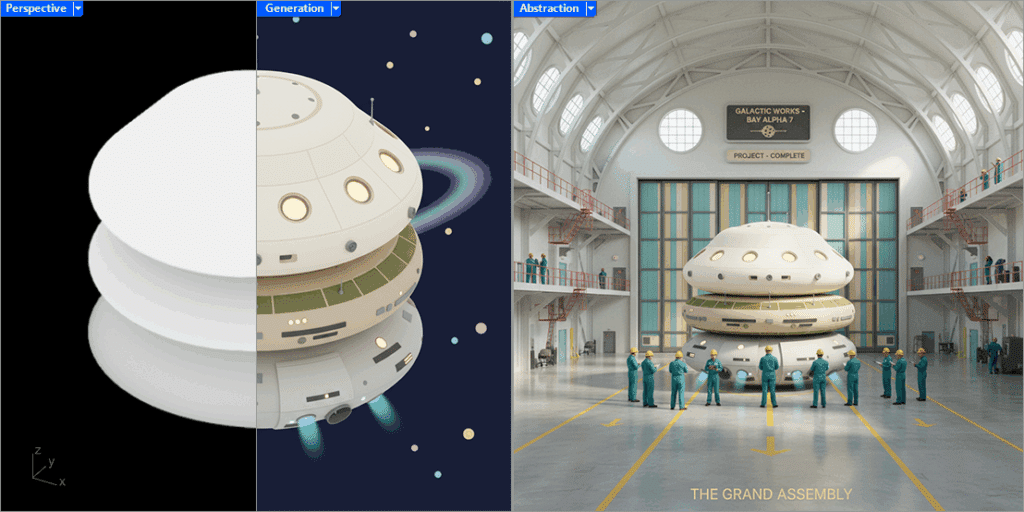
Credits: GH-Nanobanana, Gemini + Rhino (Gh) integration, Iacopo Neri https://github.com/neriiacopo/GH-Nanobanana
Intro Description & Structure
The Algorithmic Design I Thesis Cluster investigates the profound paradigm shift catalyzed by generative AI and foundation models in the architectural field. We focus on the convergence of data science, computational methods, and design, specifically examining how new modalities of digital production are redefining authorship, conceptual iteration, and the very nature of spatial representation. The cluster is dedicated to researching and developing advanced interactive and visualization futures, preparing students to navigate the complex design, construction, and theoretical challenges presented by an increasingly algorithmic built environment.
Key Research Areas
- The Worldviews of AI: Epistemology and Architectural Ontology
- Critically examines the "image of the world" embedded within current state of the art AI tools
- Investigates the inherent biases, canonical limitations, and epistemological boundaries these computational worldviews impose on architecture.
- From Intention to Generation, a Paradigm Shift?
- Analyses how generative AI (GenAI) fundamentally alters architectural, urban, and design practice in 2D and 3D domains.
- Explores the implications of this shift on design authorship, conceptual iteration speed, and the redefinition of design skill sets.
- Creativity in an Era of Automation:
- Explore how AI tools can push the boundaries of architectural imagination.
- Investigate methodologies for integrating AI into the creative workflow.
- Advanced Visualization and Interactive Futures
- Focus on the incorporation of LLMs into architectural processes.
- Enhance professional practice through AI-enabled efficiency and collaboration.
Course Objectives
- Empower Creative Exploration of advanced computation technology and AI
- Master Methods for Complex Form Generation
- Integrate Data-Driven Approaches to both research and design
- Innovate Architectural Workflows
This cluster empowers students to become critical practitioners, ready to navigate the ethical and intellectual complexities of the algorithmic age, thereby shaping an architectural future that is both technologically informed and profoundly human-centered.
Course Structure
- Lectures and Reviews
- Bi-weekly sessions covering theoretical and practical aspects of AI in architecture.
- Thesis Project
- Individual research projects focused on one of the key areas.
- Regular presentations and critiques to refine ideas and methodologies.
Nothing Found