Within the current global context of rapid change, integrated with the potentials of digital technologies, IAAC’s Master in Advanced Architecture (MAA) is committed to the generation of new ideas and applications for Urban Design, Self Sufficiency, Digital Manufacturing Techniques and Advanced Interaction.

In this context IAAC works with a multidisciplinary approach, facing the challenges posed by our environment and the future development of cities, architecture and buildings, through a virtuous combination of technology, biology, computational design, digital and robotic fabrication, pushing innovation beyond the boundaries of a more traditional architectural approach.

Filters
Course

Scribbly Situation

A fast, dynamic, playful and chatty game        AIM: To create a fun, engaging, and creative game to reveal and capture how tweens use and imagine spaces (in Trumbull Hall Park or other Chicago Housing Project). what is scribbly situation?                            Scribble a situation in 60 seconds, then find what’s similar and what’s unique in everyone’s drawings. … Read more

Brick Flow

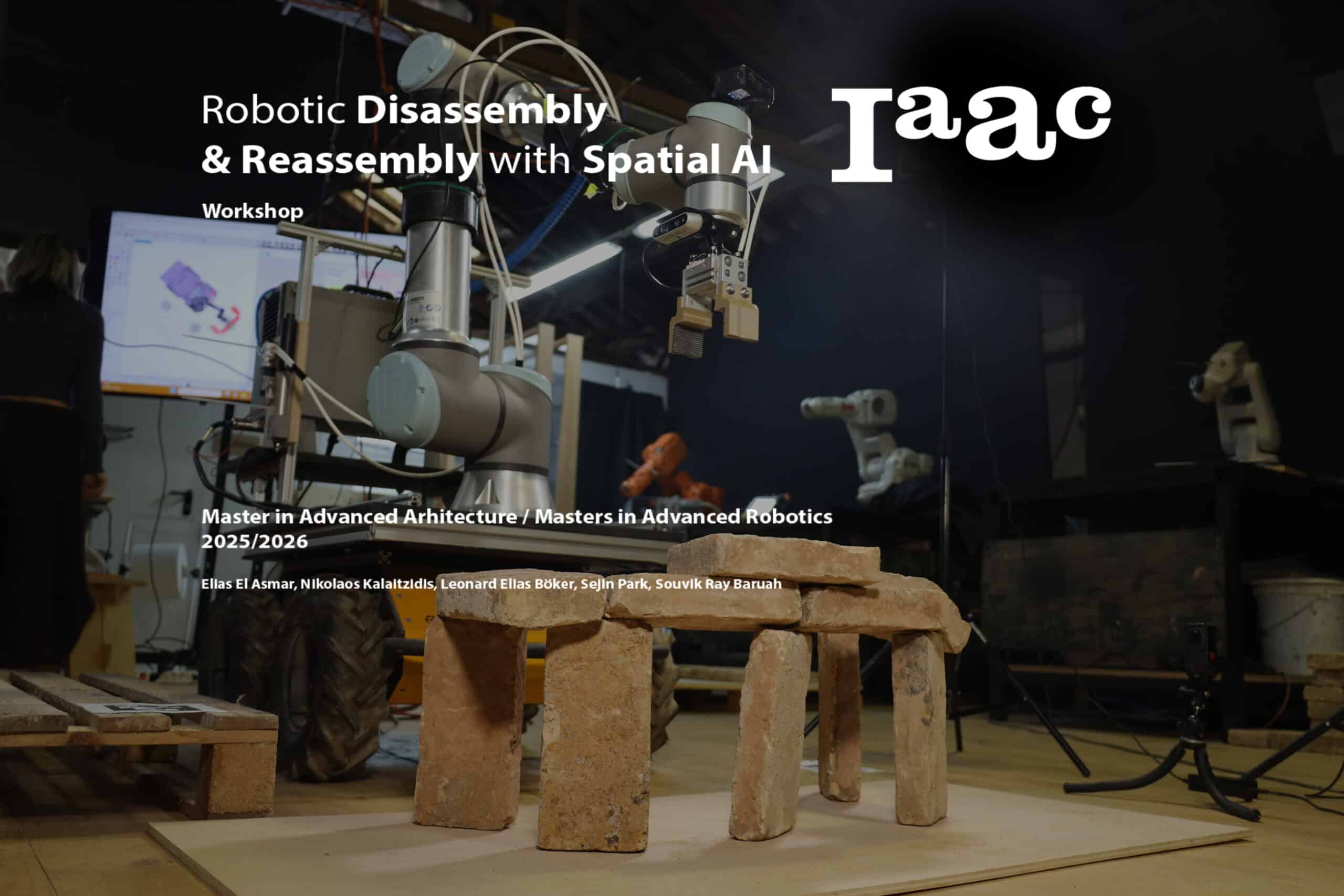
Robotic Disassembly & Reassembly with Spatial AI Abstract The project explores a circular construction workflow that integrates robotic systems with Spatial AI to automate the disassembly and reassembly of brick structures. Utilizing a Gemini Vision-Language Model (VLM) pipeline, the system performs autonomous material evaluation, identifying surface damages such as chipping, spalling, and staining, as well … Read more

Adaptive Helios-Prism

Project Description Sunlight-Adapted Parametric Design: The sculpture’s reflective panels are parametrically arranged to interact dynamically with sunlight. Their angles can be calibrated to optimize light reflection, create dazzling visual effects, or provide shifting patterns of shade throughout the day. Functional and Adaptable Plaza: The installation transforms the plaza into a versatile space. Its adaptive light-reflecting and … Read more

Passadís d’ordinadors

Concept Inspiration Creating a tensile pavilion structure based on Felix Candela‘s arch and aisle geometric logistics and diagrams. Iterative design approach based on ‘anchor points’ on a frame. Exploring scalable methodology for Kangaroo based computational design processes. ‘Iglesia de la Medalla Milagrosa‘ Felix Candela – photo by Lola Alvarez Bravo, 1954 Felix Candela Drawings and … Read more

Beaver Burrow Pavillion

This project introduces a high-performance terrace pavilion that merges environmental data with advanced robotic fabrication. The design process began with a comprehensive solar and circulation analysis, identifying thermal hotspots and vantage points to determine the optimal balance between shaded gathering areas and open viewing corners. The resulting structure features a complex, interlocking timber geometry that … Read more

Urban Oasis Pavilion

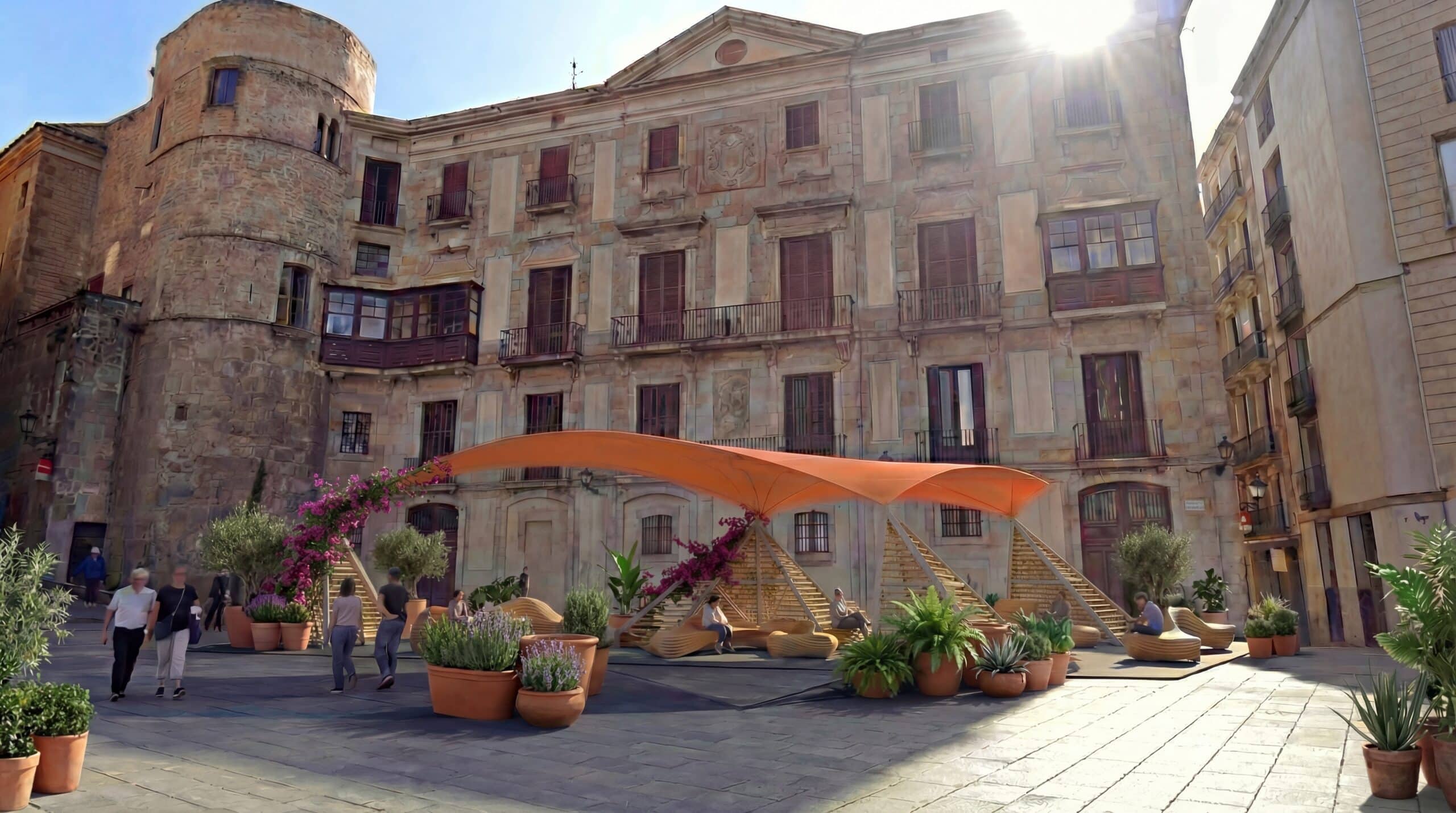
The Urban Oasis Pavilion is a temporary installation in Plaça Catalunya that transforms one of Barcelona’s busiest urban nodes into a space for shade, rest, and social encounter. Its porous, flowing surface filters light, noise, and heat to create a more comfortable microclimate within the dense city environment, offering a place for pause and relief … Read more

The Cellular Dune

Project Brief Forces of Nature explores how architectural form can emerge from the interaction of natural forces rather than being predefined. Using computational simulations, the project allows tension, gravity, and equilibrium to shape spatial structures. The installation translates invisible physical behaviors into visible design, creating a form that is discovered through force-driven processes and realized … Read more

Computational Design Seminar II | Air-Cast Shell

Site analysis The architectural intervention is situated within Plaça de la Virreina, a prominent public square in the Gràcia district. The initial analysis involved a comprehensive mapping of existing urban conditions, specifically focusing on the primary access points to the square and the location of existing trees. These environmental constraints were not viewed as obstacles … Read more

Reciprocal Canopy

Designed for the IAAC rooftop, this pavilion merges computational design with advanced robotic fabrication. The geometry originates in Grasshopper, where a basic mesh is transformed into an optimized vault using Kangaroo’s physics-based dynamic relaxation. A reciprocal frame pattern is then applied, translating the continuous shell into short, mutually supporting timber pieces. Because every interlocking element … Read more

El Xarxaire pabellon

Site Specification The pavilion, located in Plaza del Mar, Barceloneta, features a design adaptable to coastal winds and connected to the sea, primarily constructed from polywood marine 3mm thickness fabricated in CNC machine to withstand its beach environment. Plaza del Mar is a vast, 17,000-square-meter urban “void” that serves as Barceloneta’s primary window to the … Read more

Recursive Shell

This project, titled Recursive Shell, is located at Plaça del Pi. The pavilion explores form-finding through inverted arch logic and modular timber shells. Using a Kangaroo Bouncy Solver, the design optimizes structural stability via parameters like pressure, edge lengths, and vertex loads. The system consists of interlocking triangular panels and joint discs extracted from a … Read more

REPOSE

Computational Design II (Level 2) – Final Assignment This project proposes a computational timber pavilion for the IAAC rooftop in Barcelona, conceived as a Bio-Maker space that integrates digital fabrication, structural logic, and urban biodiversity. The structure is generated through a parametric space-frame system composed of American oak members connected through stainless steel bolt ball … Read more

Arcada Viva

The project situates the pavilion within the urban fabric of Plaça Reial, accompanied by initial conceptual sketches that explore a shell-like structure emerging from the geometry and atmosphere of the square. SITE INSPIRATION WORKFLOW PSEUDO CODE RENDERS