
Barcelona Built a Road to the Port. Someone Else Paid for It.
In 1992, the city tore down a wall. The old industrial waterfront that had cut Barcelona off from the Mediterranean for over a century was demolished to make way for the Olympic Village. For the first time in living memory, residents could walk to the beach. The transformation was celebrated as one of the great urban renewals of the twentieth century, a city reclaiming its coastline.
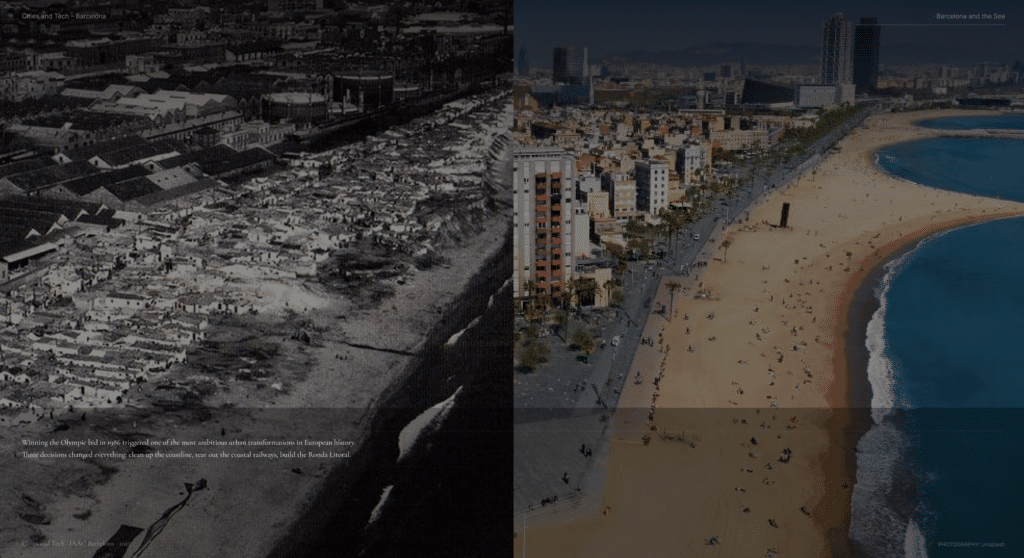
The Ronda Litoral was part of that same moment. A coastal highway to move the city forward. Infrastructure that, on paper, opened Barcelona to the sea.
Thirty years later, it is doing something else entirely.
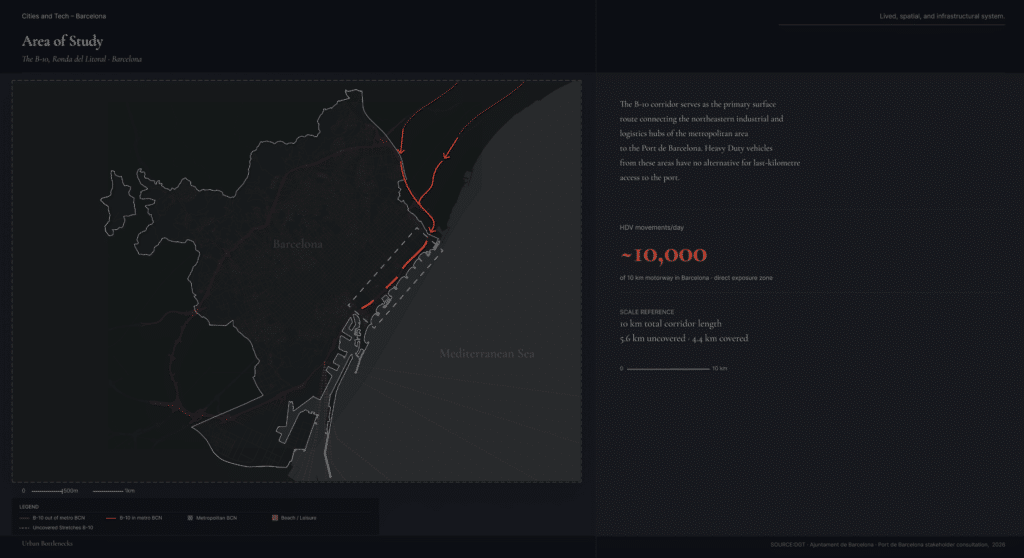
Every day, thousands of heavy goods vehicles travel the B-10, the uncovered stretch of the Ronda Litoral running past Poblenou, Mar Bella, and the neighbourhoods closest to the water. These are the trucks that keep the port moving, shelves stocked, and containers on schedule. They are also, this thesis argues, exporting a cost that never appears on any invoice.
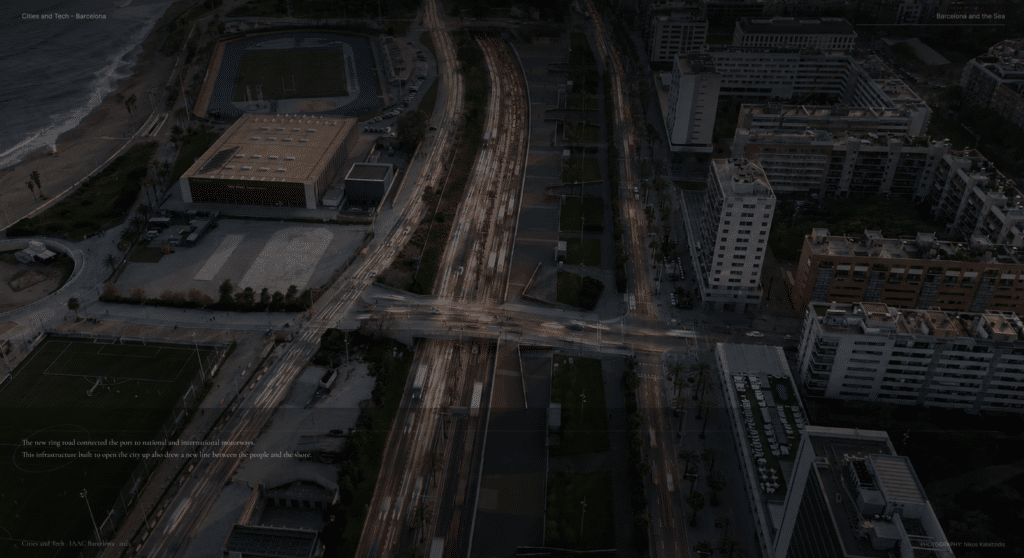
The Port of Barcelona is the largest port in the Mediterranean by container traffic. It is also landlocked by the city. Almost everything that moves through it moves by road, around streets, past schools, past apartment windows. The port generates wealth. The logistics chain captures it. The neighbourhood absorbs what is left over: noise, pollution, and a coastline that is technically open but practically difficult to enjoy.
For the past year, I have been trying to quantify exactly what that means.
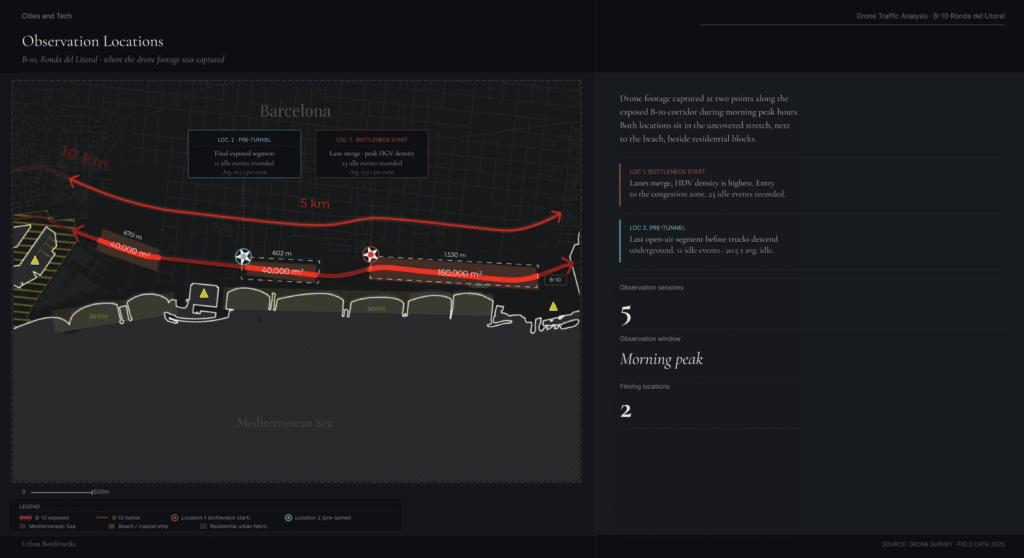
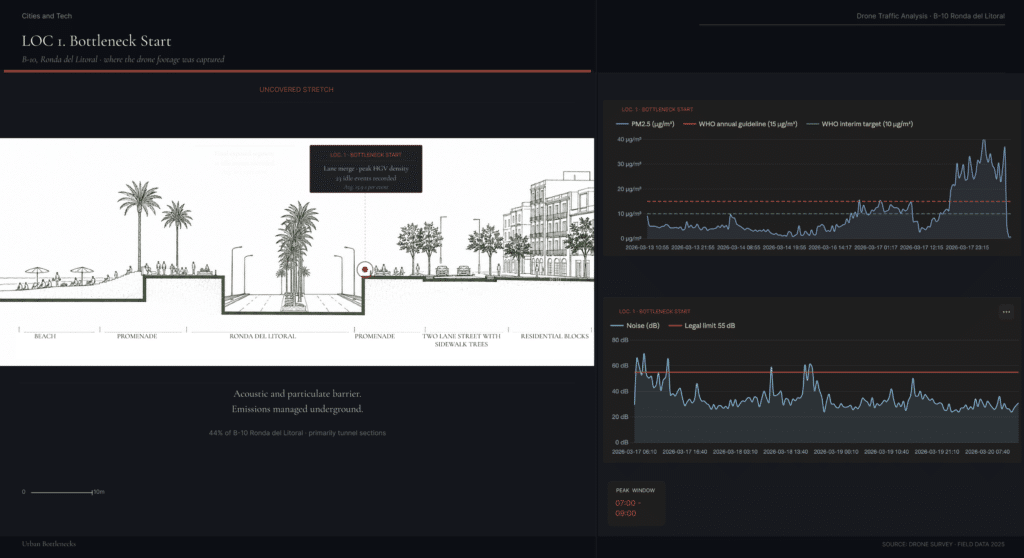
The methodology combines three approaches. Drone footage, analysed using traffic survey software, tracked individual vehicles at two locations along the B-10 corridor: one at the Mar Bella approach, where the bottleneck begins, and one near the pre-tunnel section where it ends. Street-level sensors recorded air quality and noise at five-minute intervals across both sites. GIS spatial analysis mapped the residential and educational exposure within the corridor’s buffer zone.
What the data shows is a system under consistent stress.
Across 438 tracked heavy goods vehicles, average speed drops 16% between the two locations. Trucks slow, stack, and idle. In those moments of idling, the environmental impact concentrates. Noise levels regularly exceed 65 dB, the legal nighttime limit in Barcelona. PM2.5 air pollution, the fine particulate matter most associated with respiratory and cardiovascular disease, nearly doubles when noise peaks above 65 dB. On one recorded day at 2pm, sensors logged 88 dB and 44.9 μg/m³ of PM2.5 simultaneously.
These are not anomalies. They are the rhythm of the corridor.
For every hour a truck drives this stretch, it is stationary for one hour and eighteen minutes. That ratio, more time stopped than moving, is the geometry of a system not designed for the volume it now carries.
34,627 people live within 500 metres of this stretch. 274 schools sit inside the same buffer zone.
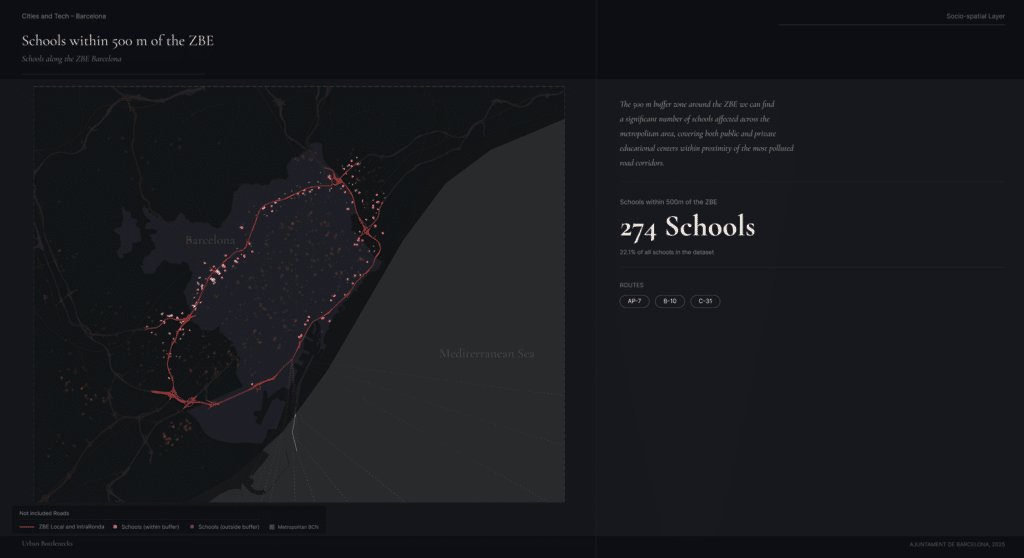
These are not abstract numbers. They represent the population that absorbs what the port externalises, the health burden that does not appear in the port’s balance sheet, the quality of life that does not factor into the logistics cost model. Research by ISGlobal estimates over 52,000 DALYs (disability-adjusted life years) lost annually across Barcelona from traffic-related conditions. The B-10 corridor is not the only contributor, but it is among the most concentrated.
The economic argument for change is, at this point, straightforward.
The port’s own externalities study puts the social cost of the current road-only freight model at approximately €800 million. The rail investment committed for the port’s southern access, a dedicated freight rail connection with a 2032 operational horizon, is €730 million. The intervention costs less than the damage it would prevent.
This is not a fringe position. It is the conclusion that follows from the port’s own figures, applied consistently.
What has been missing is not the data. It is the framing. Road freight in Barcelona has been treated as a neutral logistical fact, the cost of a functioning port in a functioning city. What this research argues is that it is neither neutral nor inevitable. It is a policy choice, made repeatedly, to route the cost of convenience through the bodies and neighbourhoods least positioned to push back.
Design and planning have a role here that goes beyond the 2032 timeline. The question of what happens to the uncovered sections of the Ronda Litoral, whether they remain as they are, are decked, are partially rerouted, or are transformed is a design question as much as an infrastructure one. The communities living 500 metres from the sea deserve to be part of that conversation.
This thesis does not propose a single solution. It proposes a reckoning with the cost structure that currently makes inaction the default.
The port is not the villain of this story. Neither is the logistics sector, nor the consumer at the end of the supply chain. The problem is systemic: an infrastructure built for one era, carrying the load of another, with the difference paid by people who had no say in the arrangement.
The title of this project is The Cost of Convenience. The closing line is simpler than any of the figures:
It lives 500 metres from the sea.
