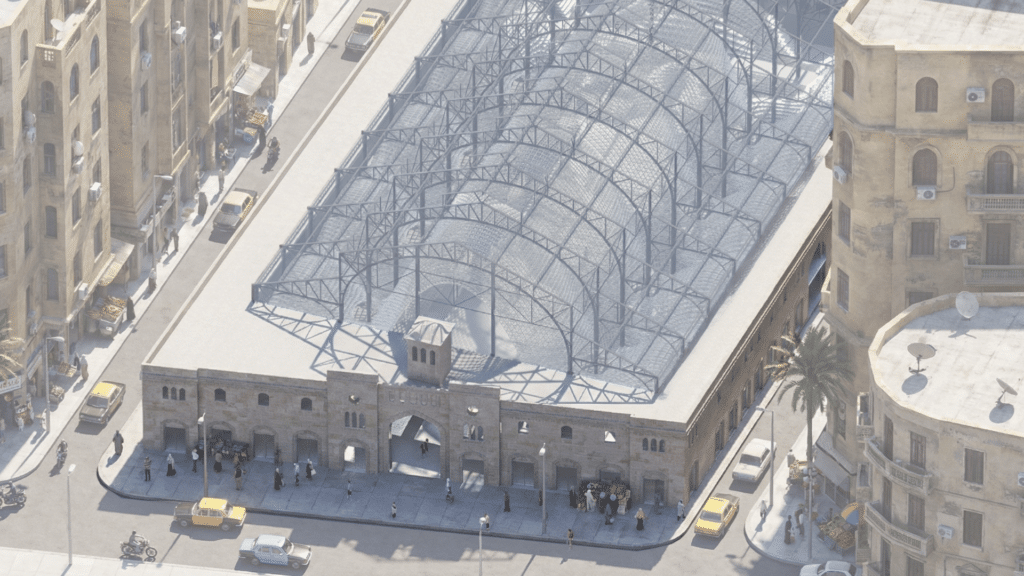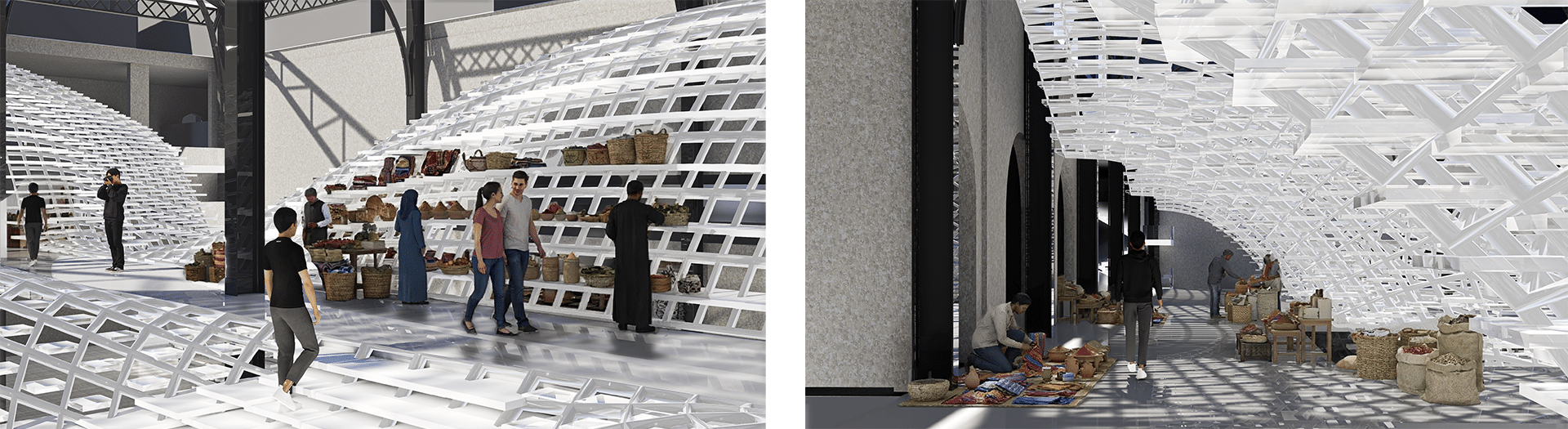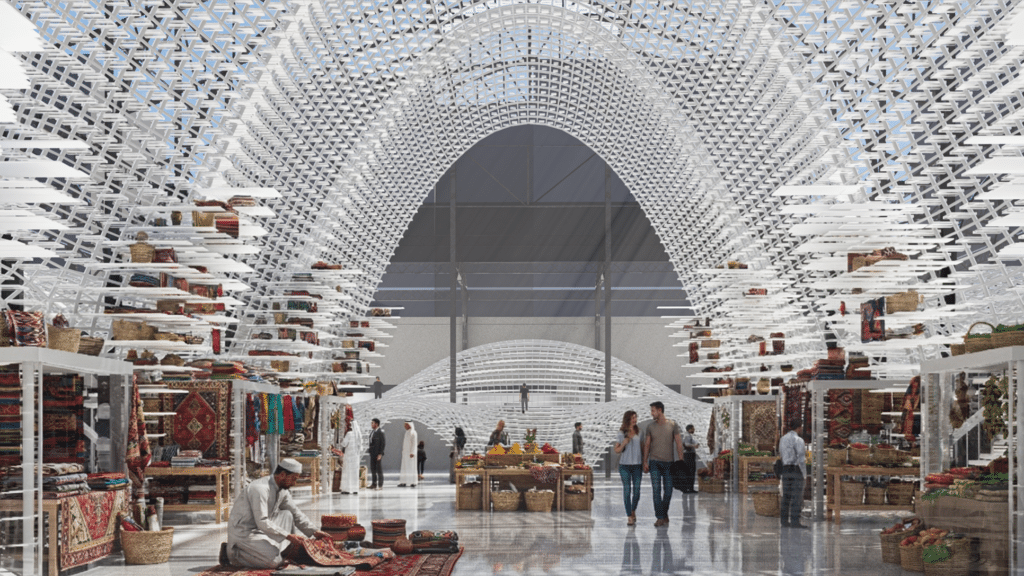
The “sedimented light” effect created by the lattice, filtering sunlight into the market below .
Introduction – More Than Just a Roof
In the dense historic fabric of Cairo, light is both a blessing and a burden. The Luminous Stratum proposes a new architectural language that negotiates this relationship – a “volume of sedimented light” that mimics the city’s historical stratification while filtering the harsh sun .
Designed as a final assignment for the Complex Forming seminar, this project introduces an independent system of stacked lamellas that hover within the void of the existing Bab Al-Luk historic market .
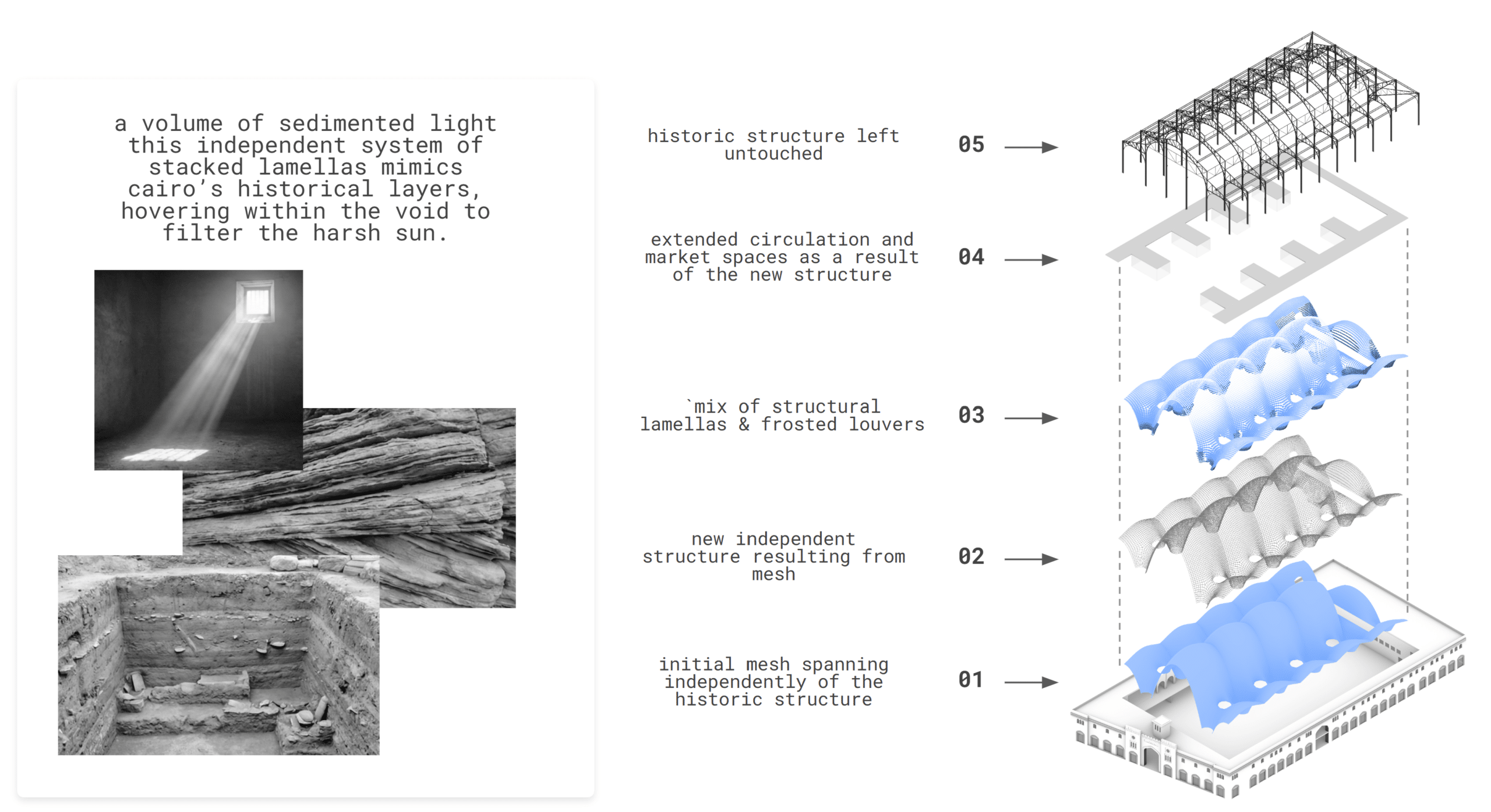
An independent system of stacked lamellas that filters the harsh sun while leaving the historic structure untouched .
Computational Form-Finding.
The resulting geometry is generated through a rigorous computational workflow using Kangaroo physics. The process is defined by these key steps :
- Initial Mesh & Strategic Voids: The process begins with a flat mesh, voids are cut immediately into this mesh. These voids are not random; they are calculated to ensure the new form pulls away from the historic context, respecting the constraint of independence.
- Form-Finding Goals: We established edge anchor points (XY) and applied specific ‘OnCurve’ goals for arcs and circles to define the footprint.
- Vertical Loading: To create the vaulted volume, vertical load forces (+Z vertices loads) were applied, pulling the mesh upward into a relaxed catenary form.
- Sorting Logic: The most defining aspect of the system is how the mesh faces are sorted based on their normal vectors .
- Vertical faces (v ≈ 1) become gradient frosted louvers to control sun glare .
- Horizontal faces (v ≈ 0) become structural lamellas, serving as shelving units and walkable surfaces .
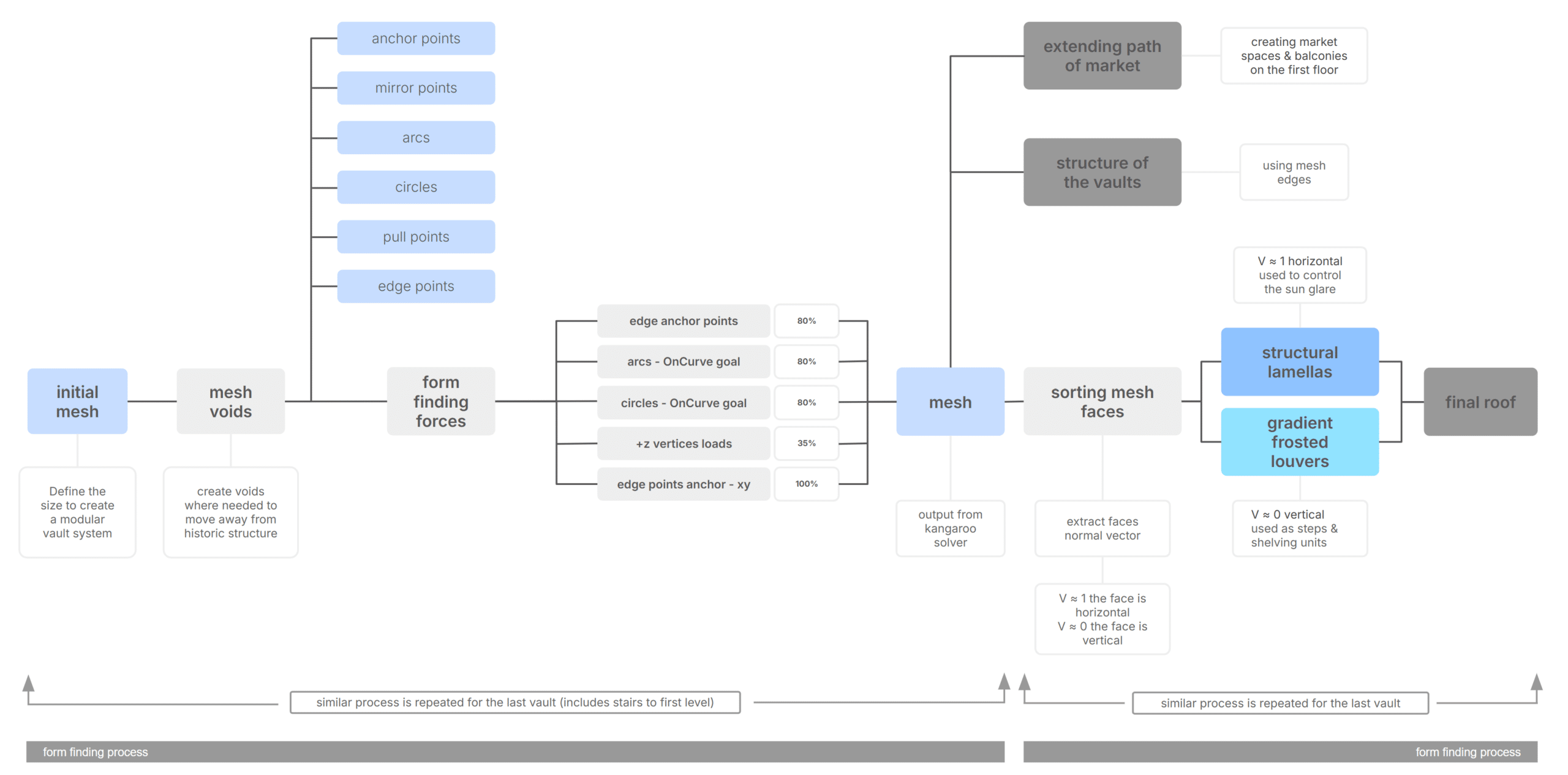
The computational logic defining anchor points, form-finding forces, and the sorting of mesh faces .
A Modular System
The resulting architecture is a modular system, repeated to cover the length of the market hall. However, the system remains adaptable. For the last vault in the sequence, the workflow was modified with different anchor points to generate a continuous staircase, seamlessly connecting the ground floor to the upper level.
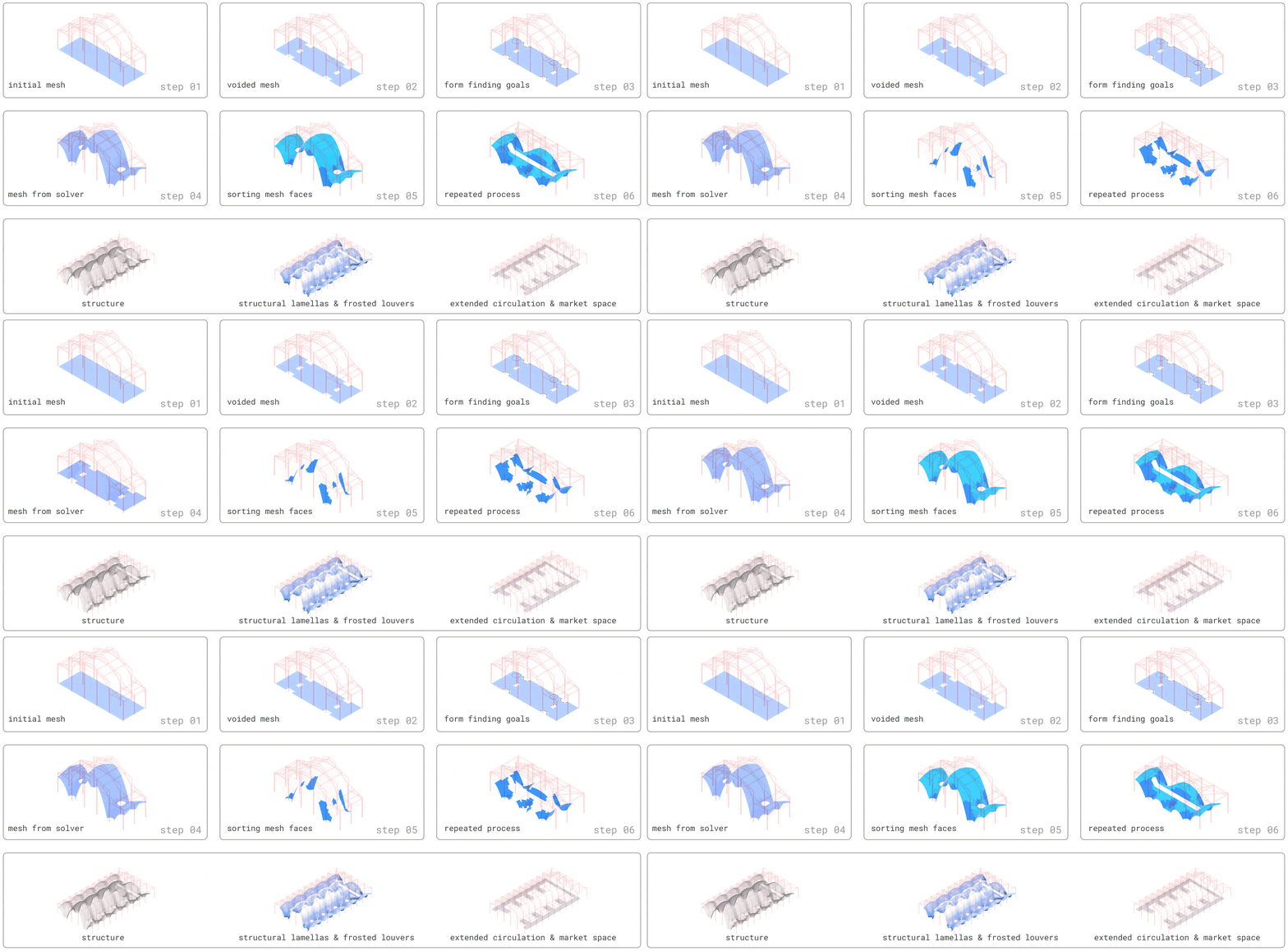
A step-by-step visualization of the form-finding.
The form-finding process served as a generator for the architectural elements, they all materialized simultaneously from the relaxed mesh. The geometry’s orientation dictated its function. Automatically resolving the complex form into structural lamellas, protective louvers, and walkable paths in one unified move.
Optimization Through Iteration
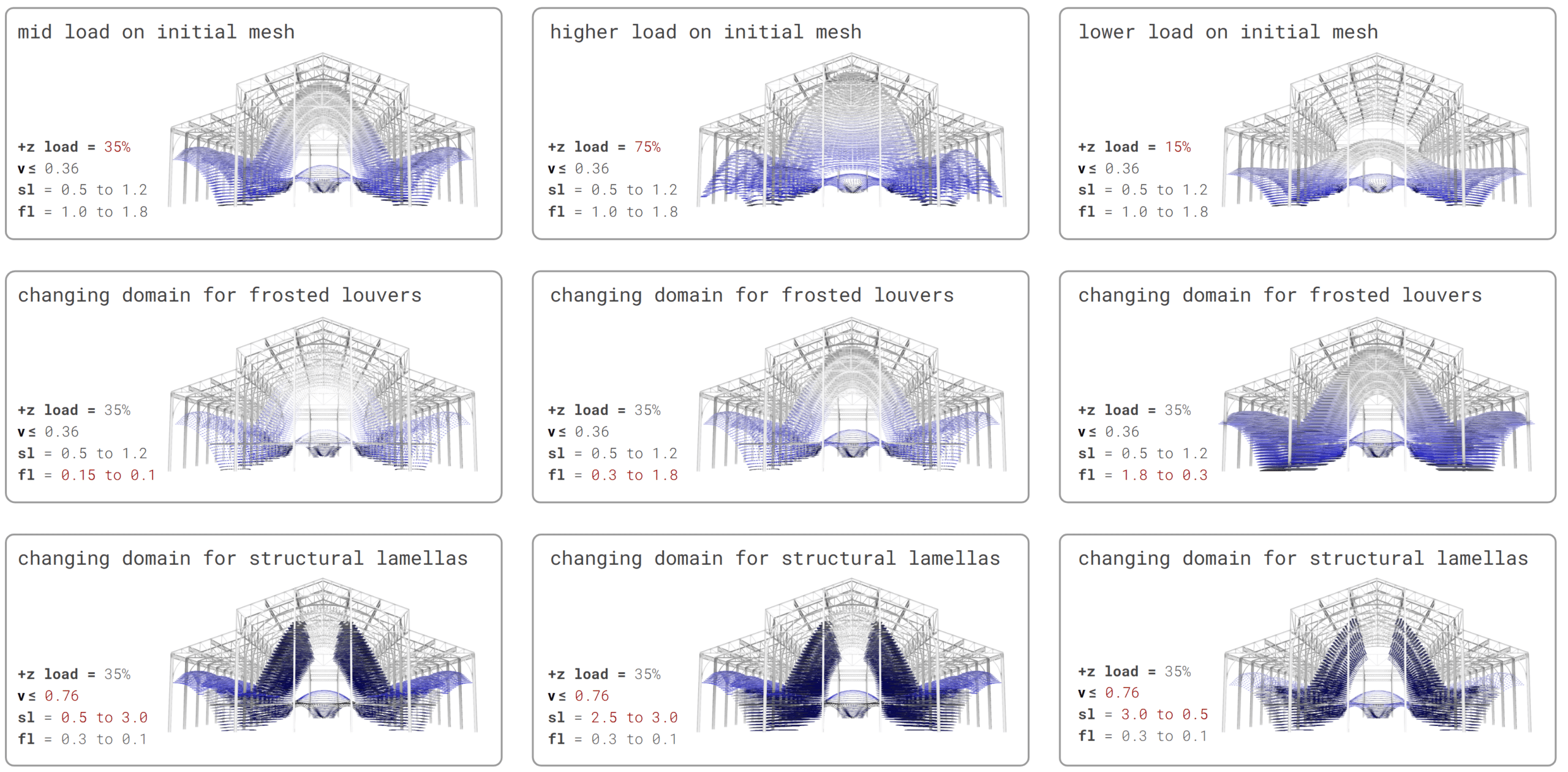
Iterative testing of vertical loads and louver domains to achieve the optimal structural balance .
Form-finding is rarely a linear path. To achieve the final geometry of The Luminous Stratum, the design underwent rigorous iterative testing, specifically focusing on vertical load distribution and component density .
I tested various vertical loads on the initial mesh, ranging from a shallow 15% to a steep 75% . The challenge was to generate a volume that maximized the internal market space without overpowering the historic context.
Parallel to this, I calibrated the domains for the frosted louvers and structural lamellas . By adjusting these parameters, I could fine-tune the structure’s porosity, finding the precise balance between effective sun shading and structural integrity. The process culminated in a selected iteration using a 35% vertical load, which provided the optimal vault height and spatial clearance for the functional layers below .
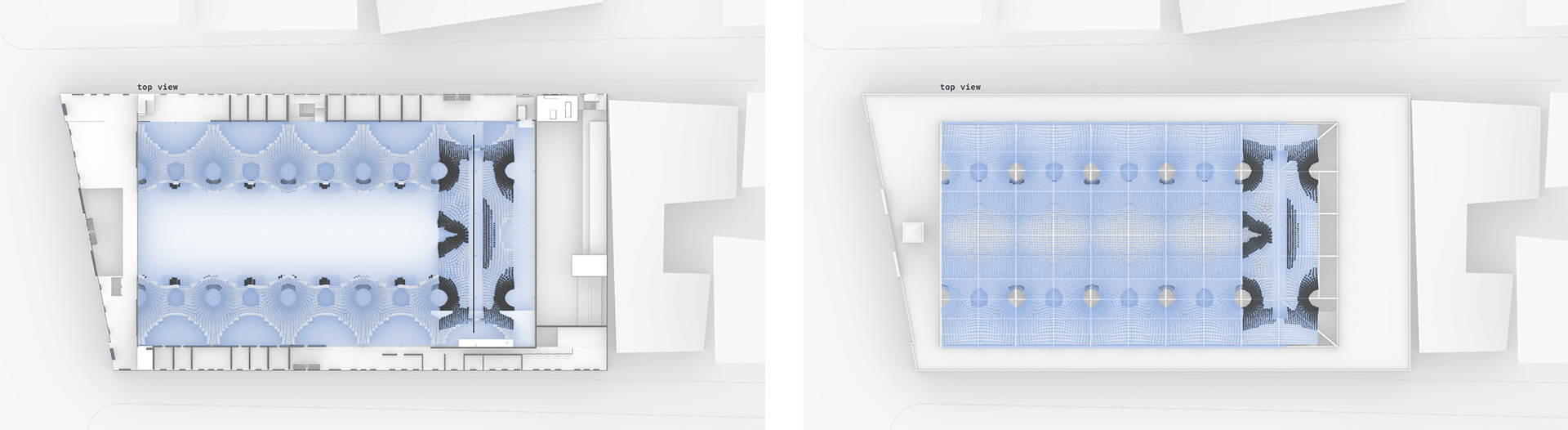
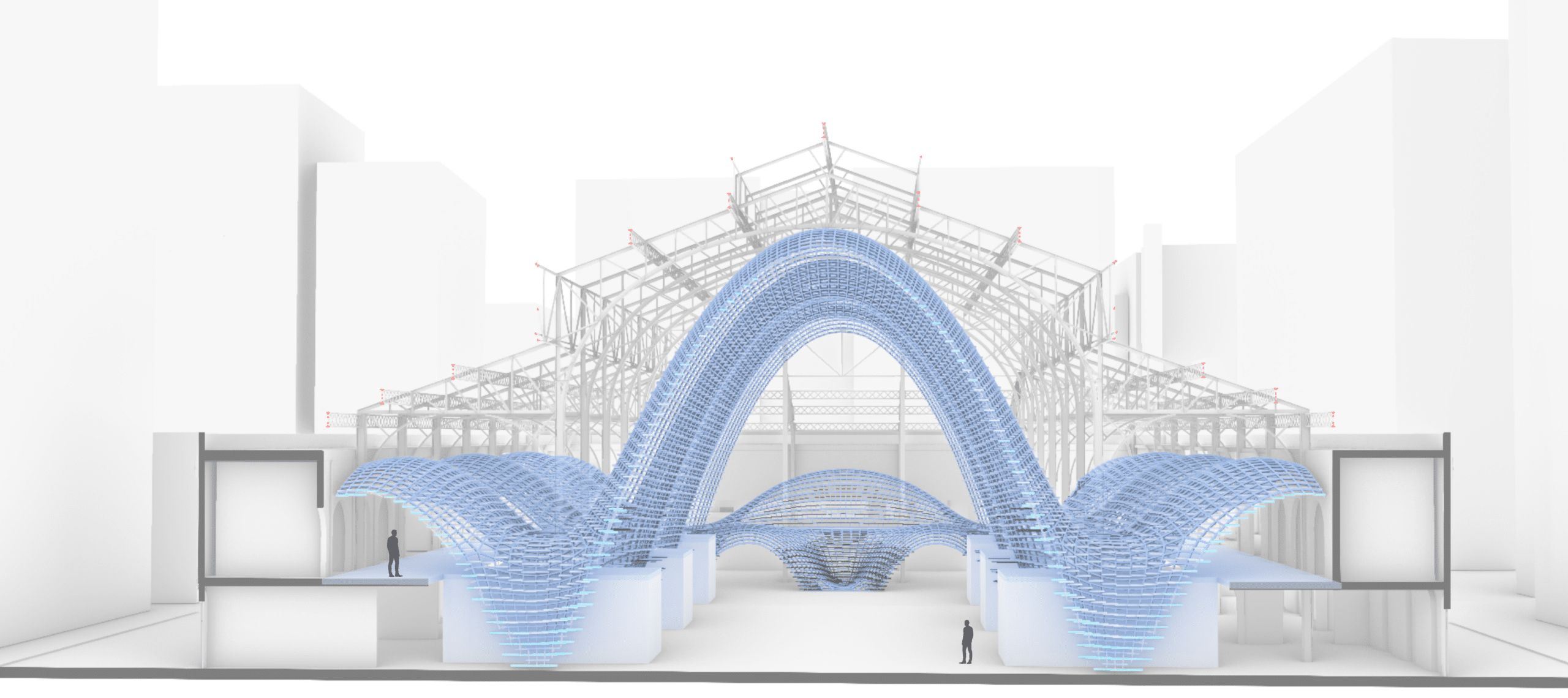
section highlighting independence and function
The section shows how the project is read as a an independent system that hovers within the void, filtering the sun while strictly maintaining its distance from the historic walls . This view highlights the project’s primary environmental strategy: acting as a porous buffer that protects the atrium without sealing it off.
Conclusion
The Luminous Stratum reads as a continuous volume, an independent lattice that nests within the historic void . By turning a pattern into a structural filter, the project revitalizes the market below, creating an atmosphere of filtered light that respects the past while embracing a computational future.