
Bab al-Luq Reimagined: Computation, Climate, and Cultural Memory
This project approaches the Bab al-Luq Market not as a blank surface for formal experimentation, but as a site layered with climatic intelligence and symbolic meaning. Its proposal is rooted in two elements deeply embedded in Cairene architectural and cultural memory: the malqaf and the lotus flower.
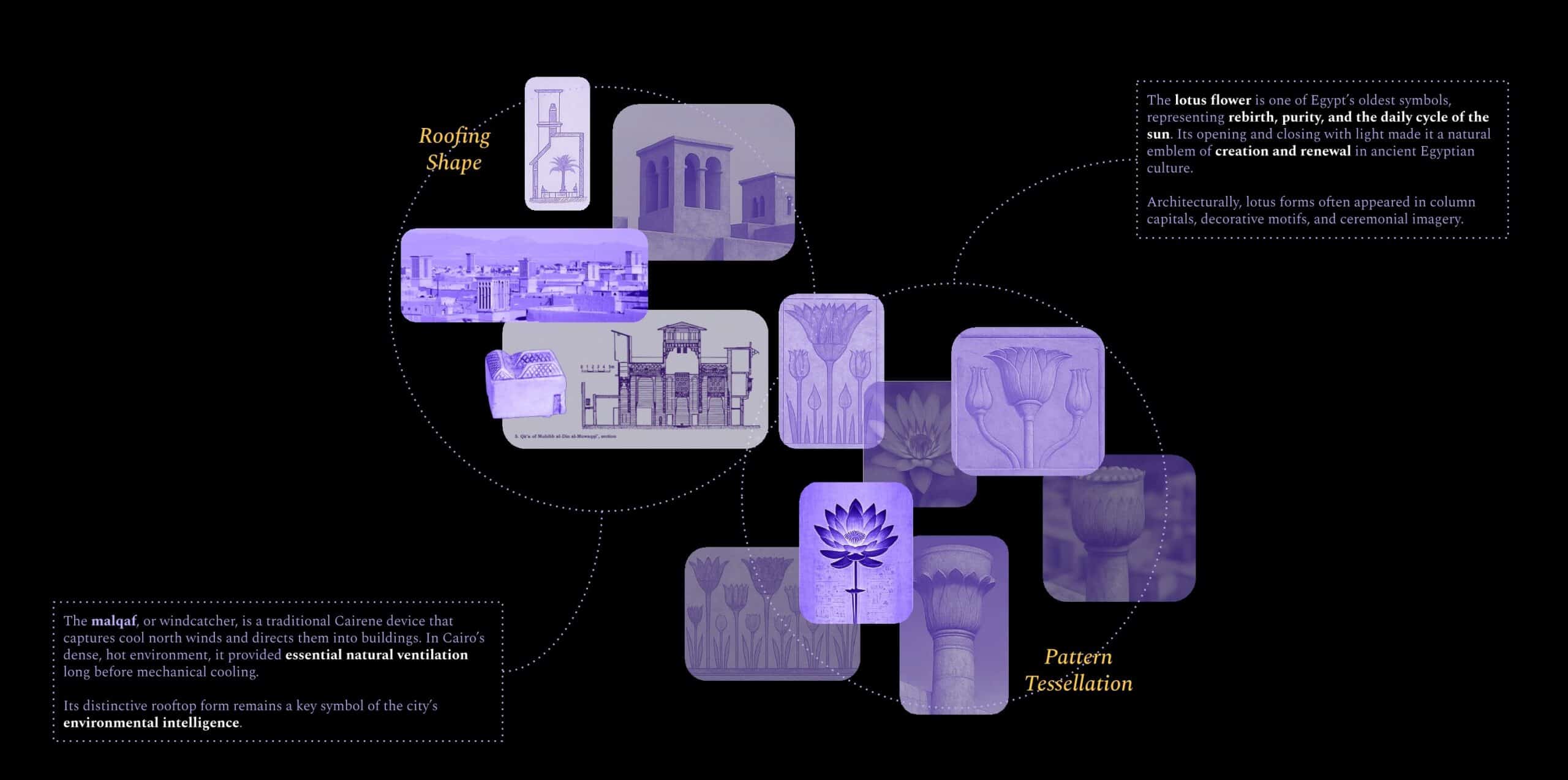
The malqaf, Cairo’s traditional windcatcher, is a passive environmental device that captures prevailing breezes and draws them into interior spaces. Here, its logic is abstracted and reinterpreted as the formal driver of a new market roof. This structural gesture is overlaid with the imagery of the Egyptian lotus—an ancient symbol of rebirth, purity, and the sun’s daily cycle—used to inform the roof’s pattern and tonal language. Together, these references frame the intervention as a contemporary act of renewal: a symbolic and spatial rebirth of the Bab al-Luq Market.
A Computational Framework
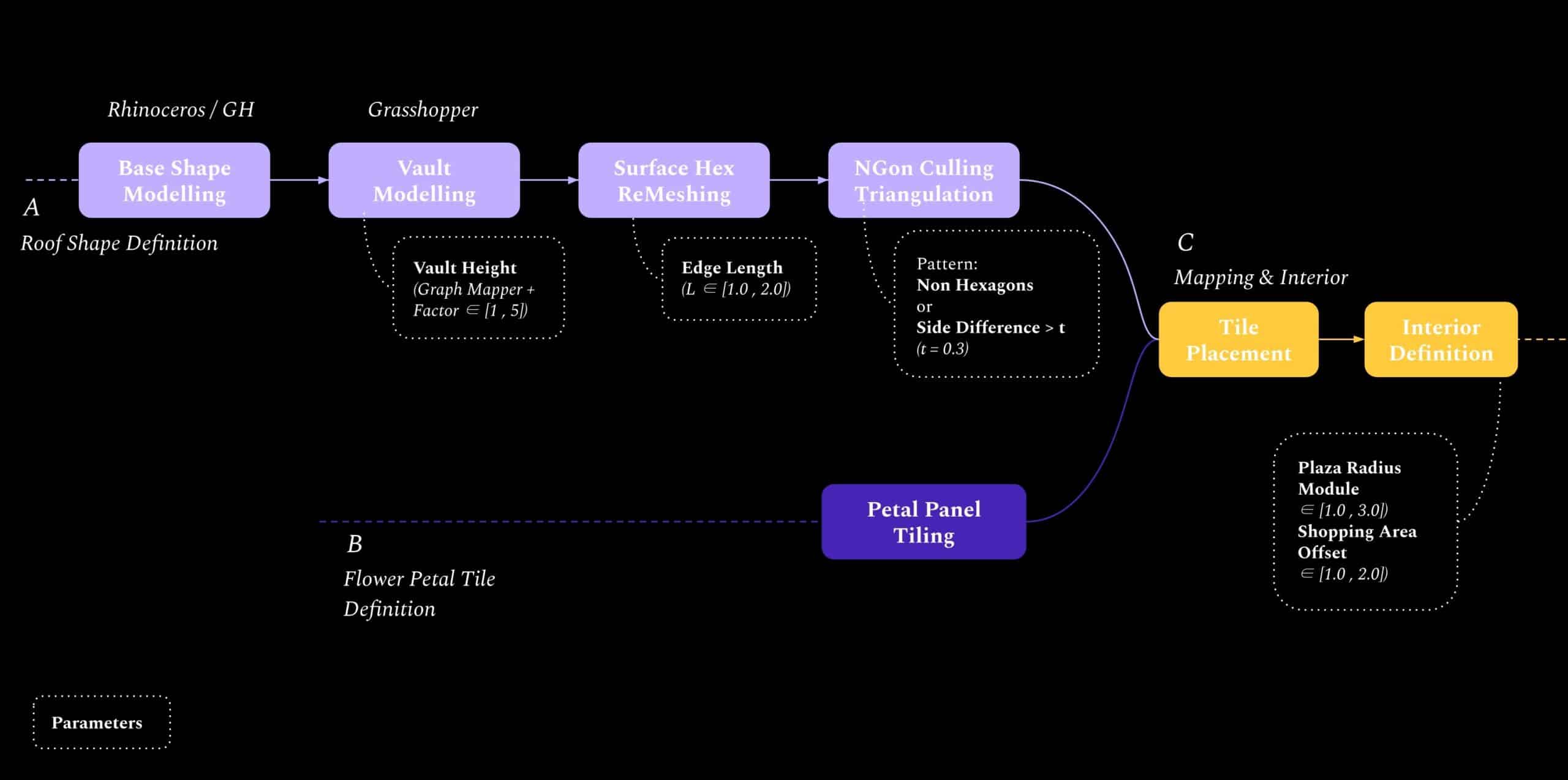
Rather than separating form, ornament, and program, the project unfolds through a single computational workflow. The process begins with the modeling of a simplified roof volume, which serves as the geometric foundation for a system of lateral vaults. These vaults are remeshed into a predominantly hexagonal grid, establishing a surface capable of both structural logic and ornamental variation.
In parallel, a family of lotus-inspired tiles is developed, consisting of two distinct types: flower tiles and leaf tiles. The convergence of these two systems—geometry and ornament—occurs during the placement phase, where the roof surface begins to inform interior circulation and spatial organization below.
Iterating the Vault
Although the malqaf remained the conceptual anchor throughout the project, its translation into form evolved through multiple iterations. Early explorations relied on flat surfaces extracted directly from conventional malqaf sections. These were followed by rectangular openings and later by catenary vaults generated using Kangaroo, allowing the geometry to respond to structural and formal constraints.
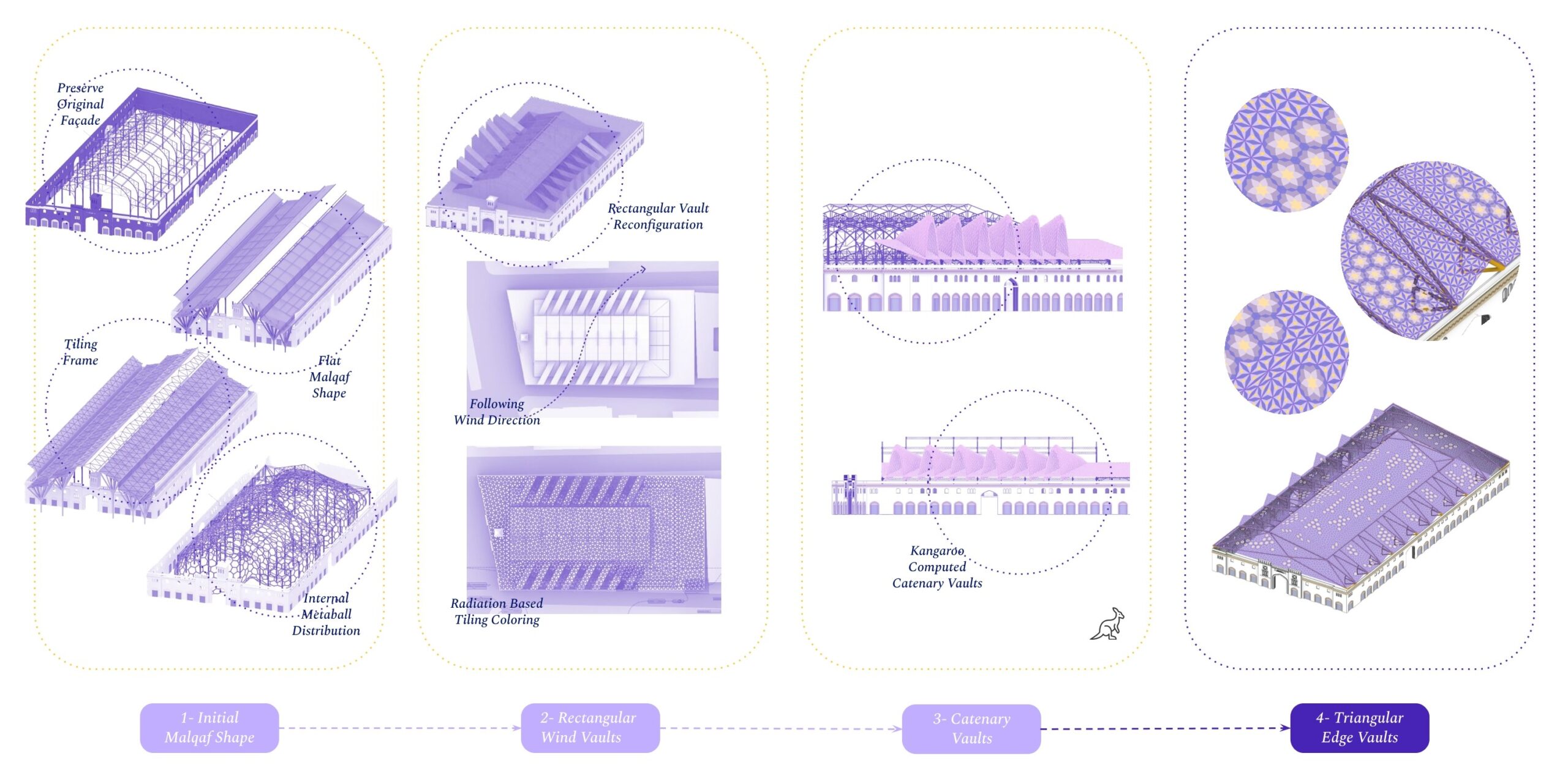
The final iteration distills these explorations into a series of triangular vaults, directly aligned with the existing modular structure of the market. This decision grounds the new intervention in the logic of the preexisting framework, allowing the roof to extend the market’s structural language rather than overwrite it.
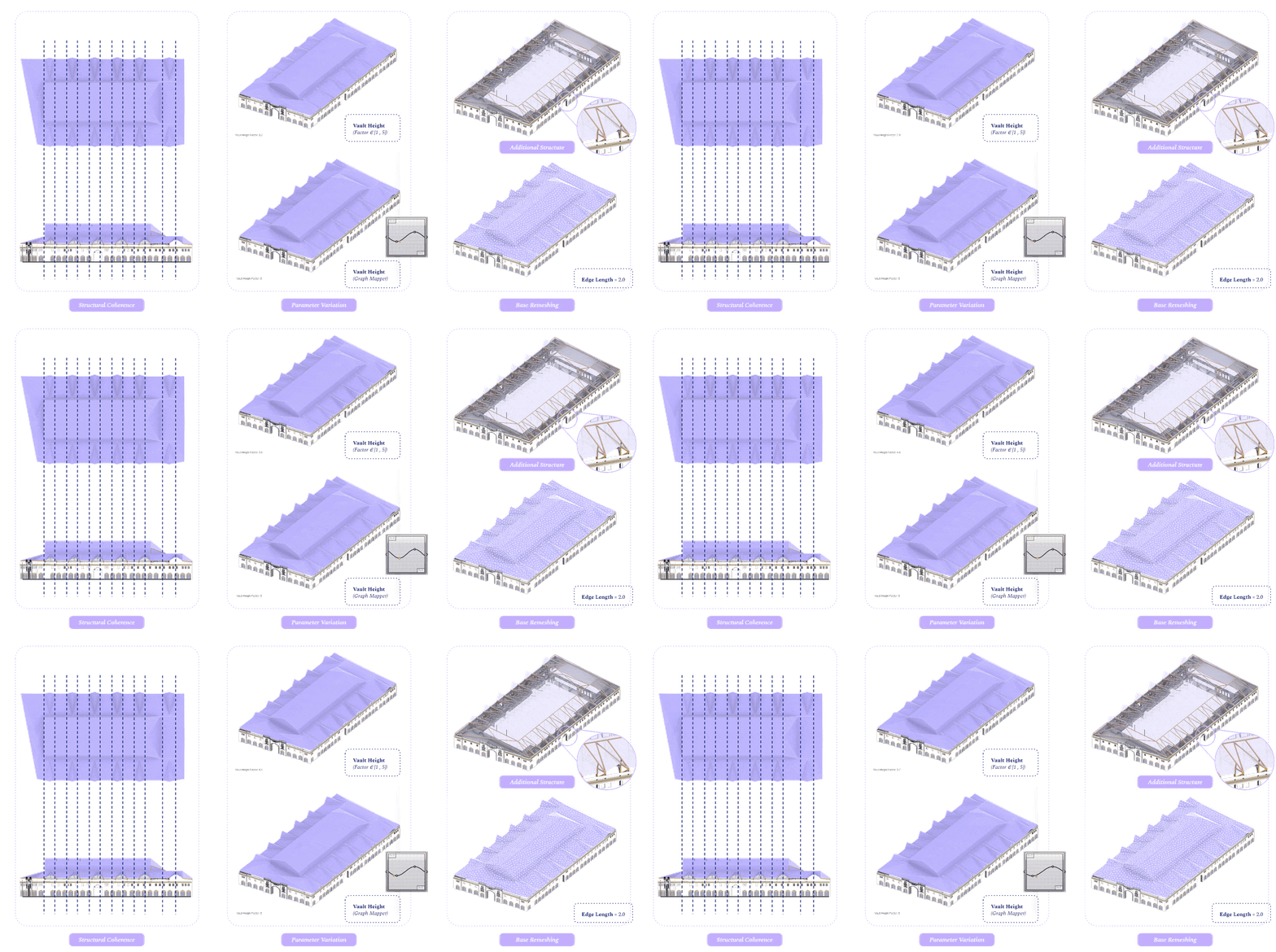
Each vault is positioned on the structural grid and governed by a consistent height parameter, while variation along the longitudinal axis is introduced through a graph mapper. Additional structural elements reinforce the vault edges and reconnect them to the existing trusses, and the roof surfaces are meshed using a target edge length to generate an n-gon-based geometry.
Ornament as Logic
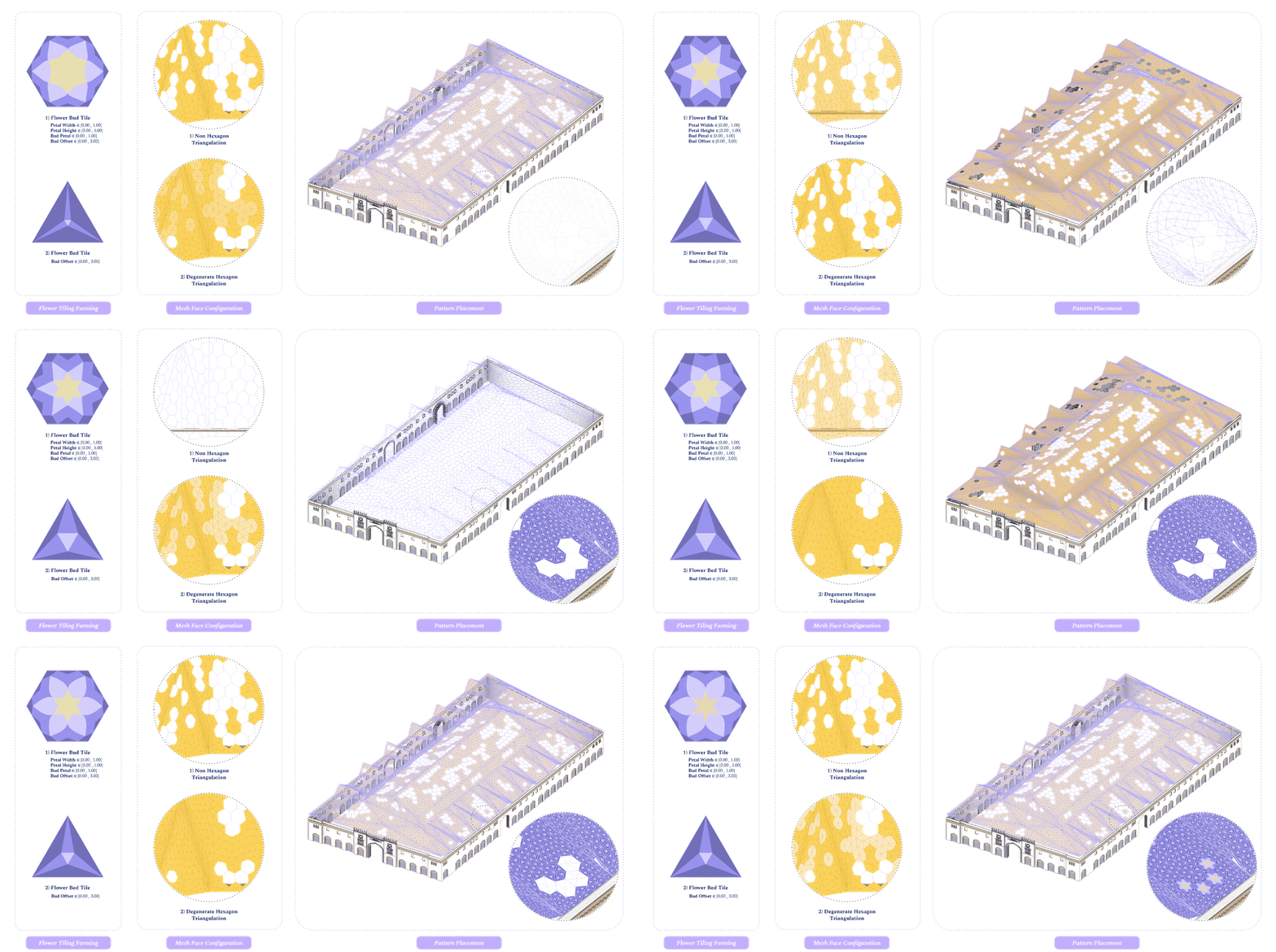
Once the base mesh is established, the lotus tiling system is applied through a rule-based triangulation process. Non-hexagonal faces—such as pentagons and heptagons—are automatically triangulated, as are hexagons that exceed a user-defined tolerance for edge-length irregularity.
These triangulated zones receive leaf and stem tiles, forming a textured ornamental background, while the remaining regular hexagons host the lotus flower tiles. In this way, ornament emerges not as a superficial layer, but as a direct consequence of geometric performance and computational constraints.
From Roof to Ground
The logic of the roof extends beyond its surface, shaping the organization of the market below. By analyzing the roof mesh, the system identifies the four largest clusters of hexagons, which become the spatial anchors for four interior plazas. Each plaza is conceived as a seasonal marker, symbolically referencing the passage of time.
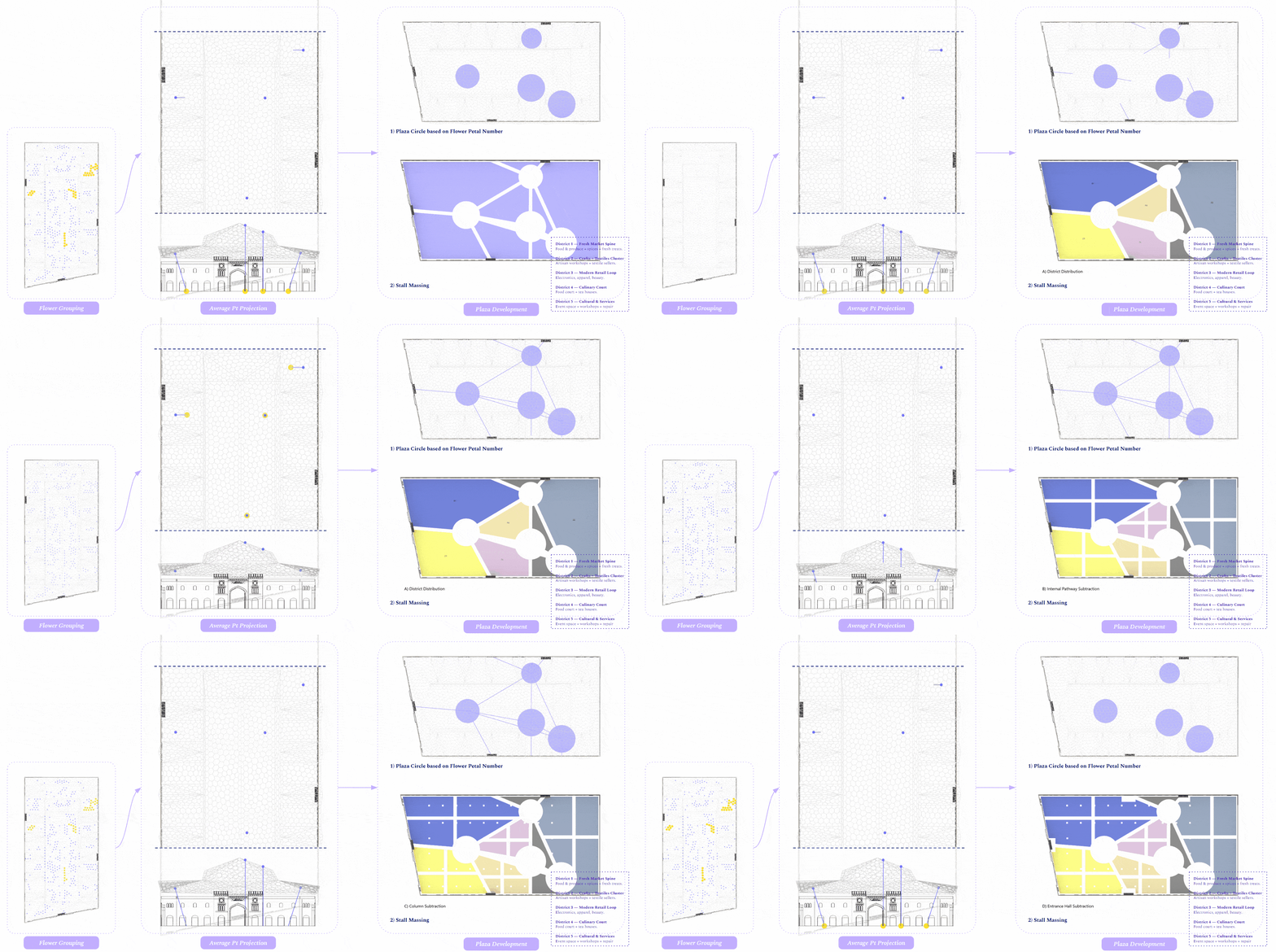
The centroid of each cluster is projected onto the ground plane along the mesh normal, and plaza radii are calibrated according to cluster size. These spaces are then connected to one another and to the market entrances, generating a continuous network of circulation paths.
The remaining floor area is subdivided and evaluated by tile size, allowing each zone to be assigned to one of five programmatic districts: Fresh Produce, Crafts and Textiles, Retail, Food and Tea Court, and Culture and Services. As a result, spatial hierarchy and program distribution emerge directly from the computational reading of the roof geometry.
Variation, Feedback, and Atmosphere
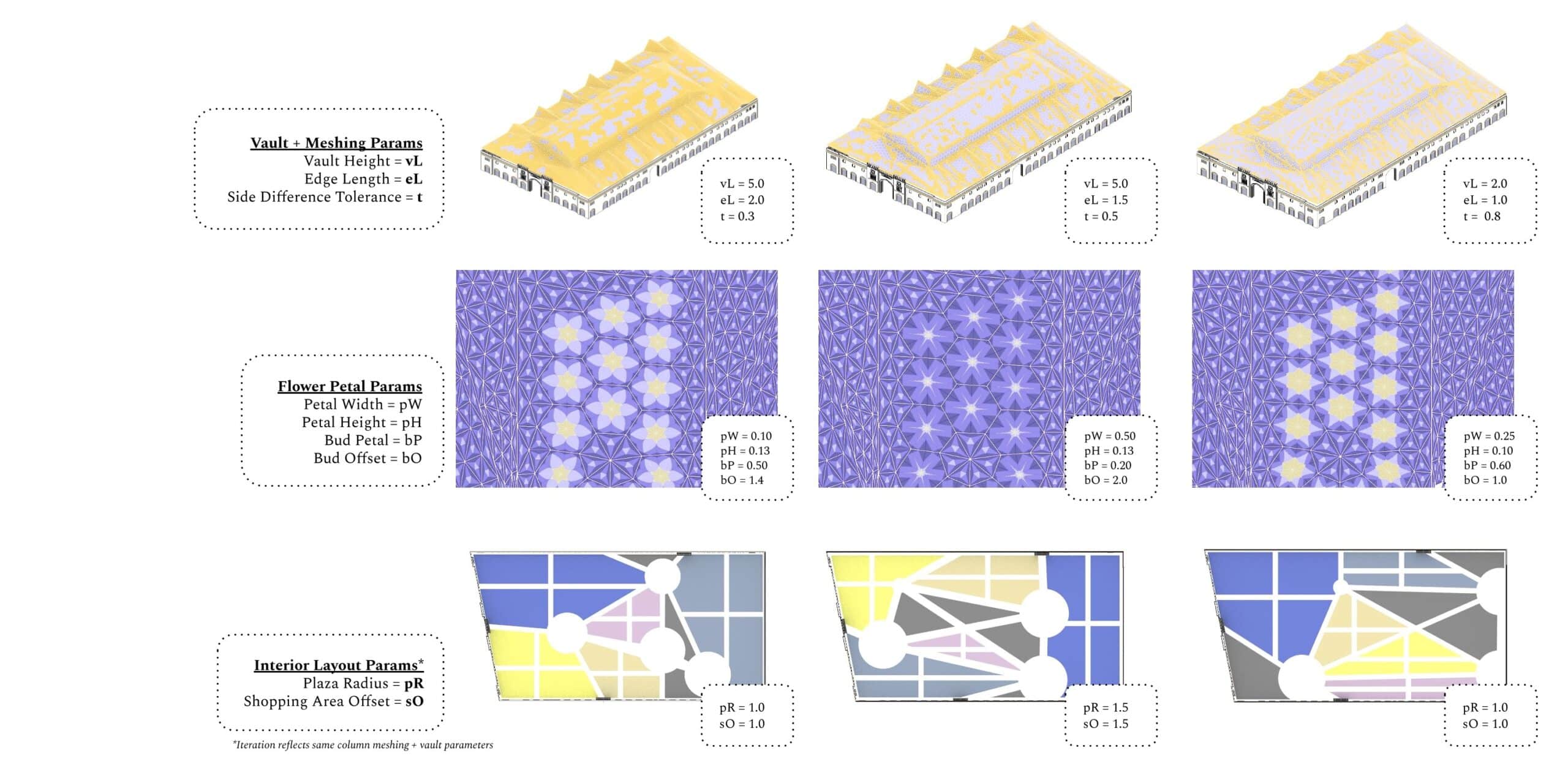
A series of iterations explores the interplay between vault geometry, meshing parameters, tiling rules, and plaza sizing. Small changes in surface logic lead to significant shifts in hexagonal clustering, and consequently, in the interior spatial layout. The project thus treats variation as a design instrument rather than a byproduct.
The proposal is visualized through a set of TwinMotion-generated and AI-enhanced images, capturing the roof’s exterior presence, the interior atmosphere of the market, and the resulting plan and section relationships. Together, they present a project that positions computation not as an abstract exercise, but as a tool for engaging climate, structure, and cultural memory within a contemporary architectural language.
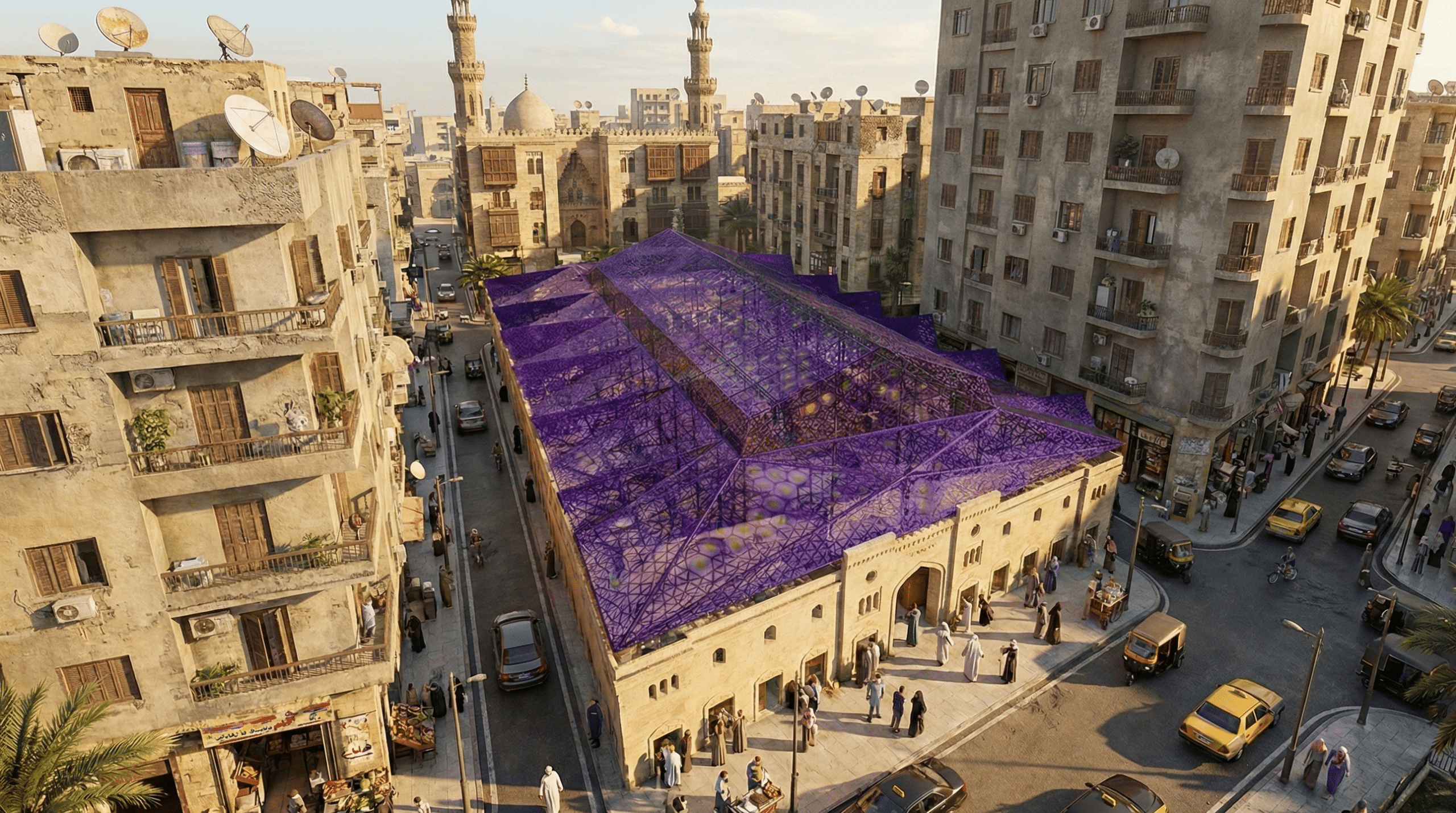
From above, the roof reads as a luminous canopy set within Cairo’s dense fabric, its patterned surface catching light much like a contemporary clerestory. Suspended between structure and ornament, it bridges the mystical and the everyday, marking the market as a renewed civic heart within the city.
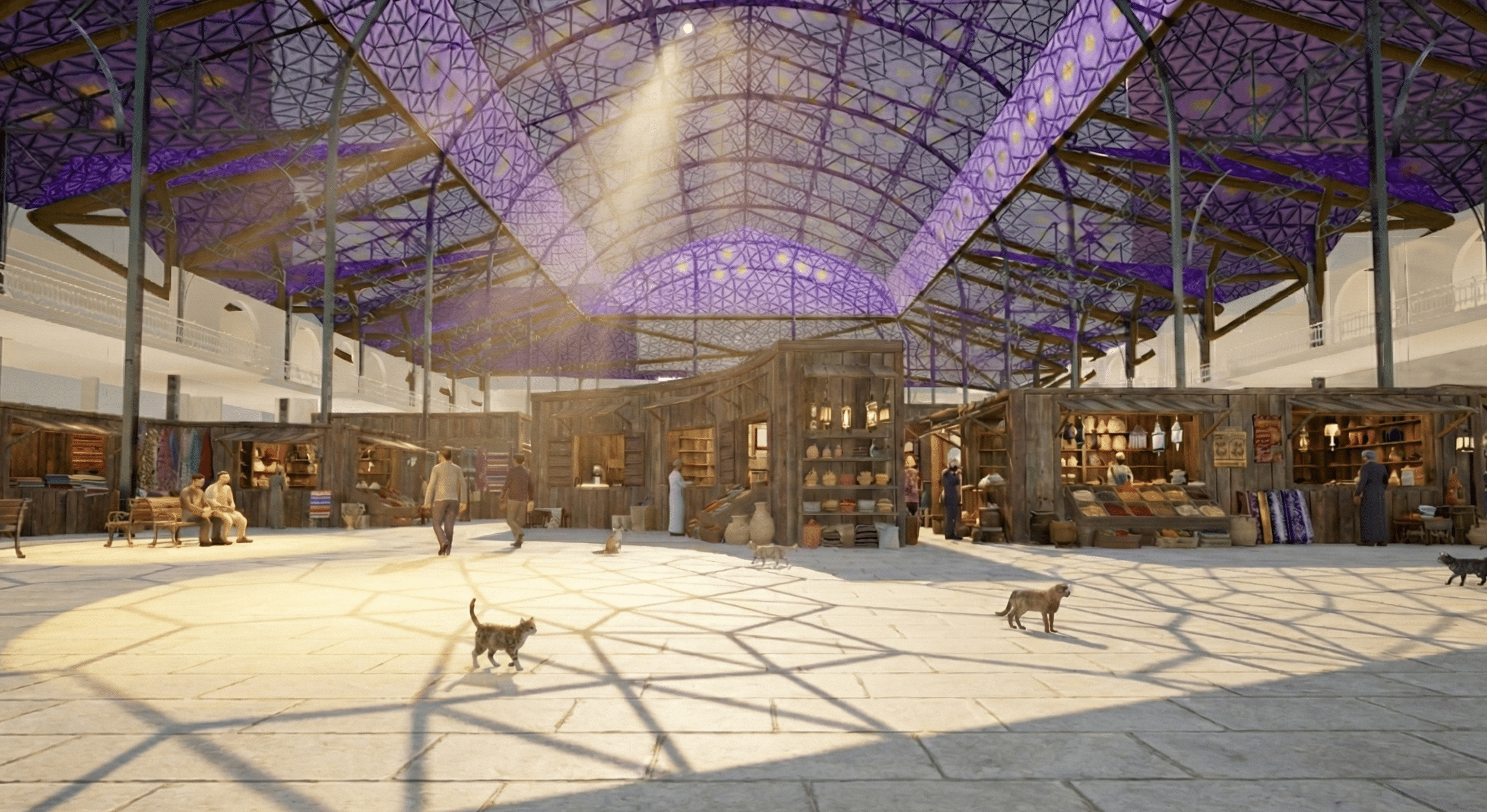
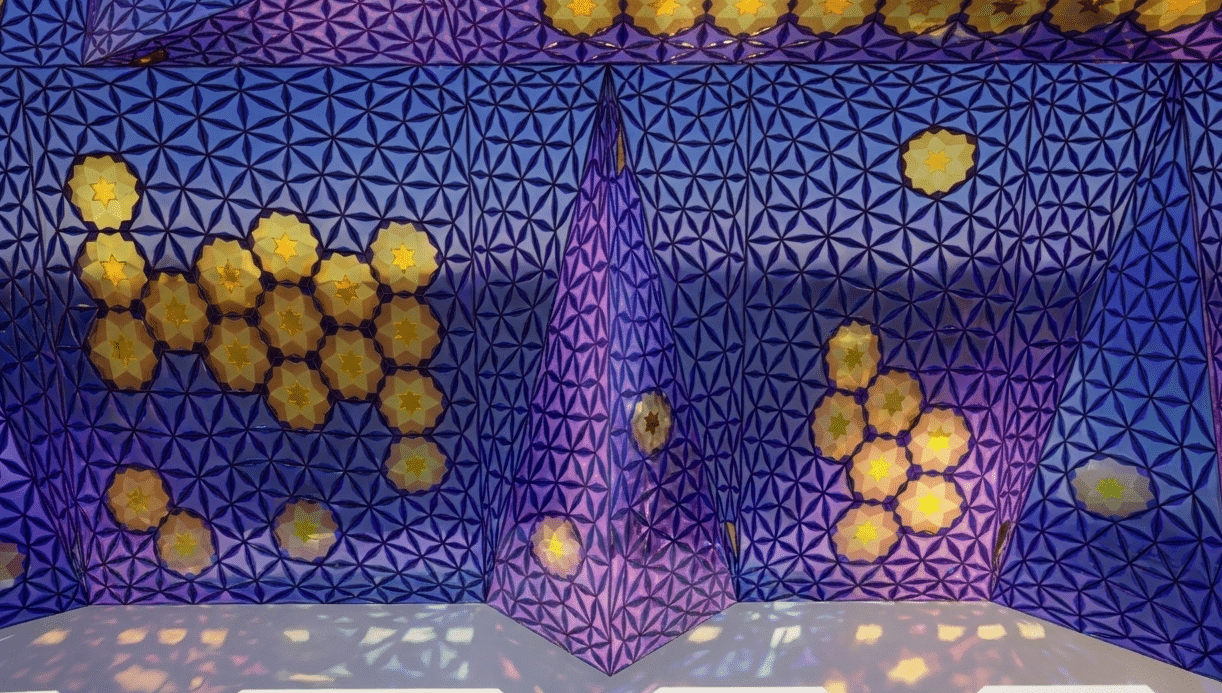
Light filters through the lotus-patterned roof like stained glass, dissolving into color and shadow as it reaches the market floor. The space takes on a quiet, almost sacred atmosphere—where everyday exchange is momentarily elevated, and the rebirth of the market feels both physical and ritual.
