
In 3D printed architecture, the toolpath and the bead resolution define what is actually built. The geometry we design is only its proxy. This post summarizes my thesis research, which asks whether print success can be simulated during the design process, instead of after the design is sliced.
Research topic and context
Where complex geometry emerges to achieve performance, additive fabrication becomes a viable way to produce it, which makes simulating its buildability important. 3D printing works across a growing range of materials with less waste, and a 2026 market report lists companies such as COBOD, ICON, XtreeE and CyBe Construction among the major players in construction printing.
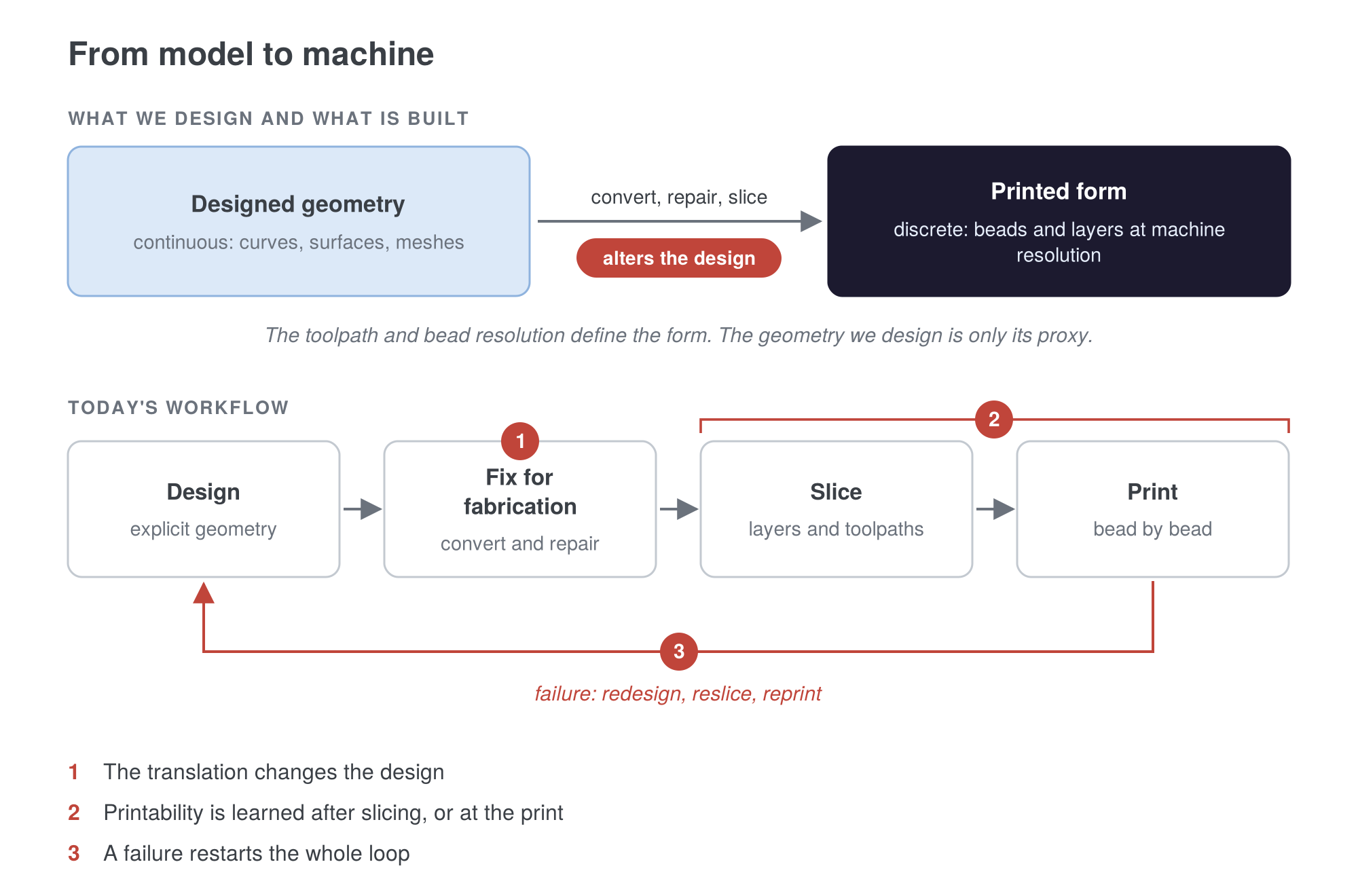
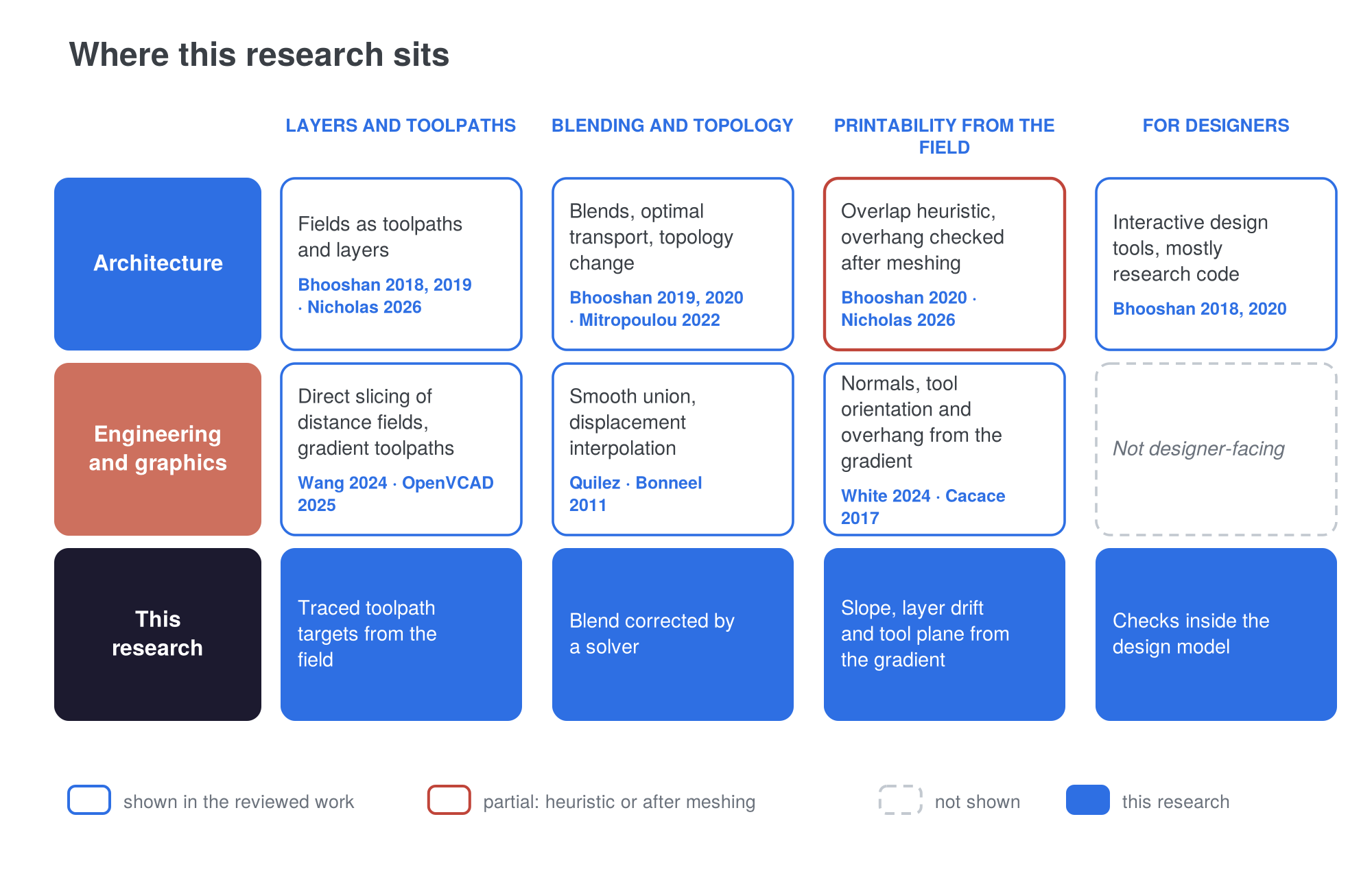
The literature shows the same pattern. Field methods build coherent layers but give no guarantee that a print will work (Bhooshan et al. 2020). Paths too far apart cause failures (Mitropoulou et al. 2022), and overhang is checked after meshing (Nicholas et al. 2026). My approach uses signed distance fields, where offsets, merges and splits already exist in the model and are accessed by reading a different iso value.
Innovation
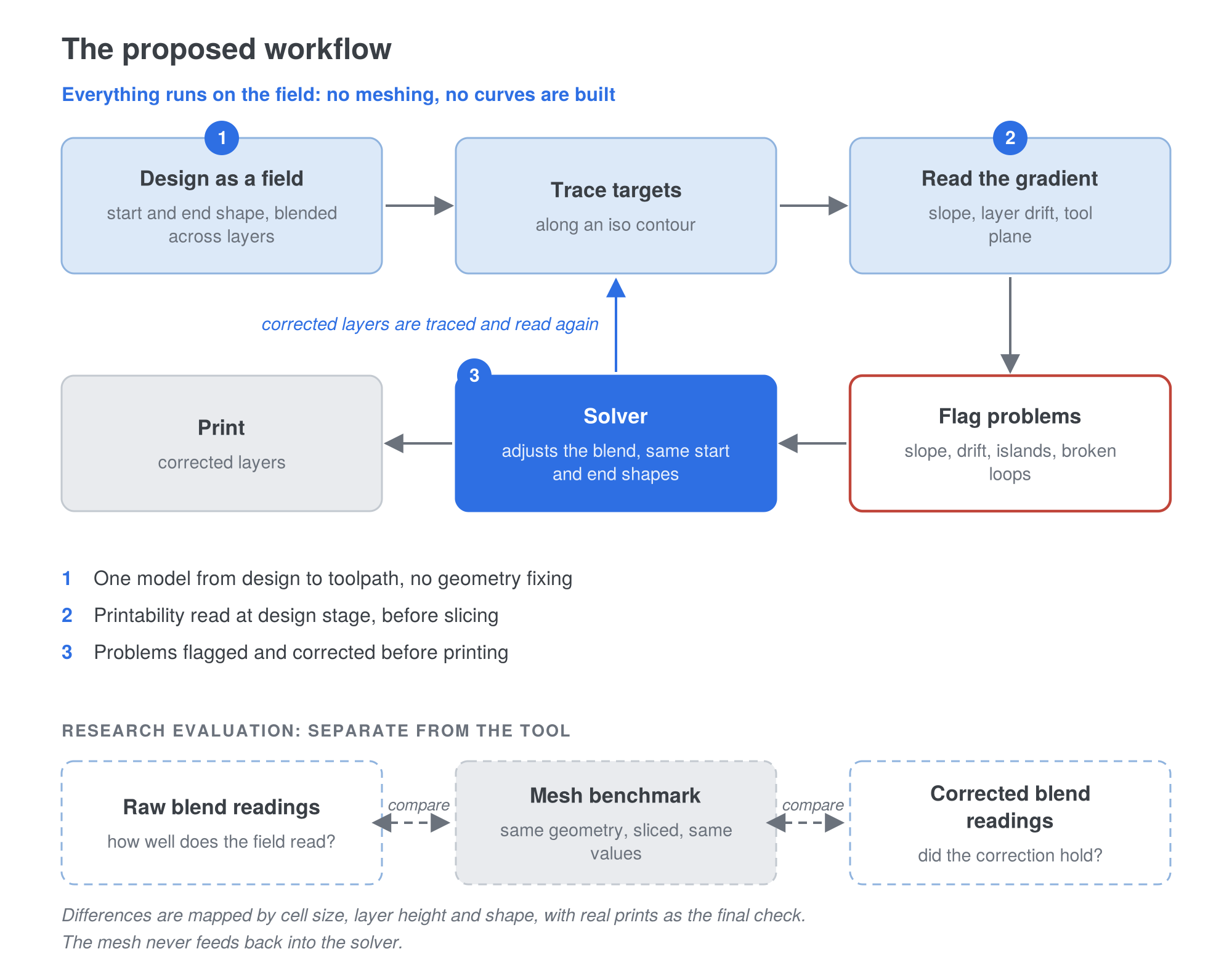
In the work I reviewed, field-based design workflows in architecture check printability heuristically or after meshing. In engineering and graphics it is read from fields, but not as designer-facing tools. This research aims to combine them: printability is read in the design field, a solver corrects the blend, and the readings are tested against a mesh benchmark. It changes what we know, what we can do and what we can verify.
The proposed workflow, and how it is tested
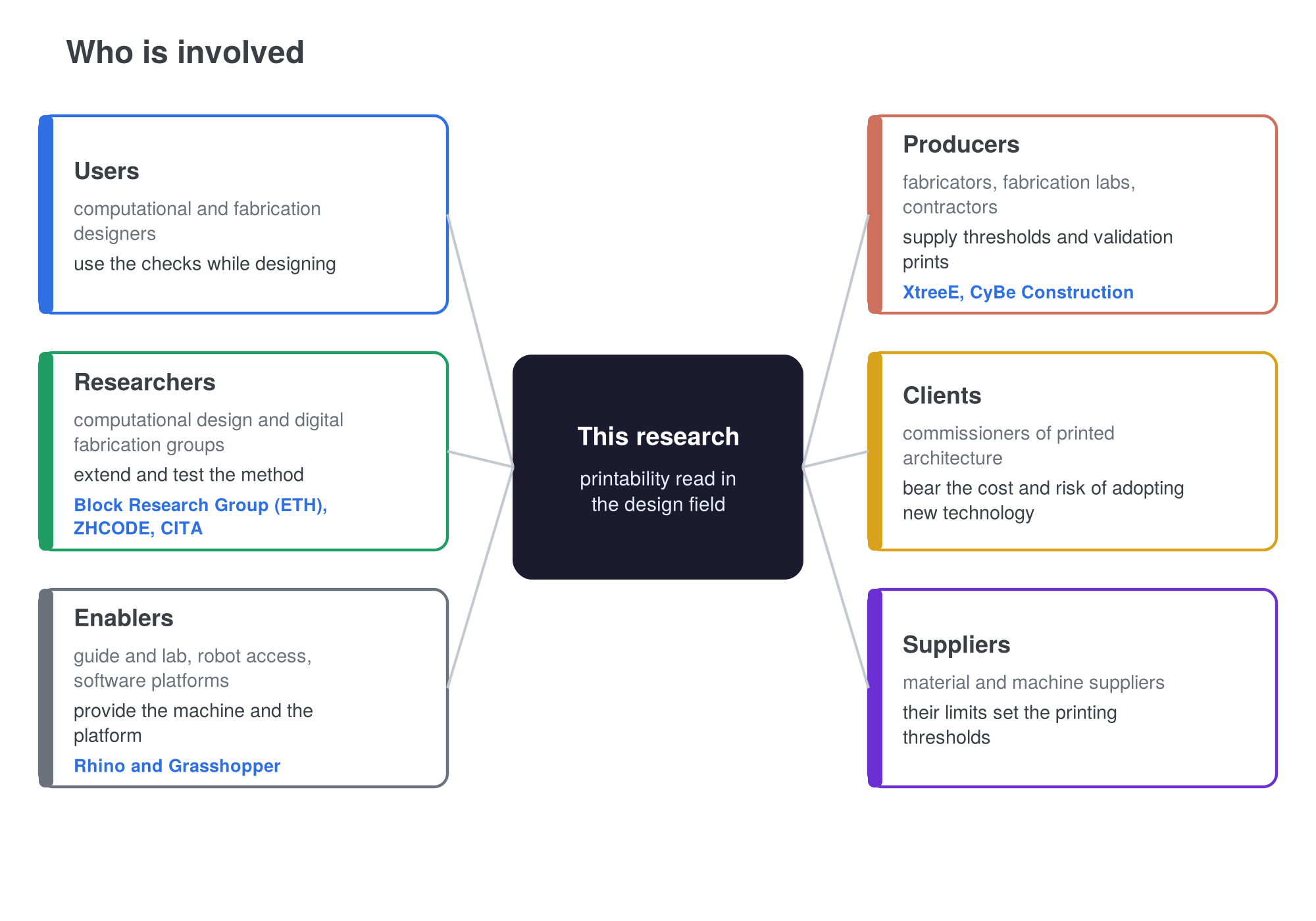
Actors
The actors range from the designers who use the checks to the clients who bear the risk. Producers include XtreeE and Caracol, which makes large-scale 3D printing systems for construction, and CyBe, which offers concrete printers together with parametric design software and materials. Researchers include the Block Research Group, ZHCODE and CITA.
What can be exploited
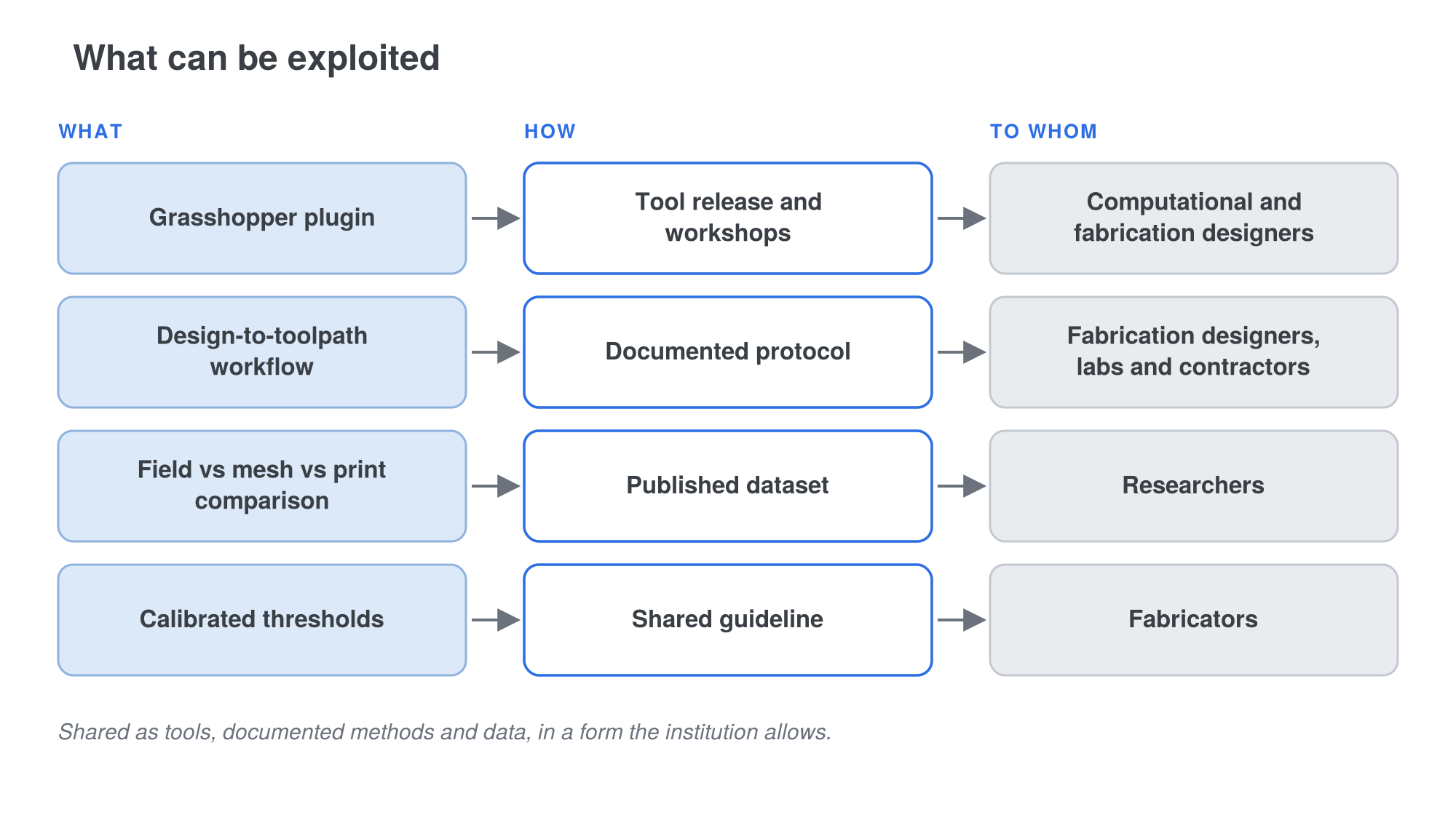
The four results, a plugin, a workflow, a dataset and thresholds, are shared through tool release and workshops, a documented protocol, published data and a shared guideline, in a form the institution allows.
Impact and dimensions
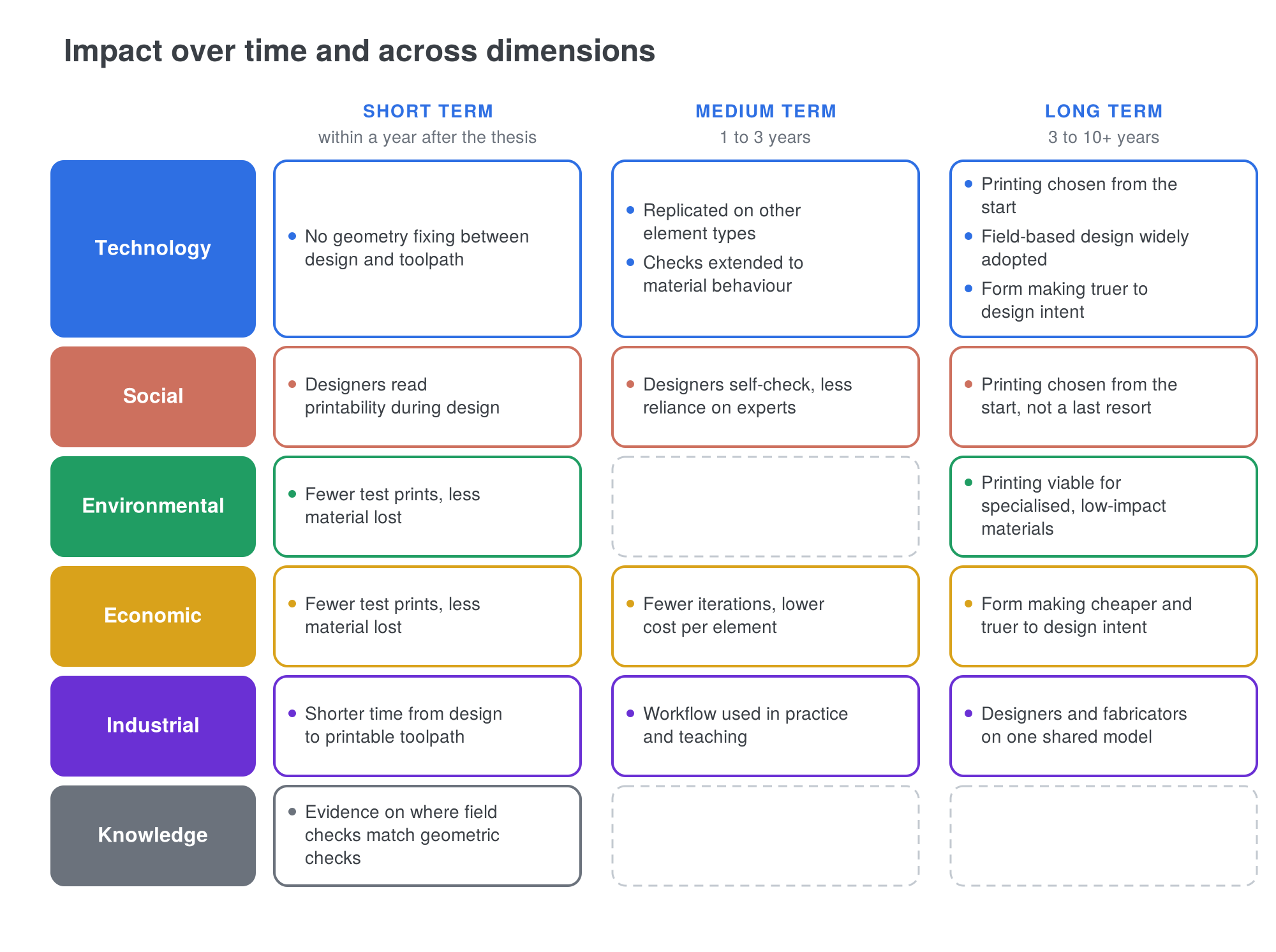
In the short term the workflow removes geometry fixing and shows where field checks hold. Within three years it is used in practice and teaching. In the long term 3D printing is chosen from the start, and designers and fabricators work on one shared model. The impact spans technology, social, environmental, economic, industrial and knowledge dimensions.
Technology readiness level
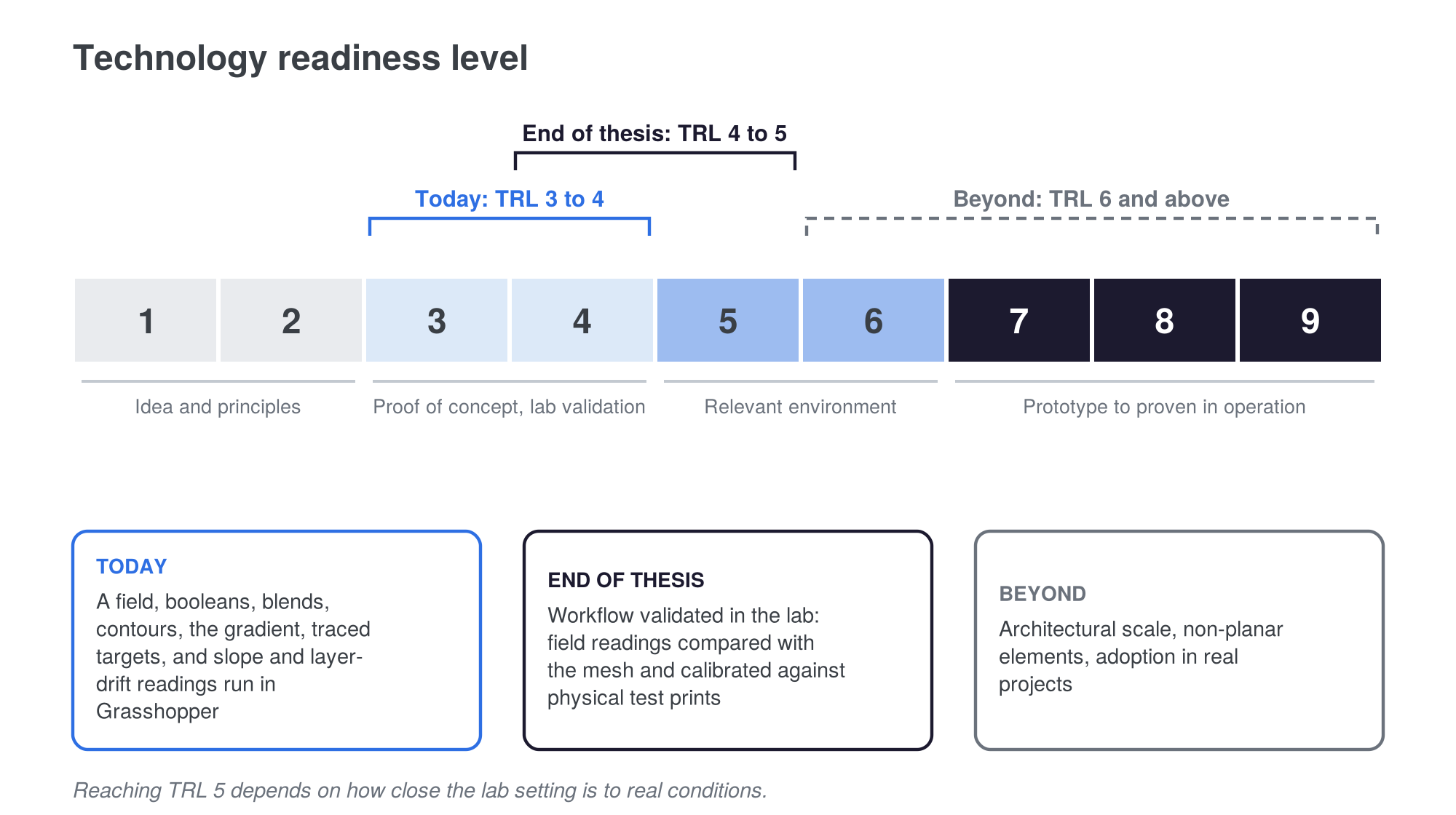
Today the research sits at TRL 3 to 4, and the aim is TRL 4 to 5 by the end of the thesis, with validation prints at lab scale. Collaboration with designers, fabricators and contractors is the path beyond.
References
- Bhooshan, Van Mele, Block 2018. Equilibrium-aware shape design for concrete printing. Humanizing Digital Reality (DMS 2017), Springer. doi 10.1007/978-981-10-6611-5_42
- Bhooshan, Ladinig, Van Mele, Block 2019. Function representation for robotic 3D printed concrete. ROBARCH 2018, Springer. doi 10.1007/978-3-319-92294-2_8
- Bhooshan, Van Mele, Block 2020. Morph & Slerp: shape description for 3D printing of concrete. SCF ’20, ACM. doi 10.1145/3424630.3425413
- Mitropoulou, Bernhard, Dillenburger 2022. Nonplanar 3D printing of bifurcating forms. 3D Printing and Additive Manufacturing 9(3):189-201. doi 10.1089/3dp.2021.0023
- Nicholas, Rossi, Eppinger et al. 2026. Design-to-fabrication workflows for large-scale continuous FDM grading of biopolymer composites. Applied Sciences 16:1569. doi 10.3390/app16031569
- Wang, Zhang, Cai et al. 2024. Universal and efficient hybrid modeling and direct slicing method for additive manufacturing processes. Advances in Manufacturing 12(2):300-316. doi 10.1007/s40436-023-00468-8
- Wade, Beck, MacCurdy 2025. Implicit toolpath generation for functionally graded additive manufacturing via gradient-informed slicing (OpenVCAD). Additive Manufacturing. doi 10.1016/j.addma.2025.104963
- White 2024. Level Set Grid. Poster, Florida State University. sc.fsu.edu/images/stories/xpo/2024/White_Cx24.pdf
- Cacace, Cristiani, Rocchi 2017. A level set based method for fixing overhangs in 3D printing. Applied Mathematical Modelling 44:446-455.
- Bonneel, van de Panne, Paris, Heidrich 2011. Displacement interpolation using Lagrangian mass transport. ACM Transactions on Graphics 30(6), article 158.
- Research Nester 2026. 3D Printing Construction market, report 4593 (published 7 April 2026).
