

Introduction
Finding the right home isn’t just about square meters or the number of bedrooms. A floor plan that works beautifully for one household can be completely unsuitable for another. Parents with young children, remote workers, retirees, or pet owners all experience the same space differently. Yet today’s search tools still rely on simple filters that fail to capture how people actually live.
inHabit is a spatial intelligence copilot that finds the layout that fits the way you live.
Rather than treating a floor plan as a static drawing, inHabit approaches it as a living system that can be understood, searched, and evaluated through the lens of everyday routines. The result is a spatial intelligence copilot capable of matching layouts to people’s lifestyles while explaining why a particular design fits their needs.
The Challenge
Architectural layouts are relatively easy to generate, but much harder to evaluate systematically.
Existing design tools often excel at creating floor plans but provide limited insight into how well those plans support different ways of living. Likewise, real estate search platforms reduce homes to a handful of numerical attributes—number of bedrooms, floor area, or price—ignoring the spatial qualities that make a home enjoyable to inhabit.
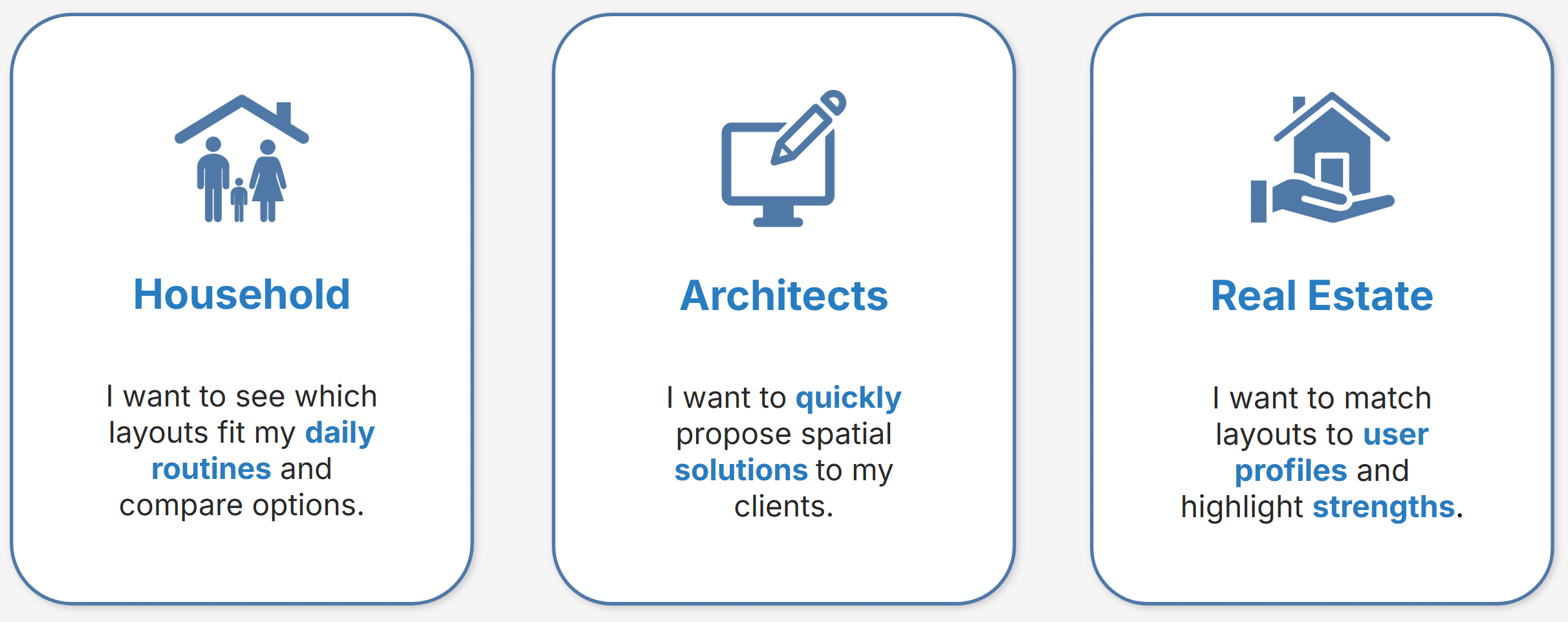
Our goal was to build a system capable of answering questions such as:
- How will daylight and circulation affect everyday routines?
- Which apartment best suits a retired couple with a dog?
- Which kitchen works for two people cooking together?
- Which layout supports working from home while maintaining privacy?
A Human-Centred Search Approach
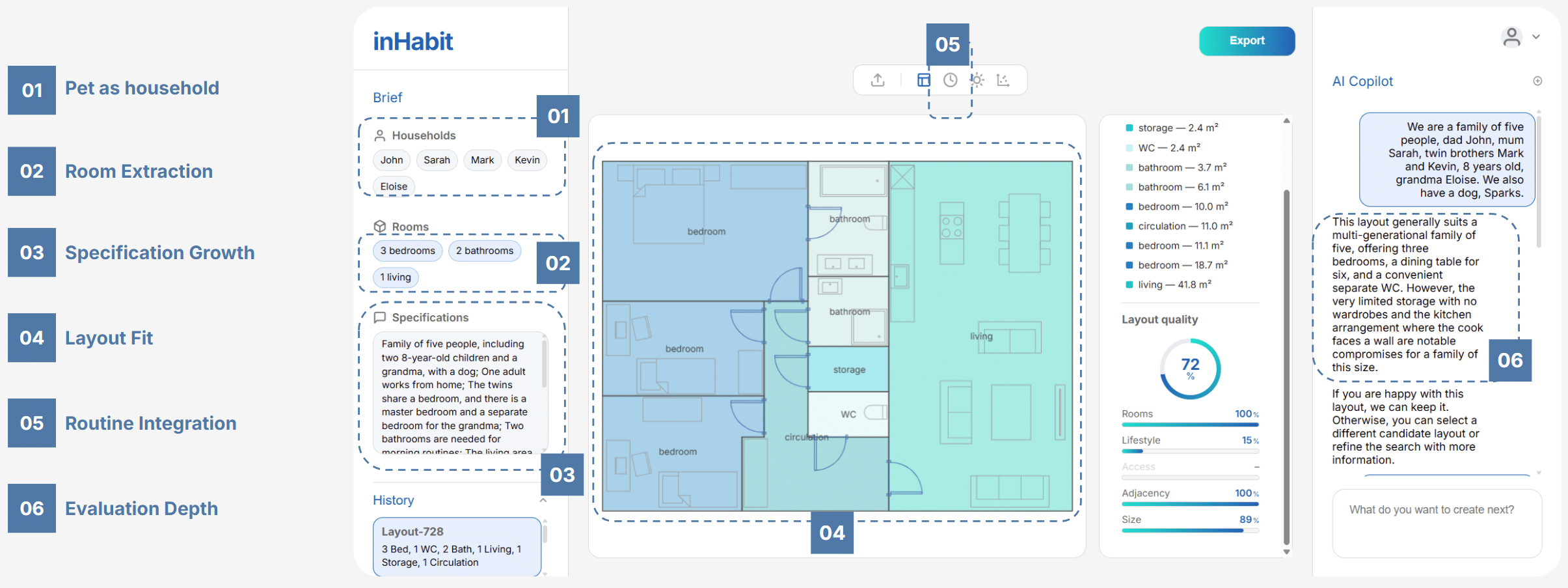
At the core of inHabit is a conversational interface.
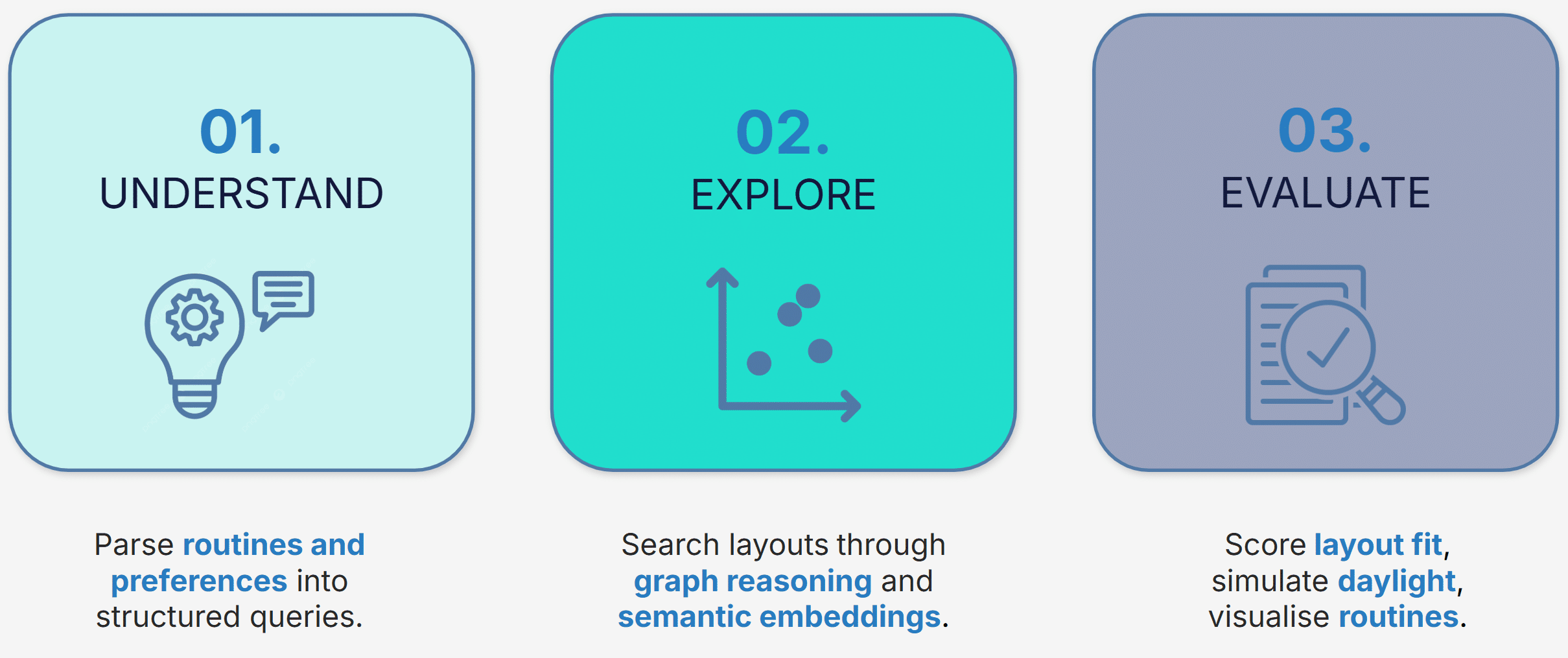
Users simply describe their household, habits, and preferences in natural language. The system interprets this brief, converts it into structured information, searches a database of residential layouts, and returns the most suitable match together with an explanation.
The process is deliberately iterative.
Each additional detail—whether it’s owning a cat, preferring an open kitchen, needing an extra guest room, or working from home—refines the search. Instead of restarting from scratch, the system continuously updates its understanding of the user, producing increasingly accurate layout recommendations.
Building a Rich Residential Dataset
Creating meaningful search results required more than collecting floor plans.
While we initially explored the RPLAN dataset because of its compatibility with hypergraph-based layout adaptation, we eventually migrated to PlanFinder to obtain detailed information about furniture, windows, and architectural elements.
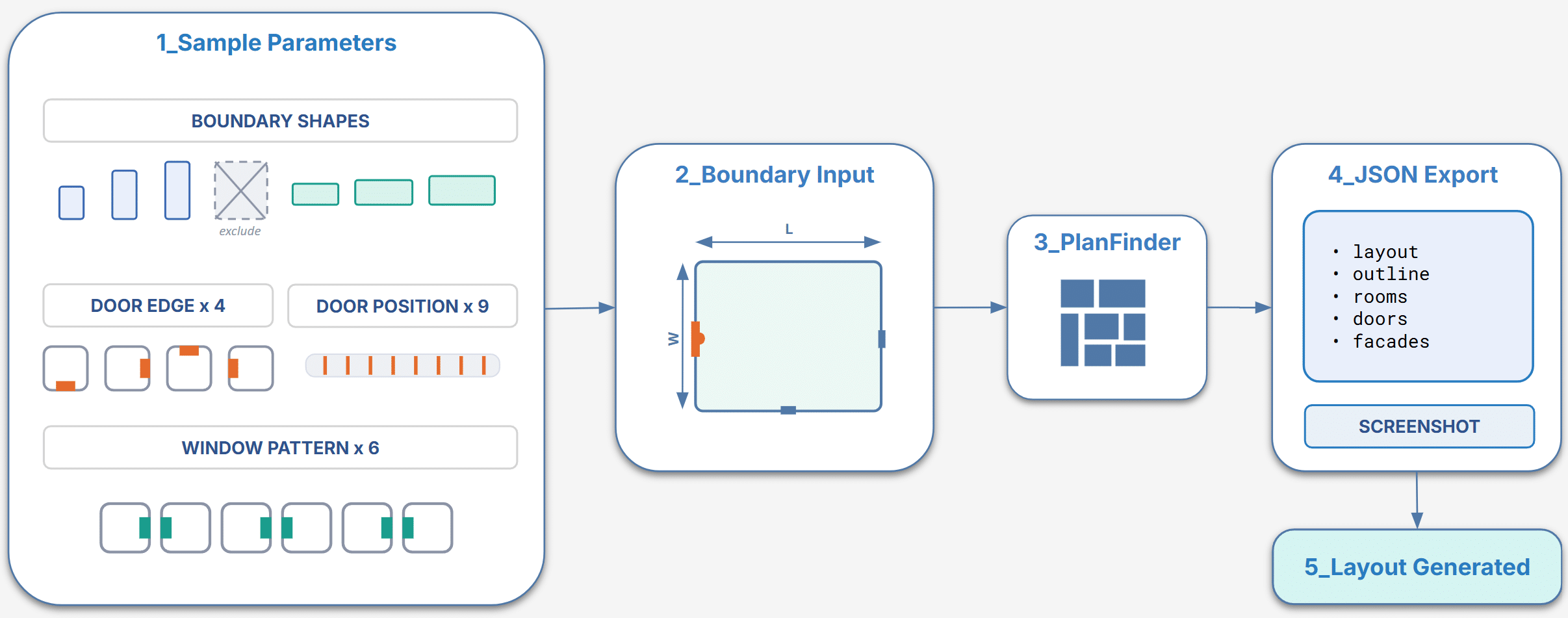
Using a series of custom Python scripts, we generated thousands of parameter combinations describing apartment boundaries, entrances, and window configurations. These configurations were processed through PlanFinder and exported as structured JSON files alongside rendered floor plans.
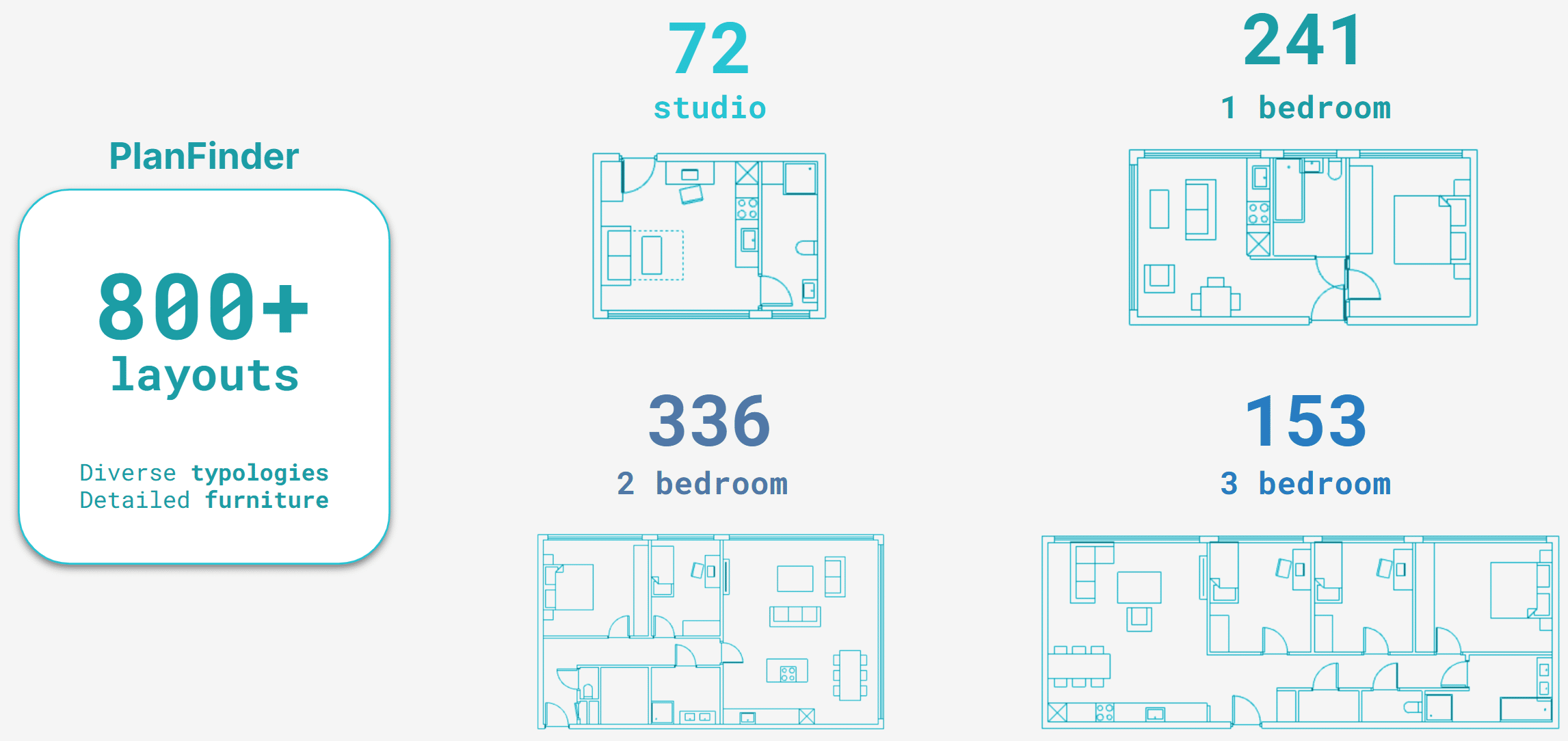
The final dataset contains more than 800 furnished residential layouts spanning multiple apartment sizes and typologies.
Teaching the Computer to Understand Furniture
Furniture carries important information about how a home is used.
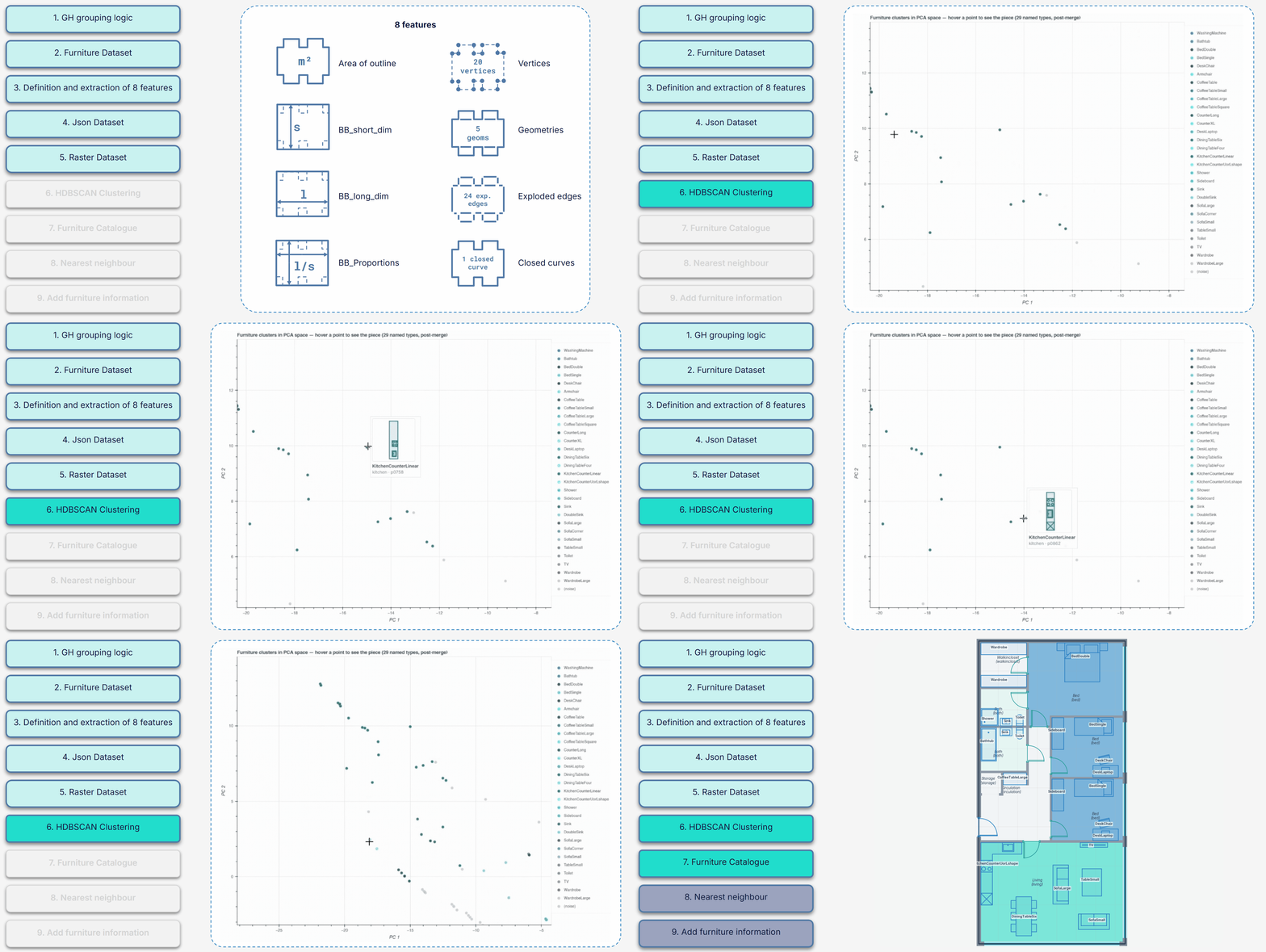
To make layouts searchable beyond simple geometry, we extracted furniture outlines, encoded their geometric properties, and clustered them using HDBSCAN. A semantic catalogue describing 29 furniture categories and eight architectural features allowed the system to recognise and classify furnishings across the dataset.
Although the pipeline performed extremely well for distinctive geometries, simple rectangular objects occasionally remained difficult to distinguish—a reminder that even apparently simple shapes can become ambiguous at scale.
Describing Spaces in Natural language
Geometry alone is not enough.
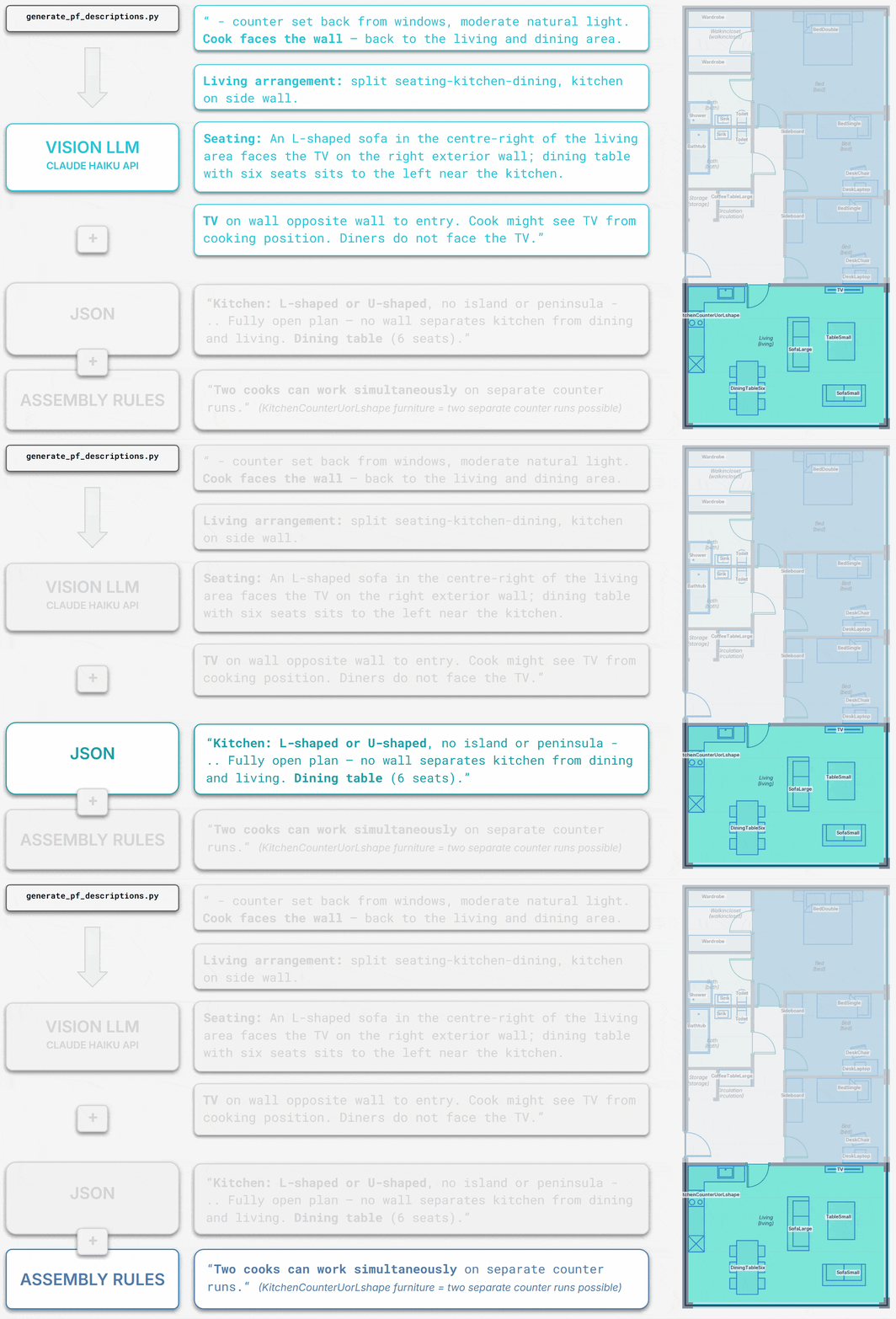
Each apartment receives a detailed semantic description generated through a combination of structured rules and Vision Language Models.
The descriptions capture characteristics such as:
- kitchen configuration
- openness between rooms
- dining relationships
- natural lighting
- visibility between spaces
- opportunities for shared activities
- possible daily routines
Rather than asking the language model to invent these descriptions, most architectural relationships are computed deterministically and stored in JSON. The LLM acts primarily as an interpreter, assembling this information into readable language.
This hybrid approach combines the reliability of explicit geometric analysis with the flexibility of natural language generation.
Representing Layouts as Graphs
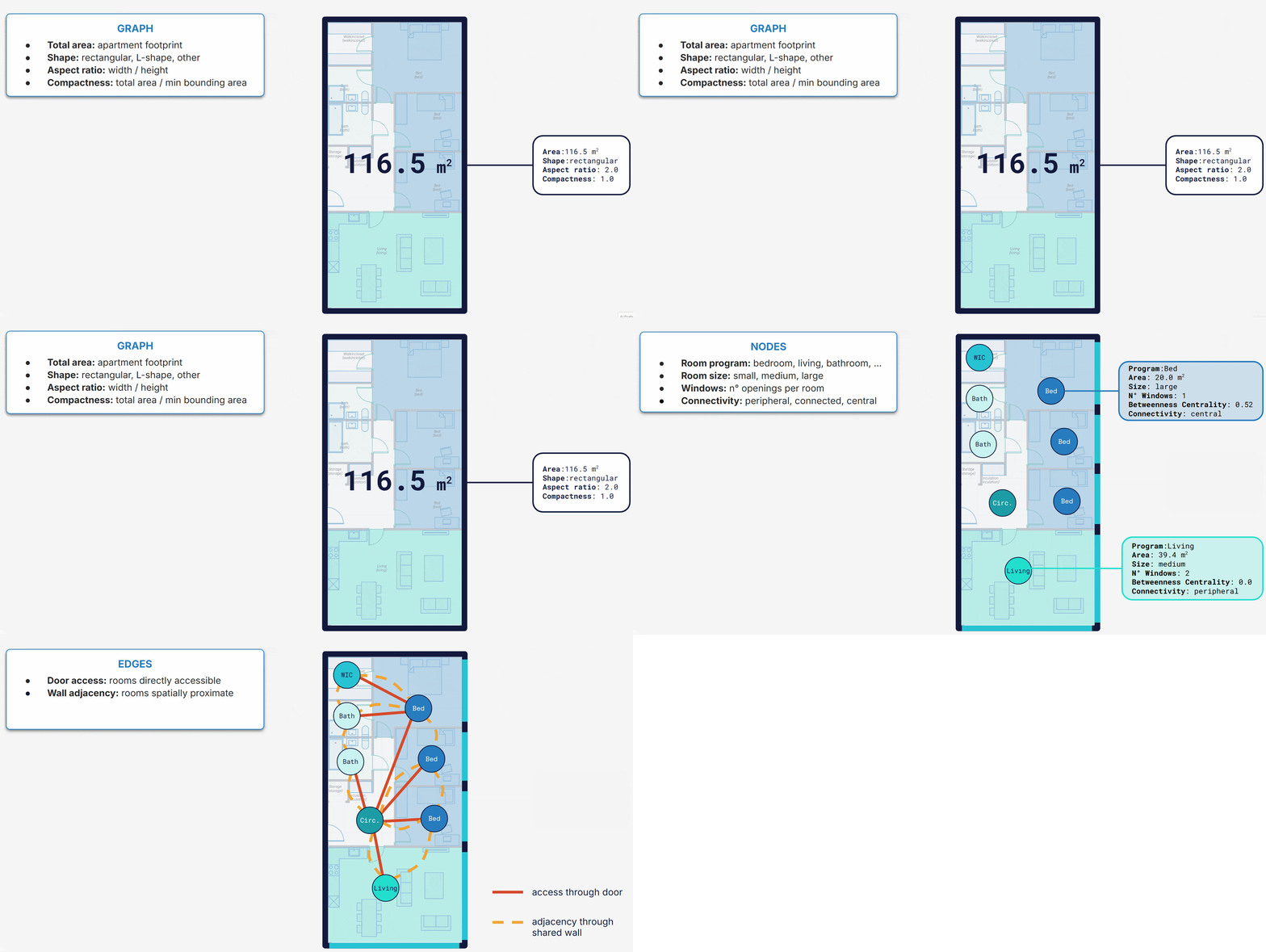
Alongside semantic descriptions, every apartment is represented as a graph.
The apartment itself stores global properties such as area, shape, compactness, and aspect ratio. Individual rooms become graph nodes containing information about their size, function, window count, and spatial centrality.
Edges describe how rooms relate to one another, whether through direct door connections or shared walls.
This graph representation enables structural comparisons between layouts, allowing the system to search not only for similar room programmes but also for similar spatial organisations.
Searching Beyond Keywords
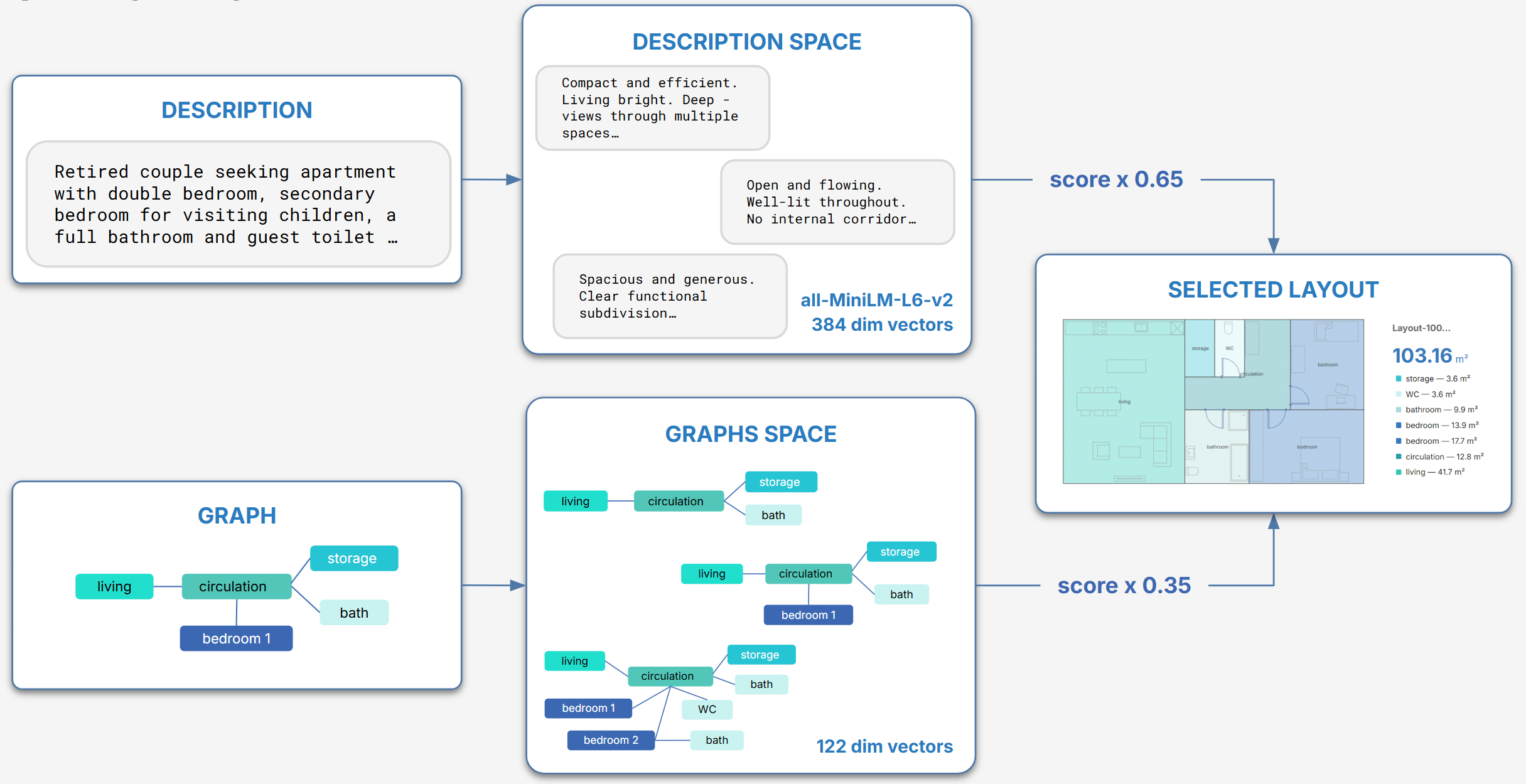
When a user submits a request, two complementary searches happen simultaneously.
The semantic description is converted into embeddings that capture lifestyle preferences and spatial qualities, while the graph representation captures architectural structure.
The search process therefore goes far beyond keyword matching. It considers how a home functions as a spatial system.
To make these relationships easier to understand, layouts are projected into a two-dimensional similarity space using PCA, allowing users to explore neighbouring solutions or even generate intermediate layouts between two examples.
An Agent That Reasons About Homes
The search engine is organised as a stateful agent workflow.
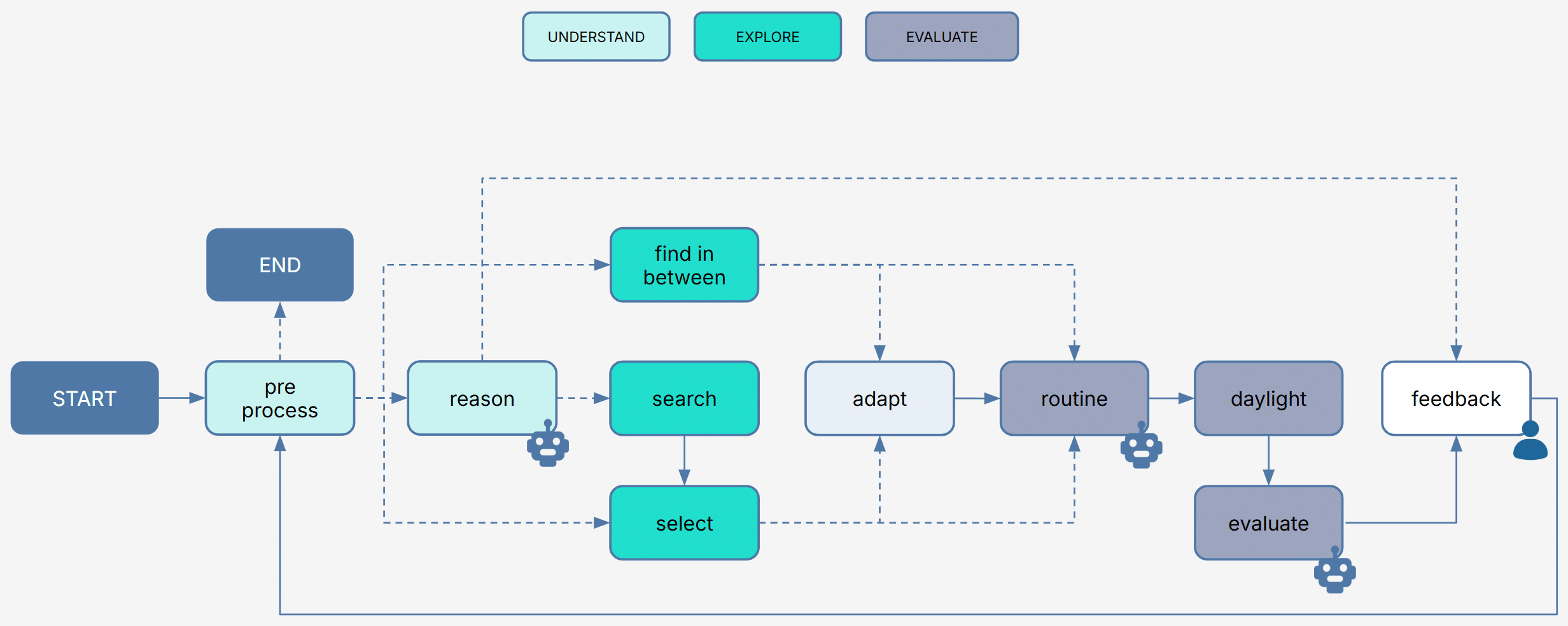
A pre-processing stage subdivide the direct select queries from more complex one which go to reason node. It first determines whether additional clarification is needed before interpreting the user’s request and extracting three complementary representations:
- household composition
- semantic description
- graph structure.
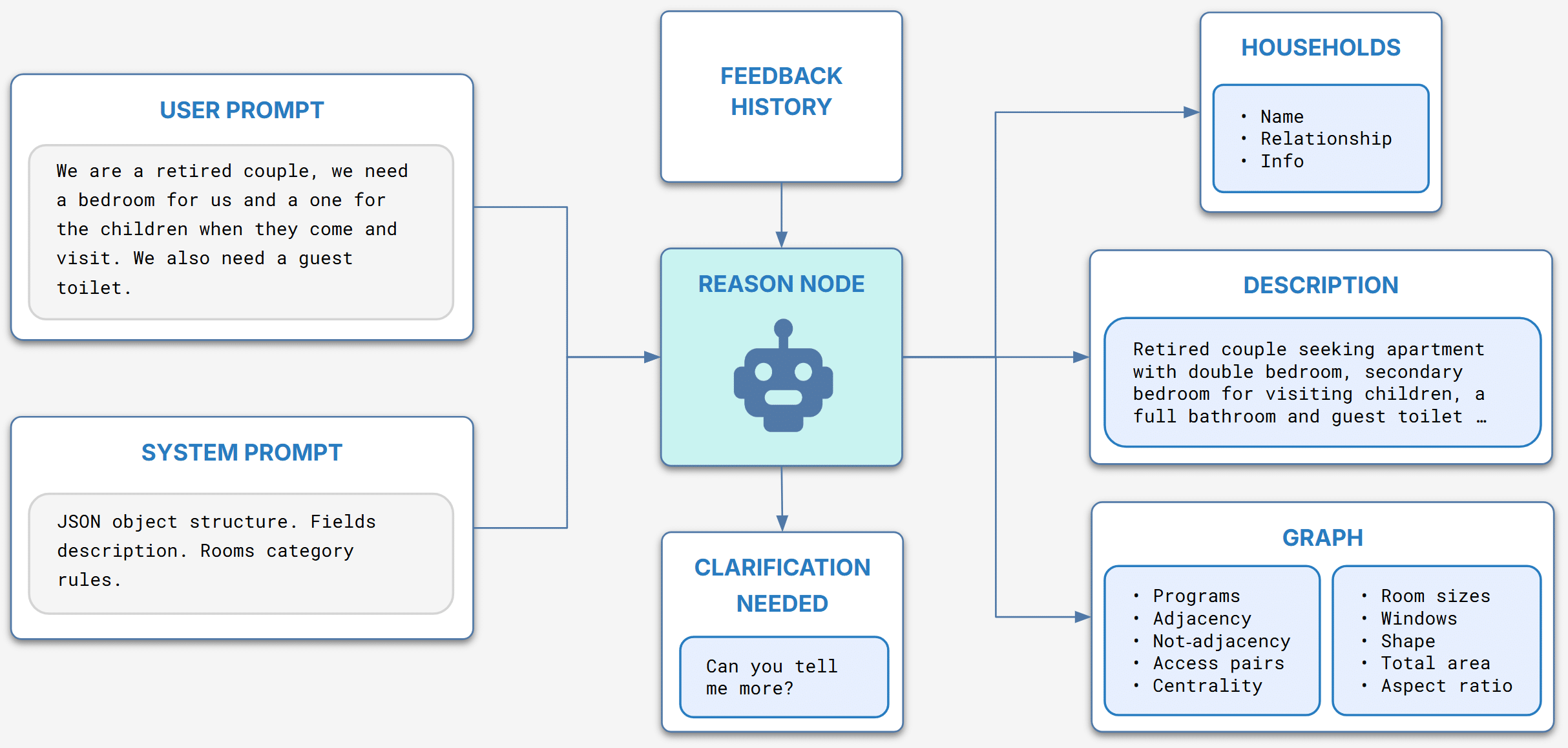
Rather than treating each prompt as an isolated query, the agent maintains a persistent conversation state. The evolving brief, user feedback, and outputs from previous iterations are stored and progressively accumulated, allowing the system to refine its understanding of the household over time.
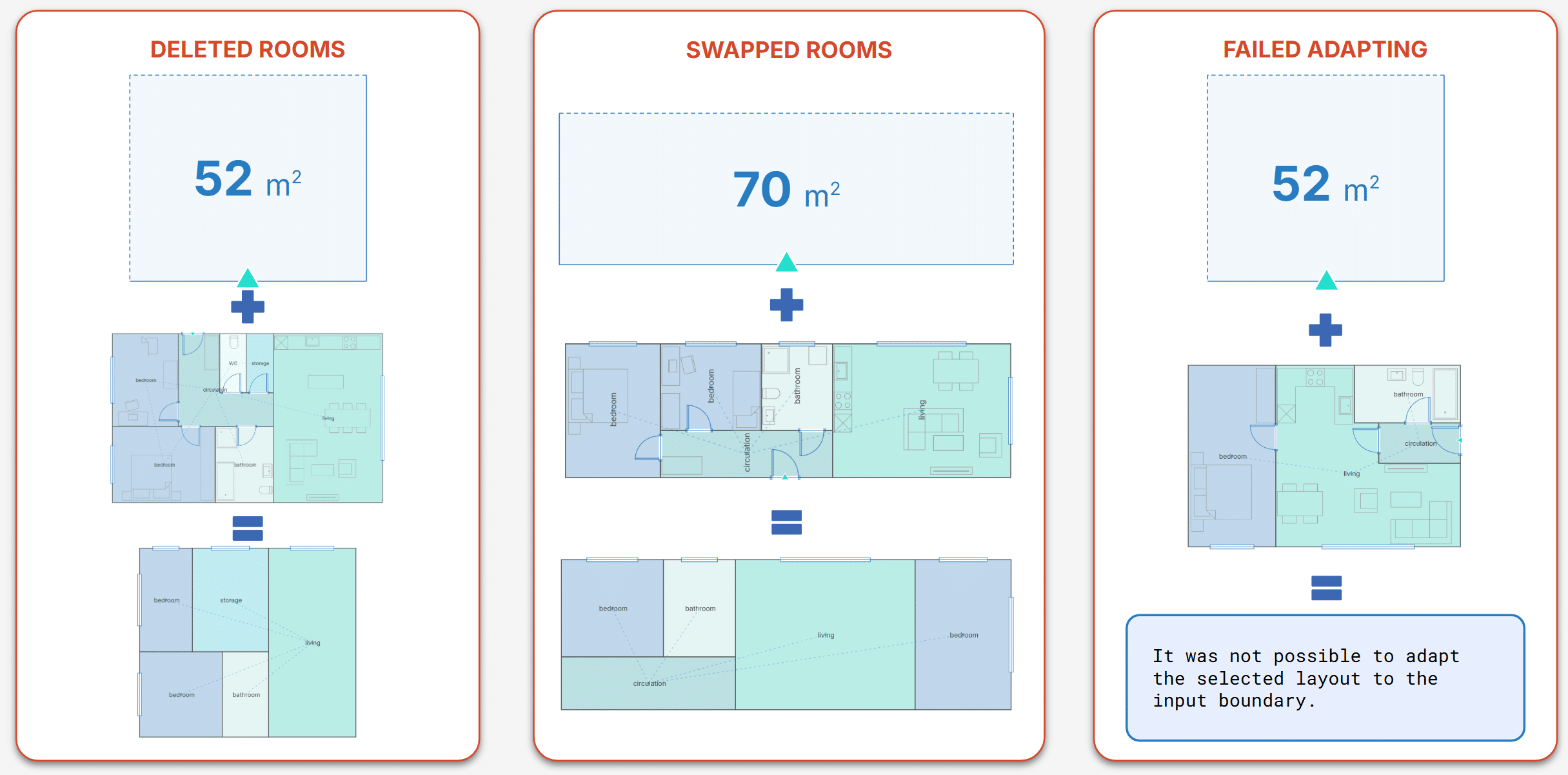
The search node then retrieves the highest-ranking layout by combining semantic and graph-based similarity scores. If required, an adaptation node uses Grasshopper and RGraphLib to transform the selected plan to fit a different building boundary through hypergraph operations.
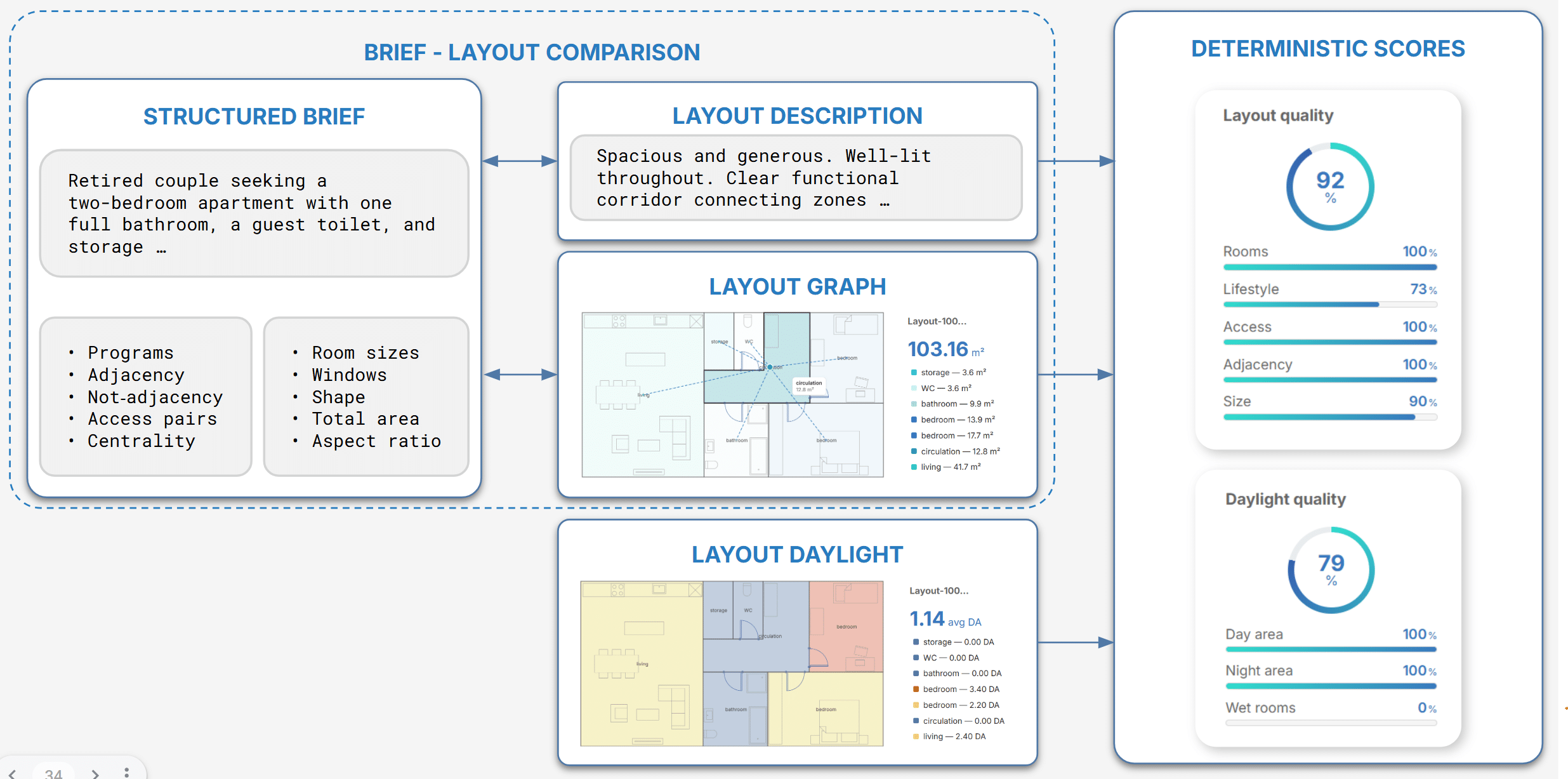
Finally, the evaluation stage analyses the proposed layout by comparing it against the accumulated brief, simulating daylight performance, and generating daily routines for each household member. It returns both deterministic scores and a natural-language explanation of the layout’s strengths and limitations. The user’s feedback is written back into the conversation state, closing the loop and informing every subsequent iteration.s.
From Geometry to Everyday Life
Perhaps the most distinctive feature of inHabit is that it does not stop after finding a layout.
Instead, it attempts to explain how that layout supports everyday living.
The interface visualises daylight performance, displays the underlying room graph, and animates daily routines generated for each resident. Rather than presenting architecture as a collection of rooms, the system illustrates how people might actually move through and inhabit those spaces.
This transforms abstract geometry into something much more relatable.
Benchmarking Different Language Models
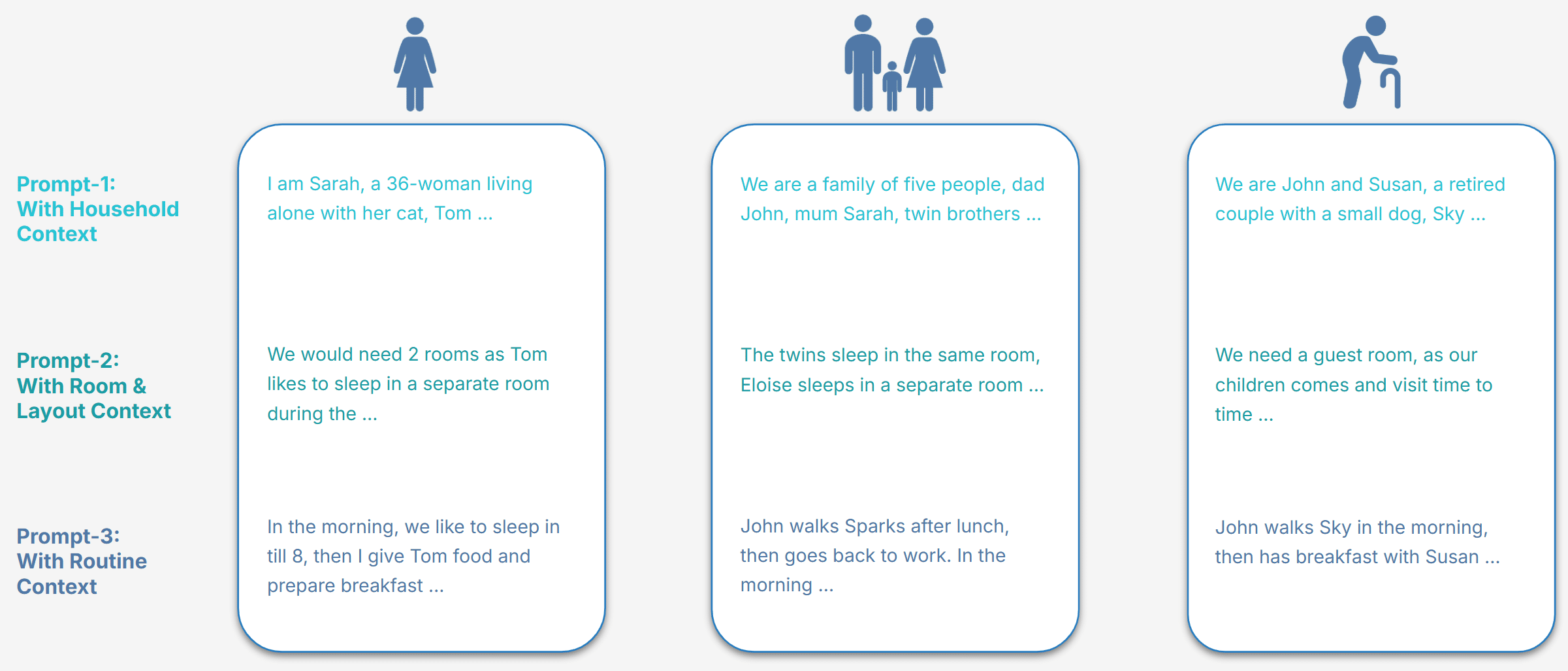
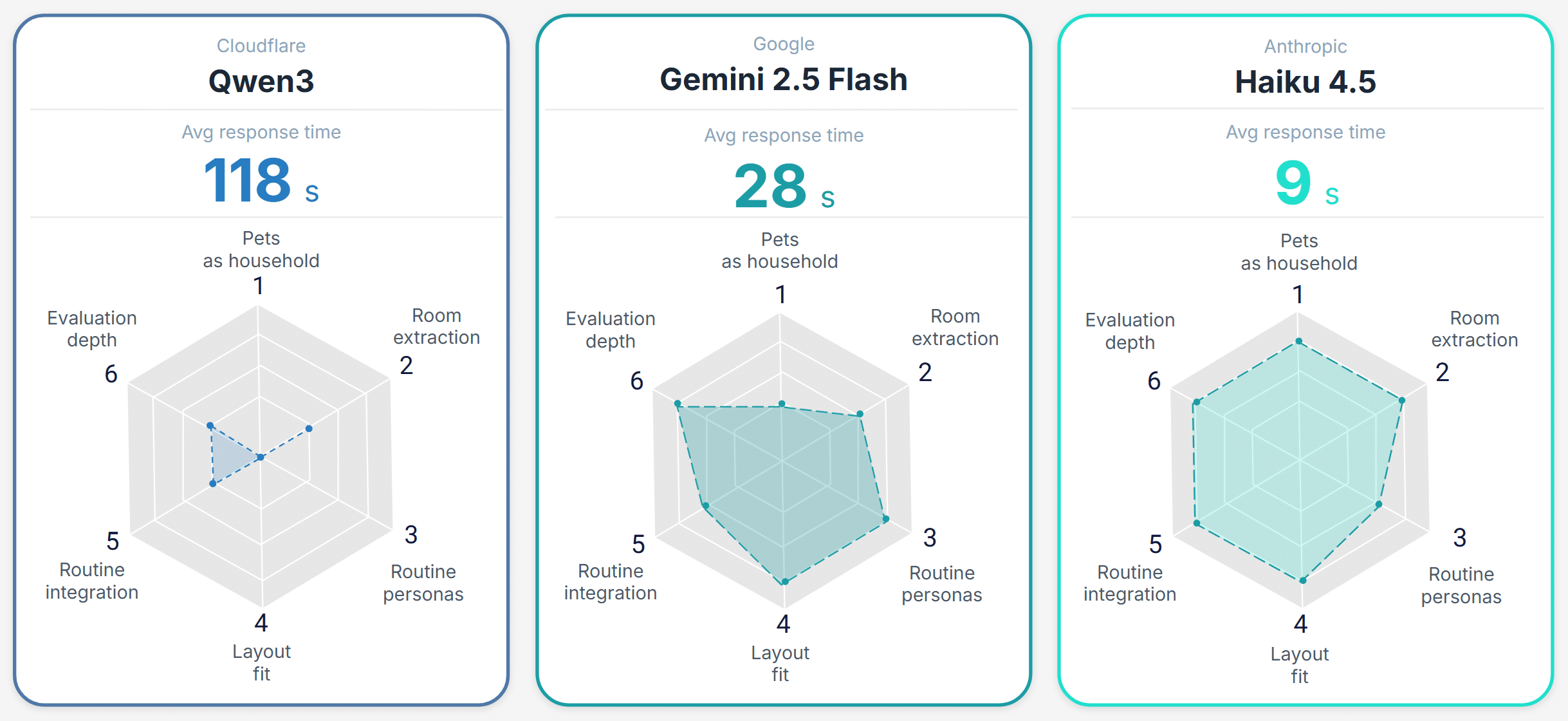
To evaluate the system, we tested three language models—Qwen, Gemini, and Claude Haiku—using nine progressively complex prompts covering different household types and increasing levels of contextual information.
The results highlighted clear differences.
Qwen struggled to preserve behavioural context because routine generation frequently failed, forcing repeated layout re-ranking.
Gemini successfully maintained layouts and routines but simplified household understanding and generated shared rather than individual daily schedules.
Claude Haiku consistently produced the strongest overall performance, correctly recognising pets, extracting richer room information, maintaining layout stability across conversations, and integrating household routines more effectively into its evaluations.
Looking Forward
inHabit demonstrates that residential layouts can become much more than static drawings.
By combining graph representations, semantic understanding, architectural analysis, and conversational AI, the project creates a search process that is explainable, iterative, and centred on the way people actually live.
While challenges remain—particularly around routine generation, geometric adaptation of irregular layouts, and furniture recognition—the project illustrates a broader shift in architectural computing: from generating spaces to understanding them.
Ultimately, the future of residential search may not be about finding a home with three bedrooms.
It may be about finding the home that best fits your life.
