The Master in City & Technology’s academic structure is based on IAAC’s innovative, learn-by-doing and design-through-research methodology which focuses on the development of interdisciplinary skills. During the Master in City & Technology students will have the opportunity to be part of a highly international group, including faculty members, researchers, and lecturers, in which they are encouraged to develop collective decision-making processes and materialize their project ideas.

Filters
Course

The Land Remembers

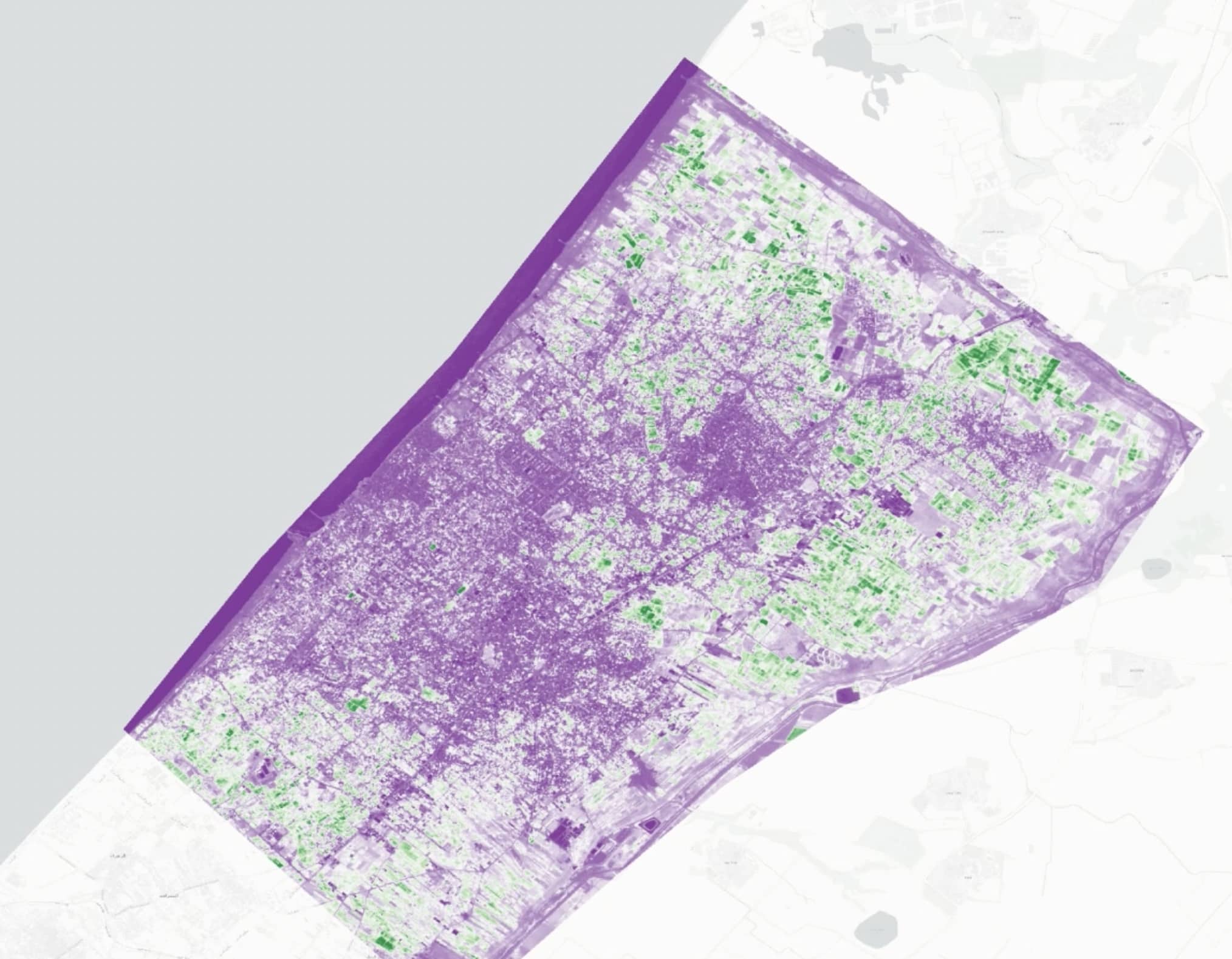
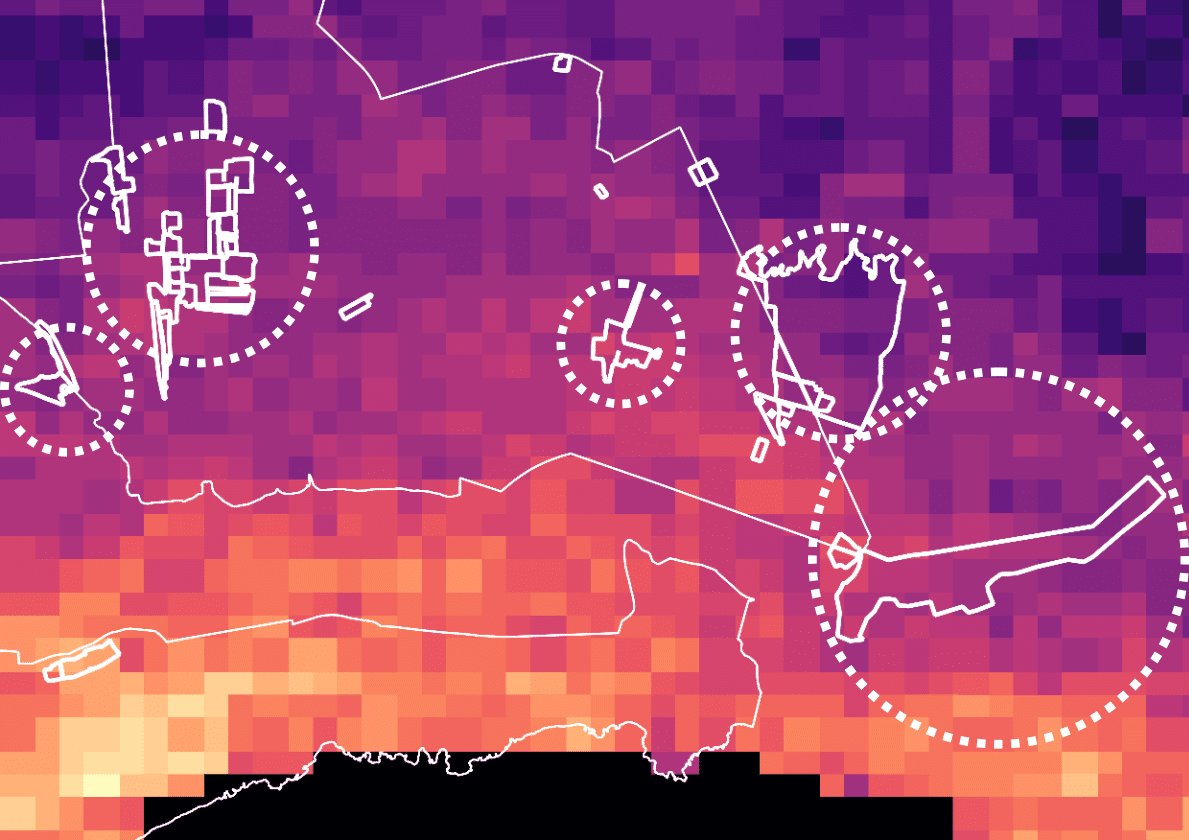
Agricultural landscapes often disappear from visual and political attention during conflict, overshadowed by images of urban destruction. This project uses satellite imagery to examine agricultural land in Gaza, focusing on the Beit Hanoun belt as an intersection between destruction and food systems. Through vegetation indices and bombing crater detection, the study distinguishes seasonal agricultural cycles … Read more

The Agariyas of Gujarat

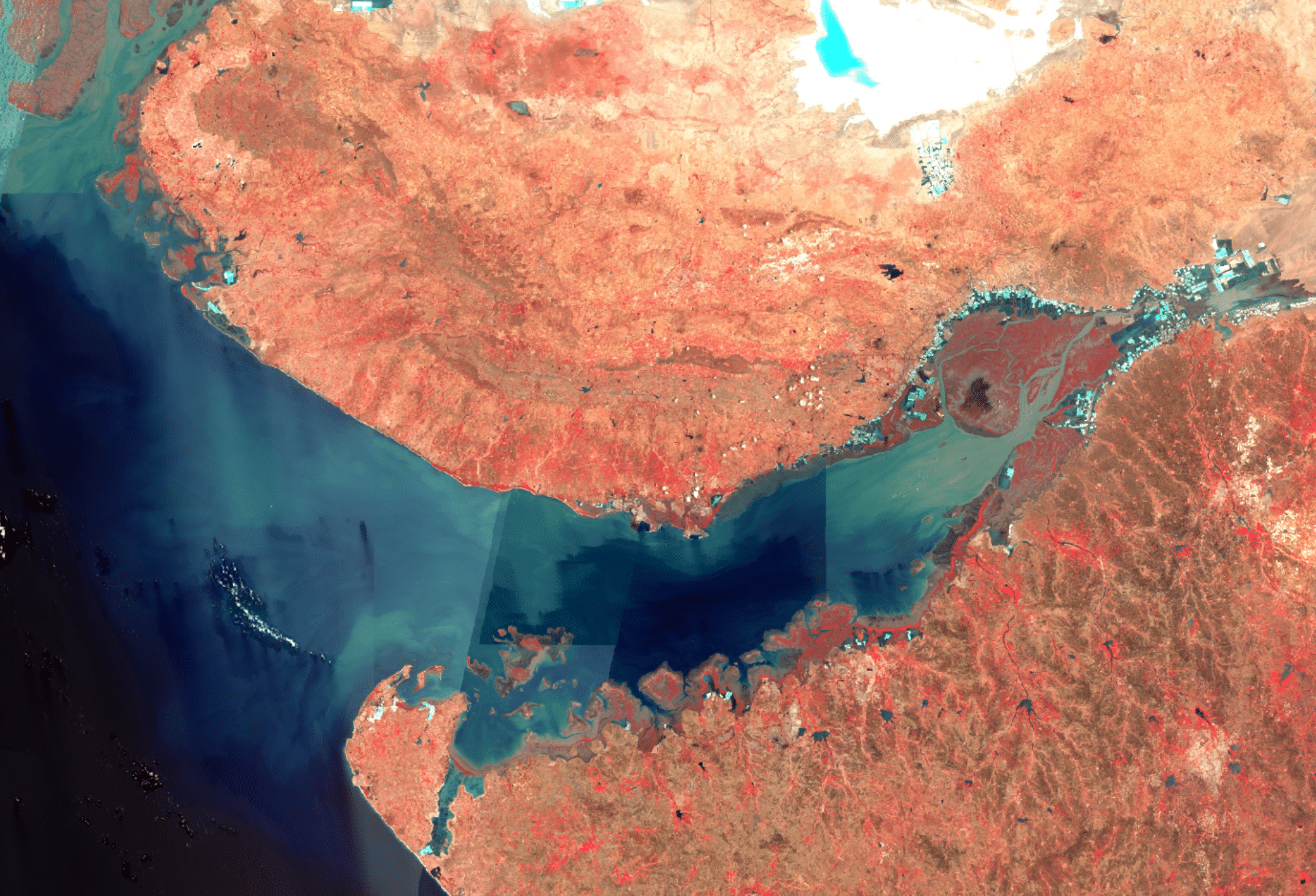
Salt is an essential mineral for humans and animals alike. When consumed, it breaks down into sodium and chloride – elements vital to muscle and nerve function, fluid balance, and the regulation of blood pressure and pH levels. Because sodium is lost through sweat, both humans and animals must replenish it to maintain physiological stability; … Read more

Sand Mining – from Afar

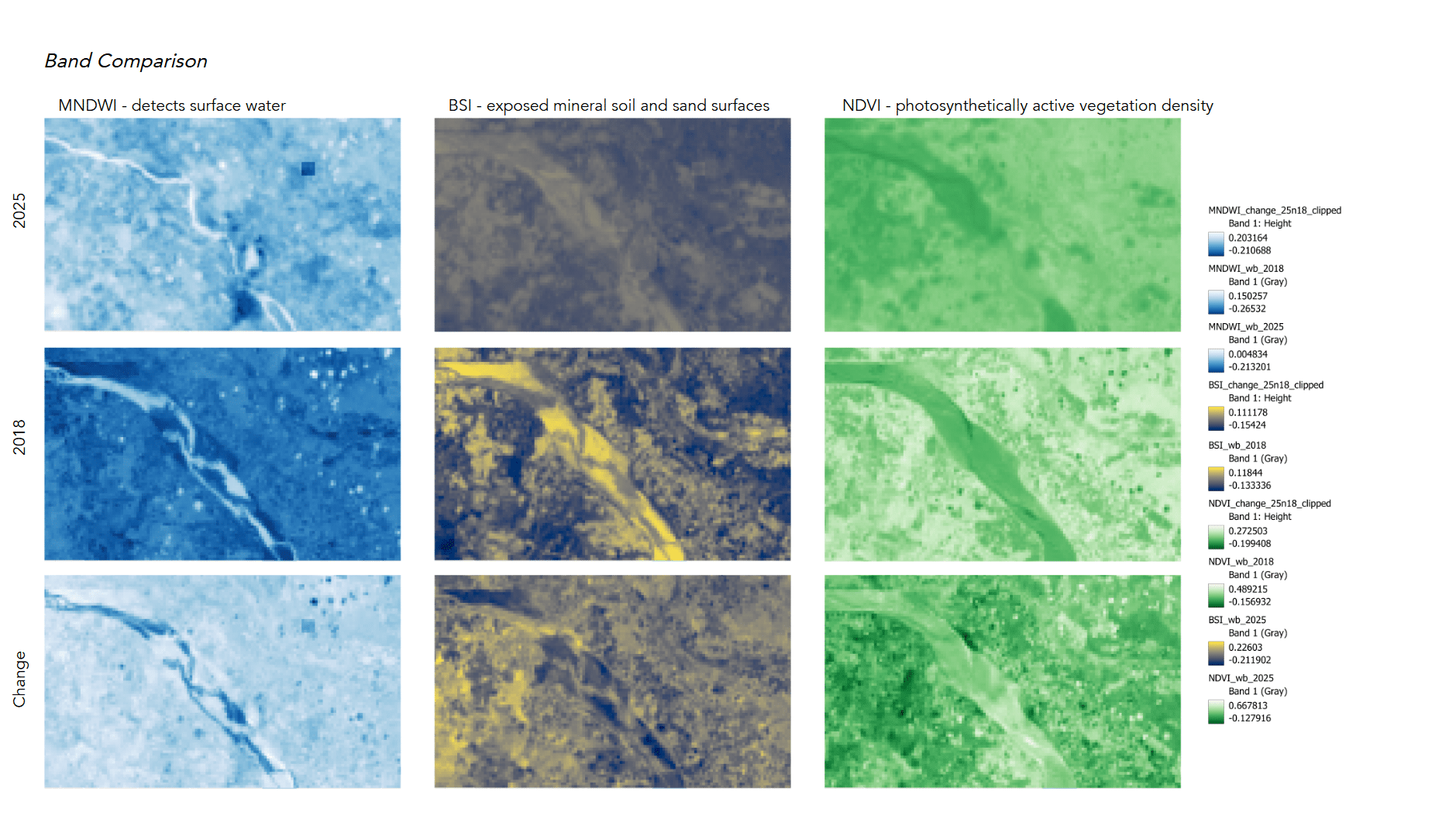
DETECTING SAND MINING USING MULTI-TEMPORAL SATELLITE IMAGERY Introduction Sand is ubiquitous in the modern world. It is the second-most extracted material on Earth after water, driven principally by the global demand for concrete, infrastructure, and urban expansion. Estimates place global sand and gravel extraction at 40–50 billion tonnes per year, a scale that outstrips many … Read more

The Wooded Circle

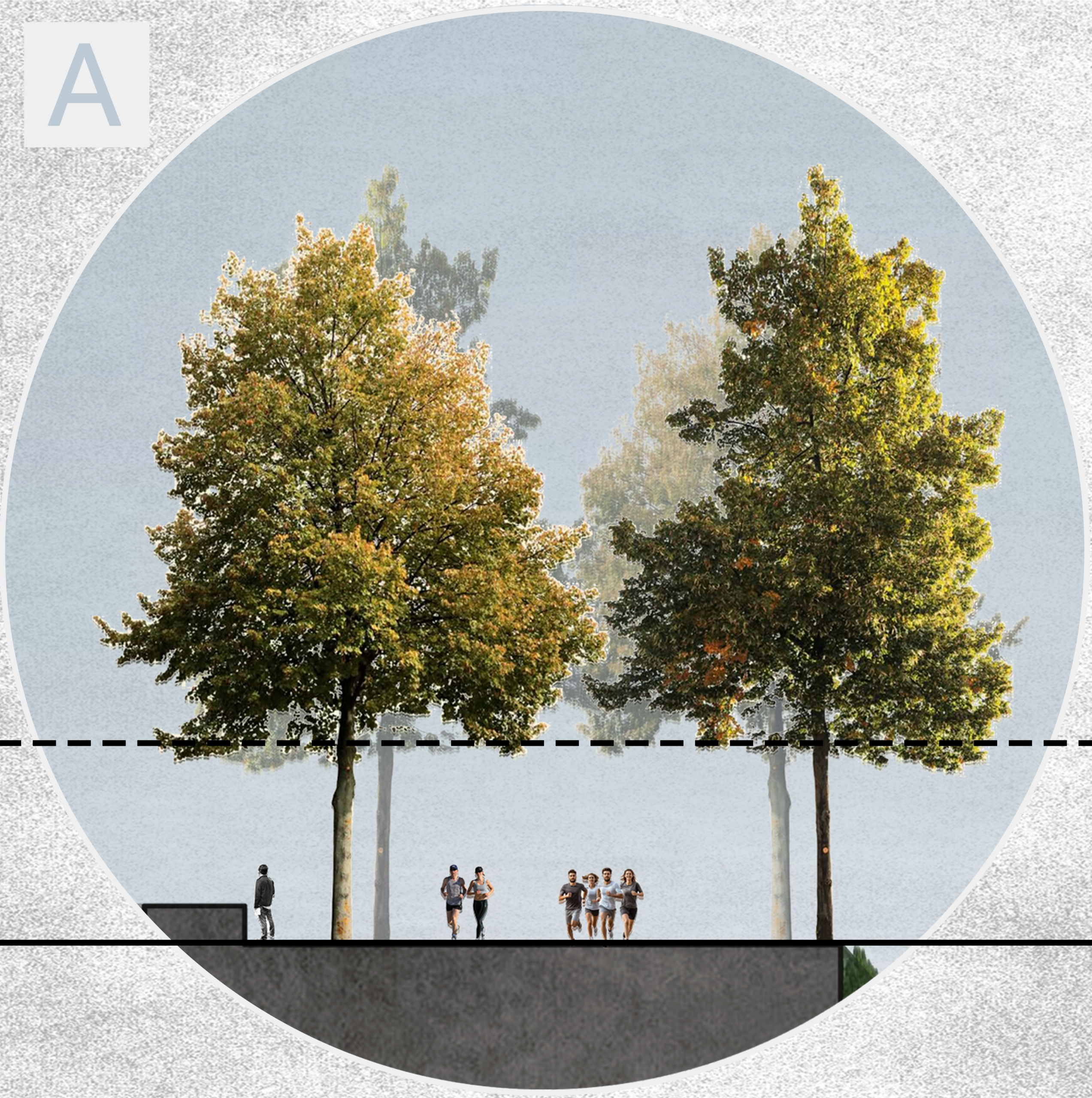
Started off in 1504 as a Renaissance-era fortification system, designed to resist cannon warfare. Over the years, it has undergone many reconstructions, with the latest turning it into a managed heritage park in the early 2000s (Planted rows of trees) . Ecology has played an important role in each of its eras, as we’ll see … Read more

Who else lives here?

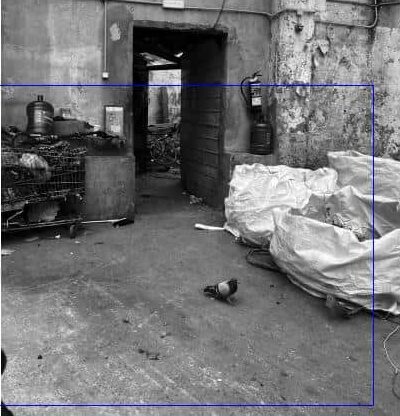
Urban space is conventionally conceptualized as an anthropocentric construct. However, non-human species continuously appropriate architectural surfaces, infrastructural voids, and vegetated fragments. Birds occupy ledges and canopy layers, insects colonize engineered soils, bats navigate nocturnal corridors along tree lines, and plants root within pavement fissures. These presences are not incidental; they reflect how spatial design either … Read more

How does Power operate spatially in Poblenou?

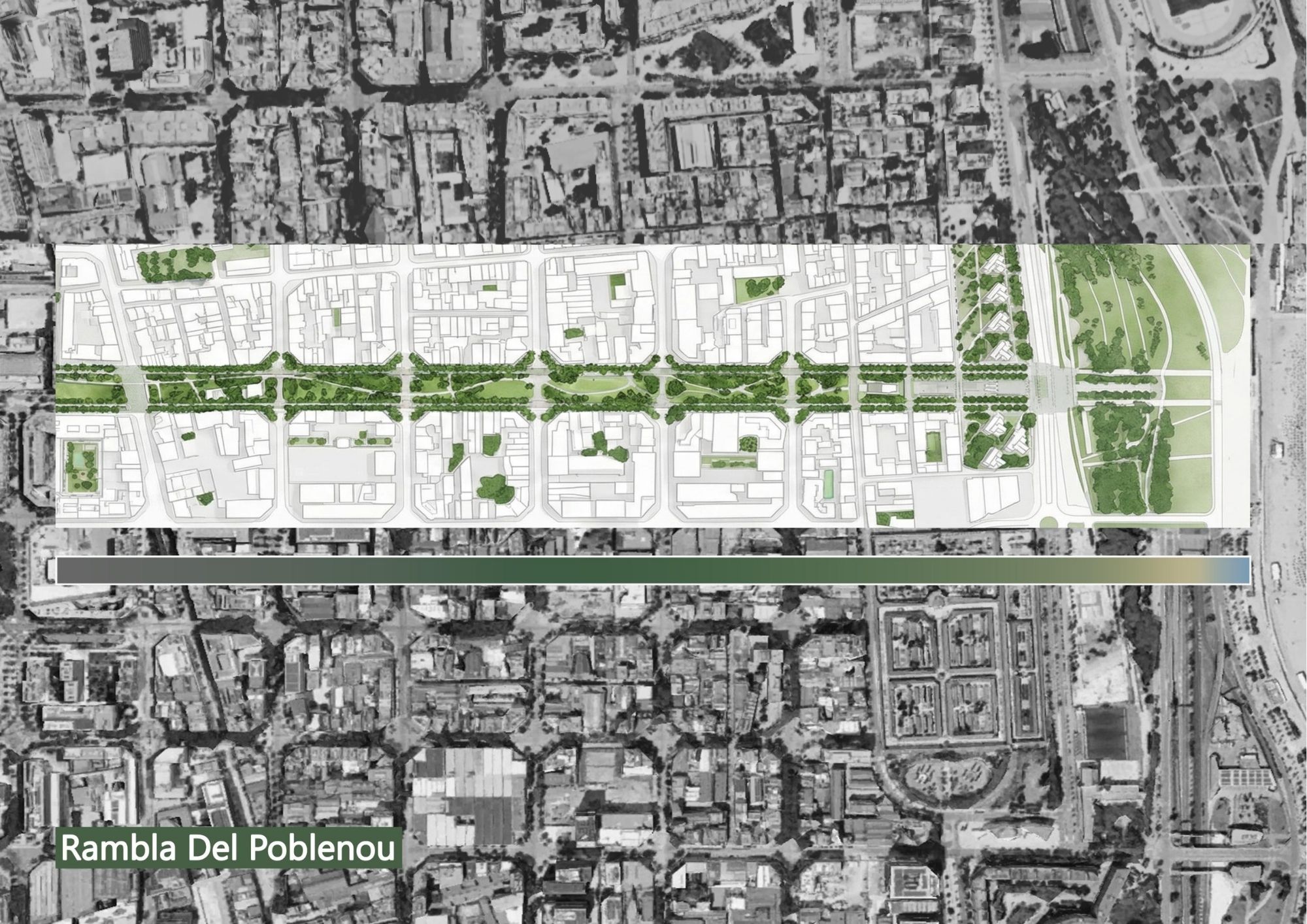
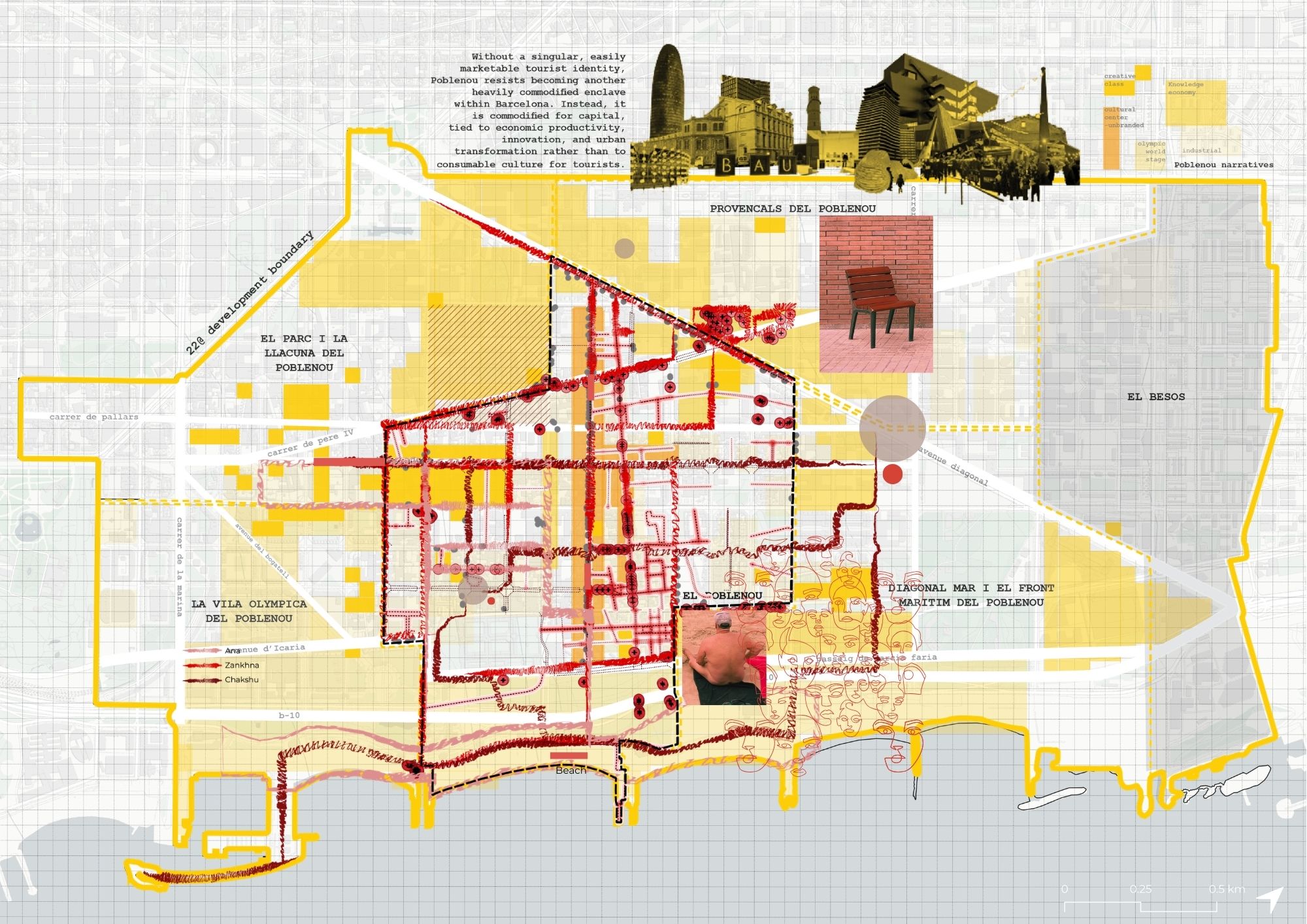
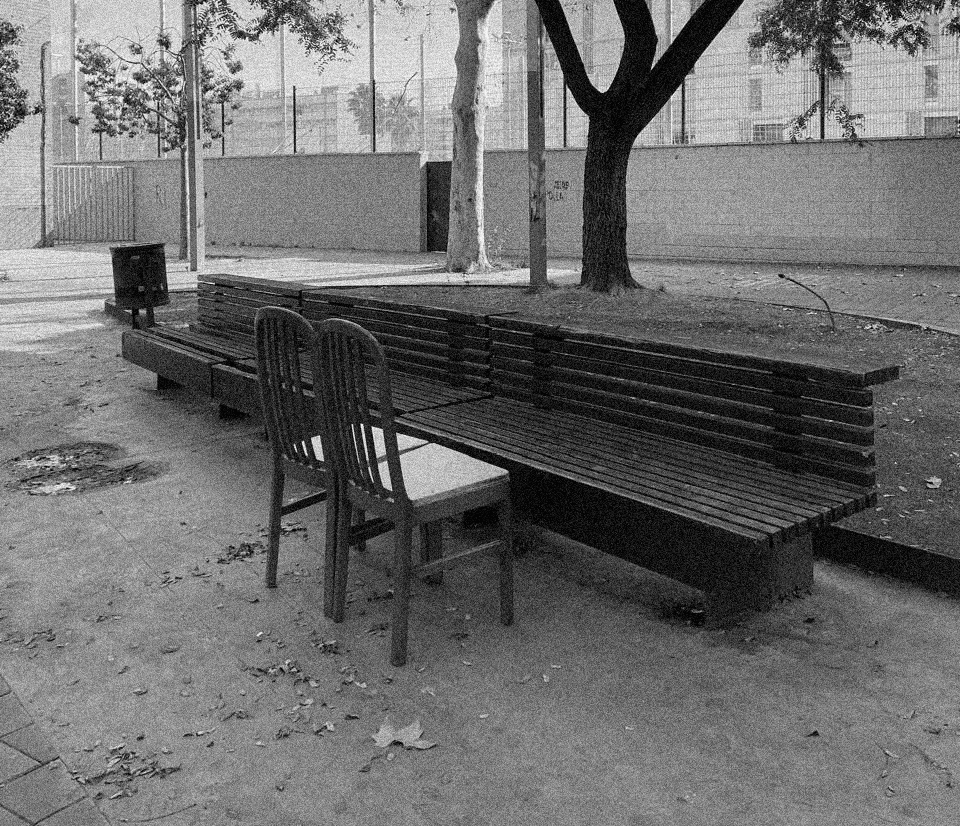
This project explores how power operates spatially through counter-cartography and autoethnography in Poblenou, Barcelona. Combining observation, mapping, and self-tracking, the research examines how infrastructure, urban objects, rules, and rhythms shape behavior, movement, and perception. Benches, pedestrian streets, and smoking practices reveal how freedom, restriction, and permission are unevenly distributed. Findings show that movement is widely … Read more

Poblenou as Lived Space

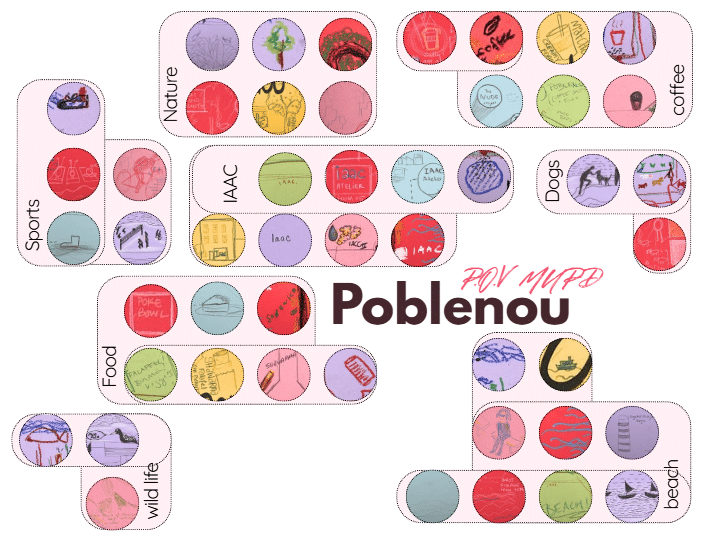
Cities are often described in terms of movement. We often tend to move through them in familiar loops – leaving home to catch the metro, commuting to work, coming back in the evening, running errands, going to appointments. Over time, these repeated paths shape how we think about urban space and can seem to define … Read more

Learning From Sants

When we locate Sants within Barcelona, it appears to be on the city’s edge. However, when considering the metropolitan area as a whole, Sants is actually closer to the center. Historically, Sants was one of the towns surrounding Barcelona until its annexation in 1897. Its agricultural and industrial roots contribute to a unique neighborhood identity—one … Read more

Layers of Besòs: Unfolding Barrio’s Identities

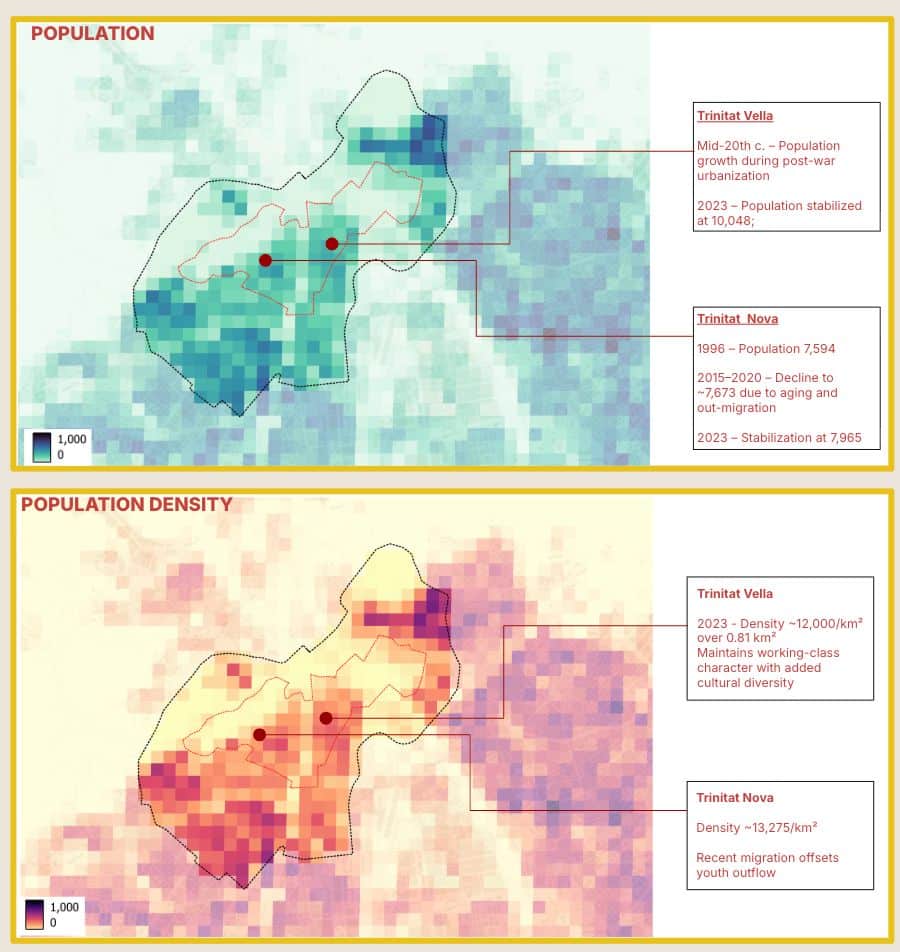
Introduction: Understanding Besòs Beyond the Surface The El Besòs i el Maresme area in Barcelona carries a complex history—one shaped by migration, exclusion, and resilience. Often perceived through the lenses of insecurity and economic struggle, the neighborhood is in fact a vibrant intersection of identities, cultures, and urban transformations. Layers of Besòs is a research-driven … Read more

Investigating [Soy Farming] – Deforestation, and Political Conflict in the Amazon

“The Amazon rainforest, often called the ‘lungs of the Earth,’ is rapidly disappearing. But this isn’t just an environmental crisis—it’s a geopolitical and economic issue. In the heart of this transformation lies [Mato Grosso], Brazil’s largest soy-producing state. Its key location fuels both economic growth and ecological destruction, leading to tensions over land use, trade … Read more

Informal Settlements in Chile

Informal settlements have become a pressing issue across Latin America, reflecting deep-rooted socioeconomic inequalities and rapid urbanization. In 2014, approximately one-quarter of the urban population in Latin American cities lived in informal housing. By 2017, this number had increased to nearly one-third, and the trend continues to rise. Each country’s informal settlements have unique names … Read more

The California Wildfires

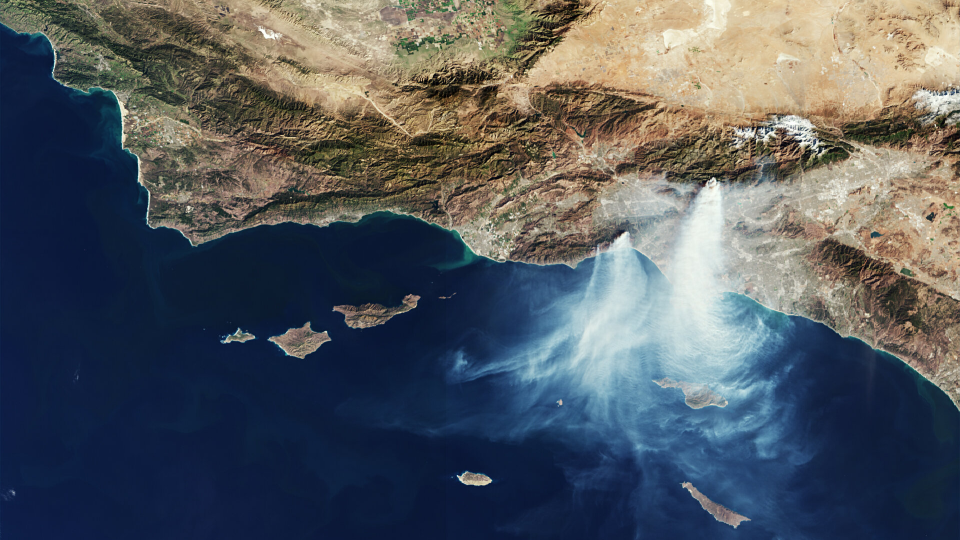
January brought a challenging start for California, as a series of devastating wildfires swept through the state, endangering lives, destroying homes, and reshaping entire communities. These fires were not only among the most destructive in California’s history but also ranked among the costliest ever recorded in the United States. The scale of destruction was unprecedented, … Read more

SEU

Sentir l’Espai Urbà Cities communicate with us through different ways: sound, image, smells, textures, materials, weather, among others. But how do we perceive all these layers?  How do we feel about it? What role does urban design play in this exchange? How do we feel the city? Every day, we are immersed in urban surroundings … Read more