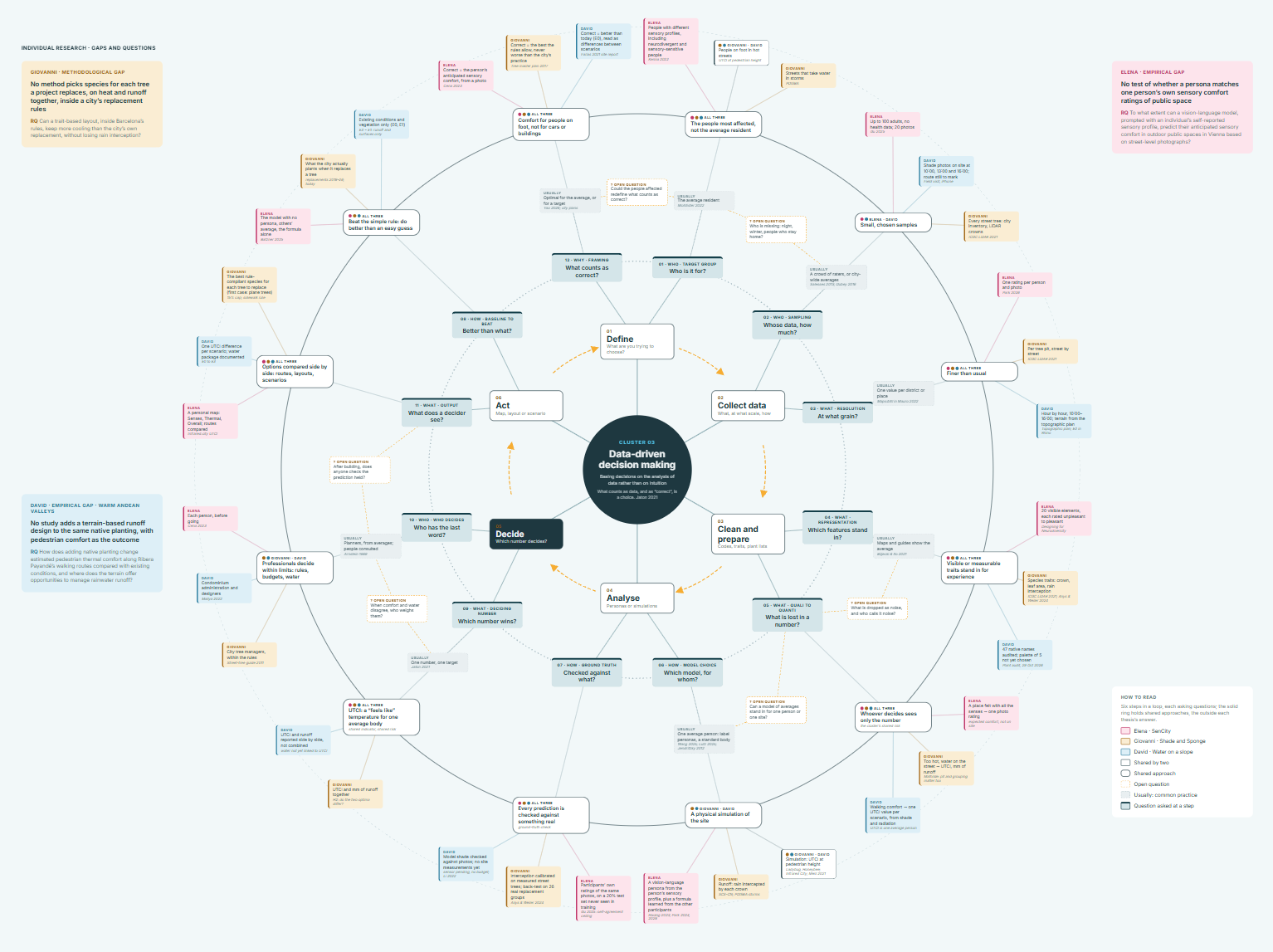
How three master’s theses on urban comfort fit into data-driven decision making, and where they part ways.
“Decide based on data, not intuition” sounds simple. But what counts as data, and what counts as a “correct” result, is always a choice. Elena, Giovanni and David are writing three theses on how people experience the street: through their senses, through heat, through shade and water. Putting them side by side on one diagram made those choices visible, and showed how much the three projects share.
The loop every decision goes through
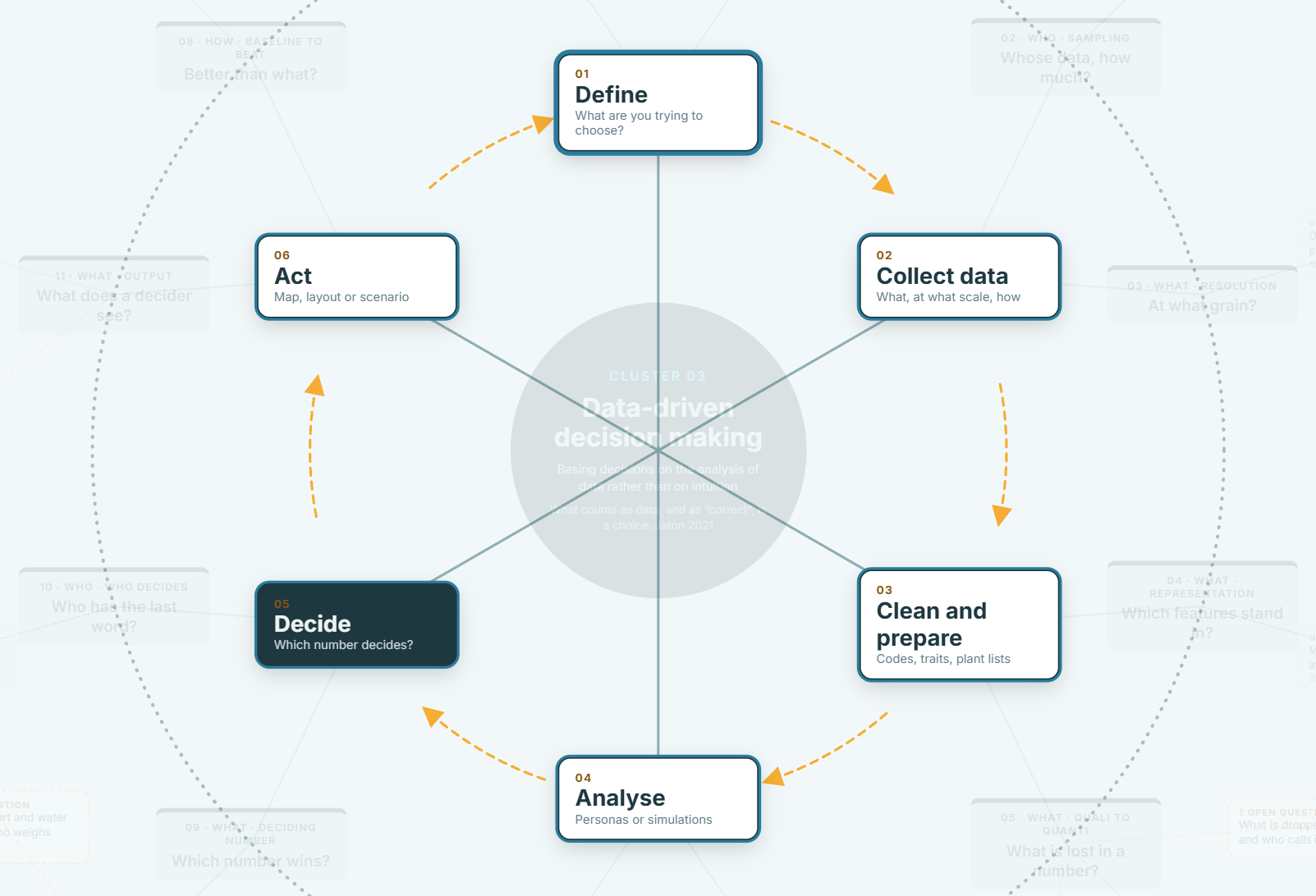
At the centre is the loop that every data-driven decision follows: define, collect data, clean and prepare, analyse, decide, act, and then start again. Each step asks one or two questions. For each question there is a usual answer, the way it is normally done, and then there are the answers our three theses give.
Define: correct for whom?
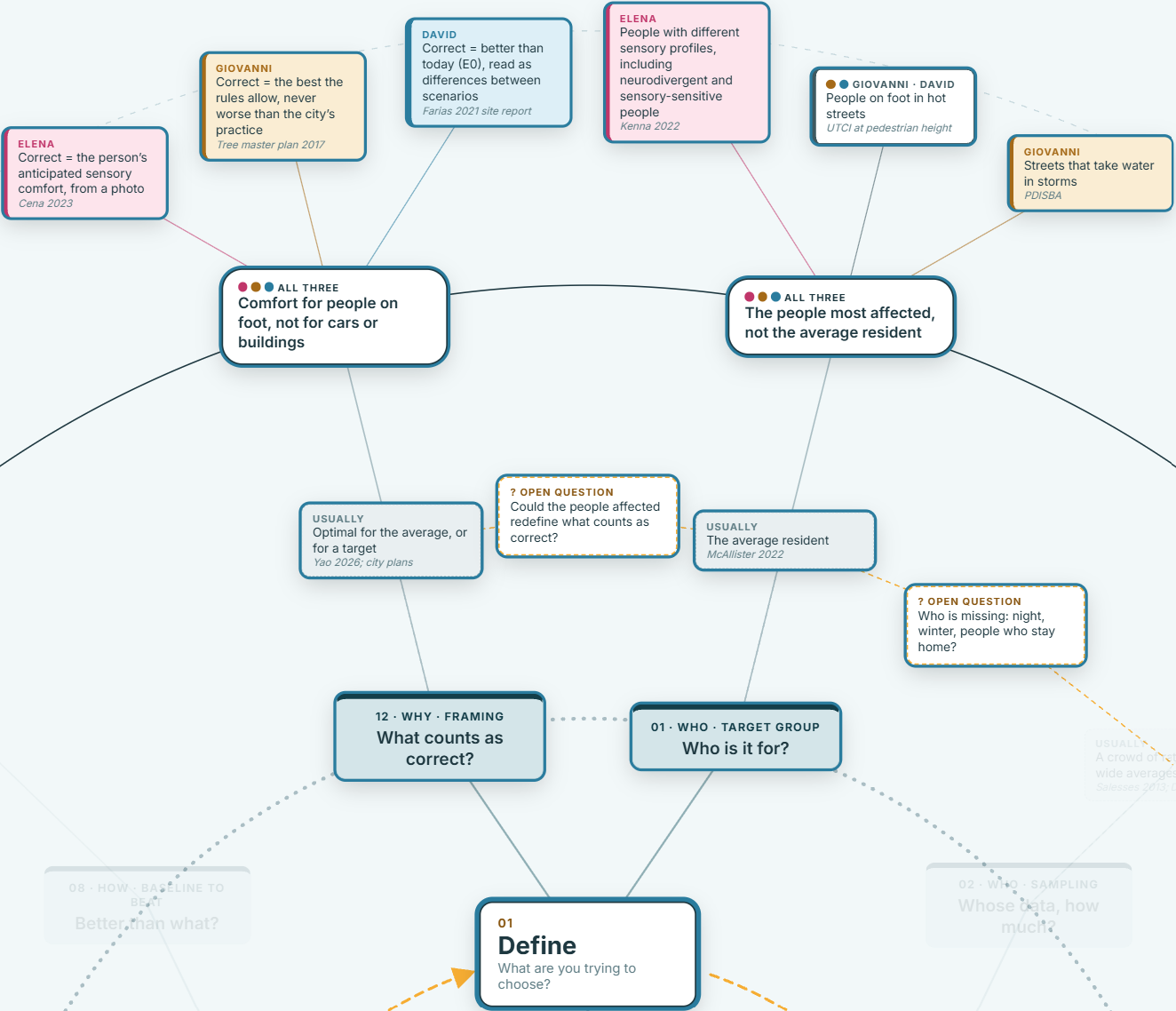
It starts with the first question: what counts as correct, and who is it for? Usually, the answer is the optimum for the average resident.
All three theses move away from that. They design for the people most affected, people on foot, not cars or buildings. For Elena, that means people with different sensory profiles, including sensory-sensitive people. For Giovanni and David, it means people walking in hot streets.
Collect and prepare: finer than usual
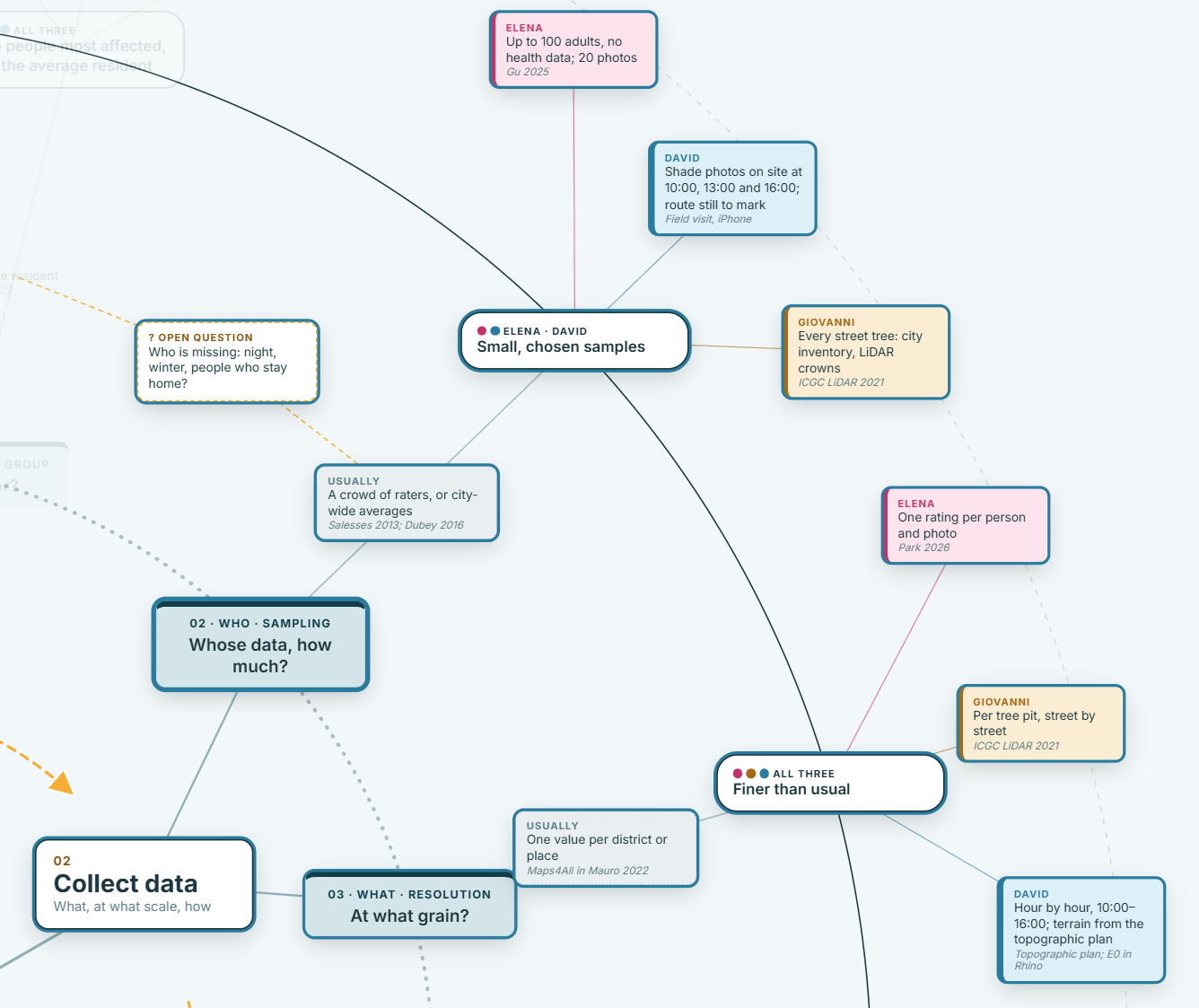
Data usually comes from a crowd of raters or from city-wide averages. Elena and David work with smaller samples; Giovanni uses every street tree in the city’s inventory. But all three go finer than usual: one rating per person and photo, one value per tree pit, one value per hour.
To prepare the data, all three let something visible or measurable stand in for experience. That is the risk we share, and the question at the heart of the diagram: what is lost in a number? Whoever decides only sees that number.
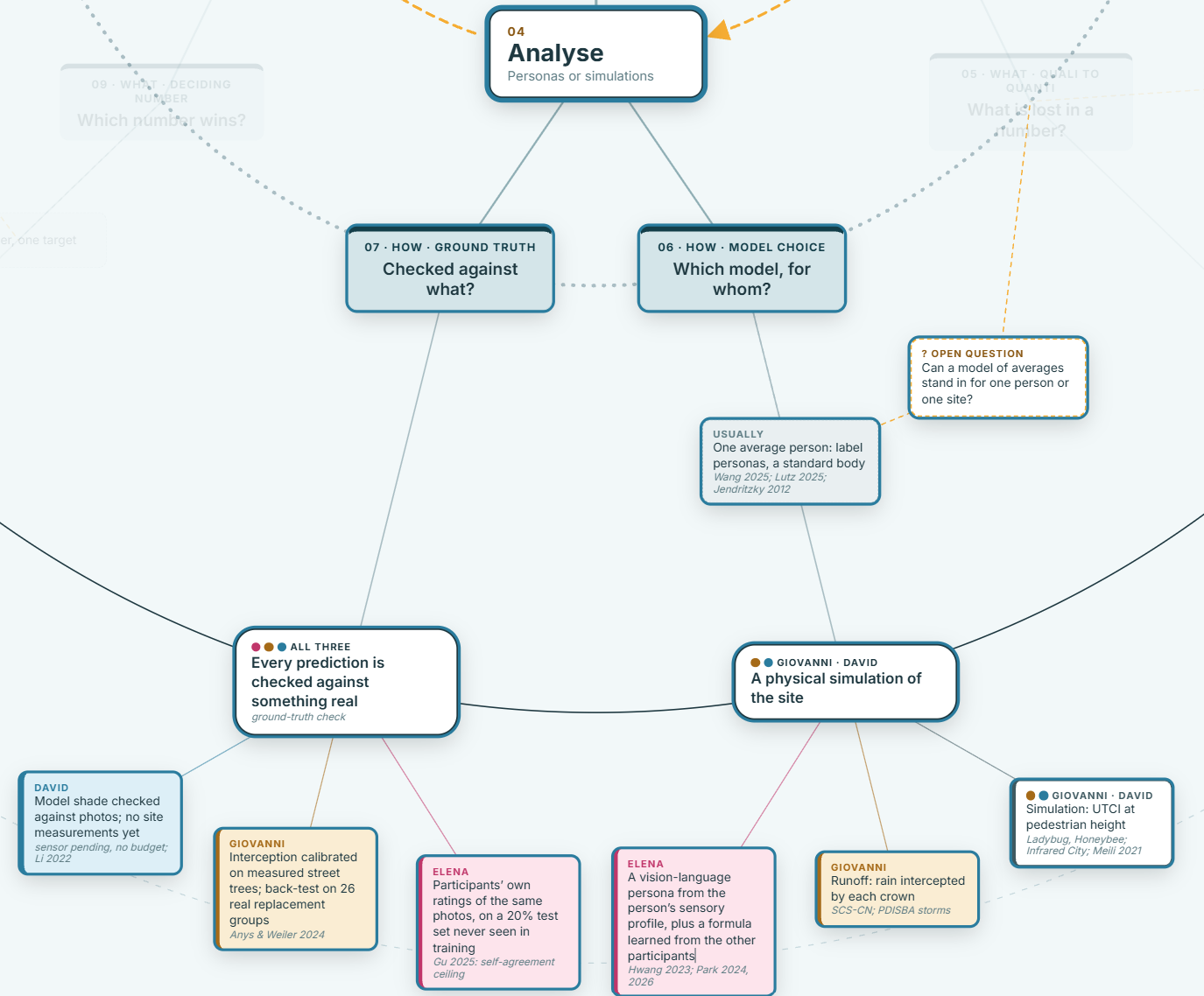
Analyse: one person, not an average
The usual model is one average person: a persona built from labels, or a standard body in a thermal simulation.
Giovanni and David simulate the site physically. Elena uses a vision-language model that answers as one specific person, built from that person’s own sensory profile. And all three check their predictions against something real: for Elena, participants’ own ratings, on people kept apart from training; for David, his model’s shade against photos taken on site; for Giovanni, rain interception measured on street trees.
Decide and act: who decides, against what?
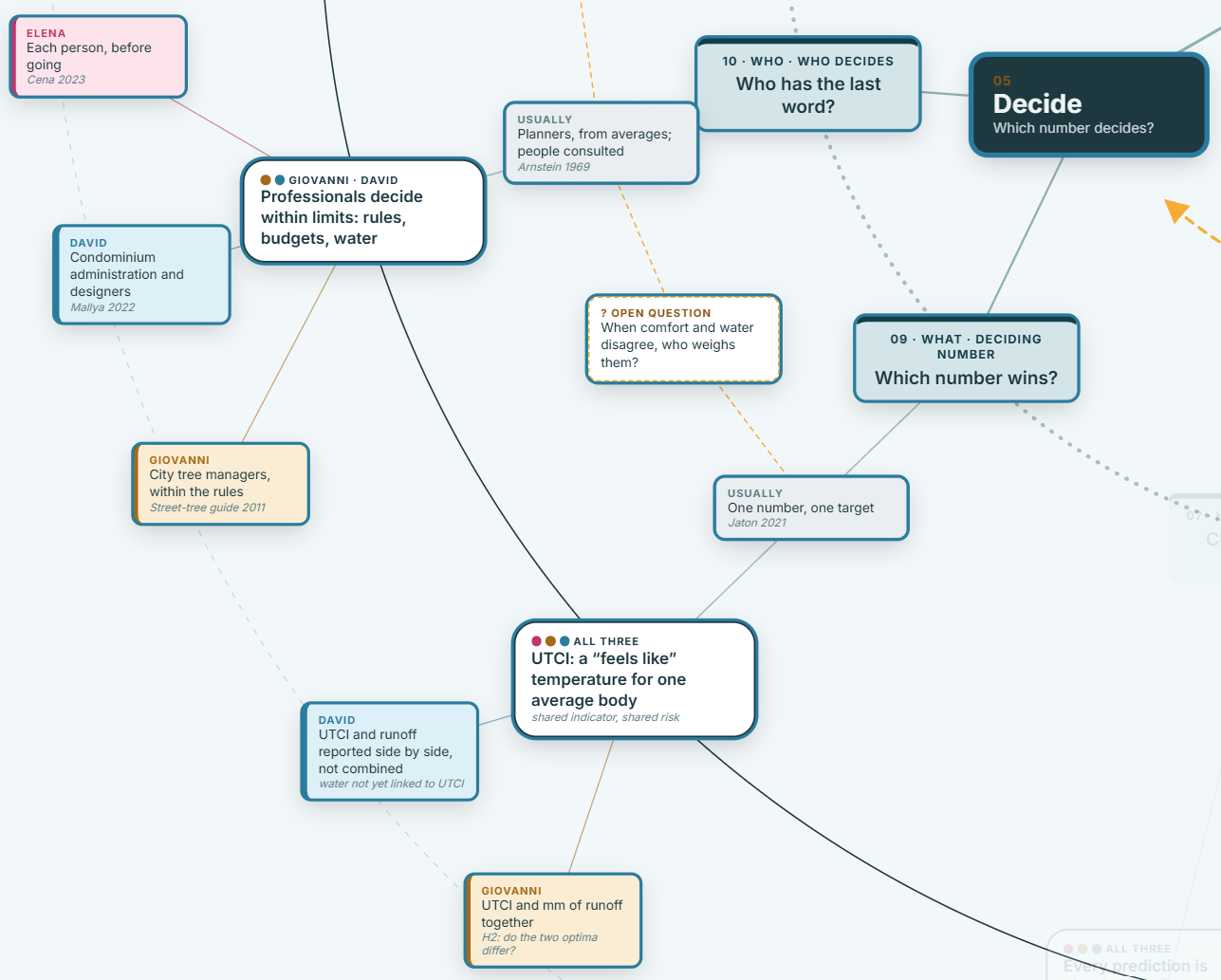
The deciding number is often UTCI, a “feels like” temperature for one average body. It is an indicator we share, and a risk we share.
Planners usually decide, from averages. In Elena’s case, each person decides for themselves, before going somewhere new.
Each thesis also has to beat a simple baseline. For Elena, that is the model with no profile and the average of the other participants; for Giovanni, what the city actually plants when it replaces a tree; for David, the existing site and its vegetation alone.
The questions none of us answers yet
Some questions stay open for all three theses:
- Could the people affected redefine what counts as correct?
- Who is missing from the data: night, winter, people who stay at home?
- Can a model of averages stand in for one person or one site?
- And after building, does anyone check that the prediction held?
All three of us predict before acting; none of us monitors afterwards. That is a gap the whole cluster shares.
Where we differ
We split at the very first question: what counts as correct.
- For Elena, it is one person’s anticipated sensory comfort, from a photo: the optimum for the individual.
- For Giovanni, it is the best the city’s tree rules allow, never worse than what the city plants today.
- For David, it is better than today, read as differences between scenarios, with the water designed and documented, not simulated.
Same loop, three “corrects”
The same loop, three different places and three different ideas of what is correct. But one shared direction: away from the average, towards the people a decision actually affects. And always checked against something real.