
“I’m worried it will be too much for me”
Imagine Sarah. She is 35, autistic, and recently moved to Vienna. She would like to explore the city: a park to read in, a square to meet friends, a market street. But maps show her what is there, not how it will feel. Narrow paths and people too close can overwhelm her within minutes, and she only finds out when she arrives. So she sticks to the few places she knows, and misses out.
(Sarah is invented, to illustrate, like Jonas and Clara below; the real profiles come from my survey.)
Every place reaches us through the senses
A public space reaches us through all our senses: hearing, sight, smell, touch, heat and cold, balance, the feeling of our own body, and inner signals like tiredness or thirst. Noise, glare, heat, crowds and the lack of quiet spots decide whether we can stay in a place, enjoy it, or need to leave.
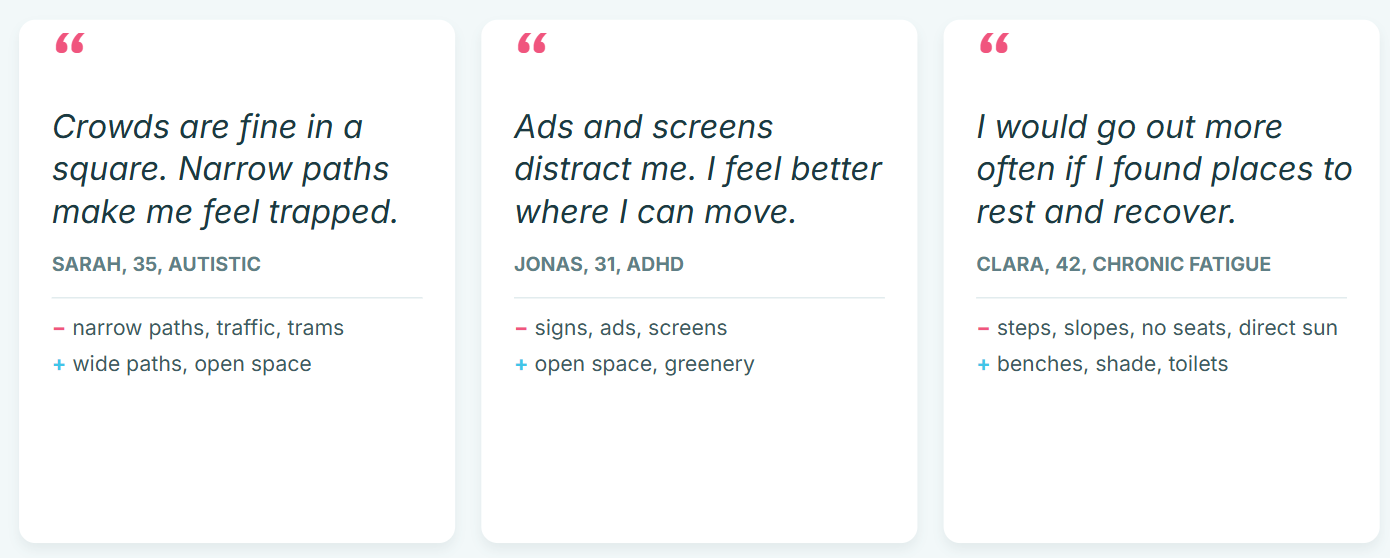
And these needs differ from person to person. Sarah is fine with crowds in an open square, but not on a narrow path. Jonas, 31, with ADHD, is distracted by ads and screens and feels better where he can move. Clara, 42, with chronic fatigue, needs benches, shade and toilets, and routes without steps and slopes, while navigation apps only show her the fastest one. The same label hides very different needs.
When public spaces feel exhausting or threatening, people avoid them. They miss social and work opportunities, and the city stops feeling like theirs.
The problem: nothing tells you in advance
- Maps show the way, how long it takes, even how hot it is, but not how a place will feel to your senses.
- Ratings show the average. Map apps recommend popular, highly rated places, and sensory maps rate each place once, for everyone.
- AI could help, and can already describe places from photos, but it answers for an average person, and sometimes with stereotypes.
All of them are built for the average. AI personas, an AI answering as one specific person, could personalise the answer, but nobody has tested whether they actually match the real person. In my literature map, thirty-three papers dealt with neurodiversity, nine of them also with inclusive design, two with sensory profiles, and none with AI personas. That empty step is where my thesis sits.
Who it is for
SenCity is for people with high sensory sensitivity: many neurodivergent people, but also older people, people with migraine or chronic fatigue, and anyone who finds some places too much. It is also for the planners and designers who want public spaces that work for more than the average person.
Left out for now: people who are offline, children, and people who speak neither English nor Italian, the two survey languages.
What is new
The closest existing tool, HushMap, rates indoor venues such as restaurants and stores, for noise, crowds and light, and learns from your ratings over time. SenCity covers public spaces (streets, squares, parks), all the senses plus heat and cold, starts from your own sensory profile, and checks each prediction against the real person.
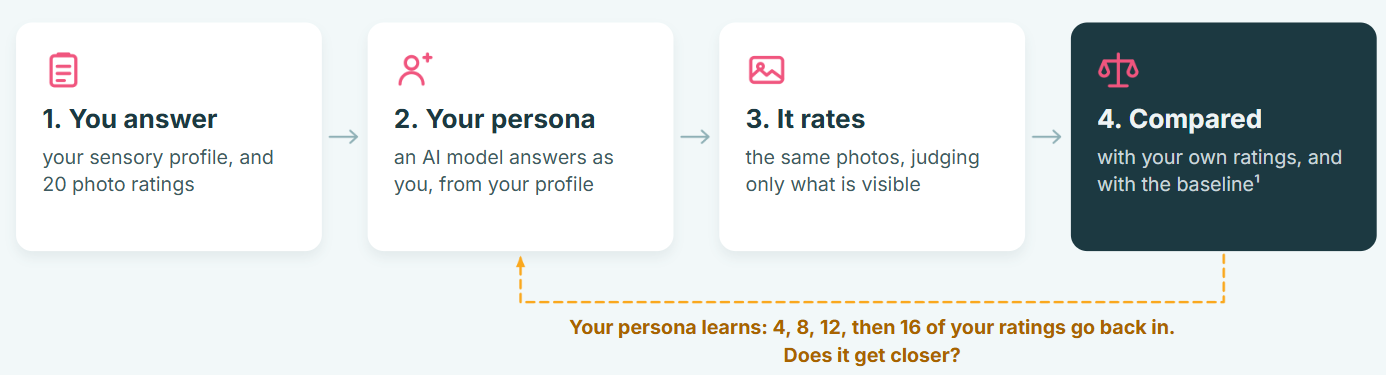
Why start from your own profile? In a first pilot, the default model, with no profile, imagined “refuge points where I could recover from the overstimulation”: it assumed the same overload for everyone. Given the person’s sensory profile, it wrote instead of “good energy and movement, which appeals to me”, with crowds becoming uncomfortable only after a while. It used what the person had actually said. The question is whether that makes its ratings closer to the person’s own.
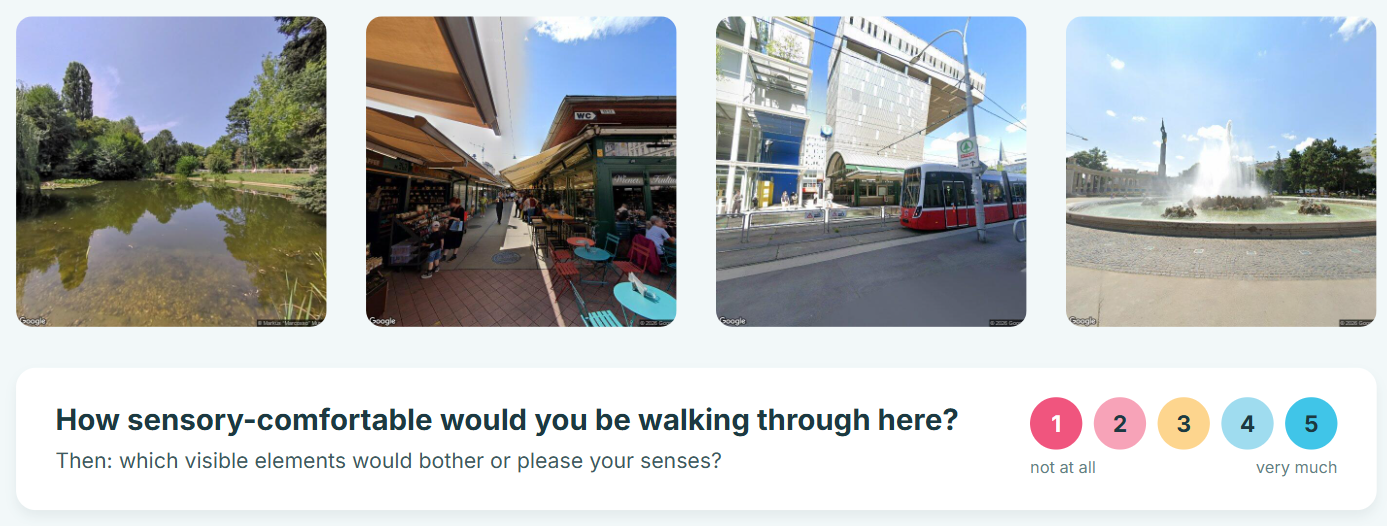
To find out, people rate twenty photos of public places in Vienna, the same for everyone, from a quiet pond to a busy market: how sensory-comfortable would they be walking through, and what would bother or please their senses? An AI model answers the same questions as each person, from their profile, and is compared with their real answers and with the default model. Then their ratings go back in, a few at a time: does it get closer?
Who needs to be involved
SenCity involves many actors:
- Communities: sensory-sensitive people, their families and self-advocacy groups. They know what a place does to them, and decide whether the tool is worth trusting.
- Knowledge users: planners, designers and participation practitioners, who can turn the evidence into calmer streets, more seats, more shade.
- Knowledge producers: me, the existing research, and above all participants’ lived experience.
- Enablers: supervisors, community organisers and data sources, such as open street photo platforms, who open access to people and data.
- Industry and market: AI and imagery providers, civic tech, design firms.
- Regulation and policy: the GDPR, the EU AI Act, and the UN Convention on the Rights of Persons with Disabilities.
- Funders: later on, EU or city innovation funds.
- Non-humans: the AI models, the streets, trees, heat and the images themselves.
The first three matter most: the people affected, the people who can change the places, and the people who make the work possible.
What others can use
- A test, for researchers and AI developers: each AI persona checked against its own person, not against an average.
- Evidence, for planners, ethics boards and AI policy: what bothers or pleases people’s senses in public space, and whether a personal profile beats the default.
- An app, for people with sensory sensitivities: check places and routes before going.
The rated photos and the test stay open, so other cities and groups can reuse them.
The change I hope for
The change: people with sensory sensitivities know before they go how a place may feel for them, and planners design for more than the average person. Step by step:
- Short term, by the end of the thesis: we learn what makes AI predictions close to a real person; participants see the results; and there is an open test others can rerun.
- Medium term, in one to three years: people use the app in daily life to choose places and routes, and discover new places that suit them; the predictions improve with users’ own ratings; and the approach is tested with other groups and cities.
- Long term, five years and more: people feel more confident and avoid fewer places; public spaces are designed for different senses; and there are shared standards for testing AI personas.
The impact reaches in several directions:
- Social: more people feel able to use the city’s public spaces.
- Urban: sensory comfort becomes a design criterion, next to heat and traffic.
- Technological: a reusable way to test AI personas, person by person.
- Ethical: evidence on when AI may speak for a person, and when it stereotypes.
- Academic: an open dataset and a person-level method.
- Economic: it is cheaper than asking everyone. The whole study costs a few tens of dollars in model calls.
What could go wrong
This rests on assumptions: that a photo shows enough of a place, that people can describe their own senses, and that knowing in advance reduces stress. And there are real risks: wrong predictions could mislead people about where to go, AI could repeat stereotypes, and it could be used instead of asking real people.
That is why every prediction is checked against the person it claims to speak for, and why one principle guides the whole project: AI should support people’s voices, never replace them.
Where it stands
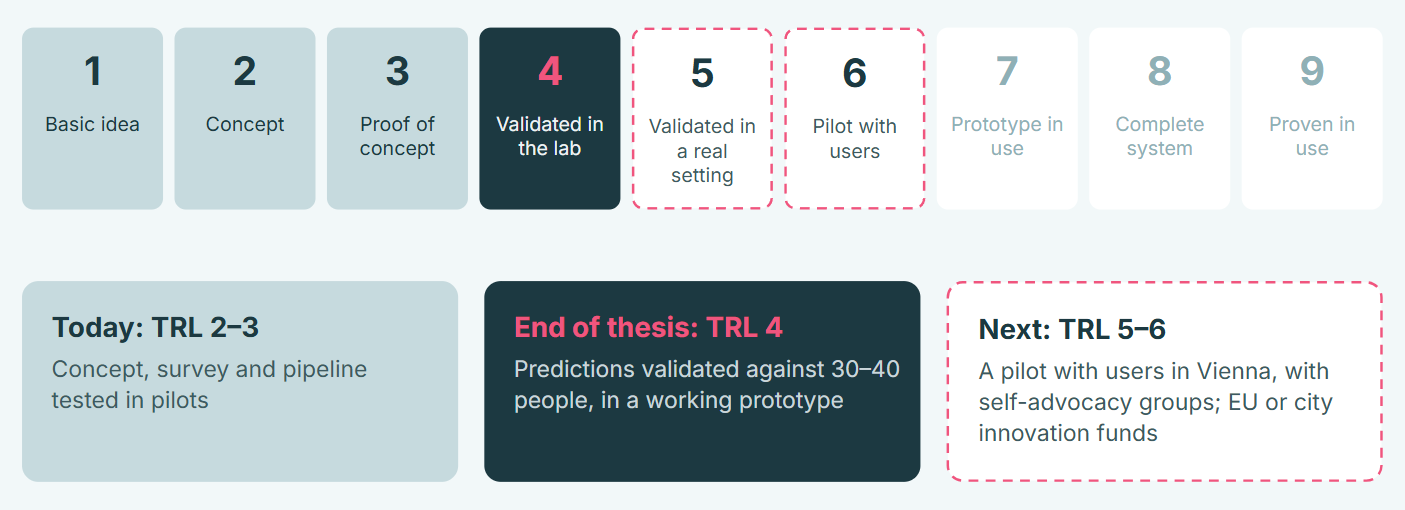
Today SenCity is at technology readiness level two to three: the concept, the survey and the pipeline work in pilots. By the end of the thesis it should reach level four: predictions validated against thirty to forty people, in a working prototype. The next step is a pilot with users in Vienna, together with self-advocacy groups, with support from EU or city innovation funds.
You can help
Back to Sarah: with SenCity, she could check the street, the park and the square before going. Maps show the way; SenCity wants to show the feel.
To find out whether an AI can really tell how a place will feel to your senses, I need people to rate twenty photos of Vienna. It takes about fifteen to twenty minutes, and you don’t need to know the city. Everyone’s senses count, whether you are very sensitive to noise and light or barely notice them.
Thank you, and please share it with anyone who might want to take part.
