
Conceptual Framework
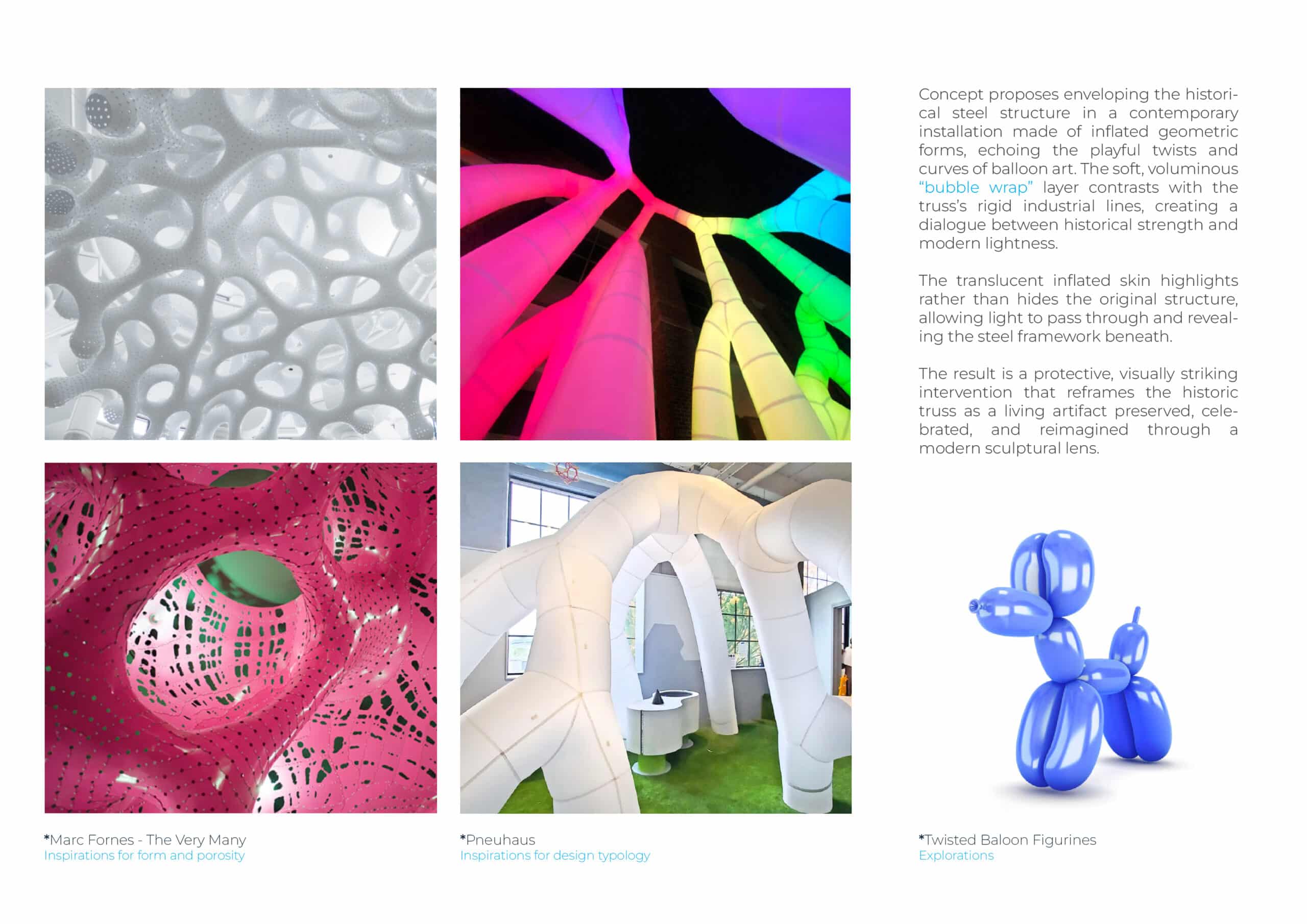
The Project explores a contemporary dialogue between past and present by enveloping a historic steel truss within a soft, inflated architectural skin. Inspired by the playful curves and buoyancy of balloon art, the installation introduces a layer of translucent, geometric “bubble wrap” forms that gently overgrow the rigid industrial structure beneath.
Rather than obscuring the truss, this inflated membrane amplifies it. Light filters through the porous surface, revealing the steel framework in shifting silhouettes and emphasizing the contrast between historical strength and modern lightness. The result is an immersive interplay of mass and air, permanence and ephemerality.
Through Interporous Overgrowth, the historic truss is reframed as a living artifact, protected, illuminated, and reimagined through a contemporary sculptural lens that celebrates both its legacy and its transformation.
Design Explorations
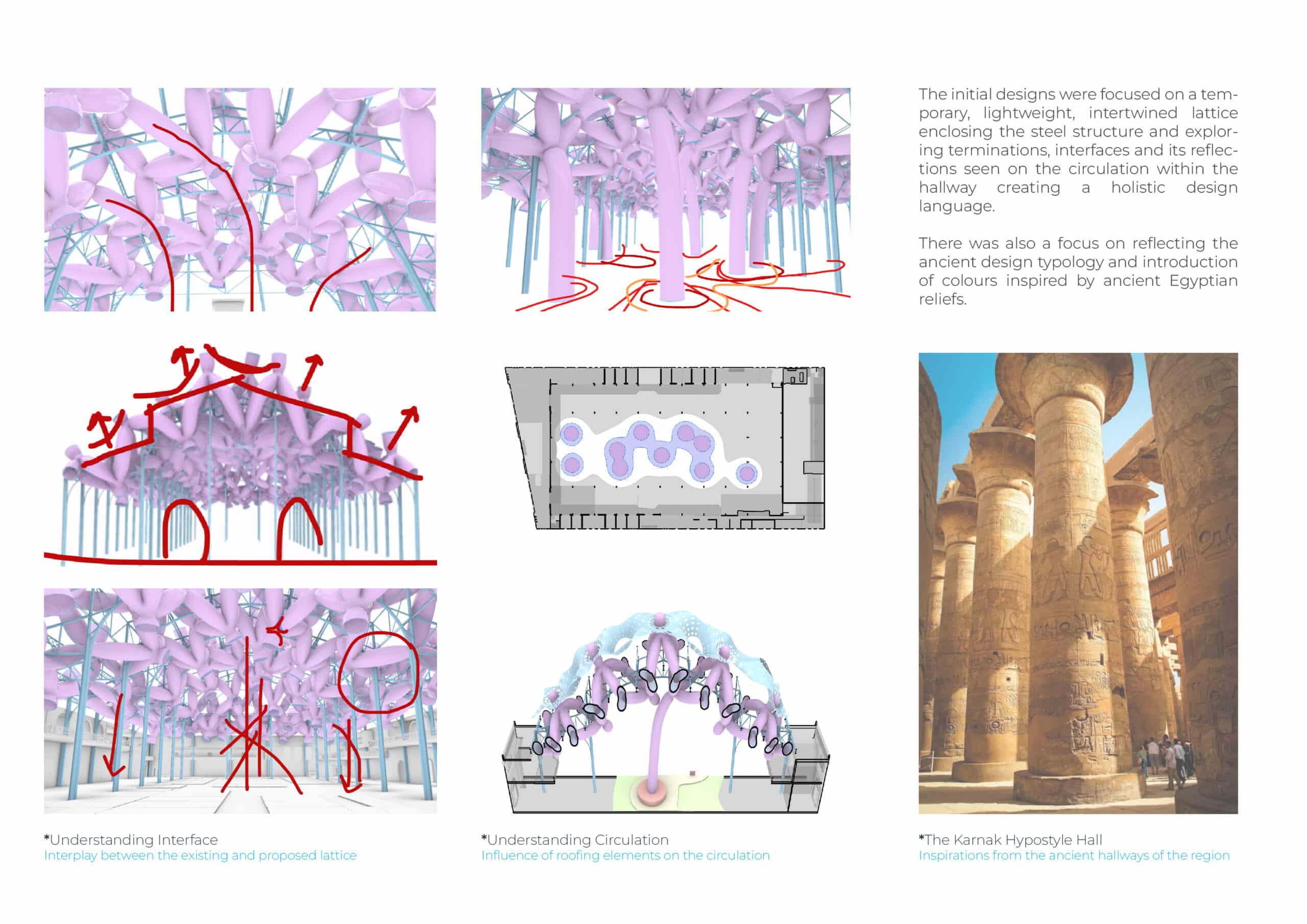
The initial design explorations focused on creating a temporary, lightweight lattice that intertwines with and encloses the existing steel structure. This early framework investigated terminations, interfaces, and moments of connection, as well as how the forms and patterns are perceived along the hallway’s circulation—helping establish a cohesive and immersive design language.
In parallel, the concept reflected on ancient design typologies, introducing a considered palette inspired by ancient Egyptian reliefs. These references added historical and cultural depth, enriching the contemporary intervention with layered meaning.
Form Finding Process
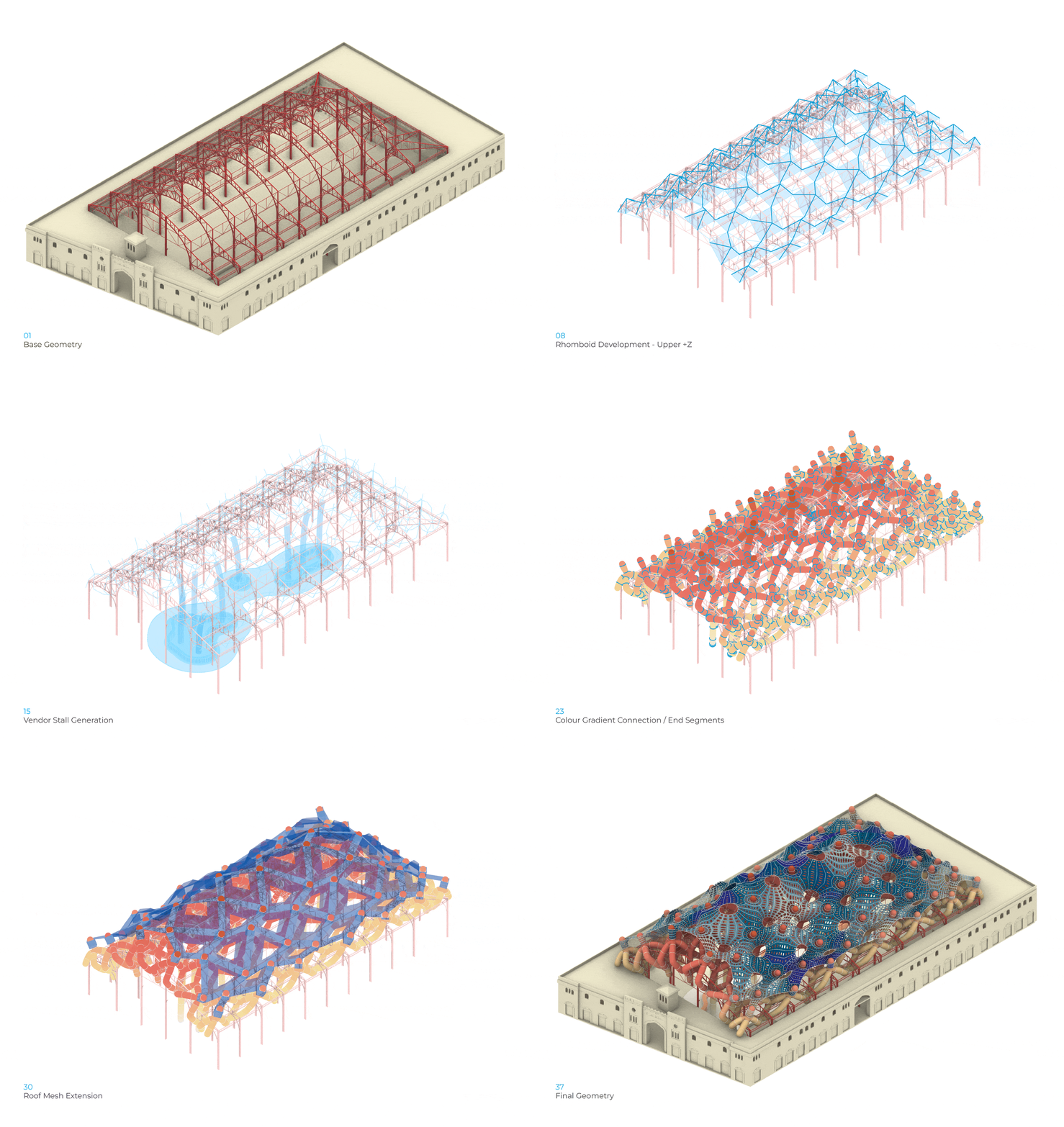
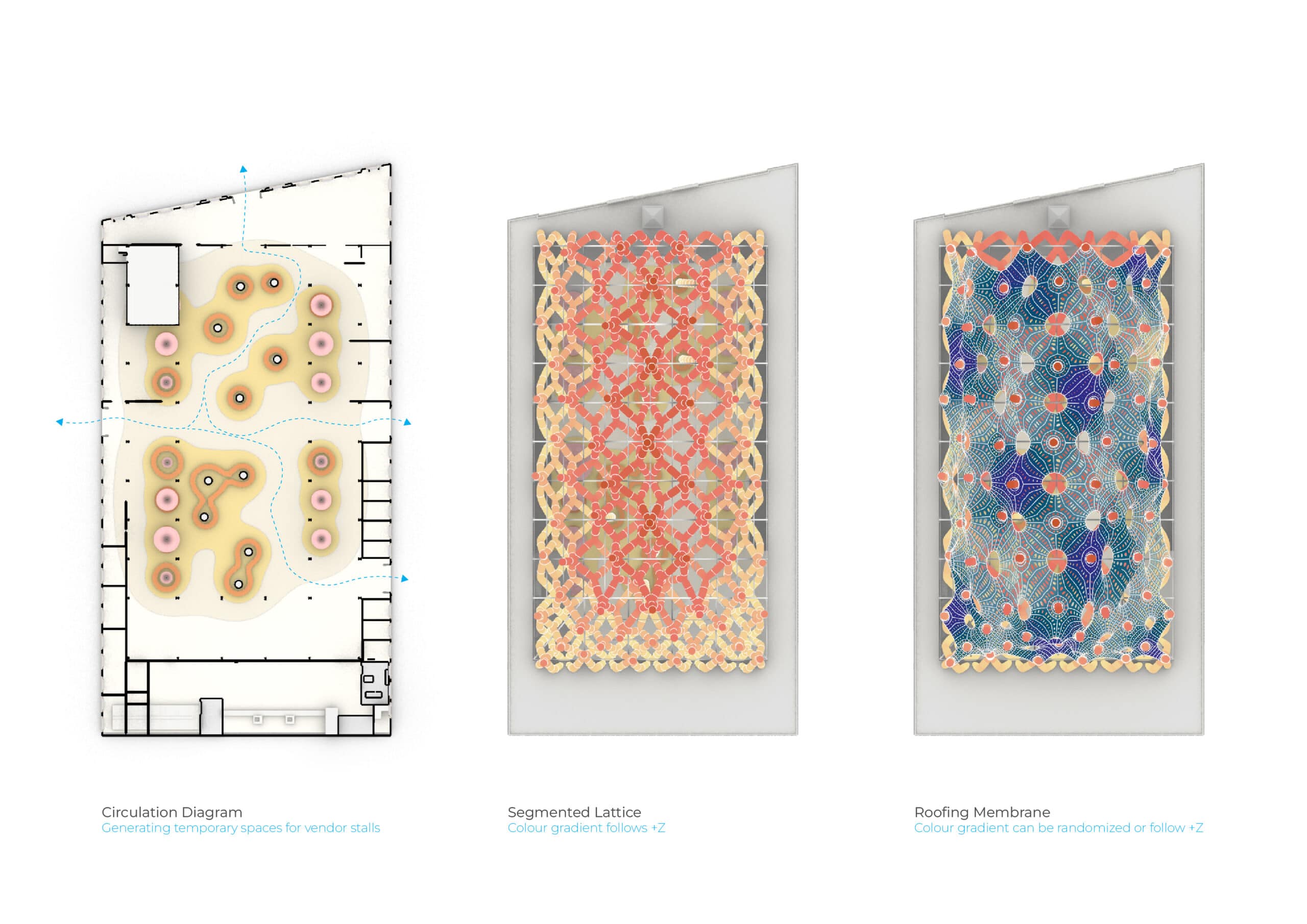
The form finding process uses the roof paneling extracted from given geometry , using the centroids of the panels to build a separate mesh which is checkered to create a set of rhomboids on the upper and lower faces of the roof, an extra set of randomized anchors are created to form termination points both as ground anchors for vendor stall generation and separately as anchors for the roof membrane. This is followed by multipiping and inflating the final grid which is segmented for strip development then colored following the gradient either in + z direction or as per random seeding points.
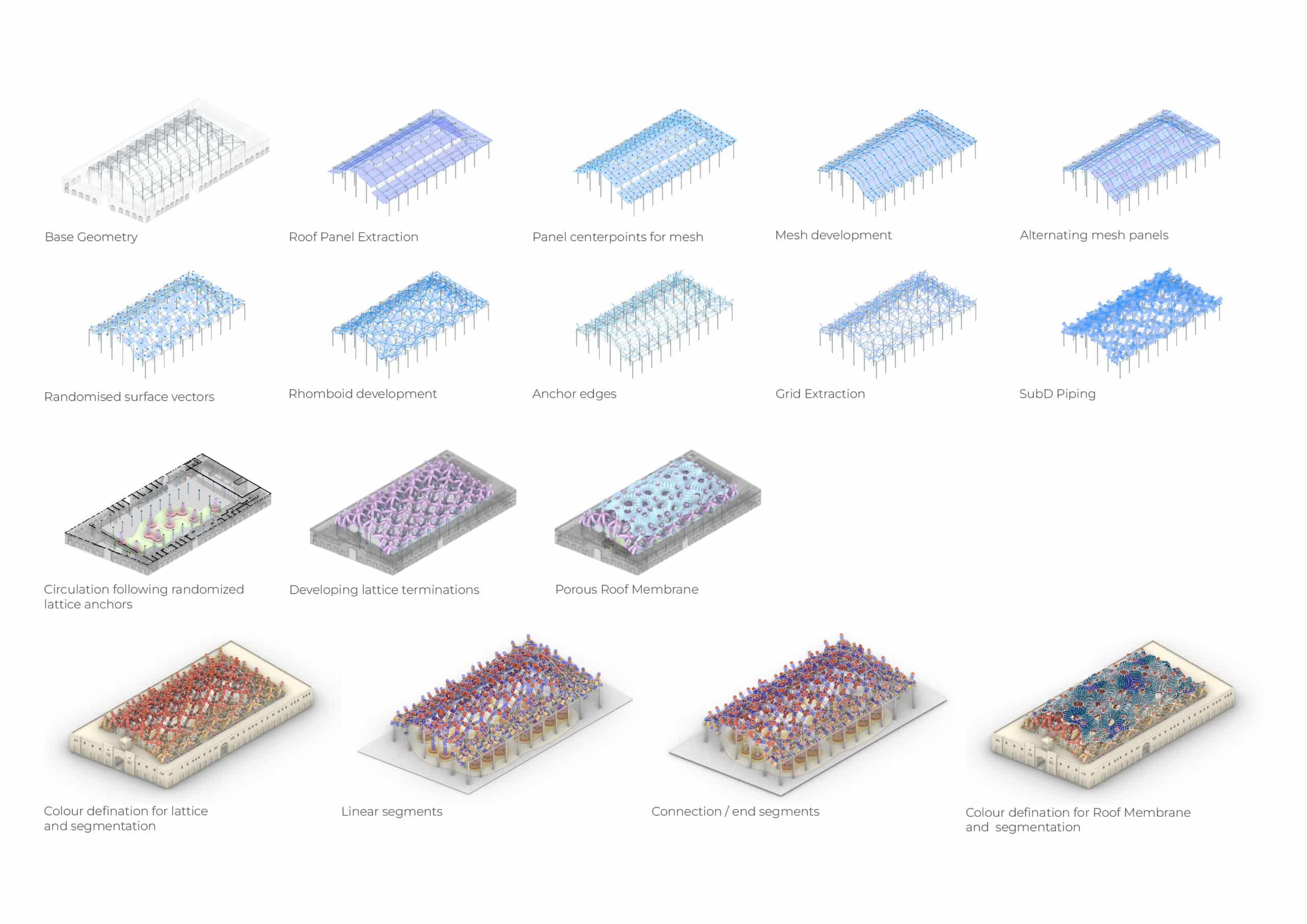
The next step involves using base geometry of the upper nodes to develop a mesh membrane with multiple randomization options, which is similarly developed as strips ,colored with gradient variations and processed to develop required porosity.
Building Layout
The building layout here has an organic pattern which has evolved out of randomized column anchors extracted from the roof structure. The floor locations of the columns are used as a base for a meta-ball geometry variations and can be developed into multiple options as per the spatial needs. The soft lattice and the roof membrane have the flexibility to morph into multiple scenarios with variations in member heights, orientation vectors, and porosity scales.
Sectional Study
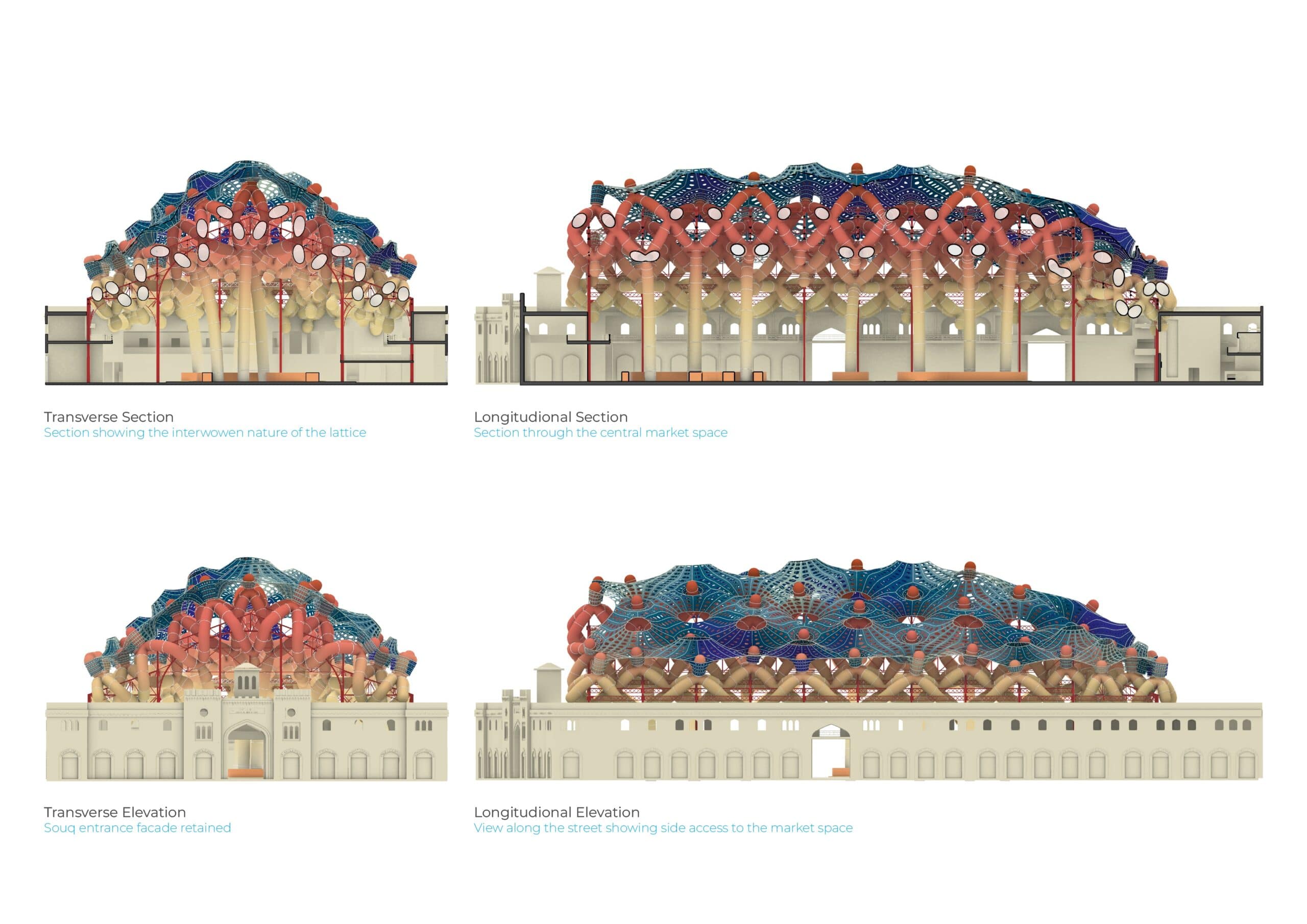
The sections reveal how the inflated members intertwine to form a stable, self-supporting lattice without external supports. This soft lattice wraps around the colonial-era steel structure, visible in the elevations as a light, enveloping layer that contrasts with the original rigid framework.
Visualizations
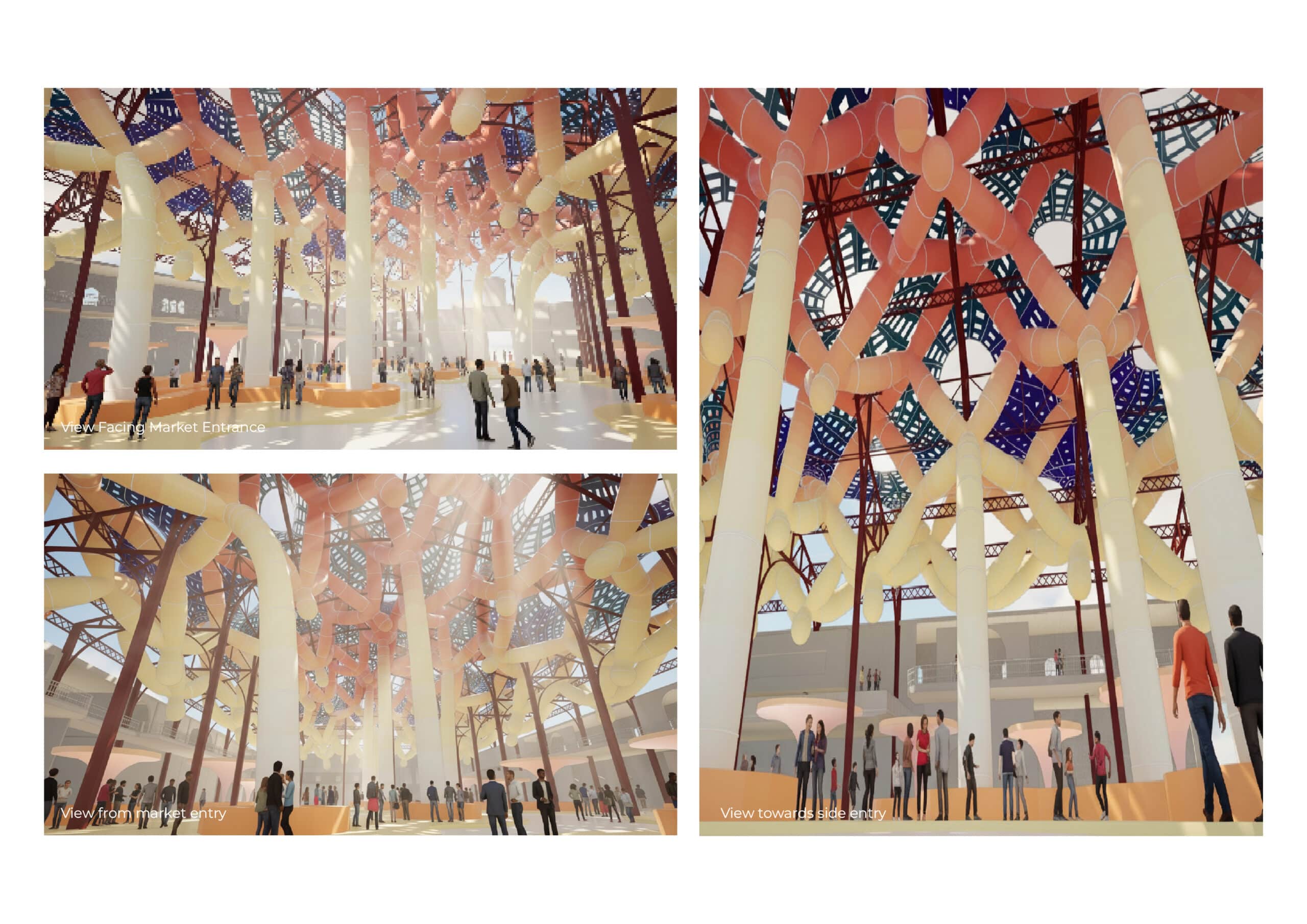
A series of renderings and sectional studies bring the proposal to life, highlighting how the inflated lattice interacts with the existing colonial-era steel framework. The images capture the dynamic light filtering through the translucent forms, the sense of movement along the interior circulation, and the spatial dialogue between old and new. These visualizations emphasize how the design explores material innovation, structural ingenuity, and historical layering, presenting a contemporary interpretation that both protects and animates the historic truss.
The aerial view highlights the porous roof membrane softly enveloping the colonial-era structure, showcasing its self-supporting form, the interplay of light and shadow, and the color palette inspired by historical reliefs.
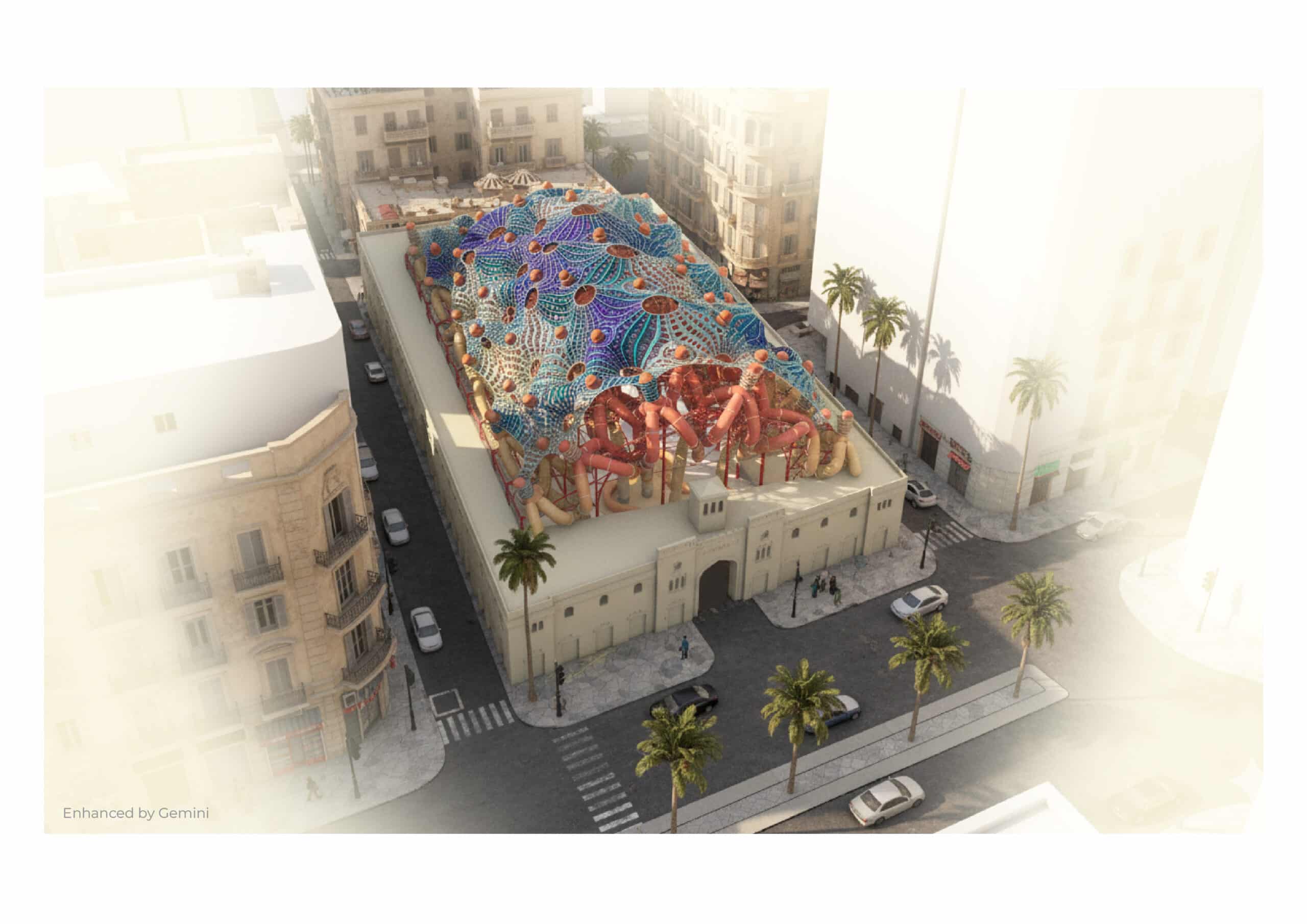
The intervention reimagines the historic structure as a living, illuminated artifact, where heritage and innovation converge.
Through its porous membrane and dynamic presence, the project breathes new life into the past while inviting fresh experiences of form and light.
