
How architectural neuroimmunology is redefining the relationship between design and human health.
The AEC industry optimizes for physical efficiency but neglects the neuro-physiological impact of built environments. This research investigates how Generative AI and Game Engine simulations, integrated into BIM workflows, can enable predictive cognitive performance analysis, transitioning the discipline from Building Information Modeling to Behavior Information Modeling.
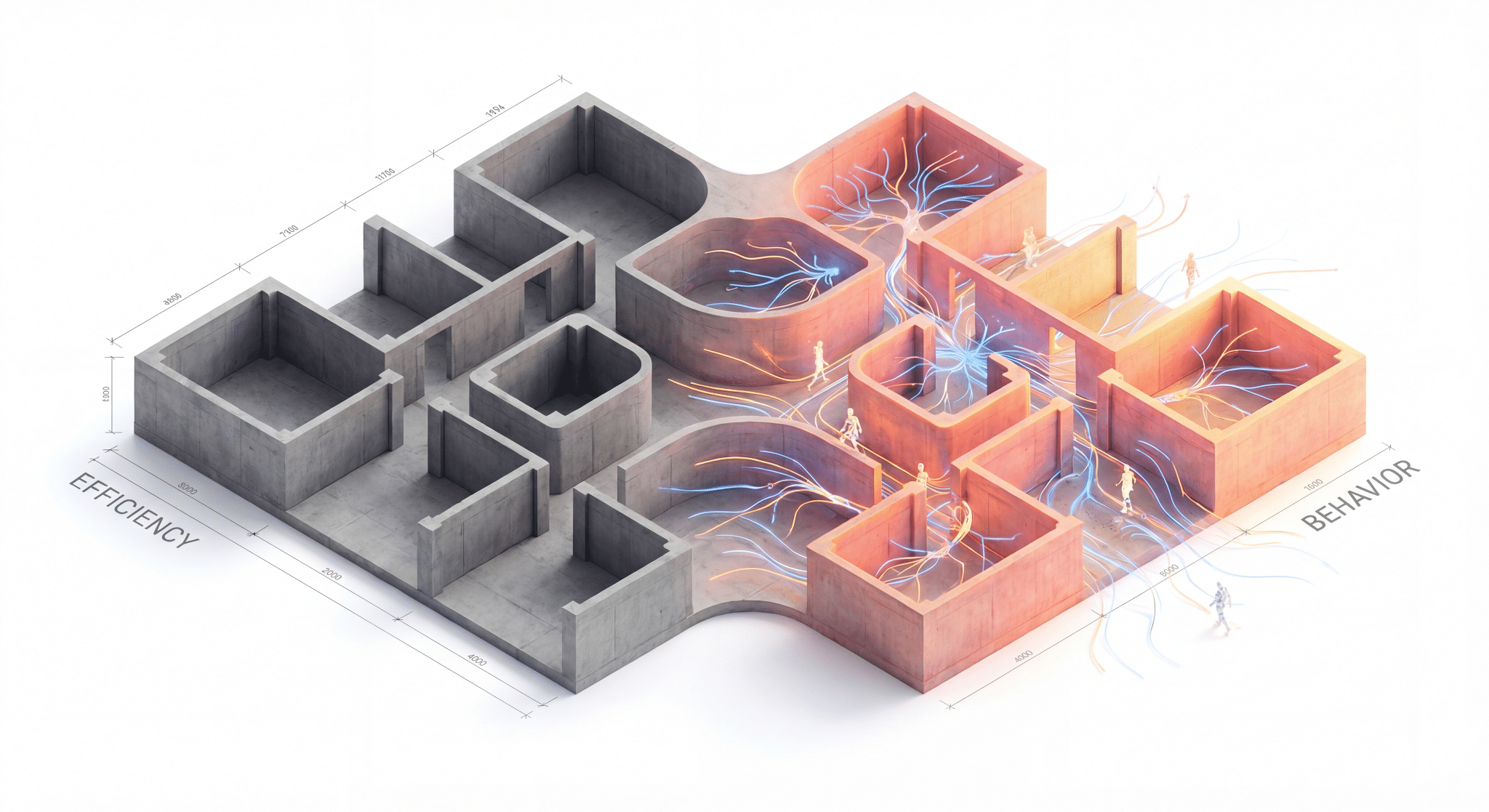
The Problem: We Optimize Everything Except the Brain
We spend up to 95.6% of our time in or around the built environment. We have regulations for structural integrity, fire safety, energy performance, and accessibility. But there is no standard, anywhere in the world, that measures whether a building is good for your brain.
This was the starting point for our conversation with Dr. Cleo Valentine on the MaCAD Theory Podcast. Valentine is a researcher and lecturer working at the intersection of architecture, computational neuroscience, and public health. She holds positions at the University of Cambridge, Harvard T.H. Chan School of Public Health, HKS Inc., and the UCL/RISE Centre for NeuroArchitecture and NeuroDesign. Her work has been exhibited at the Venice and Seoul Biennales and featured in WIRED, Dezeen, and the British Medical Journal.
Her research asks a deceptively simple question: can the shapes, patterns, and proportions of a building trigger inflammation in the brain?
The answer, based on her pilot studies, appears to be yes.
The Science: From Beauty to Brain Inflammation
Valentine did not start in neuroscience. She started in neuroaesthetics, investigating the intuition that buildings we find beautiful might actually be good for us. Her early research used machine learning to measure the presence of biomorphic geometries in architectural environments (patterns and forms derived from nature) and then traced whether those geometries correlated with improved public health outcomes. They did.
But that result raised a deeper question: why? What physiological mechanism would connect the perception of beauty in a building to measurable changes in health?
The answer led her to found a new field: architectural neuroimmunology. The core theory, which she calls architecturally mediated allostatic overload, works like this:
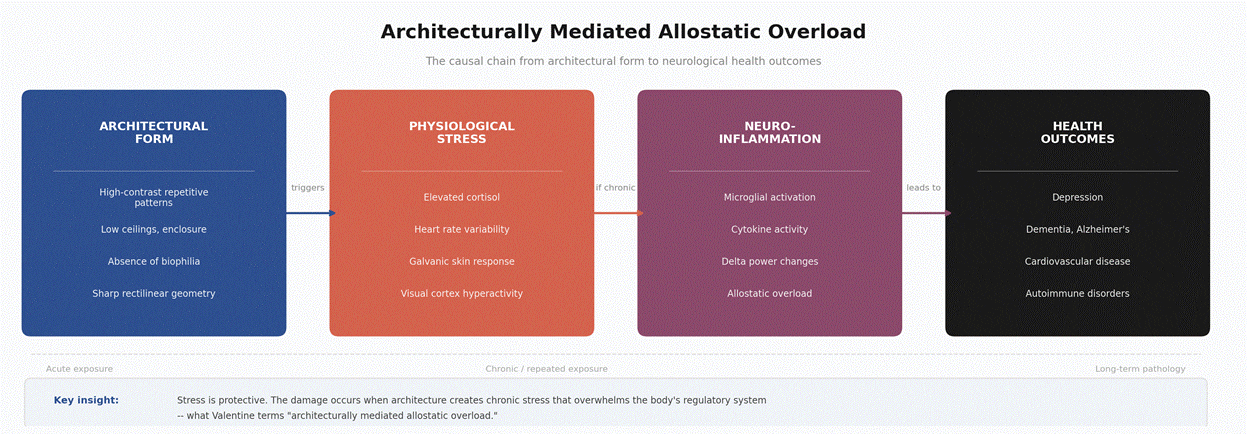
In her pilot study, Valentine used a 32-channel quantitative EEG to measure participants’ brain activity while they viewed buildings with varying levels of biophilic design. When participants viewed buildings with higher degrees of biophilia (natural materials, organic forms, living elements), their delta power activity decreased, particularly in frontal and central brain regions. This pattern is associated with reduced neuroinflammatory signaling. In effect, their brains appeared calmer.
Stress, Valentine emphasizes, is not the enemy. It is protective and necessary. The problem arises when architectural environments create chronic stress: when you live in a space that repeatedly triggers your stress response without offering relief. Over time, this overwhelms the body’s regulatory system and can contribute to conditions ranging from depression to cardiovascular disease to neurodegeneration.
For those of us in the architecture profession, this reframes the stakes of design entirely. A facade is not just an aesthetic choice. It is a public health decision.
The Matrix: Complexity, Coherence, and What Your Brain Needs
One of the most actionable frameworks that emerged from our conversation was what Valentine calls the complexity-coherence relationship. It explains why both extremes of architectural expression (the blank minimalist facade and the chaotic patterned tower) can be neurologically harmful, and why nature gets it right.
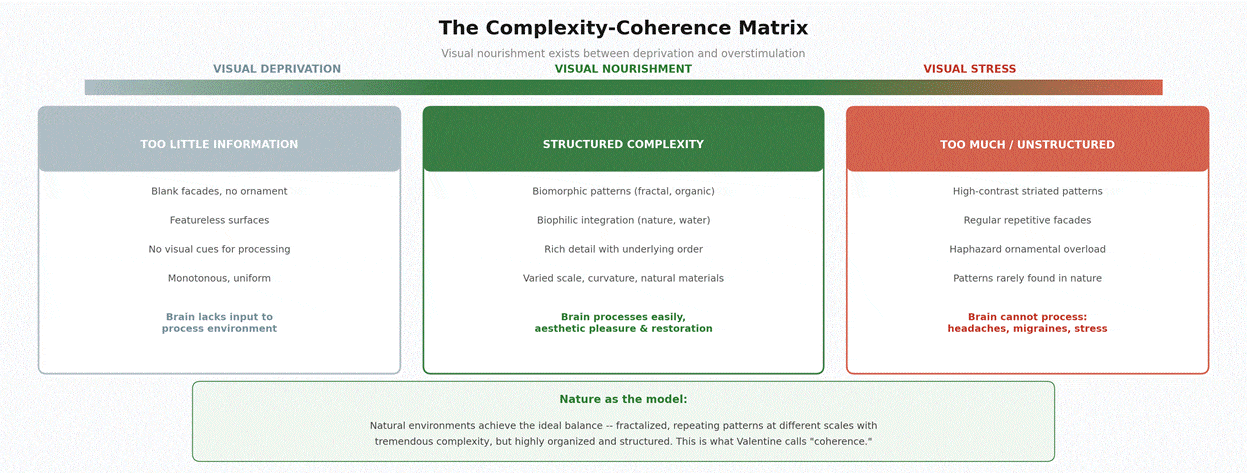
The insight is elegant: a tree has tremendous geometric complexity (fractal branching, textured bark, layered canopy) but it is also highly structured and ordered. Your brain can process it efficiently, and that efficiency produces the sensation we experience as beauty or calm. A prefabricated high-rise repeating the same panel a hundred times is the opposite: regular, repetitive, and so different from the natural environment that the brain struggles to make sense of it. A blank glass facade offers nothing at all to process.
Valentine’s work with Heatherwick Studio’s Humanise campaign has been exploring this exact tension. The campaign describes a crisis of “boring” architecture, but boring is perhaps too mild a word. Neurologically understimulating or overstimulating environments are not just aesthetically unpleasant. They are, potentially, pathogenic.
During the podcast, the conversation turned to Paris, a city that both Valentine and one of us (Emilie) independently identified as a space that illustrates these principles. Valentine described its rules-based architectural language: forms repeating in different permutations and combinations at different scales, with fractalized iterations that are ornately complex but beautifully structured. It is no accident that these environments feel good. They follow patterns that align with how our visual system processes information.
The Gap: Why We Know More Than We Can Apply
If the science is becoming clearer, why is it not yet standard practice? Valentine identifies several friction points.
The transferability problem. Neuroarchitectural research requires controlled environments: one variable changed, everything else held constant. But that is not how we experience buildings. During one of her studies, a participant showed a strong stress response to a facade, only to report afterwards that they had been thinking about an exam the entire time. The built environment is dynamically experienced and multisensory, and isolating the impact of a single architectural feature from the noise of daily life is extremely difficult.
The speed problem. Conducting full-scale EEG experiments on a project-by-project basis is expensive, slow, and impractical for a design process with tight deadlines and budgets.
The knowledge-action gap. Designers often have strong intuitions about what makes a space feel right, but lack the scientific evidence to defend those intuitions when budgets get cut. Valentine describes this as the core bottleneck: the obstacle is not apathy but the inability to justify design decisions that would genuinely support wellbeing.
This is where computational prediction becomes critical.
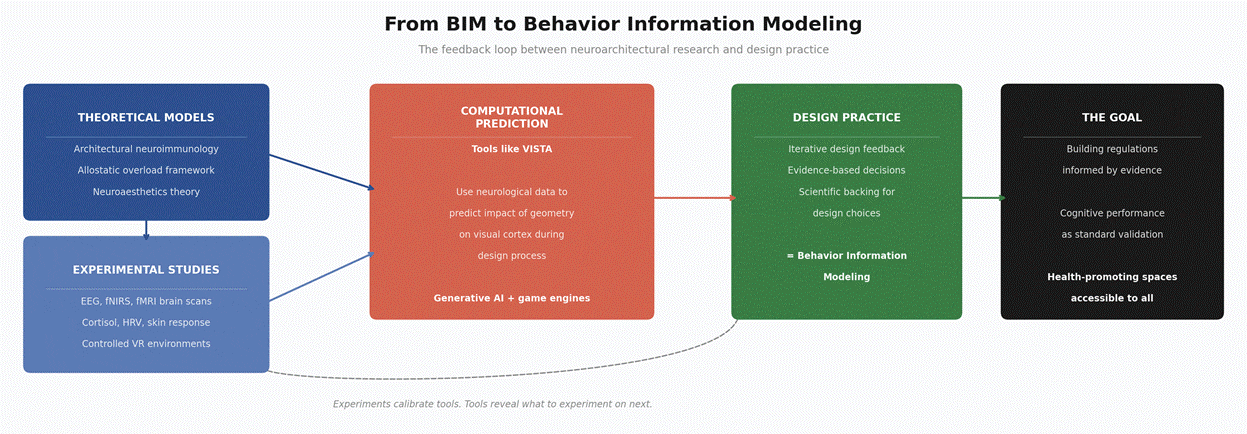
Valentine’s team at HKS has developed a tool called VISTA (Visual Stress Analysis Tool), a computational program that predicts the impact of architectural geometry on the primary visual cortex during the design process. Rather than running a brain scan for every design iteration, VISTA uses existing neurological data to flag when a facade composition is likely to cause visual cortex hyperactivity (which can lead to headaches, migraines, and impaired cognitive function). This creates the iterative feedback loop that the profession needs: design, test, adjust, repeat.
Generative AI and game engines play supporting roles. AI tools like Midjourney allow researchers to rapidly generate facade variations for testing. Game engines and VR provide simulated environments that, while imperfect, offer meaningful data about visual and emotional responses. Valentine is honest about the limitations: sensory mismatch in VR causes cognitive fatigue, depth perception changes alter how images map onto the retina, and multisensory congruence remains a challenge. But she argues that these tools tell us something, even if they cannot tell us everything, and that something is more than what we had before.
The Path Forward: From Nice-to-Have to Non-Negotiable
The most provocative moment in the conversation came when we asked Valentine whether cognitive performance could become a standard dimension of building validation alongside structural and energy performance. Her answer was unequivocal: it should be mandated through building regulations.
If someone is unwell and prescribed medication, and then they go back to a house that fundamentally doesn’t serve their health and is dysregulating to their nervous system, that’s a public health concern. It’s not a nice thing to have. It’s a necessary thing to have.
Valentine draws a parallel to where sustainability was 15 years ago: a field where the science was emerging, the industry was skeptical, and progress felt like pushing a rope. She believes neuroarchitecture is at the same inflection point, and that the catalyst will likely be public awareness.
There are signs that the shift is already underway. Valentine reports seeing design briefs where the primary goal is to create spaces that regulate the nervous system. Accreditation systems like LEED and WELL are beginning to engage with neuroscience findings. Her team published in the British Medical Journal, signaling that architectural design is being taken seriously as a public health intervention. And the tools are catching up: computational prediction, VR simulation, and wearable biosensors are making it possible to study these questions at a speed and scale that was impossible even three years ago.
Still, Valentine maintains scientific honesty. When asked what architects should do, she says the “what not to do” list is more robust than the “what to do” list. Avoid high-contrast regular repetitive patterns at scale. Do not create environments devoid of visual complexity. Be wary of forms rarely found in nature. These guidelines are not prescriptive enough to stifle design, she argues. They establish a floor while leaving the creative ceiling open.
A Thought to Carry With You
Near the end of our conversation, Valentine offered a framing that has stayed with us. She borrowed it from her colleague Ian Hosking: if it is better than what we have right now, then we are winning. Incremental progress is progress. We may not revitalize the entire building regulatory framework overnight, but we can make better decisions today with the knowledge we already have.
Somewhere between the structural engineer’s certainty and the neuroscientist’s nuance, there is a new kind of architectural practice waiting to emerge. One that treats cognitive performance not as a luxury, but as a baseline requirement for any space that claims to serve humans.
We think the field deserves a new name for this data layer. We have been calling it Behavior Information Modeling. Valentine seemed to agree.
This blog post is based on Episode X of the MaCAD Theory Podcast: Optimizing for the Mind: Integrating Generative AI and Game Engines into BIM, recorded at IAAC Barcelona.
Guest: Dr. Cleo Valentine | Cambridge, Harvard, HKS, UCL/RISE
Hosts: Emilie El Chidiac & Charles Abi Chahine | MaCAD, IAAC
Listen to the full episode: [LINK]
