
Using climate clustering, vernacular precedent research, and evolutionary optimisation to create climate-responsive design typologies when no established local precedent exists
Overview
Lovingly named after the very first test location, Project Michigan is a tool that provides climate-responsive design guidelines when no local vernacular precedent exists. Through scraping climate data and global vernacular information, it helps identify places with similar climate conditions in order to learn from their built solutions and extract design strategies that can be adapted to new contexts.

Computational method
Part 01 – Identify Climate Analogues
Launch the Climate Engine…
Select any city in the world and discover its closest climate matches. Adjust the sliders to prioritise temperature, rainfall, humidity, solar radiation, or seasonal variation and see how the results change in real time:
Part 02 – Refining cities into climate clusters
Find your perfect matches...
Using KNIME, PCA dimensionality reduction, and K-Means clustering, the analogue city dataset is refined into distinct climate clusters. PCA was used to reduce multiple climate variables into a simplified visual climate space, while K-Means clustering was used to identify the groups of climatically similar cities.
Part 03 – Extract vernacular parameters
Custom design guidelines…
Climate analogue cities are translated into a set of vernacular guidelines, providing a research starting point for designing in a similar environment.
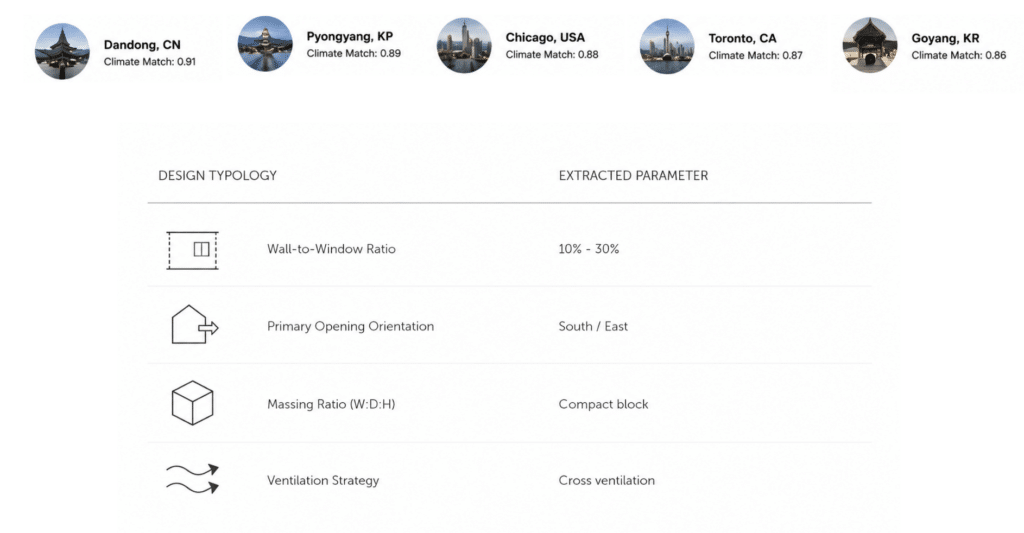
Part 04 – Evolution Optimisation
Let the data evolve the design…
Architectural parameters extracted from the climate analogue cities become design genes within a Grasshopper model. Wallacei evaluates hundreds of design variations to produce a climate-responsive building typology tailored to the custom location.
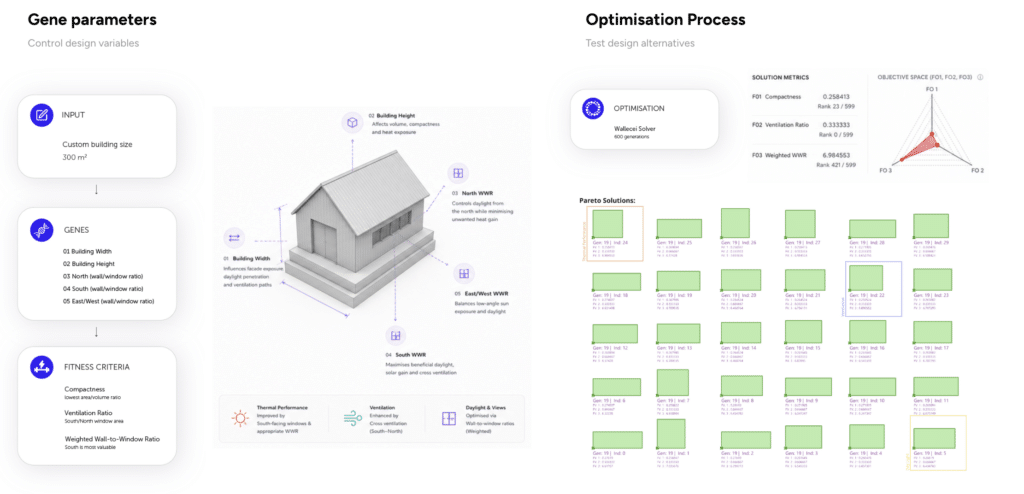


Part 05 – Start Building
Create architecture native to its climate…
Now you have a climate-responsive vernacular blueprint tailored to your site. These guidelines provide a foundation for designing climate-responsive architecture in any location, even where no suitable vernacular precedent exists. For instance, a high-performance farm Fab-Lab in Rural Lower Michigan…

