Parasyte: exisiting structure refit and expansion
System boundaries Results List of relevant sources for the Life Cycle Inventory
The MaCAD is a unique online programme training a new generation of architects, engineers and designers ready to develop skills into the latest softwares, computational tools, BIM technologies and AI towards innovation for the Architecture, Engineering and Construction (AEC) industry.
System boundaries Results List of relevant sources for the Life Cycle Inventory
Abstract This project evaluates the carbon footprint of concrete core units in modular high-rise construction, using CO₂ emissions as the primary indicator. The goal is to assess the potential environmental impact and determine if the proposed building aligns with environmental policies. Lifecycle stages analyzed include raw material extraction, material processing, transportation, assembly, and end-of-life, with … Read more
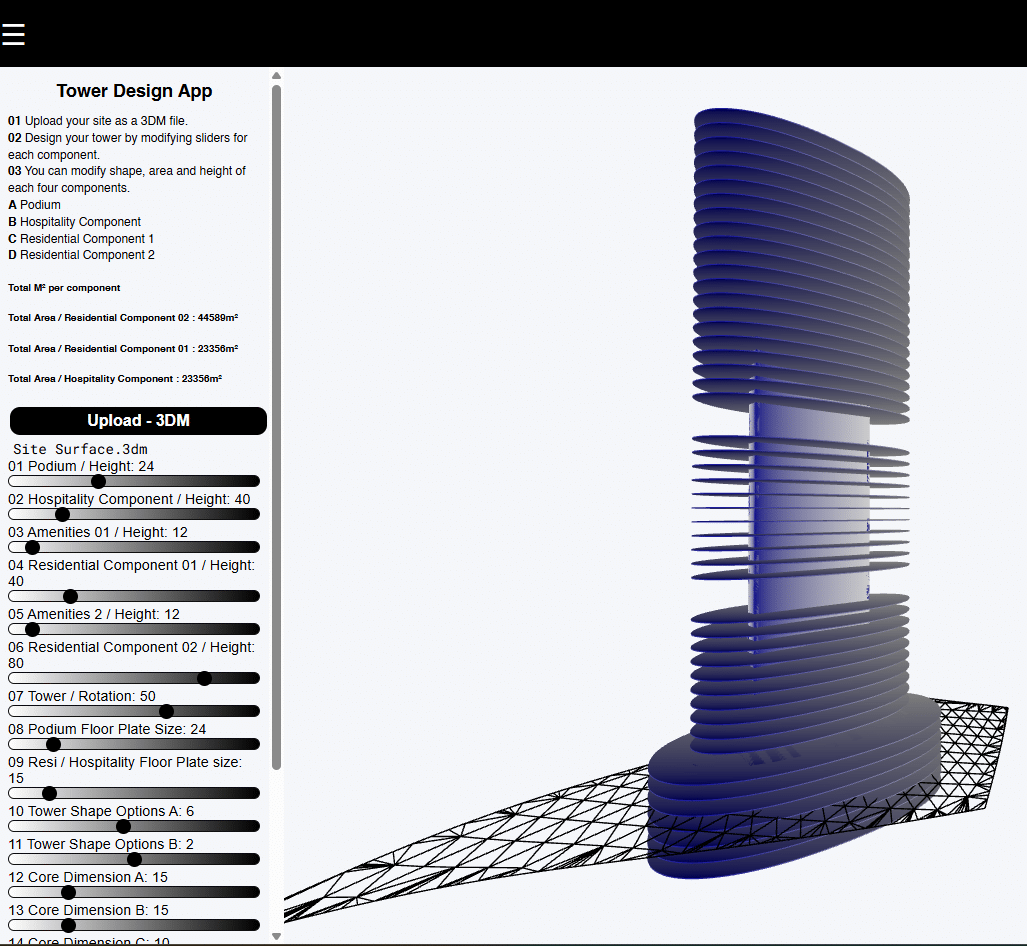
Where Data Meets De At its core, our approach to mixed-use tower design represents a paradigm shift – one that embraces efficiency-driven decision making across multiple scales. Rather than following traditional static design methods, we’ve developed a dynamic framework that continuously evaluates decisions through four key stages: initial data processing and site analysis, space planning … Read more
For our MaCAD Studio project, we wanted to explore the idea of circularity during the assembling/disassembling stage of the various programmatic functions housed by the building structure. The main materials employed are CLT and Reinforced Steel, of which we picked the first to be the focus of our study since it is the primary material … Read more
AS6 COMPLEX FORMING Design Concept and Computational Design System for Project HOPE “Project HOPE” is an innovative prison design that shifts the focus from punishment to rehabilitation. The project is built on the principle of creating therapeutic environments that support mental well-being and personal growth within correctional facilities. By employing a robust Computational Design System, … Read more
Introduction The Parametric Nexus project represents a forward-thinking approach to high-rise construction, where sustainability is at the forefront. With its use of advanced materials like glass, steel, and concrete, the project aims to minimize environmental impacts through a comprehensive Life Cycle Impact Assessment (LCIA). This blog explores the rationale, methods, and key findings of this … Read more
NeoCapsules Residence: A Vision for Modern Family Living Affordable design solution for families NeoCapsules, an innovative residential complex inspired by the Nakagin Tower concept, offers a dynamic and adaptable living environment that seamlessly integrates sustainability with an urban lifestyle. This innovative approach fosters growth, flexibility, and community interaction, making it more than just a building, … Read more
Abstract By the year 2025, there will be 200+ zettabytes of data in cloud storage. The servers handling this cloud storage space live in data centers. Since we live in the era of data, demand is surging, in fact, a 50% growth is expected by 2030. Data centers are energy consuming monsters, hence their lifecycle … Read more
INTRODUCTION The Staggered Building is a high rise building developed with a bottom up approach.Within the design process for the building, we have tackled more or less in depth the following themes: mixed use, vertical circulation, structural design, design for comfort and environmental design. The main tools we have used are galapagos mostrly for optimization, … Read more
Designing a Mixed-Use High-Rise for Urban Efficiency and Adaptability In the evolving urban landscape, designing a high-rise that blends commercial, residential, and recreational spaces requires thoughtful planning and innovative approaches. Our project, Parametric Nexus, employs parametric design tools to optimize functionality, sustainability, and adaptability. Here’s a closer look at the key elements of our design … Read more
INTRODUCTION We approached our parametric project with a top-down methodology, emphasizing the importance of urban, climatic, social, and economic parameters. These factors, alongside the needs for project development, are crucial when discussing architecture that focuses on the reuse and recycling of existing structures in both established and developing contexts. CONCEPT & STAGES The algorithm is … Read more
DATA CENTER: A BOTTOM-UP APPROACH WITH MODULAR AGGREGATION Data creation is exploding. With all the selfies and useless files people refuse to delete on the cloud, by the year 2025, there will be 200+ zettabytes of data in cloud storage. This explosion of data triggers the industry to streamline data management, security and storage, raising … Read more
Welcome to a deep dive into the AdaptiveFlow Tower, a groundbreaking high-rise residential project developed under the guidance of the IAAC – MaCAD – ACESD program. Conceived by Amira El-Saeed, Aleyna Kırcalı, and Mohamed Attay, this project represents a pioneering approach to urban living where adaptability and sustainability intersect seamlessly with architectural innovation. Concept Design … Read more
Introduction In our studio project, we use a combined bottom up and top down approach to develop a mixed use building; designed to integrate multiple functions, including residential, recreational, and commercial, within a single structure. Our goal is to feature a flexible layout, using modular construction techniques and clear circulation patterns, with well-designed junctions. Programmatic … Read more
Concept The concept of our proposal seeks to integrate into a building a residential program implemented with the incorporation of nature, creating ecosystems where people and nature can coexist. People Nature Ecosystems Structurally speaking, we wanted to transfer the general concept of the project to the structure by adopting sinuous geometries that respond simultaneously to … Read more
SITE PLAN & ANALYSIS STRUCTURAL ELEMENTS The building has a total footprint of about 50 meters per 37 meters. The typical grid is of 8.4m, and becomes smaller towards the edge of the slabs. The core is centered with the grid and it is of about 16,8m x 12,6m. It occupies about the 12-15% of … Read more